Revenue Operations Manager Resume Examples: free score
Write a Revenue Operations Manager Resume That Shows System Control
By Mustafa Tarabya, founder of CVBooster · Published · Updated
A revenue operations manager resume example covering CRM ownership, forecasting and pipeline hygiene, with keywords and a detailed writing guide.
Sample resumes for a revenue operations manager
The same revenue operations manager content laid out in three CVBooster templates, so you can see what the finished document looks like before you write a word.
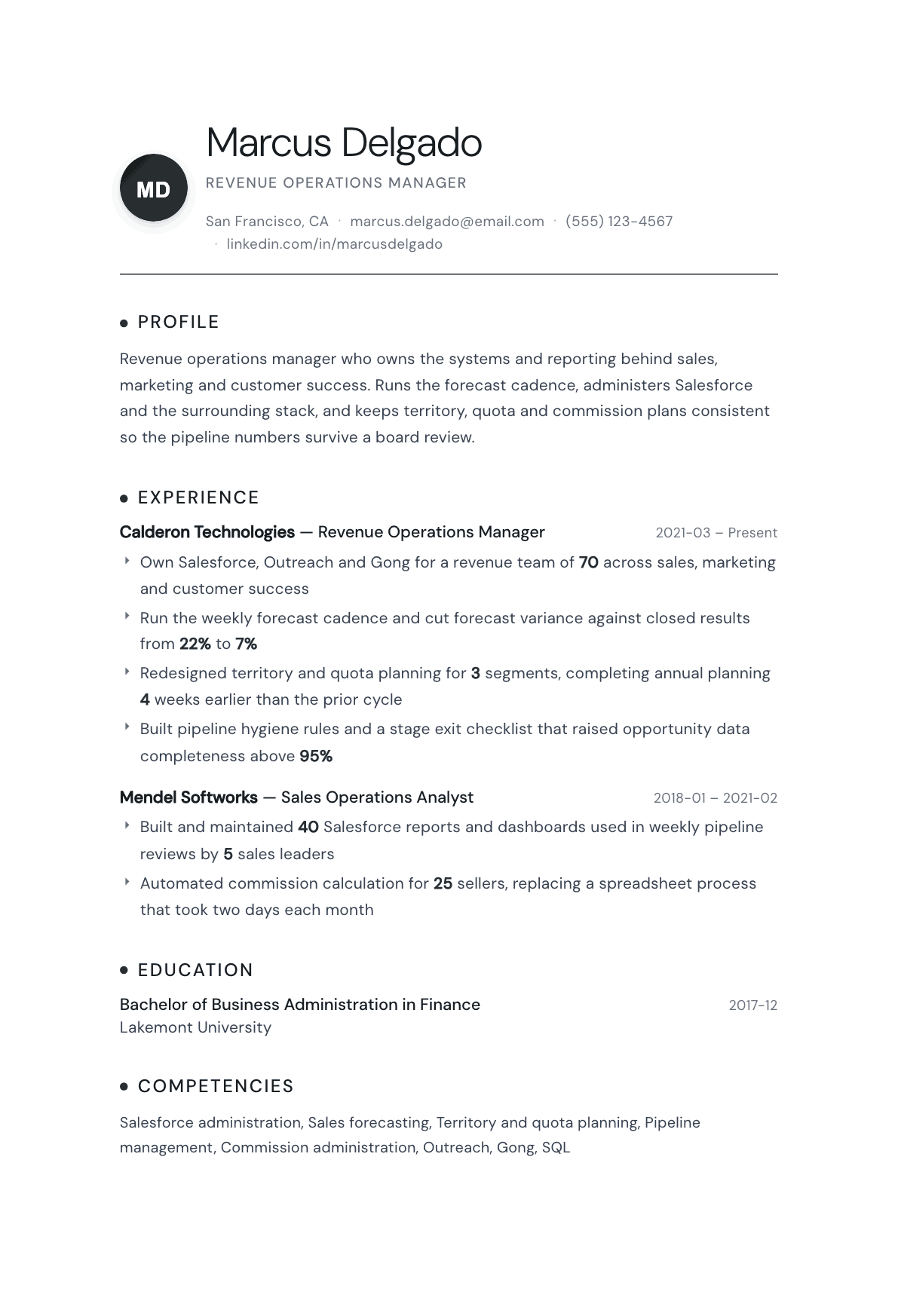
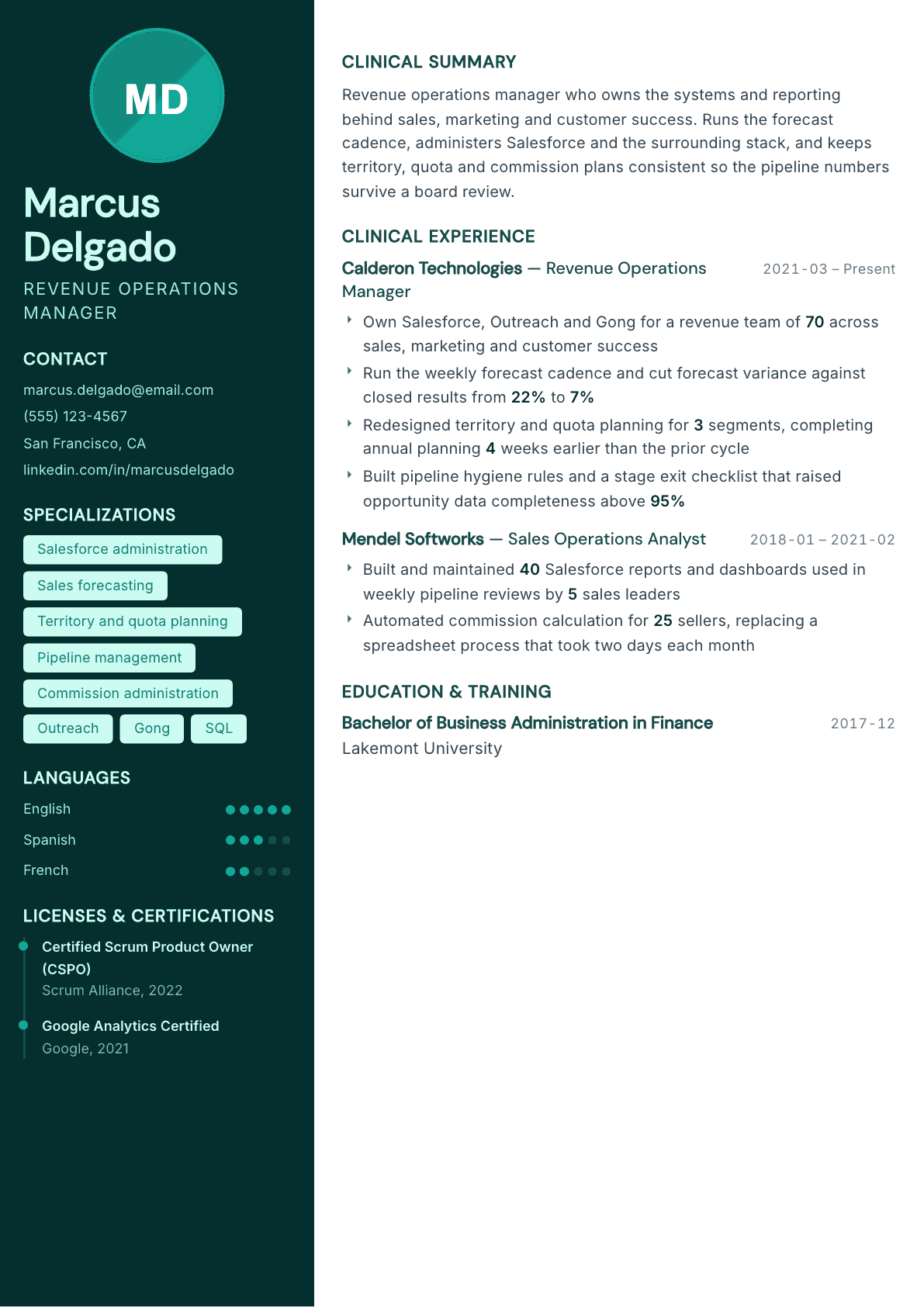
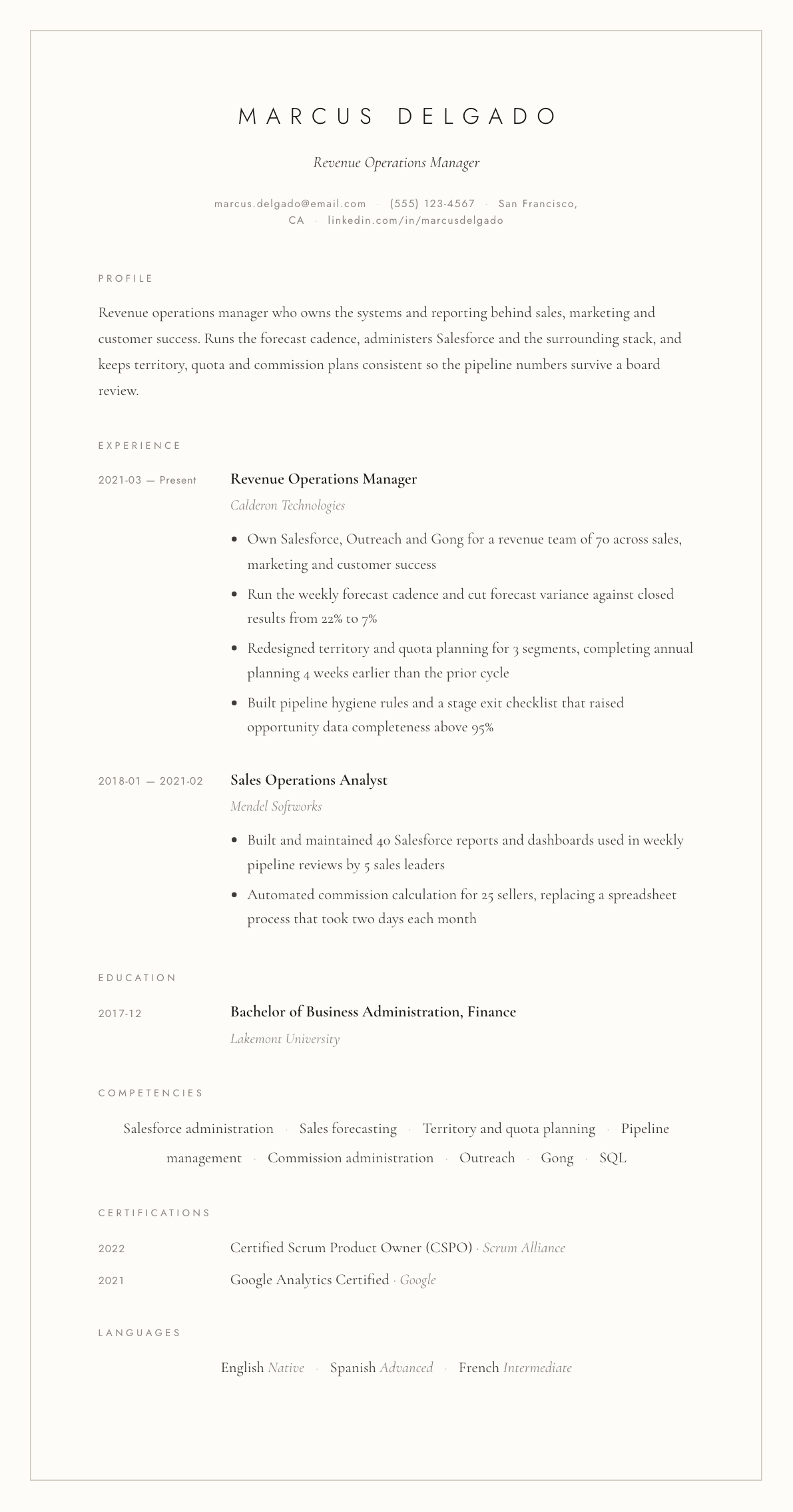
Example Revenue Operations Manager summary
Revenue operations manager supporting a seventy person revenue team across sales, marketing and customer success. Owns Salesforce and the surrounding stack, runs the weekly forecast cadence, and cut forecast variance against closed results to single digits. Redesigned territory and quota planning across three segments and finished annual planning a month earlier than before. Seeking a revenue operations leadership role in a scaling software business.
Skills to list on a Revenue Operations Manager resume
- Revenue operations
- Salesforce administration
- Sales forecasting
- Pipeline management
- Territory and quota planning
- Commission plan administration
- Funnel reporting
- CRM data governance
- Lead routing and scoring
- Outreach
- Gong
- HubSpot
- SQL
- Tableau
- Process documentation
What actually gets this resume read
- Name the revenue team size you supported, since supporting ten sellers and supporting a hundred are different jobs.
- List your systems stack explicitly, because revenue operations postings screen hard on the CRM and the tools around it.
- Quantify forecast accuracy improvement, as it is the single number a chief revenue officer cares about most.
- Cover the full revenue cycle you touch: marketing handoff, sales stages, renewals and the reporting on each.
- Show planning work such as territory carving, quota setting and compensation design alongside the systems administration.
- Include data hygiene results, because clean opportunity data is what makes every other number in the business usable.
How to write a revenue operations manager resume
Revenue operations is the function that makes the pipeline number mean something. The person hiring you, usually a chief revenue officer or a vice president of operations, has been burned by a forecast that missed, a territory plan that arrived late, or a customer relationship management system so untidy that nobody trusts a report from it. Your resume is read as an answer to whichever of those is currently hurting.
Two kinds of candidates apply for these roles. One is a systems administrator who can configure anything and has never sat in a forecast call. The other is a commercial analyst who understands the business and cannot build the automation. The strongest resumes make clear that you do both: you own the platform configuration and you run the cadence where the numbers get committed.
This guide covers how to state the revenue team you support, how to write about forecast accuracy and pipeline hygiene without sounding like a report writer, how to present planning work such as territories and quotas, and the questions that come up when a sales operations analyst steps up or a revenue operations manager moves between company sizes.
Format: team supported, systems owned, cadence run
One page under about eight years, two after that. Under each title, write a support line: how many sellers, marketers and customer success staff you supported, how many segments or regions, and the annual bookings the team carried as a band. Supporting twelve sellers in one country and seventy across three regions are different jobs sharing a title.
Then a systems line naming the stack: the customer relationship platform, the engagement tool, the conversation intelligence tool, the marketing automation platform, the billing system and the reporting layer. This is one of the most mechanically screened sections in any commercial job family, so keep the product names exact.
- Support line: sellers, segments, regions, bookings band.
- Systems line: CRM, engagement, marketing automation, billing, reporting.
- Cadence line: the meetings you run and the artifacts you own in each.
Forecasting: the number that decides whether you get the interview
Forecast accuracy is the closest thing revenue operations has to a headline metric. State the variance between committed forecast and closed result and how it changed under you, along with the cadence you ran: weekly pipeline reviews, a monthly commit, a quarterly board submission. Say who attends and what artifact you bring.
Describe the method as well as the outcome. A forecast built from stage weighting alone is different from one that blends rep commit, historical conversion by stage and age, and a manager judgment call. Explaining how you triangulate tells a revenue leader whether you can be trusted with the number in front of a board.
Include the discipline that makes the forecast possible. Stage exit criteria, close date hygiene rules, required fields at each stage, and an aging report that forces stale deals out are what turn a forecast from an opinion into an estimate.
Systems ownership: configuration, integration and data governance
Say what you actually built. Custom objects, validation rules, lead routing and scoring, opportunity stage models, approval flows, and integrations between the customer relationship platform and the surrounding tools are all concrete, and they show whether you can do the work yourself or manage an administrator who does.
Data governance deserves its own bullets because it is the foundation everything else stands on. Field completeness, duplicate management, account hierarchy structure, enrichment sources and the rules you enforce at each stage decide whether reporting is usable. Give a completeness figure and the mechanism that keeps it there.
If you have run a migration or a consolidation after an acquisition, say so. Merging two customer relationship systems is a hard, visible project and it is exactly the kind of experience a scaling company is looking for.
- Configuration: objects, fields, validation, routing, approvals.
- Integrations: engagement, marketing automation, billing, data warehouse.
- Governance: completeness rules, deduplication, account hierarchy, enrichment.
Planning and compensation: territories, quotas and commissions
Annual planning is where revenue operations is most visible to the executive team. Describe the territory model you built, the segmentation logic behind it, the capacity model that turned bookings targets into headcount, and how long the cycle took. Finishing planning earlier than the previous year is a result every revenue leader values, because late plans cost selling days.
Compensation work is closely related and worth its own lines. Quota setting, plan design input, commission calculation and dispute handling are sensitive tasks, and an operations manager who has run them without errors is trusted quickly. Say whether you administered a compensation platform or ran it in spreadsheets, and what you automated.
- Territory design: segmentation logic, coverage model, account carving.
- Capacity planning: bookings target to headcount and ramp assumptions.
- Compensation: quota setting, commission calculation, dispute resolution.
Revenue Operations Manager resume summary examples
Sales operations analyst
Sales operations analyst with three years supporting a team of 25 sellers, building and maintaining 40 Salesforce reports and dashboards used in weekly pipeline reviews. Automated commission calculation and replaced a spreadsheet process that took two days each month. Ready for a revenue operations role with systems ownership.
Owning the revenue stack
Revenue operations manager supporting a 70 person revenue team across sales, marketing and customer success, owning Salesforce, Outreach and Gong. Runs the weekly forecast cadence and cut forecast variance against closed results from 22% to 7%, and redesigned territory and quota planning across three segments.
Head of revenue operations
Revenue operations lead managing a team of four across systems, analytics and enablement operations for a software business selling into two segments. Consolidated two customer relationship systems after an acquisition, rebuilt the funnel model shared by marketing and sales, and delivered annual planning a month before the fiscal year opened.
Work experience bullets: before and after
Before: Managed the CRM for the sales team.
After: Owned Salesforce configuration for a 70 person revenue team, building the opportunity stage model, lead routing rules and validation that enforces required fields at each stage exit.
The rewrite names the team size and the specific configuration work rather than claiming platform ownership abstractly.
Before: Improved forecast accuracy.
After: Rebuilt the weekly forecast on stage conversion history blended with rep commit and manager judgment, cutting variance between committed forecast and closed result from 22% to 7% over four quarters.
It gives the method, the before and after figures and the period over which the improvement held.
Before: Created reports and dashboards.
After: Built the pipeline coverage and funnel conversion dashboards used in weekly reviews by five sales leaders, with a single agreed definition for each stage so marketing and sales stopped reporting different numbers.
A shared definition is the part that matters, and it turns reporting into a governance result.
Before: Helped with annual sales planning.
After: Redesigned territory and quota planning for three segments using an account scoring model, and completed the cycle four weeks earlier than the previous year so sellers started the year with final plans.
The strong version shows the method and the timing benefit that a revenue leader feels directly.
Before: Cleaned up data in the system.
After: Introduced stage exit checklists and a monthly hygiene report on close dates and required fields, raising opportunity data completeness above 95% and removing 600 stale opportunities from the pipeline.
Data work becomes credible when the enforcement mechanism and the resulting completeness figure appear together.
Hard skills
- Salesforce administration
- Sales forecasting and pipeline analysis
- Territory and quota planning
- Commission plan administration
- Lead routing and scoring
- Funnel and conversion reporting
- CRM data governance
- Outreach and Gong administration
- Marketing automation integration
- SQL and warehouse reporting
- Tableau and Power BI
- Process documentation and enablement operations
Soft skills
- Working with sales leaders under pressure
- Precision with sensitive numbers
- Explaining systems to non technical users
- Neutrality in compensation disputes
- Prioritizing requests from three functions
Certifications worth listing
- Salesforce Certified Administrator (Salesforce)
- Salesforce Certified Advanced Administrator (Salesforce)
- HubSpot Revenue Operations Certification (HubSpot)
Mistakes that cost revenue operations manager candidates the interview
- Listing platform names with no indication of what you configured or administered in them.
- Leaving out the size of the revenue team you supported, which is the main scope signal available.
- Describing reporting output while never mentioning the forecast cadence you ran.
- Skipping planning and compensation work, which is where revenue operations meets the executive team.
- Claiming clean data without naming the rules and reports that keep it clean.
- Writing only for sales when the role now spans marketing, sales and customer success.
Revenue Operations Manager resume questions
What is the difference between sales operations and revenue operations?
Sales operations supports the selling team alone. Revenue operations covers the full customer path across marketing, sales and customer success, owning one funnel definition and one reporting model rather than three disconnected ones.
Do I need a Salesforce certification for a revenue operations role?
It is not universally required, but many postings list an administrator credential as preferred and some make it a filter. If you administer the platform daily, the certification is quick to justify and it removes a screening question.
How do I show forecast accuracy if my company never measured it?
Reconstruct what you can and be honest about the basis. Even describing the cadence you ran, the artifacts you produced and the discipline you enforced on stage hygiene tells a revenue leader how you would handle their forecast.
How technical should a revenue operations manager be?
Enough to configure the customer relationship platform without waiting on a developer, and enough query ability to check a number against the warehouse. Deeper engineering is a bonus, but the day to day is configuration, reporting and process.
What should I emphasize when moving to a much larger company?
Emphasize process design, documentation and governance rather than the breadth of tasks you personally covered. Larger teams split the work, so evidence that you built repeatable process matters more than proof you did everything yourself.
Related resume examples
- Sales Operations Manager Resume example
- Business Analyst Resume example
- Growth Manager Resume example
- PMO Manager Resume example
- Business Development Manager Resume example
- Business Manager Resume example