Business Development Representative Resume Examples
Create a BDR Resume That Opens Doors
By Mustafa Tarabya, founder of CVBooster · Published · Updated
Build a high-energy business development representative resume with prospecting metrics, meeting-setting results, and pipeline contribution that sales leaders hire for.
Sample resumes for a business development representative
The same business development representative content laid out in three CVBooster templates, so you can see what the finished document looks like before you write a word.
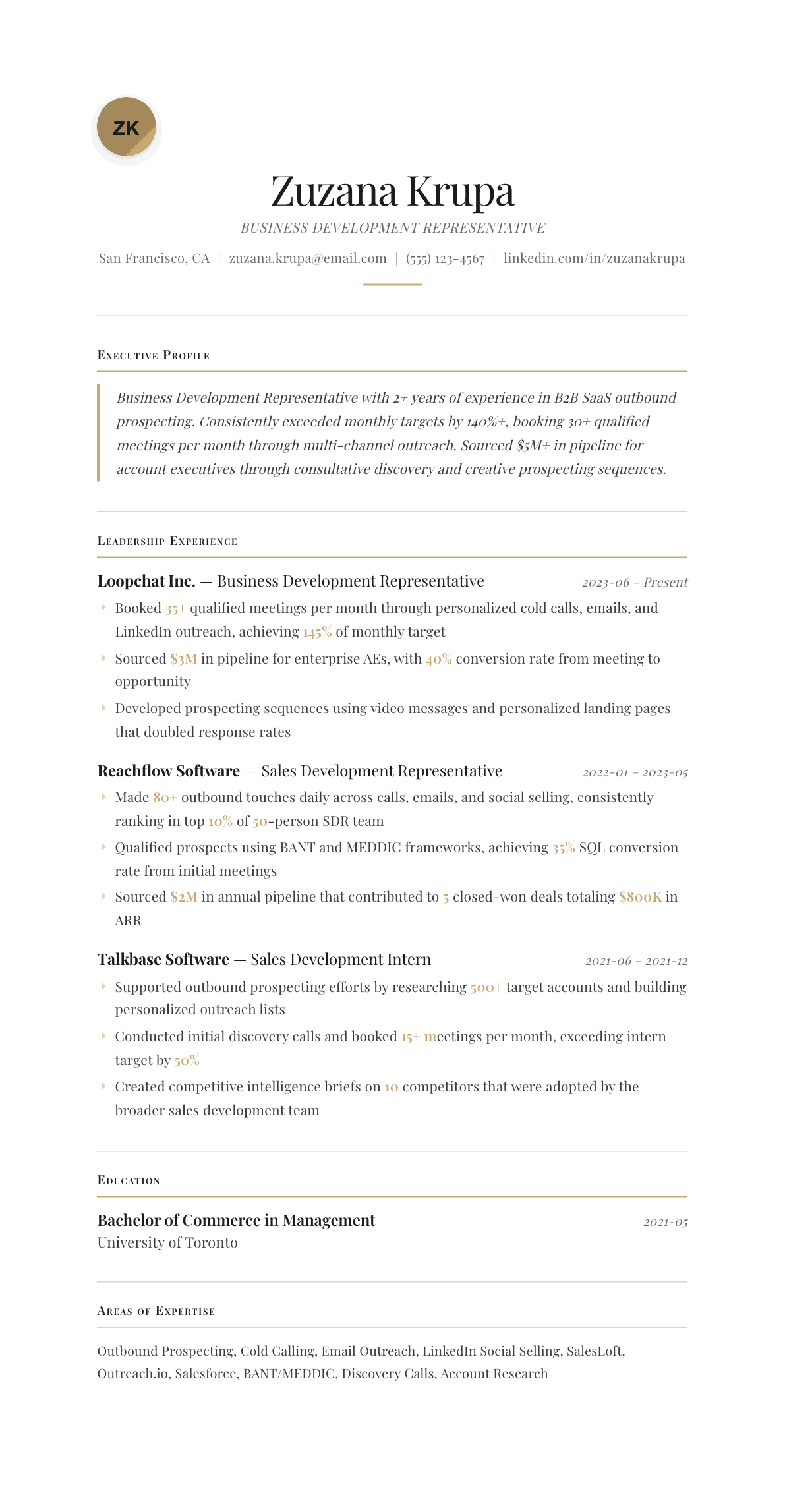
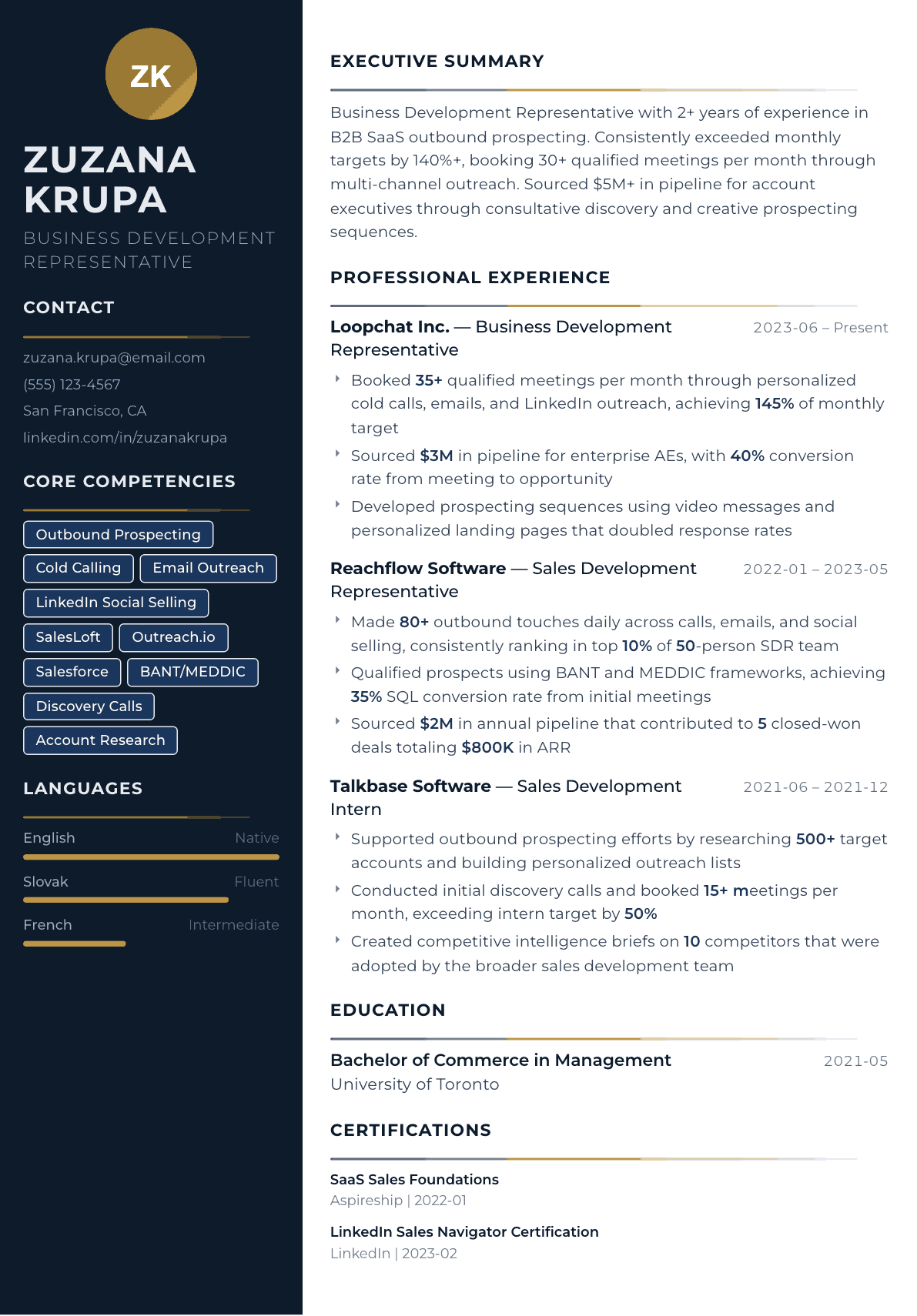
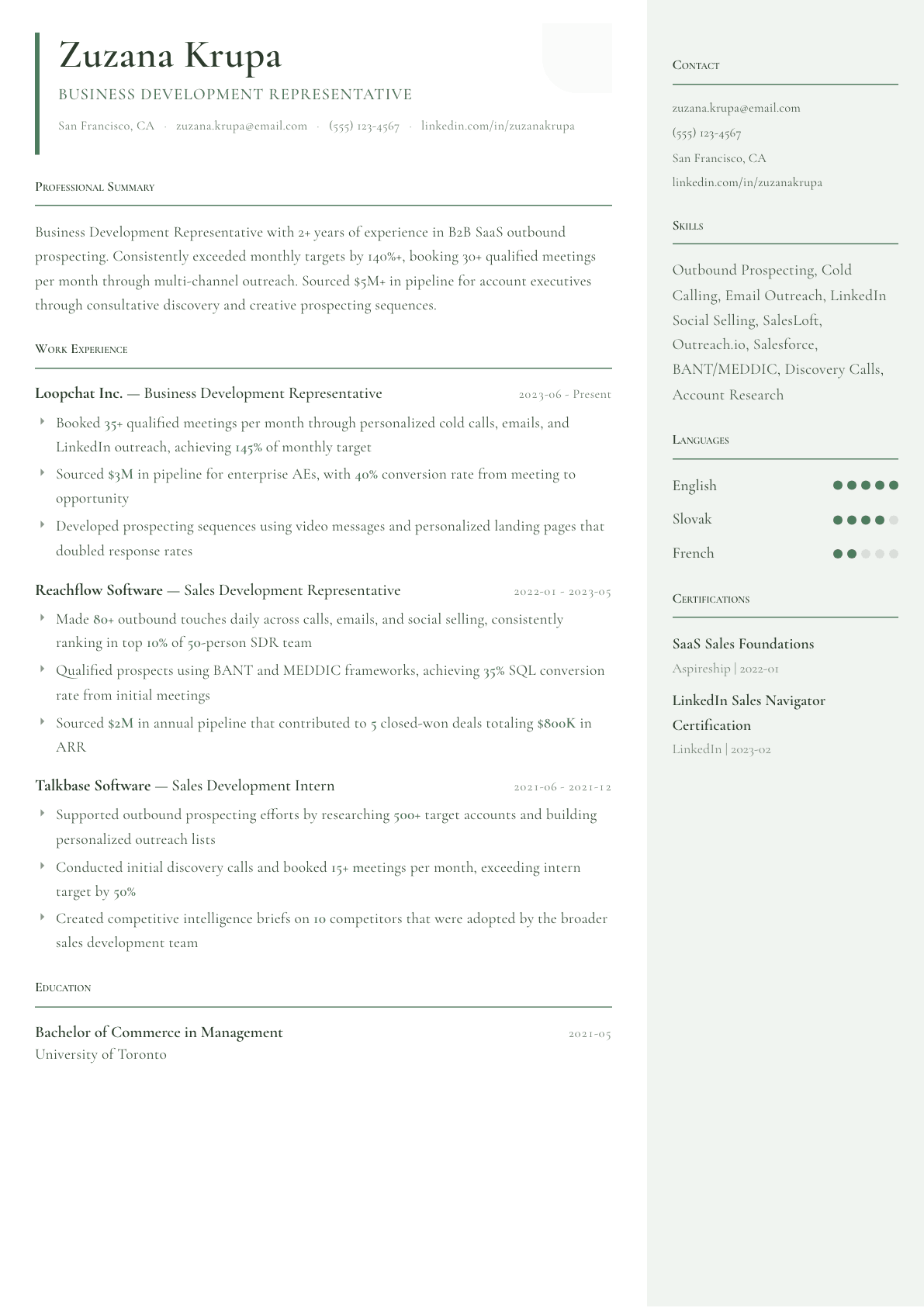
Example Business Development Representative summary
High-performing BDR with 2 years of experience sourcing $5M+ in B2B SaaS pipeline through creative multi-channel outbound prospecting. Booked 35+ qualified meetings per month at Loopchat Inc., exceeding targets by 145%. Skilled in personalized outreach, consultative discovery, and sales qualification frameworks. Ready to advance into a closing role.
Skills to list on a Business Development Representative resume
- Business Development
- Outbound Prospecting
- Cold Calling
- Email Outreach
- Social Selling
- LinkedIn Sales Navigator
- Salesforce
- SalesLoft
- Outreach.io
- Discovery Calls
- Lead Qualification
- BANT/MEDDIC
- Account Research
- Pipeline Generation
What actually gets this resume read
- Lead with activity metrics and outcomes: meetings booked, pipeline sourced, and quota attainment percentage.
- Highlight your prospecting methodology: multi-channel outreach, personalization techniques, and A/B testing.
- Quantify your ranking among peers to demonstrate consistent top performance.
- Include qualification frameworks: BANT, MEDDIC, GPCTBA/C&I, or SPIN.
- List sales tools: Salesforce, SalesLoft, Outreach, Gong, ZoomInfo, LinkedIn Sales Navigator.
How to write a business development representative resume
A business development representative resume is judged on activity, output and the gap between them. The sales manager reading it wants three numbers before anything else: how many meetings you booked in a month, how many of those the account executive kept, and what quota you were carried against. Everything else on the page is context for those three.
BDR hiring is unusual because most candidates have one or two years of history and the same job description. The resumes that get a screen are the ones that name the segment worked, the outbound channels used, the sequencing tool, and the qualification framework the team ran on. A BDR who cold called mid-market manufacturing accounts in a named territory reads very differently from one who worked inbound trial signups, even though both titles say the same thing.
This guide covers the format sales leaders expect, how to write a summary that survives a six second scan, how to build bullets around meetings held rather than meetings booked, and the questions BDRs ask when they sit down to rewrite the page before an interview.
Format: one page, reverse chronological, numbers on the right edge
Keep it to a single page until you have five years of sales history. Sales managers read fast and often on a phone between calls, so use a single column with no icons and no skill rating bars. The applicant tracking systems used by sales organizations parse plain layouts reliably, and the manager who opens the file after the recruiter should be able to find the quota line without scrolling.
Put a short achievements block directly under the summary if you have ranked on a leaderboard or hit an award tier. Sales is one of the few fields where a standalone results block near the top helps rather than clutters, because the reader is looking for exactly that.
- Header: name, city and state, phone, email, and a link to your professional profile.
- Order: summary, key results, experience, tools, education, certifications.
- Include the segment worked (SMB, mid-market, enterprise) in every job title line or company line.
- Name the quota period you carried: monthly meeting target, quarterly pipeline target, or both.
Summary: segment, channel, target, attainment
Three lines. Name the industry you sold into, the segment, the outbound channels you ran, and your attainment against target. A summary that says you are a motivated self starter with a hunter mentality tells a sales director nothing that separates you from the forty other applicants who used the same phrase.
If you are coming from outside sales, use the summary to convert your history into the vocabulary of the role. Someone moving from hospitality should point at high volume customer conversations, objection handling and daily targets, then say plainly that they are moving into outbound technology sales.
Experience: meetings held, not meetings booked
The single most credible metric on a BDR resume is qualified meetings that actually happened and were accepted by the account executive. Booked meetings inflate easily through no shows and unqualified handoffs, and experienced sales leaders know it. Write held or accepted, and if you have both numbers, show the conversion between them.
Each role needs the context line first: what the company sold, to whom, and what your patch was. Then three to five bullets covering output, conversion, and one thing you built. The thing you built matters more than candidates think: a sequence that outperformed the team default, a call script for a new persona, a territory research process, an objection library. It shows you were more than a set of hands on a dialer.
Give the volume honestly rather than rounding up. Dial counts, connect rates, sequence enrollment volume and reply rates are all fair game, but a manager who hires you will see the real numbers inside a month, so the resume should match what you can defend in a screen.
- Context line: segment, average contract value band, territory or vertical, team size.
- Output: meetings held per month against target, pipeline value sourced, opportunities created.
- Conversion: meeting to opportunity rate, opportunity to closed won rate where you know it.
- Build: a sequence, a script, a research process, a persona playbook you created.
Tools: the stack is a qualification filter
Sales leaders filter on the stack because ramp time depends on it. Name the customer relationship management system (Salesforce, HubSpot), the sequencing platform (Outreach, Salesloft, Apollo), the data and intent sources (ZoomInfo, LinkedIn Sales Navigator, Clearbit), the dialer, and the conversation intelligence tool if the team recorded calls. A BDR who has lived inside Outreach and Salesforce can be productive in week two at a company running the same stack.
List the qualification framework by name too. BANT, MEDDIC, MEDDPICC and SPICED are not interchangeable, and a hiring manager running MEDDPICC will read a candidate who has used it as lower risk.
Keywords a sales recruiter is scanning for
Outbound prospecting, cold calling, qualified meetings, pipeline generation, sales qualified lead, discovery call, account research, multi channel outreach, quota attainment, territory, cadence, and the names of the tools. Use the exact wording from the posting once in the summary or tools section and once inside a bullet where it is attached to a result. A keyword block with no evidence behind it reads as padding to the human who follows the software.
Business Development Representative resume summary examples
First sales role
Recent business graduate moving into outbound technology sales after two years in high volume retail, where I ran daily conversion targets and handled objections face to face. Completed a SaaS sales foundations program, trained on Salesforce and Outreach, and looking for a BDR seat in mid-market software.
One year in
Business Development Representative selling data infrastructure into mid-market accounts, averaging 22 held meetings a month against a target of 18. Run multi-channel outreach across cold calls, email and LinkedIn in a named 300 account territory, qualifying on MEDDIC and handing off to three enterprise account executives.
Senior BDR
Senior BDR and team lead with three years of outbound experience in cybersecurity, finishing the last two years at 130% of a quarterly pipeline target. Own the outbound playbook for the financial services vertical, onboard new hires through their first 30 days, and mentor four reps on cold call structure.
Work experience bullets: before and after
Before: Made cold calls and sent emails to potential customers.
After: Ran 70 outbound touches a day across cold calls, personalized email and LinkedIn in a 300 account mid-market territory, generating 22 held meetings a month against a target of 18.
The daily volume, the territory size and the held meeting number against target turn an activity description into a performance record.
Before: Booked meetings for account executives.
After: Sourced 260 accepted meetings over 12 months for three enterprise account executives, with 41% converting into qualified opportunities after discovery.
Accepted meetings and a conversion rate are the numbers a sales manager trusts, because booked meetings inflate through no shows.
Before: Used Outreach and Salesforce daily.
After: Built a five-touch Outreach sequence for the operations persona that lifted reply rate from 4% to 11%, then rolled it out to the full 12 person BDR team.
Naming what you built with the tool, and who adopted it, proves ownership rather than exposure.
Before: Consistently hit and exceeded targets.
After: Finished at or above quota in 11 of 12 months, ranking second of 14 BDRs on pipeline sourced and earning a place in the annual top performer trip.
A ranking and a count of months make the claim checkable, where the word consistently does not.
Before: Researched target accounts before reaching out.
After: Built account research briefs covering hiring signals, tech stack and recent funding for 40 target accounts a week, which the account executives reused in first calls.
It names the research inputs and shows the output was used downstream, which is what separates preparation from busywork.
Hard skills
- Outbound prospecting
- Cold calling
- Multi-channel sequencing
- Account research
- Lead qualification (BANT, MEDDIC)
- Salesforce
- HubSpot CRM
- Outreach and Salesloft
- LinkedIn Sales Navigator
- ZoomInfo
- Pipeline reporting
- Discovery calls
- Territory planning
- Email copywriting
Soft skills
- Resilience after rejection
- Active listening
- Objection handling
- Coachability
- Time blocking
- Written brevity
Certifications worth listing
- Salesforce Certified Administrator (Salesforce)
- HubSpot Sales Software Certification (HubSpot Academy)
- Certified Inside Sales Professional (CISP) (AA-ISP / Emblaze)
- LinkedIn Sales Navigator Certification (LinkedIn)
Mistakes that cost business development representative candidates the interview
- Reporting booked meetings without the held or accepted number, which any experienced sales manager will discount on sight.
- Leaving out the segment and average deal size, so the reader cannot tell whether you called small business owners or enterprise security teams.
- Listing every tool on the market instead of the four you actually worked in daily, which invites a screening question you cannot answer.
- Describing the job rather than your results: prospected, qualified and handed off is the definition of the role, not evidence of doing it well.
- Using a two column template with skill rating bars, which parses badly and signals that you are guessing at what sales leaders value.
- Hiding the target you were carried against, which makes an attainment claim impossible to interpret.
- Writing a summary made of adjectives such as driven, passionate and hungry, all of which appear on nearly every competing resume.
Business Development Representative resume questions
What if my BDR numbers were bad because of the territory?
Give the number anyway and add the context in the same bullet: a new territory with no installed base, a product in early release, or a quota set before the segment was tested. Sales managers respect a candidate who can explain a miss with specifics far more than one who omits the figure.
How do I write a BDR resume with no sales experience?
Lead with any job that had a daily target, live conversations and rejection: retail, hospitality, fundraising, recruiting, athletics. Convert those into sales language, then add a sales training program and hands on time in a customer relationship management tool so the reader sees you have prepared rather than just applied.
Should I say which account executives I supported?
Name the number and the segment rather than the individuals. Supporting three enterprise account executives is a different job from supporting eight small business reps, and it tells the manager how many stakeholders you coordinated with and what deal sizes your meetings fed.
Is a leaderboard ranking worth putting on the resume?
Yes, when you give the denominator. Ranking second of fourteen is meaningful, while top performer on its own is not. Add the period the ranking covered, since a single strong month reads differently from four consecutive quarters near the top of the board.
How long before a BDR should stop listing internships?
Drop internships once you have a full year of paid quota carrying work. Until then keep one line for an internship that involved real prospecting or research, since it shows the reader you were doing the work before you had the title.