Cable Installer Resume Examples: the lines they read
Write a Cable Installer Resume That Wins the Route
By Mustafa Tarabya, founder of CVBooster · Published · Updated
Cable installer resume examples with drop, aerial and underground keywords, plus a guide to writing installs, testing and customer visits.
Sample resumes for a cable installer
The same cable installer content laid out in three CVBooster templates, so you can see what the finished document looks like before you write a word.
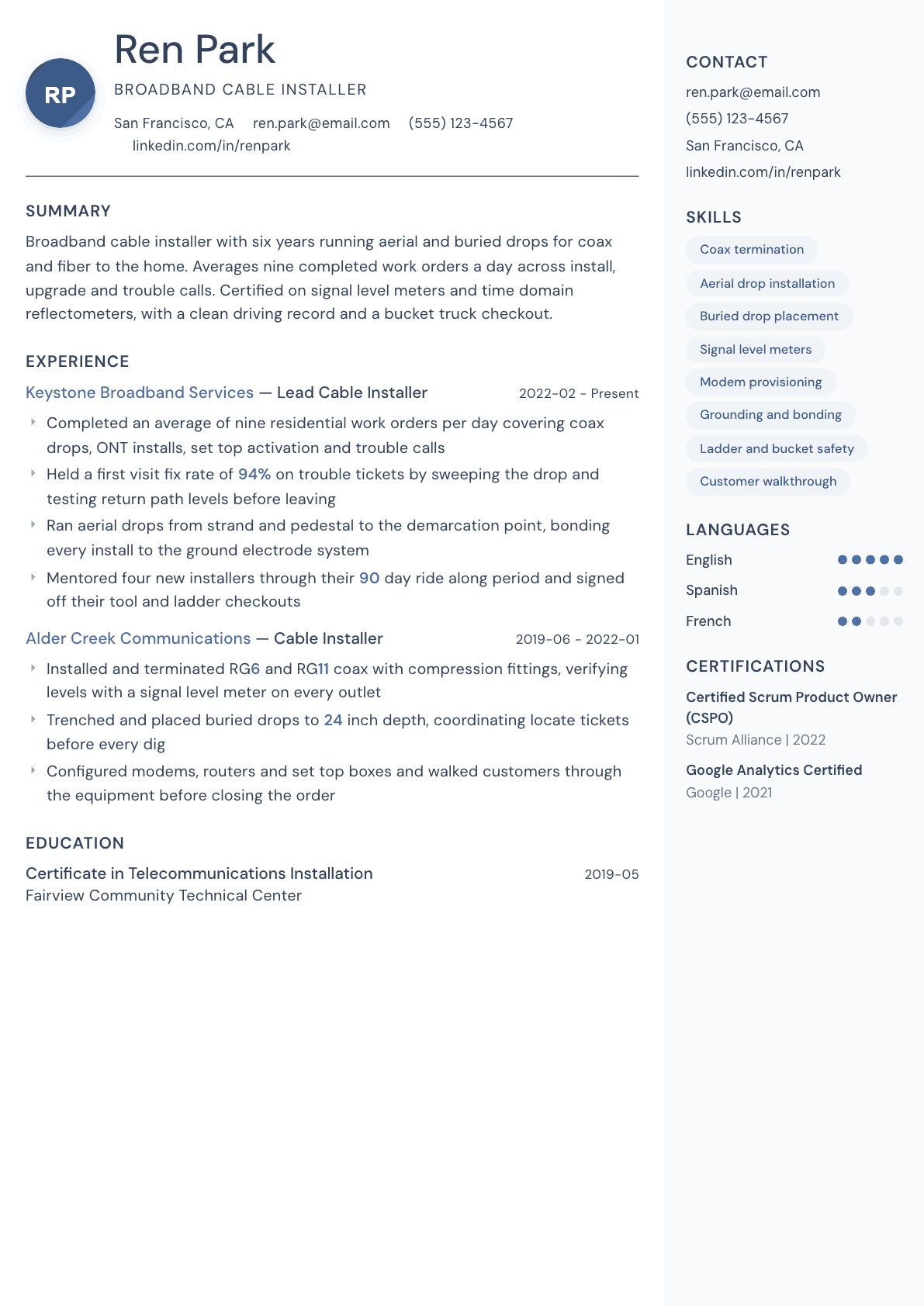
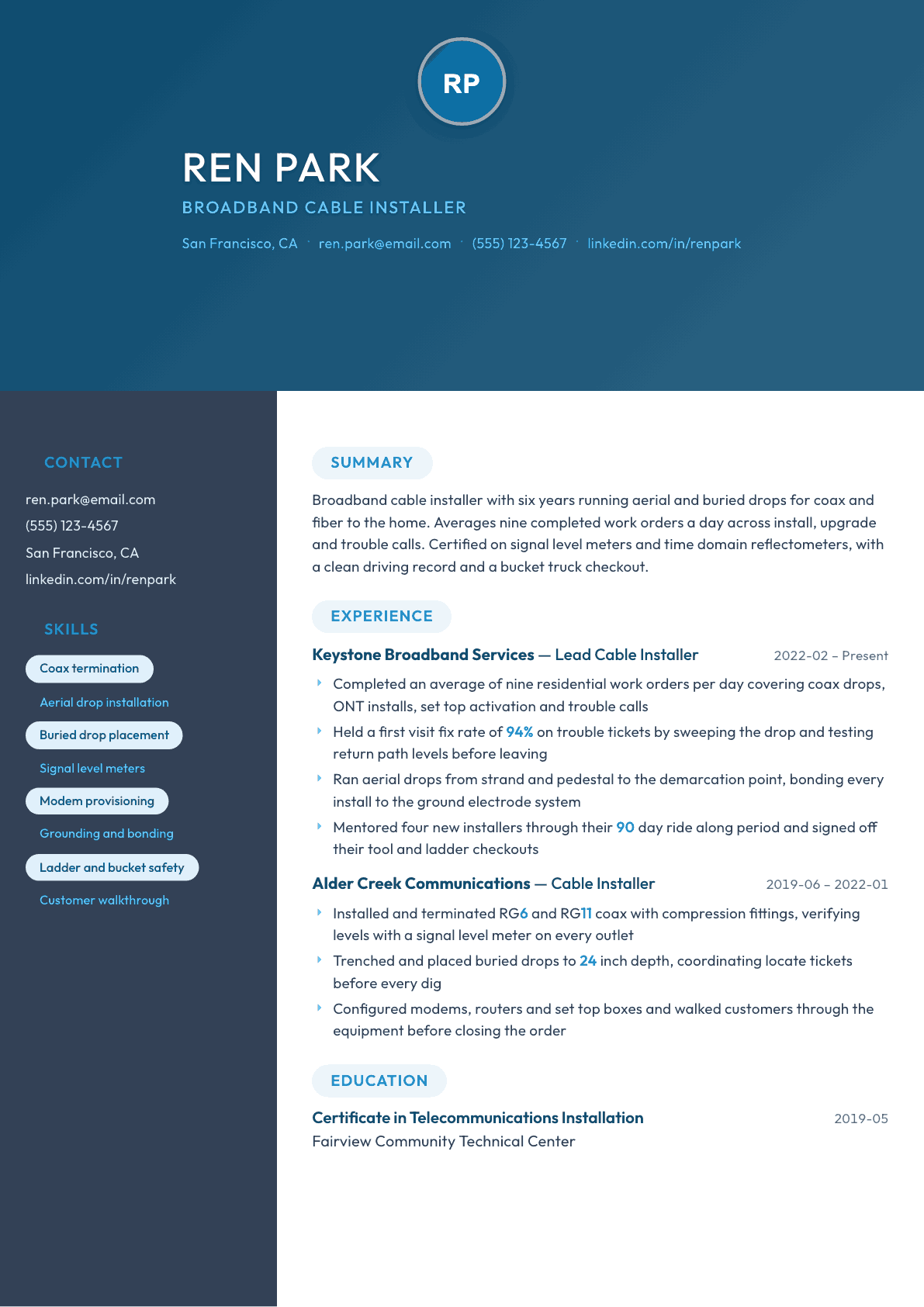
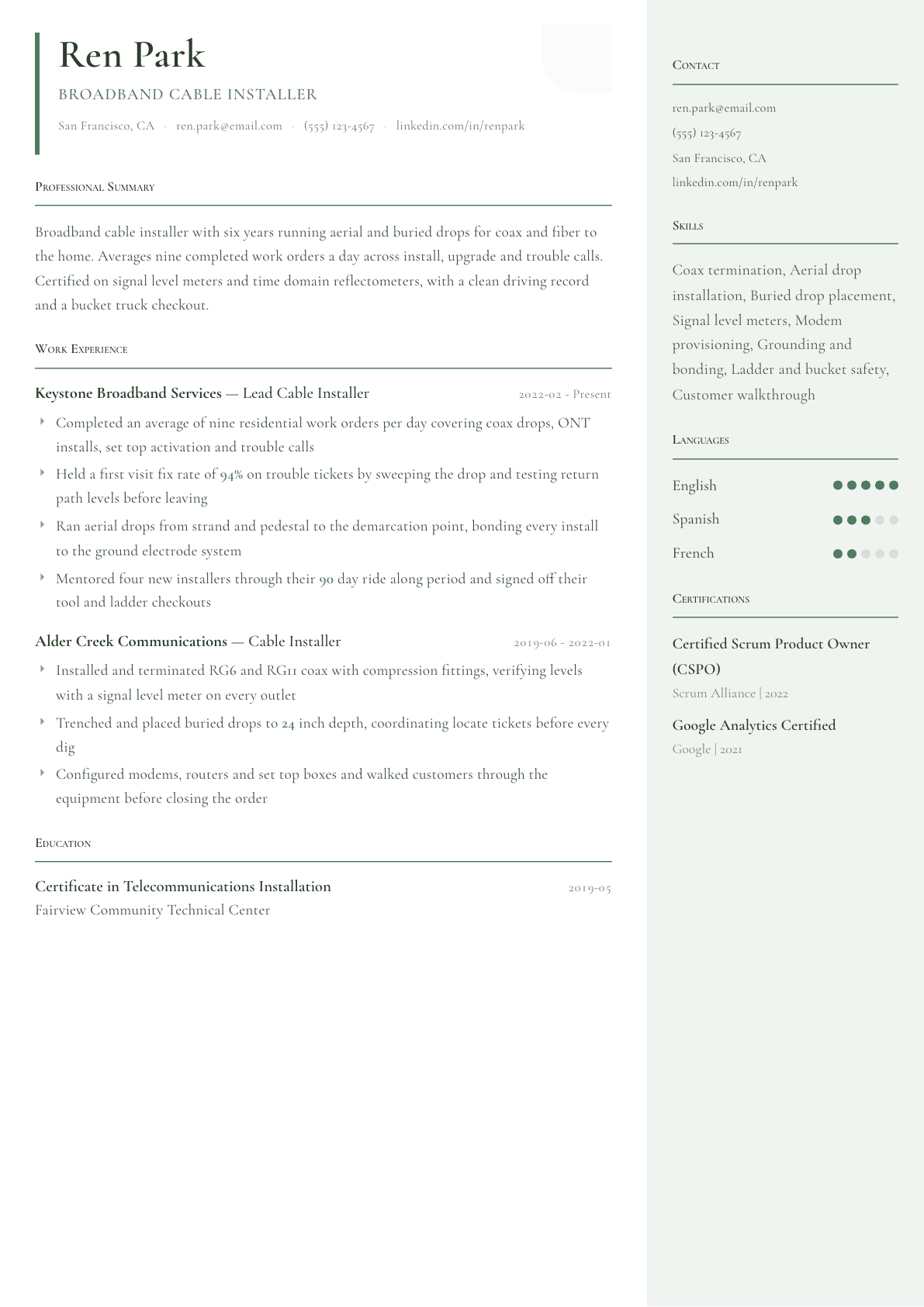
Example Cable Installer summary
Cable installer with six years of residential and small business work covering coax and fiber drops, aerial strand runs and buried placement. Turns nine work orders a day with a high first visit fix rate, tests every outlet with a signal level meter, and bonds each install to code. Comfortable explaining equipment to customers and selling added outlets during the visit.
Skills to list on a Cable Installer resume
- Coax cable termination
- Fiber to the home drops
- Aerial strand work
- Underground boring and trenching
- Signal level metering
- Return path testing
- Modem and router provisioning
- Set top box activation
- Grounding and bonding
- Locate ticket coordination
- Ladder safety
- Bucket truck operation
- Work order systems
- Customer education
What actually gets this resume read
- Give the daily work order count and the mix of installs, upgrades and trouble calls so a dispatcher can size you up.
- Name the test gear you carry, such as signal level meters, reflectometers and power meters, and say what you test for.
- Say whether your drops were aerial, buried or both, and mention strand work, pedestals and locate ticket handling.
- Include first visit fix rate or repeat call rate if you tracked them, because those numbers drive installer scorecards.
- List your driving record status, vehicle class and any bucket truck or lift checkout near the top of the resume.
- Show the customer facing half of the job: equipment walkthroughs, sales of added outlets, and how you handle a hostile call.
How to write a cable installer resume
A cable installer resume is read by a field supervisor or a contractor dispatcher whose whole job is routing work orders to people who close them. He is not evaluating your character. He is estimating how many jobs a day you can turn, how often you will roll a second truck to the same address, and whether he can hand you a route without babysitting it.
That means the resume has to speak in the language of the dispatch board: order volume, order types, first visit resolution, and the tools you carry. A cable installer resume written as a list of duties reads exactly like the last forty applications, because installing cable is the duty. What separates candidates is throughput and quality of the finished drop.
This guide covers how to structure the page, which numbers to put on it, how to handle the customer facing half of the job that most applicants leave out, and what to do when your history is a mix of contractor and direct employment.
Format: one page, tools and credentials visible immediately
One page is right for almost every cable installer. Field supervisors read fast and read on a phone. Put a compact block under your name with the essentials: driving record status, vehicle and lift checkouts, ladder capacity you work at, and whether you own a full tool kit and test set.
Do not build a skills section from adjectives. The reader wants nouns: compression tools, signal level meter, power meter, cable locator, fish tape, hammer drill, and the work order platform you have used.
- Header: name, city and state, phone, email, and the classification you are applying as.
- Field readiness block: license class, driving record, lift or bucket checkout, tool ownership.
- Experience with order counts and order types, then tools and test gear, then training.
- Add service territory or willingness to relocate if you are applying outside your area.
Write jobs in order volume and order mix
Every job entry should say how many work orders a day you completed and what the mix was. A route that runs nine orders of new installs is a different skill from a route of six trouble calls, and both are different from upgrade and disconnect work. State the mix and let the supervisor do the math on your route capacity.
Name the plant you worked in. Coax on a hybrid fiber coaxial network, fiber to the home with an optical network terminal at the house, satellite, or structured cabling inside multiple dwelling units. Each one implies a different set of hands and a different set of problems.
If you worked multiple dwelling units, say so explicitly. Apartment and condominium work involves lock boxes, property managers, riser access and shared enclosures, and contractors staff that work separately because not every installer can handle it.
The quality numbers that matter more than speed
Turning a lot of orders means nothing if the calls come back. If you tracked first visit fix rate, repeat trouble call rate, or quality control audit scores, put them on the page. These are the metrics that appear on an installer scorecard, and a supervisor who sees them knows you have worked somewhere that measured.
Tie the number to the practice that produced it. Sweeping the drop, checking forward and return levels at the tap and the outlet, replacing a corroded fitting instead of working around it, and bonding to the ground electrode system are the reasons a job holds. Write the practice and the number together.
Grounding, code and the safety record
Bonding and grounding is where inspections fail and where a careless installer creates liability. Say that you bond every drop to the ground electrode system, and mention the code framework you work to. A supervisor reading that line assumes you will not create a callback for an inspector.
Ladder and aerial safety belongs here too. State the ladder ratings you work at, whether you are trained for strand and pole climbing, and any lift or bucket checkout. Add your driving record status, because a company vehicle assignment depends on it and it is checked before the offer.
The customer half of the job
Installers are the only employee most subscribers ever meet in person, and companies know it. Show the customer side: walking a subscriber through the equipment before you leave, explaining what the technician can and cannot control, and defusing a call that started angry about a missed appointment.
If you sold added outlets, upgraded tiers or accessories during visits, put the volume on the page. Field sales attach is tracked on many routes and it is a real differentiator between two installers with the same completion counts.
Cable Installer resume summary examples
First year installer
Cable installer with one year of residential coax and fiber to the home work, currently completing six to seven orders a day across installs and equipment swaps. Terminates coax with compression fittings, verifies levels at every outlet, and bonds each drop. Clean driving record and full tool kit.
Five years in
Broadband installer with five years on residential and small business routes, running nine orders a day across installs, upgrades and trouble calls. Works aerial and buried drops, tests forward and return levels, and holds a first visit fix rate well above the office average on trouble tickets.
Lead installer
Lead cable installer with nine years in the field, the last three riding with new hires through their probation period and auditing completed drops for quality. Handles escalated trouble calls, multiple dwelling unit builds and riser work, and carries a bucket truck checkout and full test set.
Work experience bullets: before and after
Before: Installed cable and internet service for customers.
After: Completed an average of nine residential orders a day across new installs, tier upgrades, equipment swaps and trouble calls on a coax and fiber to the home plant.
The daily count and the order mix let a dispatcher estimate your route capacity immediately.
Before: Made sure installations worked properly.
After: Swept every drop and verified forward and return levels at the tap and each outlet before closing an order, holding a first visit fix rate of 94% on trouble tickets.
Naming the test practice explains the number instead of asking the reader to take it on faith.
Before: Ran cable outside and inside the home.
After: Ran aerial drops from strand and pedestal to the demarcation point and trenched buried drops to depth, coordinating locate tickets before every dig.
Aerial and buried are staffed differently, so spelling out both widens the roles you match.
Before: Talked to customers about their equipment.
After: Walked each subscriber through modem, router and set top operation before leaving, and converted 40 visits into added outlet or tier upgrade sales.
It shows the customer contact produced something measurable rather than being a courtesy.
Before: Helped train new employees.
After: Rode with four new installers through their probation period, signed off ladder and tool checkouts, and audited their first 50 completed drops for grounding and fitting quality.
The specifics prove you were trusted with quality control, not just company for the ride.
Hard skills
- Coax termination and compression fittings
- Fiber to the home drop installation
- Aerial strand and pedestal work
- Buried drop trenching
- Signal level metering
- Forward and return path testing
- Grounding and bonding to code
- Modem and router provisioning
- Set top box activation
- Multiple dwelling unit riser work
- Cable and utility locating
- Work order and dispatch systems
- Ladder and lift operation
- Structured cabling and wall fishing
Soft skills
- Customer walkthrough
- De-escalation on service calls
- Route self management
- Punctuality on appointment windows
- Clear job notes
- Peer training
Certifications worth listing
- Broadband Premises Installer (BPI) (Society of Cable Telecommunications Engineers)
- Broadband Premises Installer (Society of Cable Telecommunications Engineers)
- OSHA 10-Hour Construction (OSHA Training Institute Education Centers)
- Certified Fiber Optic Technician (Fiber Optic Association)
- First Aid, CPR and AED (American Red Cross)
Mistakes that cost cable installer candidates the interview
- Writing duties instead of throughput, so the reader cannot tell whether you close five orders a day or eleven.
- Leaving out the plant type, which hides whether you worked coax, fiber to the home, satellite or inside structured cabling.
- Omitting driving record status when a company vehicle assignment depends on it and it will be checked before an offer.
- Listing every tool in the truck without saying which test sets you use and what you test for.
- Skipping the customer facing half of the job even though subscriber scores are part of every installer review.
- Describing contractor work without naming the operator whose plant you built on, which makes the experience hard to place.
Cable Installer resume questions
Should a cable installer resume include work order numbers?
Yes, and they are the most persuasive thing on the page. Give the average daily completions and the mix of installs, upgrades and trouble calls, because a dispatcher is trying to predict how much of a route you can absorb.
How do I present contractor work versus direct employment?
List the contracting company as your employer and name the operator whose plant you built on in the first line of the entry. That combination tells a reader both who paid you and which network standards and specifications you worked to.
Do I need a fiber certification to apply for cable installer roles?
Not usually for coax focused routes, but a fiber credential meaningfully widens the jobs you match as networks move deeper toward the home. If you hold one, put the exact certification name and issuing body rather than writing fiber certified.
What do I write if I have no cable experience yet?
Lead with transferable field work such as electrical helper, satellite installation, low voltage alarm or telephone work, then add ladder comfort, tool ownership, a clean driving record and any coursework. Reliability and attendance evidence matters more than you expect here.
Should I include customer satisfaction scores?
Include them when you have real ones from an employer scorecard, and name the measure so a supervisor knows what it was. Vague claims about great customer service without a source read as filler and take up a line that a number could hold.
Related resume examples
- Electrician Resume example
- HVAC Technician Resume example
- Fiber Optic Technician Resume example
- Line Worker Resume example
- Excavator Operator Resume example
- Solar Installer Resume example