Fiber Optic Technician Resume Examples: read this first
Craft a Fiber Optic Technician Resume Around Splice Counts
By Mustafa Tarabya, founder of CVBooster · Published · Updated
Fiber optic technician resume examples with splicing, OTDR and OSP keywords, and a guide to writing loss budgets and turn up work.
Sample resumes for a fiber optic technician
The same fiber optic technician content laid out in three CVBooster templates, so you can see what the finished document looks like before you write a word.
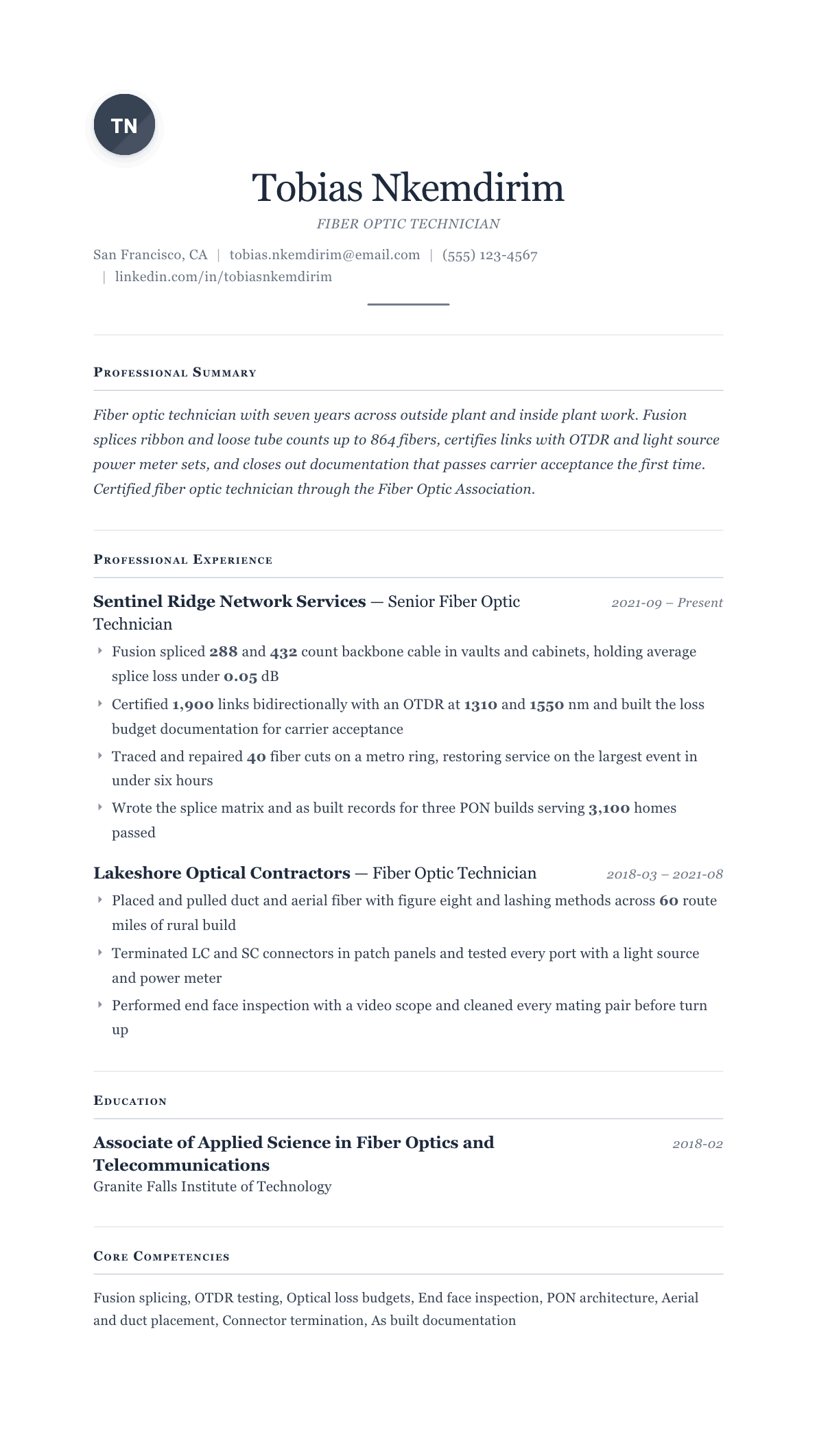
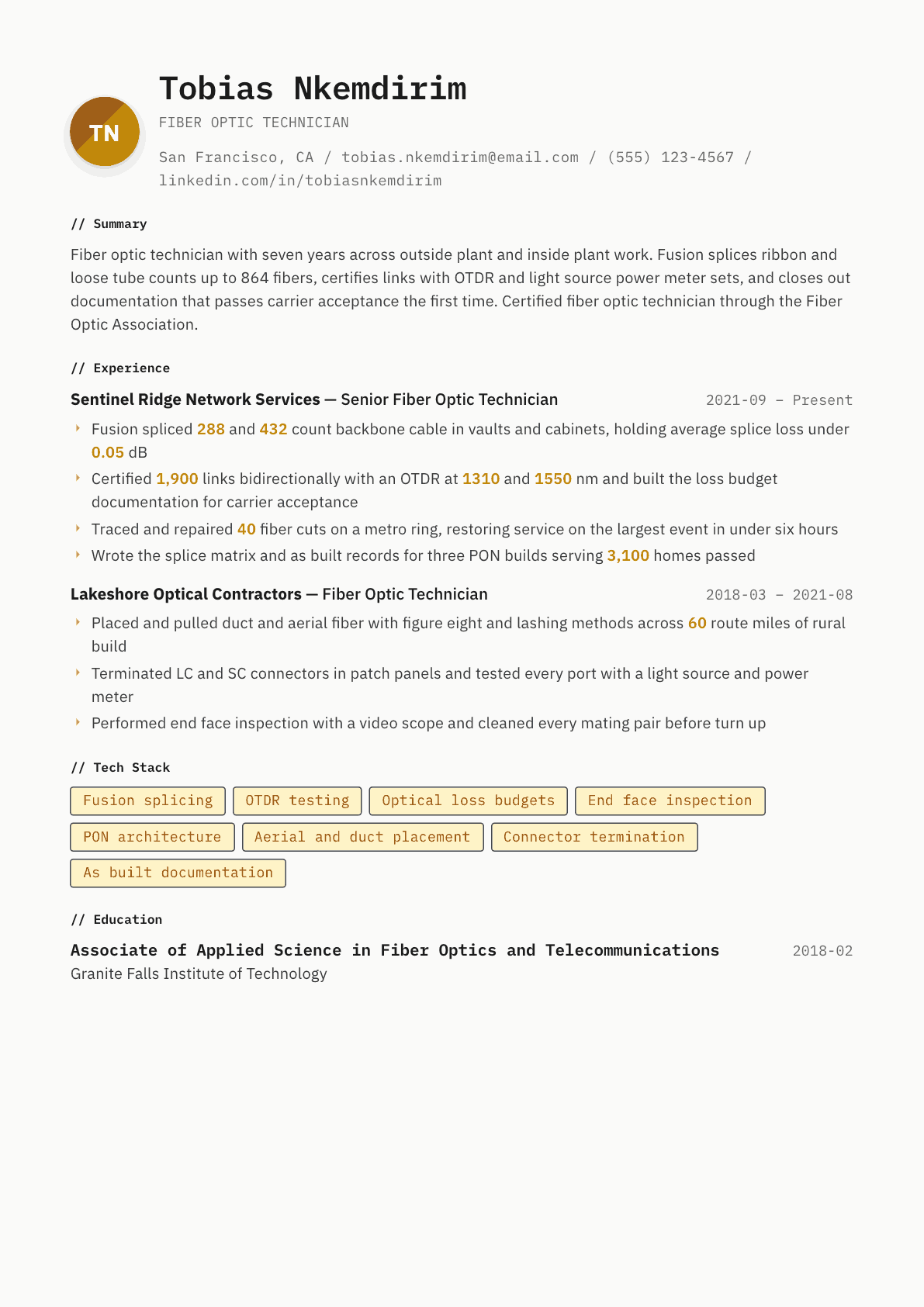
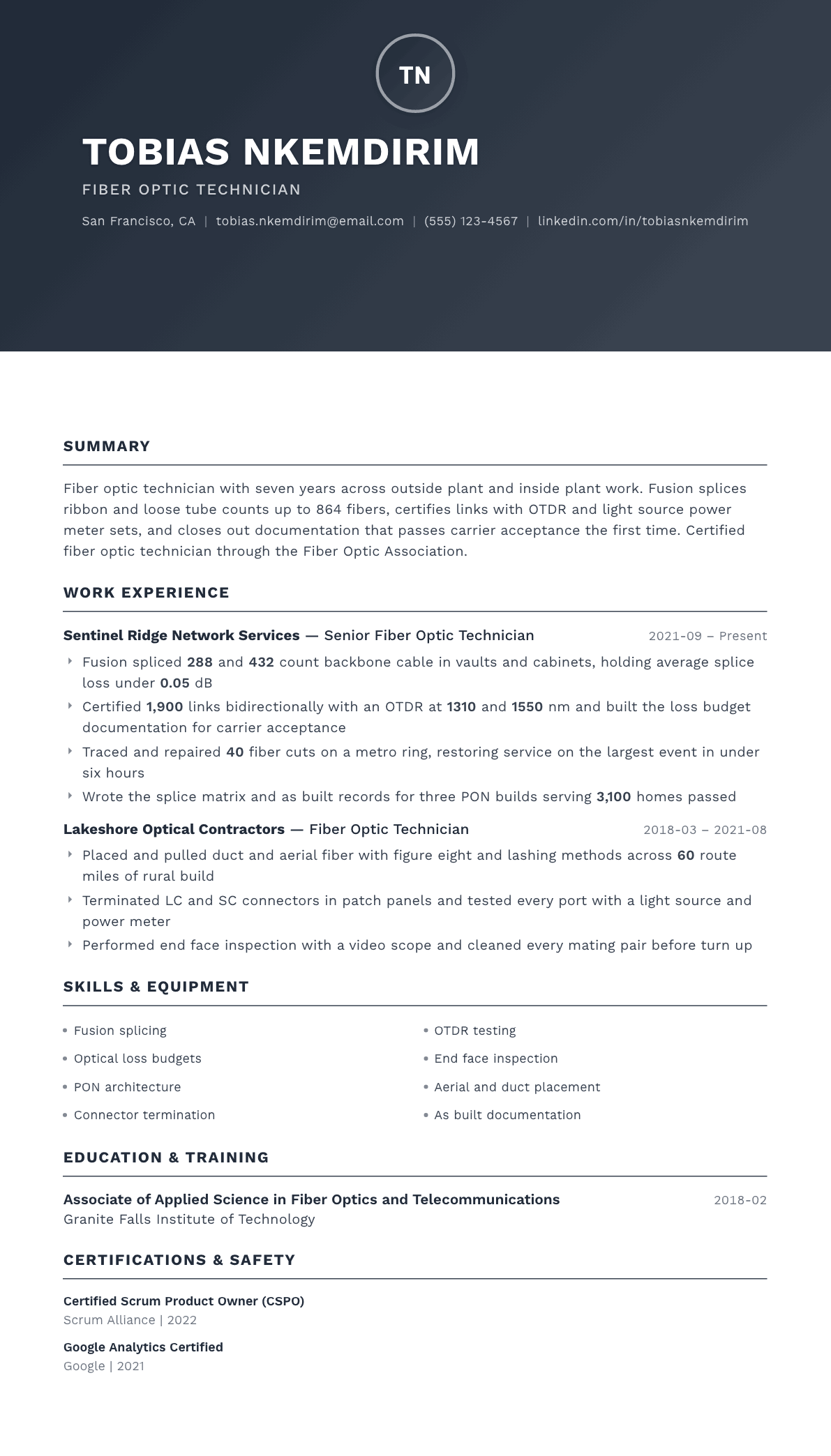
Example Fiber Optic Technician summary
Fiber optic technician with seven years of outside plant and inside plant work on counts up to 864 fibers. Splices ribbon and loose tube cable to tight loss targets, certifies links bidirectionally with an OTDR, and produces splice matrices and loss budgets that clear carrier acceptance without rework. Certified through the Fiber Optic Association and available for restoration call out.
Skills to list on a Fiber Optic Technician resume
- Fusion splicing
- Mechanical splicing
- OTDR trace analysis
- Insertion loss testing
- Optical return loss
- Loss budget calculation
- PON and FTTH builds
- Ribbon and loose tube cable
- Aerial lashing
- Duct and innerduct placement
- Connector termination
- End face inspection
- Splice matrix documentation
- Emergency restoration
- Confined space entry
What actually gets this resume read
- State fiber counts you have spliced and the average splice loss you hold, because that single number sizes your skill.
- Separate outside plant from inside plant experience so a hiring manager knows whether you work vaults or telecom rooms.
- Name the test sets by function: OTDR, light source and power meter, video inspection scope, visual fault locator.
- Show that you can close a job on paper with splice matrices, loss budgets and as built records that pass acceptance.
- Mention restoration work with response time and the outage duration, since emergency response is a hiring filter.
- List your Fiber Optic Association credentials with the exact certification name, not a generic claim of being certified.
How to write a fiber optic technician resume
A fiber optic technician resume is judged on two numbers and one habit. The numbers are the fiber counts you have spliced and the loss you hold on a splice. The habit is whether your paperwork clears acceptance the first time. A construction manager staffing a build knows that a technician who splices fast but documents badly costs more than one who is a little slower and hands in a clean matrix.
Most applicants write around this. They say experienced in fiber optics, list a splicer brand, and leave the reader guessing whether they have done ribbon work, whether they can read an OTDR trace and defend it, and whether they have ever stood in a wet vault at two in the morning on a cut.
This guide shows how to separate outside plant from inside plant, how to write splice and test work so a project manager can price your value, what certifications carry weight, and how to present restoration availability, which is often what actually gets the offer signed.
Format: certification and capability first, history second
Put a capability block under your name: certifications with issuing body, the highest fiber count you have spliced, the splicer and test platforms you are current on, and your restoration availability. A construction manager can qualify you from that block alone, which is exactly the point.
Keep the resume to one page if you are under five years in and two pages once you have multiple build types, both plant environments and a restoration record. Use a single column so the parser does not scramble your certification names.
- Header: name, city and state, phone, email, and current certification level.
- Capability block: fiber counts, splice loss target you hold, test sets, splicer platforms, availability for call out.
- Experience split by outside plant and inside plant where the history mixes them.
- Then equipment, safety training including confined space and traffic control, then education.
Separate outside plant from inside plant
These are two jobs that share a name. Outside plant means vaults, handholes, aerial lashing, pedestals, slack storage, weather and traffic. Inside plant means telecom rooms, patch panels, rack and stack, cable management and clean environments. Employers hire for one or the other and often specify it in the first line of the posting.
Write each job so the environment is unmistakable. If your history mixes them, split the bullets under one employer rather than blending them, so a reader scanning for outside plant experience finds it without inference.
Name the build types too: fiber to the home passing counts, backbone and long haul route work, dark fiber leases, campus builds, data center cross connects, wireless backhaul to cell sites. Each one implies a different pace and a different acceptance standard.
Splice work: counts, cable type, and the loss you hold
Give the highest count you have worked and the cable construction: loose tube, ribbon, micro duct, armored. Ribbon splicing is a distinct skill because of the mass fusion equipment and the preparation involved, and it should never be hidden inside a general splicing bullet.
State the average splice loss you hold and the standard you were held to. A technician who writes that he holds splices under a stated loss figure verified bidirectionally is telling a manager he understands that a one direction reading can hide a real problem.
Mention the closure and hardware you work with: dome and inline closures, cabinets, optical distribution frames, splitters in a passive network, and slack loop practice. This is the detail that separates a technician from someone who has taken a splicing class.
Testing and documentation, which is where jobs are won or lost
List your test sets by function rather than only by brand: OTDR for trace and event analysis, light source and power meter for insertion loss, optical return loss testing, visual fault locator, and a video inspection scope for end faces. Say that you inspect and clean every mating pair, because contamination is the most common cause of a failed turn up.
Then show the paperwork. Splice matrices, as built records, test result exports at both wavelengths, loss budget calculations against the design, and the acceptance package a carrier or municipality signs. A line stating that your closeout packages were accepted without rework is worth more than another tool name.
- Trace analysis at both common wavelengths, tested bidirectionally.
- Loss budget built from splice count, connector count and route distance.
- End face inspection and cleaning before every mating.
- Closeout package: matrix, as builts, test exports, photographs.
Restoration, safety and the practical qualifiers
Cuts happen at inconvenient hours and restoration is a staffing problem for every operator. Say whether you take call out, your typical response time, and the volume of restorations you have handled. Add the largest outage you helped close and how long it took to bring service back.
Round out the page with the qualifiers that quietly gate the job: confined space entry training for vaults, traffic control and flagging, aerial lift and bucket checkout, a valid license and driving record, and any background clearance a carrier or public agency required.
Fiber Optic Technician resume summary examples
New technician
Fiber optic technician with one year of inside plant work and a Certified Fiber Optic Technician credential. Terminates LC and SC connectors, tests every port with a light source and power meter, and inspects end faces with a video scope. Trained on single fiber fusion splicing and OTDR basics.
Seven years in
Fiber technician with seven years across outside plant and inside plant, splicing loose tube and ribbon cable up to 864 fibers. Certifies links bidirectionally with an OTDR, builds loss budgets against design, and produces closeout packages that clear carrier acceptance without rework. Available for restoration call out.
Lead technician
Lead fiber technician with thirteen years on passive network builds, backbone routes and wireless backhaul. Runs splice crews, writes the splice matrix and acceptance documentation, and owns restoration response on a metro ring. Trains technicians on ribbon preparation, trace interpretation and end face discipline.
Work experience bullets: before and after
Before: Spliced fiber optic cable for a telecom company.
After: Fusion spliced 288 and 432 count backbone cable in vaults and cabinets on a metro build, holding average splice loss under 0.05 dB verified bidirectionally.
Count, environment and a verified loss figure let a manager judge the skill instead of guessing at it.
Before: Tested fiber with an OTDR.
After: Certified more than 900 links bidirectionally at both wavelengths, analyzed traces for reflective and non reflective events, and built loss budgets against the design.
Testing bidirectionally at both wavelengths signals that you know what a single direction reading can hide.
Before: Repaired fiber cuts when they happened.
After: Responded to 40 fiber cuts on a metro ring under call out, restoring service on the largest event in under six hours including permanent splice and retest.
Restoration volume and time to restore are the figures an operator uses to compare technicians.
Before: Did documentation for completed jobs.
After: Wrote the splice matrix, as built records and acceptance test exports for three passive network builds serving 3,100 homes passed, all accepted without rework.
Closeout quality is a real cost driver, and accepted without rework is a claim a project manager values.
Before: Placed cable aerially and in conduit.
After: Placed and pulled duct and aerial fiber across 60 route miles using figure eight and lashing methods, managing slack loops and bend radius throughout.
Route miles and the specific placement methods show the field construction side, not just the splice trailer.
Hard skills
- Single fiber fusion splicing
- Ribbon mass fusion splicing
- Mechanical splicing
- OTDR trace and event analysis
- Insertion loss testing
- Optical return loss testing
- Loss budget calculation
- End face inspection and cleaning
- Connector termination and polishing
- Passive network and splitter builds
- Aerial lashing and duct placement
- Closure and cabinet hardware
- Splice matrix and as built documentation
- Emergency restoration response
Soft skills
- Attention to bend radius and slack discipline
- Calm under outage pressure
- Crew coordination on splice teams
- Clear field reporting
- Training junior technicians
- Coordination with locate and permit crews
Certifications worth listing
- Certified Fiber Optic Technician (CFOT) (Fiber Optic Association)
- Certified Fiber Optic Specialist in Splicing (CFOS/S) (Fiber Optic Association)
- Certified Fiber Optic Specialist in Testing (CFOS/T) (Fiber Optic Association)
- Fiber Optics Installer (FOI) (Electronics Technicians Association International)
- Optical Fiber Technician (Building Industry Consulting Service International)
- OSHA 10-Hour Construction (OSHA Training Institute Education Centers)
Mistakes that cost fiber optic technician candidates the interview
- Writing experienced in fiber optics without ever naming a fiber count, a cable construction or a loss target.
- Blending vault and aerial work with telecom room work so a reader cannot tell which environment you belong in.
- Listing splicer and test set brands while saying nothing about what you test for or how you read a trace.
- Leaving out the closeout documentation entirely, which is the part of the job project managers complain about most.
- Claiming certification generically instead of naming the exact credential and the body that issued it.
- Forgetting the practical qualifiers such as confined space training, traffic control and a valid driving record.
Fiber Optic Technician resume questions
What is the single most important number on a fiber optic technician resume?
The fiber count you have spliced, paired with the average splice loss you hold. Together they tell a construction manager the scale of cable you can prepare and the quality standard you work to, which nothing else on the page communicates as quickly.
Do employers care about ribbon splicing separately?
Yes, because mass fusion work uses different equipment and a different preparation process, and high count builds depend on it. Give ribbon experience its own line with the counts, rather than folding it into a general splicing statement.
Which fiber certifications actually help?
Credentials from the Fiber Optic Association are the most widely recognized in field roles, and specialist certifications in splicing or testing add real weight. Data center and premises employers also recognize Building Industry Consulting Service International credentials for structured cabling work.
How do I show restoration availability without overpromising?
State the call out rotations you have carried, your typical response window, and the number of cuts you have worked. Then add a plain line saying you are available for emergency response, so a hiring manager does not have to ask during the screen.
Should I list every project I worked on?
No. Group projects by build type and give the scale: route miles placed, homes passed, cell sites turned up, links certified. A reader wants the pattern of your work, not a chronological list of every job number you were assigned.
Related resume examples
- Electrician Resume example
- HVAC Technician Resume example
- Cable Installer Resume example
- Line Worker Resume example
- Health and Safety Officer Resume example
- Construction Safety Manager Resume example