Line Worker Resume Examples: free ATS score and gap list
Build a Line Worker Resume Utilities Take Seriously
By Mustafa Tarabya, founder of CVBooster · Published · Updated
Line worker resume examples, apprenticeship and voltage keywords, and a writing guide covering climbing, hot work, and storm restoration.
Sample resumes for a line worker
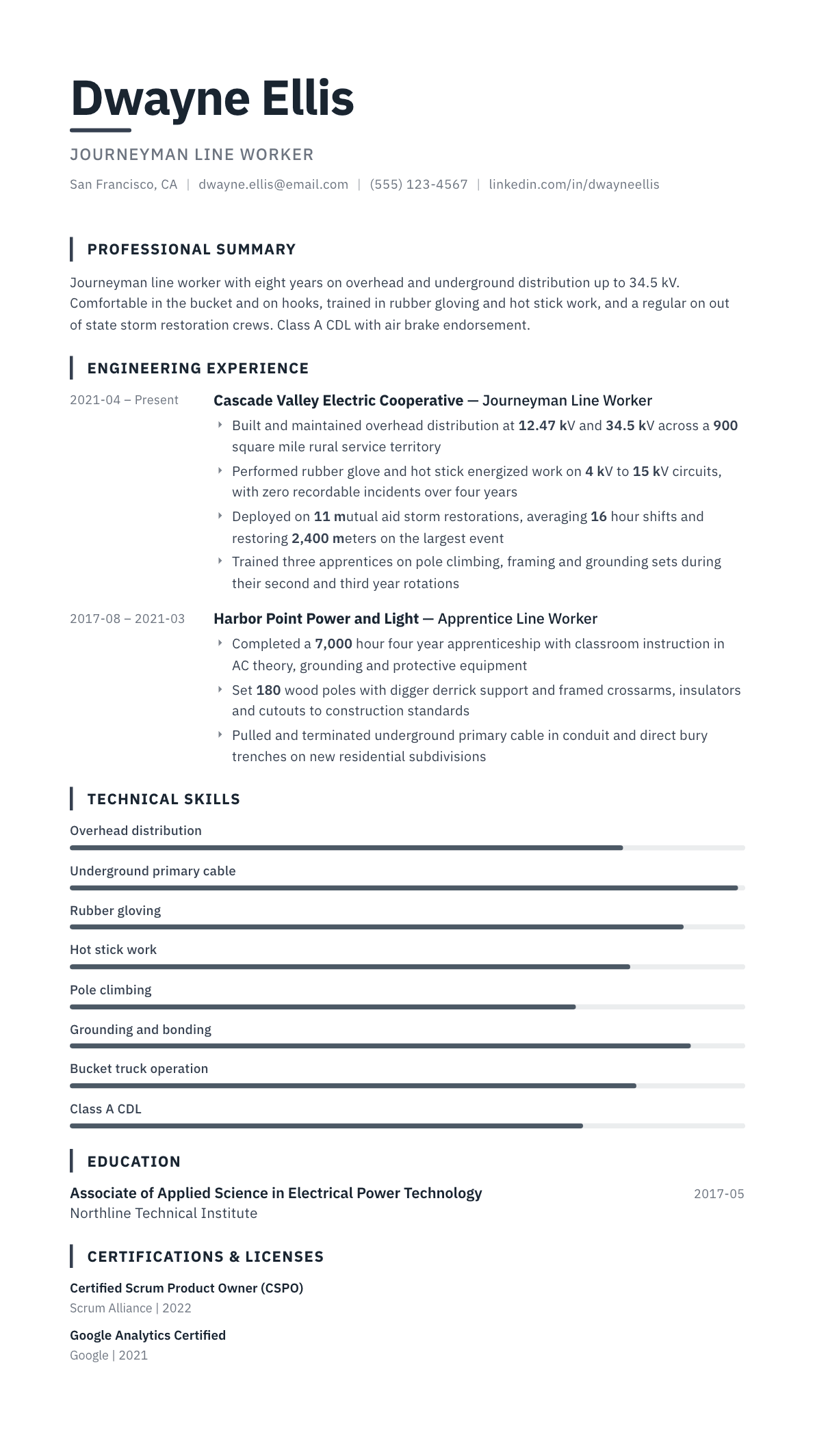
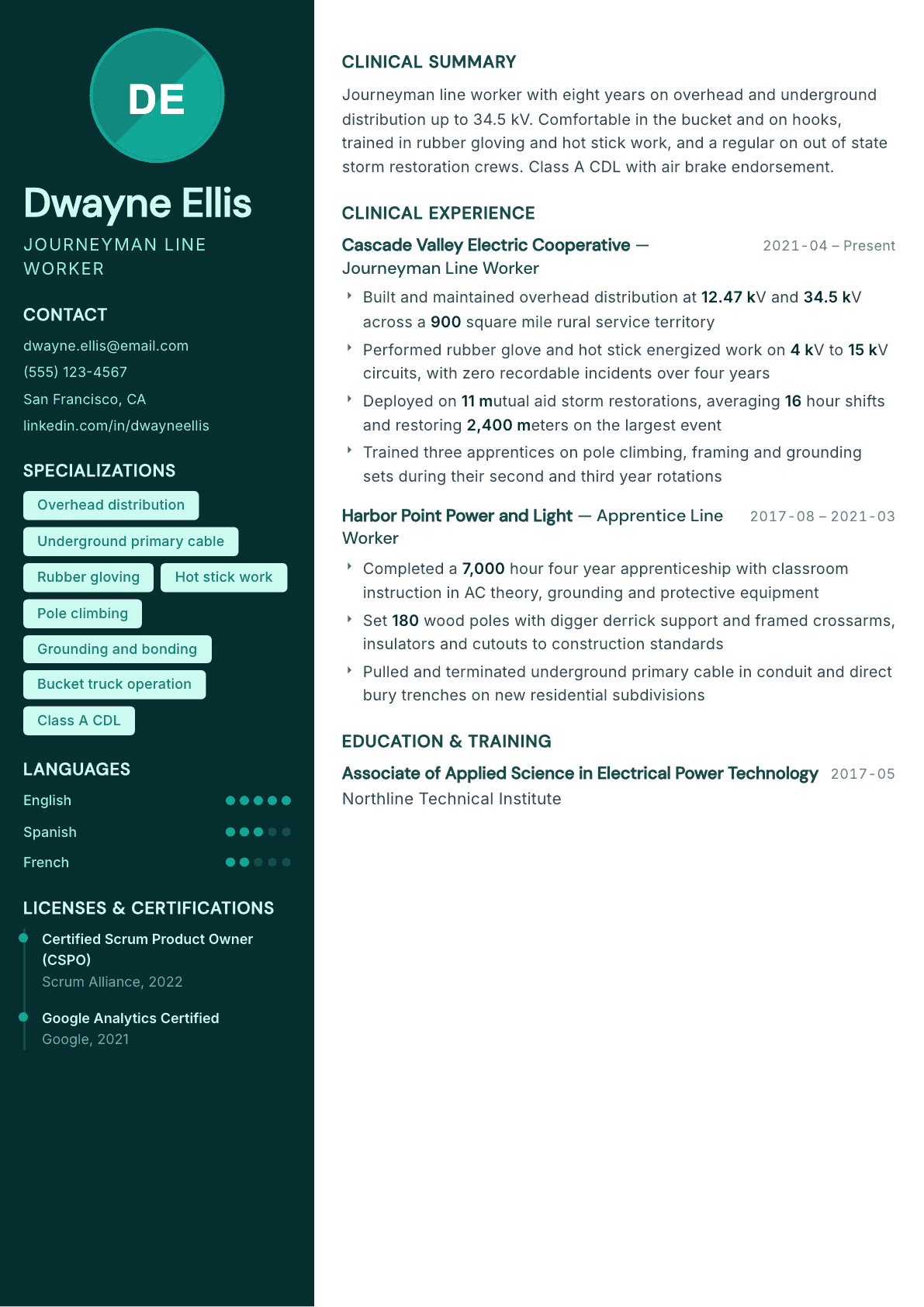
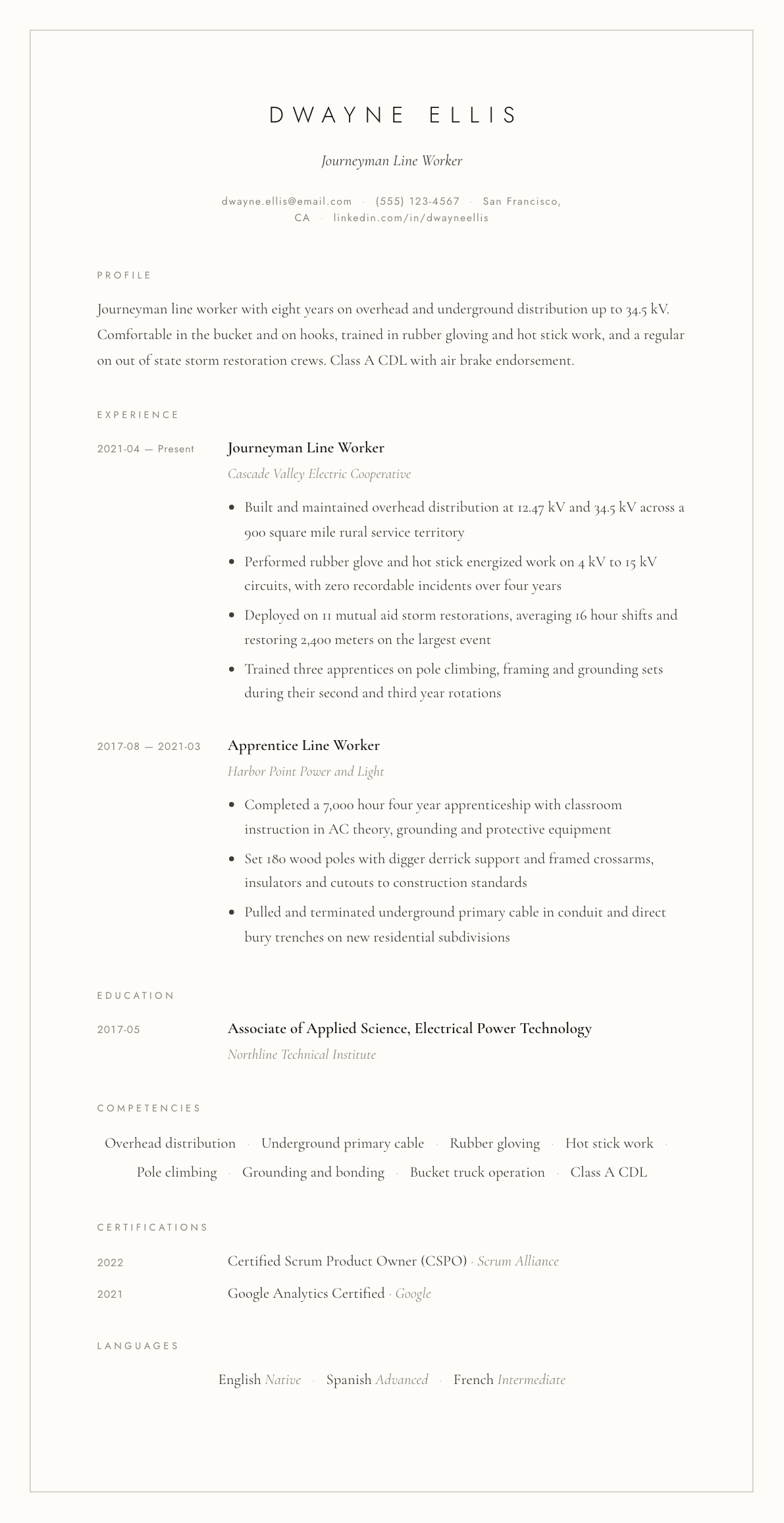
The same line worker content laid out in three CVBooster templates, so you can see what the finished document looks like before you write a word.
Example Line Worker summary
Journeyman line worker with eight years building and maintaining overhead and underground distribution circuits from 4 kV through 34.5 kV. Skilled in rubber glove energized work, transformer banking, and switching under clearance, with 11 mutual aid storm deployments. Holds a Class A CDL and certifications in first aid and pole top rescue. Looking for a crew lead position with an investor owned utility.
Skills to list on a Line Worker resume
- Overhead line construction
- Underground distribution
- Energized work practices
- Rubber glove method
- Hot stick handling
- Grounding and bonding
- Pole framing
- Transformer banking
- Digger derrick operation
- Bucket truck operation
- Cable splicing
- Switching and tagging
- Storm restoration
- Class A CDL
- Job briefings
What actually gets this resume read
- State your voltage range and whether the work was overhead, underground, transmission or distribution in every job.
- Put your apprenticeship hours, the sponsoring utility and the completion date near the top where a foreman looks first.
- Name your CDL class and endorsements on the first line of the resume, because utilities filter on it before anything else.
- List storm restoration and mutual aid deployments by count and region; travel readiness is a real hiring criterion.
- Describe safety in terms of practice, such as cover up, grounding sets and job briefings, rather than claiming a safety mindset.
- Include the equipment you are checked out on: digger derrick, bucket truck, cable puller, tensioner and wire trailers.
How to write a line worker resume
A line worker resume gets sorted by a crew foreman or a line superintendent who has a truck sitting idle and needs someone who can be productive on it inside a week. He is looking for four facts before he reads a single bullet: your ticket status, your voltage exposure, your CDL, and whether you can work energized. Everything else on the page is supporting evidence.
That is why generic construction resumes fail here. Power delivery is a trade with a formal ladder, and the ladder is public: groundman, apprentice with logged hours, journeyman, crew leader, foreman. If a reader cannot place you on that ladder in the first six seconds, the file goes into the maybe pile and stays there.
This guide covers the header block a utility expects, how to write jobs so the voltage and the construction type are unmistakable, what to say about safety without sounding like a poster, and how to present storm work, which is often the deciding factor between two otherwise equal candidates.
Format: a credential block above everything else
Two pages is acceptable for a line worker with a decade behind him, because the equipment list and the ticket list take real space. What is not acceptable is burying the tickets on page two. Build a block directly under your name that a foreman can read without scrolling.
Keep the layout single column and plain. Utility recruiting departments run resumes through parsers built for corporate applicants, and a two column layout with icons will scramble the dates that prove your apprenticeship hours.
- Header: name, city and state, phone, email, and your classification in plain words.
- Credential block: apprenticeship completion, CDL class and endorsements, pole top rescue, first aid, flagger card.
- Then experience, then equipment operated, then training and education.
- Add a willing to travel line if you take storm work; recruiters filter on it.
Say the voltage, the construction type, and the system
Every job entry needs three facts before the bullets start: the voltage class you worked, whether the work was overhead or underground, and whether the system was distribution, subtransmission or transmission. A reader who sees 12.47 kV overhead distribution knows exactly what your hands have done. A reader who sees maintained electrical infrastructure knows nothing.
Add the character of the territory. Rural cooperative work with long single phase taps and heavy vegetation is a different job from dense urban network work in vaults, and foremen hire for the one they run. Name the service area size or the customer count if you know it.
If you have transmission time, separate it out. Structure work at 115 kV and above is treated as its own skill set, and it should not be blended into a distribution bullet where it disappears.
Energized work is the line that decides the interview
State plainly which energized methods you are qualified on and at what voltage. Rubber glove work through 15 kV, hot stick work, barehand if you have it, and whether you have been checked out by the employer or only trained. These are not interchangeable, and a foreman will ask in the first phone call, so answer it on the page.
Pair the method with the protective practice: cover up, minimum approach distance, grounding sets, and the job briefing. Writing that you follow safety procedures is empty. Writing that you set protective grounds on both sides of the work zone and led the tailboard briefing shows a reader how you actually operate.
If you have a clean record, say the span of time and the type: no recordable incidents across a stated number of years, no preventable vehicle accidents, no contacts. Keep it factual and let it sit as one bullet rather than a paragraph.
Equipment, and what you are checked out to run
A separate short section listing the iron you operate saves the foreman a question. Digger derrick, insulated bucket truck, pole trailer, cable puller and tensioner, reel trailer, wire grip and come along work, and any specialty rigging. Note the ones where you hold a formal checkout as opposed to incidental use.
Underground work has its own tool list and it should be visible: cable pulling in conduit, splicing and terminating primary, pad mount transformer work, switchgear, fault locating with a thumper, and vault entry with the confined space training that goes with it.
Storm restoration and mutual aid
Utilities value crews who travel, because a hurricane season decides the operating budget. Give the number of mutual aid deployments, the regions, the typical shift length, and the restoration volume on the largest event. This is one of the few places in the trade where a number moves a hiring decision quickly.
Say something about the conditions if it is relevant: night restoration, backyard construction with no truck access, coordination with a foreign crew on an unfamiliar system. That detail tells a superintendent you will not be a passenger when he ships a crew across three states.
Line Worker resume summary examples
Second year apprentice
Second year line apprentice with 3,600 logged hours on overhead distribution at 12.47 kV, climbing certified and cleared for pole top rescue. Class A CDL with air brake endorsement. Set 90 poles and framed crossarms under journeyman direction, and completed classroom work in AC theory and grounding.
Journeyman, eight years
Journeyman line worker with eight years on overhead and underground distribution through 34.5 kV. Qualified for rubber glove work to 15 kV and hot stick work above it, checked out on digger derrick and insulated bucket. Eleven mutual aid storm deployments and zero recordable incidents over four years.
Crew foreman
Line foreman with sixteen years in power delivery, the last five running a four person overhead crew on new construction and maintenance through 34.5 kV. Leads tailboard briefings, plans clearances and switching, and has trained nine apprentices through completion. Transmission structure experience at 115 kV.
Work experience bullets: before and after
Before: Worked on power lines for a utility company.
After: Built and maintained overhead distribution at 12.47 kV and 34.5 kV across a rural cooperative territory of roughly 900 square miles.
Voltage, construction type and territory tell a foreman what your hands have actually done.
Before: Followed all safety procedures on the job.
After: Set protective grounds on both sides of every work zone and led the tailboard briefing before each energized task, with no recordable incidents in four years.
Naming the practice and the record turns a slogan into something a superintendent can verify.
Before: Helped restore power after storms.
After: Deployed on 11 mutual aid restorations across three states, working 16 hour shifts and restoring 2,400 meters on the largest event.
Deployment count, shift length and restored meters are the numbers storm coordinators compare candidates on.
Before: Trained new apprentices.
After: Trained three apprentices through their second and third year rotations on climbing, framing, grounding sets and cover up, and signed off their skill checks.
The specific curriculum shows you can carry a crew, not just tolerate a helper.
Before: Did underground cable work.
After: Pulled and terminated 15 kV primary cable in conduit and direct bury, located faults with a thumper, and changed out four pad mount transformers.
The underground skill set is separate from overhead, and listing the tasks proves you own both.
Hard skills
- Overhead distribution construction
- Underground primary cable
- Rubber glove energized work
- Hot stick methods
- Pole climbing and hooks
- Grounding and bonding
- Pole framing and dead ending
- Transformer banking
- Switching and clearance procedures
- Digger derrick operation
- Insulated bucket truck operation
- Cable fault locating
- Storm restoration
- Class A CDL driving
Soft skills
- Tailboard briefing delivery
- Crew coordination
- Apprentice mentoring
- Situational awareness
- Customer contact in the field
- Endurance on extended shifts
Certifications worth listing
- Commercial Driver License Class A (State Department of Motor Vehicles)
- OSHA 10-Hour Construction (OSHA Training Institute Education Centers)
- OSHA 30-Hour Construction (OSHA Training Institute Education Centers)
- First Aid, CPR and AED (American Red Cross)
Mistakes that cost line worker candidates the interview
- Leaving the voltage class off every job, which forces a foreman to guess whether you worked secondary services or primary circuits.
- Hiding the CDL class and endorsements at the bottom of page two when it is a threshold requirement for the posting.
- Writing safety conscious team player instead of naming cover up, grounding and briefing practices you personally perform.
- Blending transmission and distribution work into one bullet so neither skill set reads clearly.
- Omitting apprenticeship hours and the sponsoring utility, which is the only proof of classification a reader can check.
- Using a two column template with graphics, which utility parsers reorder and which drops the dates that prove your hours.
Line Worker resume questions
Do I need to list my apprenticeship hours on a line worker resume?
Yes. Hours logged, the sponsoring utility or joint apprenticeship committee, and the completion date are how a reader confirms your classification. Without them a journeyman claim is unverified and the file usually stalls in screening.
How should I show energized work qualifications?
Name the method and the voltage separately: rubber glove through 15 kV, hot stick above it, barehand if you hold it. Also say whether the employer formally checked you out or only trained you, because those are different things to a foreman.
Is storm restoration experience worth putting on the resume?
It is one of the strongest signals you can give. List the number of mutual aid deployments, the regions you traveled to, the shift lengths and the restoration volume on the largest event, then add a line confirming you are available to travel.
Should a groundman applying for an apprenticeship write the resume differently?
Yes. Lead with the CDL, the physical qualifications, any climbing school or pre apprenticeship coursework, and hands on exposure such as digging, framing on the ground, and rigging. Then show a work history that proves reliability and attendance.
How long should the resume be?
One page for an apprentice or a journeyman with under five years. Two pages once you have multiple utilities, a full equipment checkout list and a training record. Keep the credential block on page one no matter the length.
Related resume examples
- Electrician Resume example
- Crane Operator Resume example
- Cable Installer Resume example
- Journeyman Electrician Resume example
- Road Construction Worker Resume example
- Apprentice Electrician Resume example