HVAC Technician Resume Examples: the lines they read
HVAC Tech Resume Examples and an HVAC CV Sample
By Mustafa Tarabya, founder of CVBooster · Published · Updated
HVAC tech resume examples and an HVAC CV sample: certifications, equipment and tonnage, diagnostic bullets, three summaries and posting keywords.
Sample resumes for a hvac technician
The same hvac technician content laid out in three CVBooster templates, so you can see what the finished document looks like before you write a word.
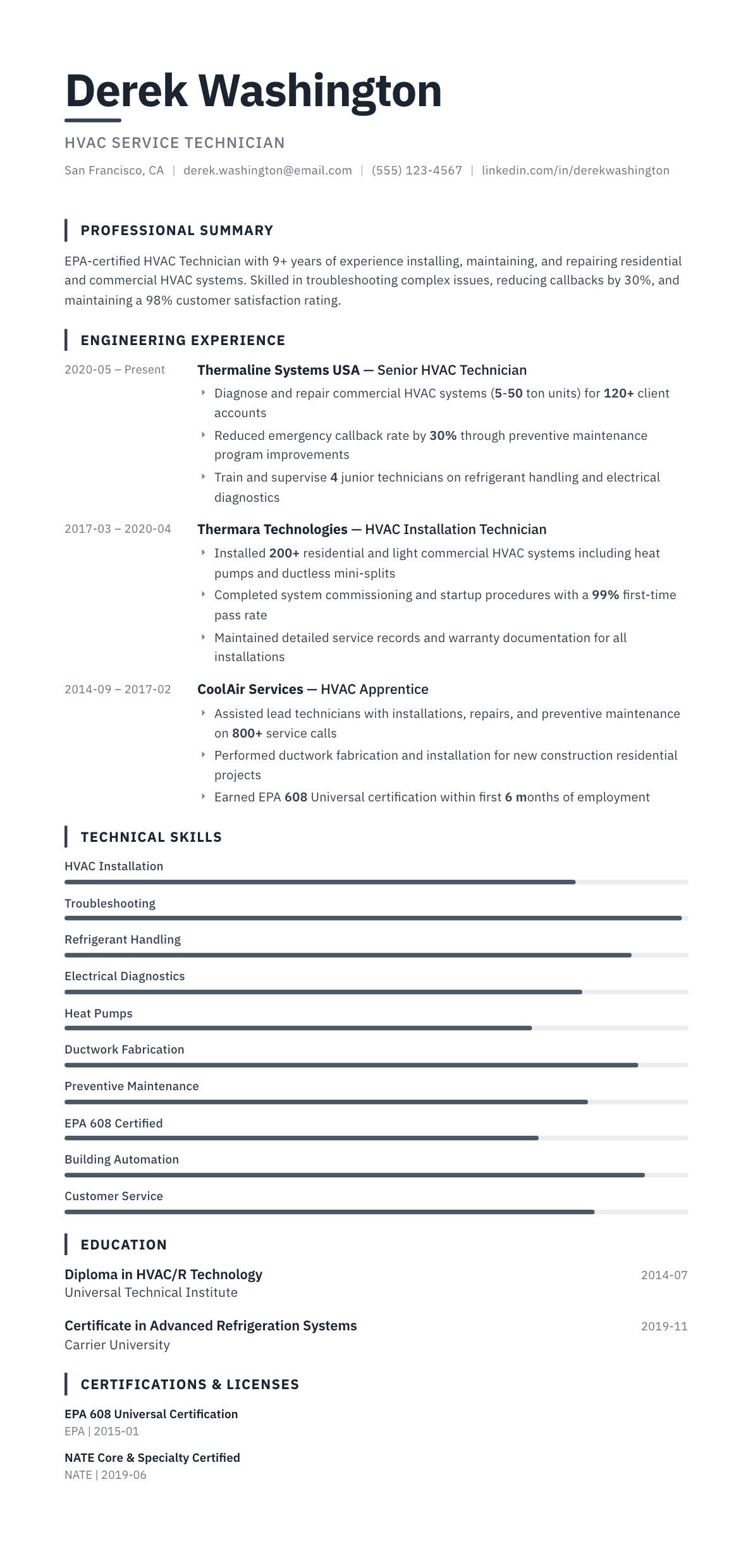
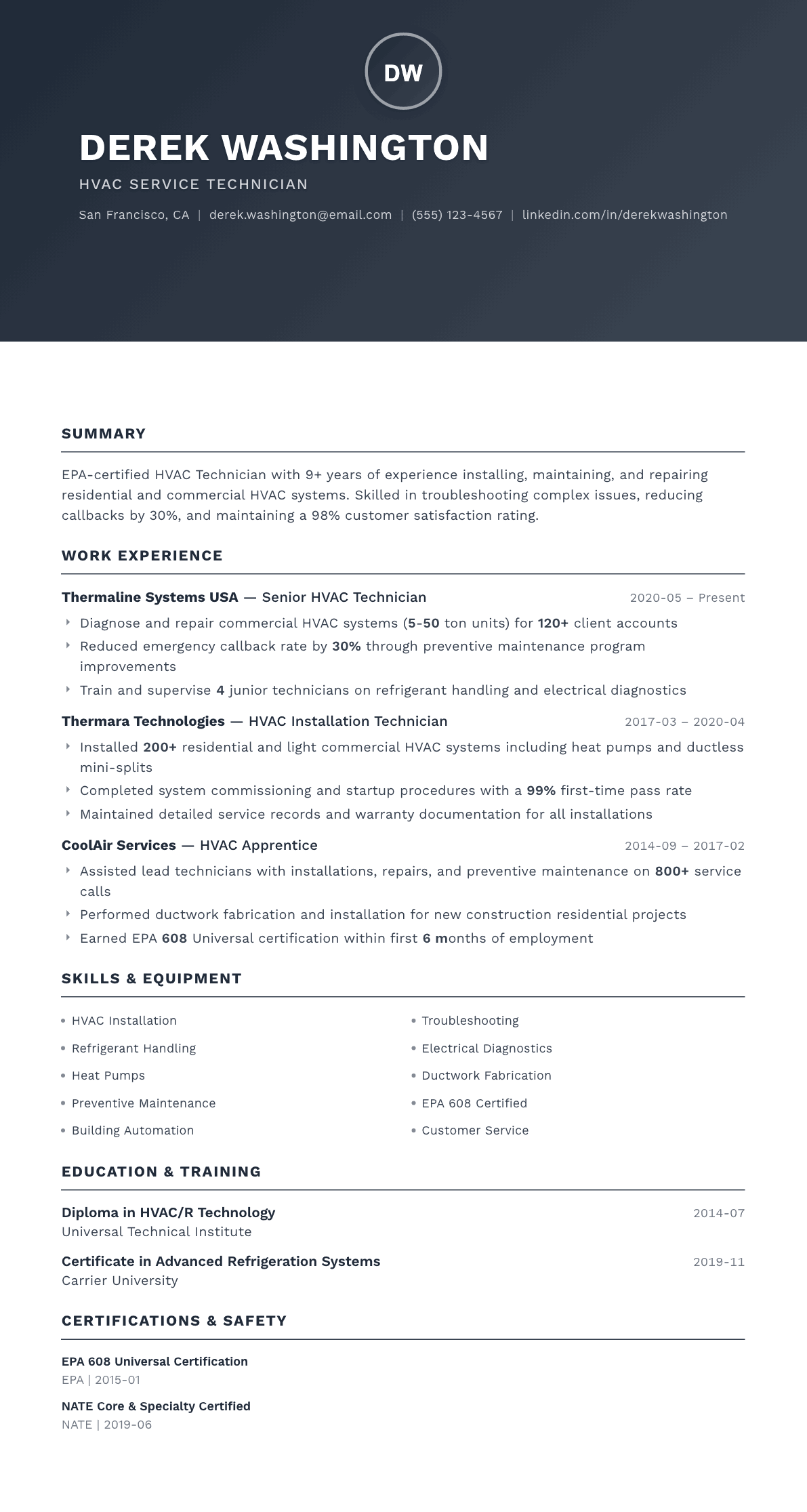
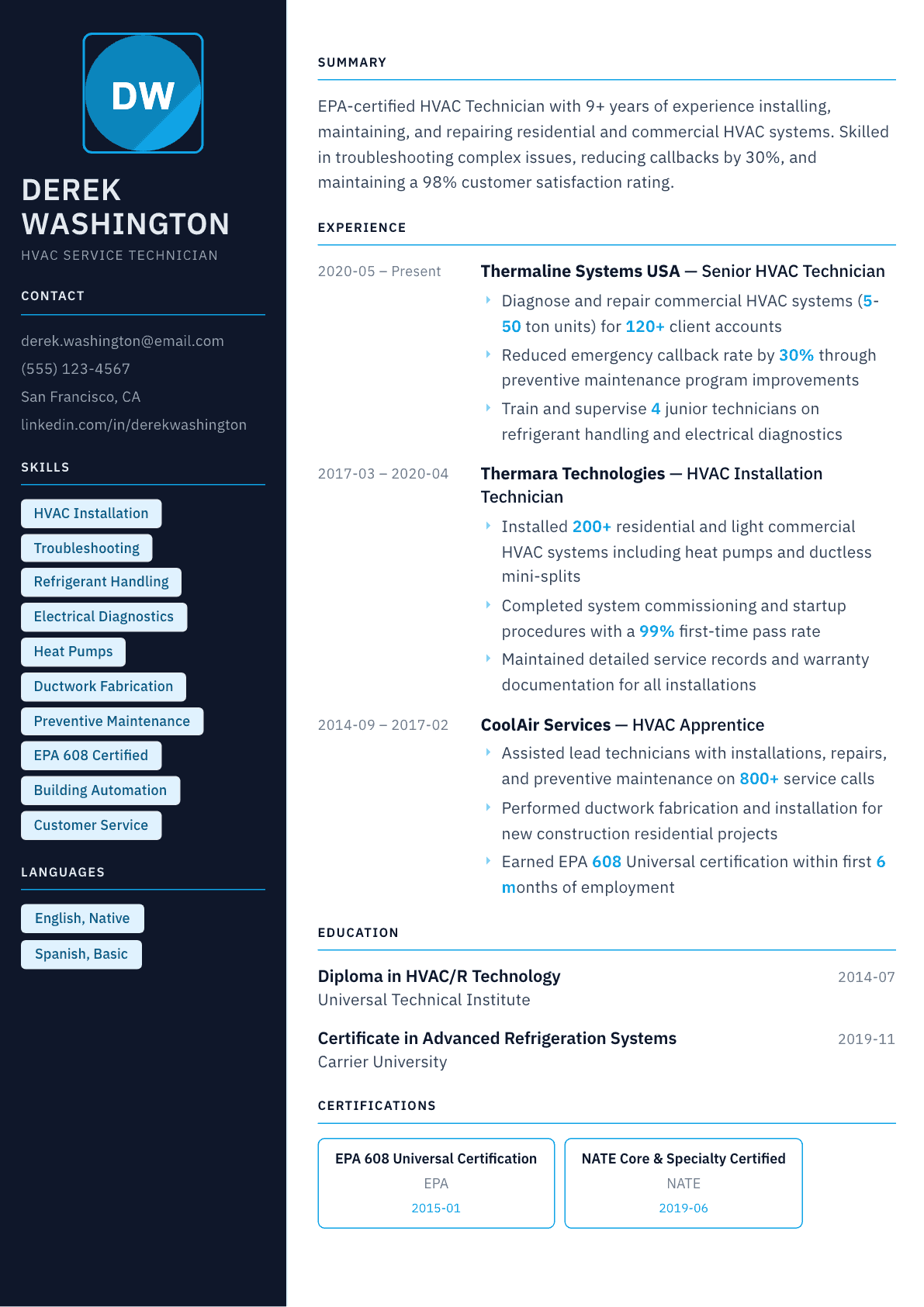
Example HVAC Technician summary
EPA 608 Universal and NATE-certified HVAC Technician with 9 years of experience in residential and commercial system installation, maintenance, and repair. Known for reducing callback rates by 30% and maintaining a 98% customer satisfaction score. Seeking a senior service technician role with a leading mechanical contractor.
Skills to list on a HVAC Technician resume
- HVAC Installation
- System Diagnostics
- Refrigerant Handling
- Heat Pump Systems
- Ductwork Design
- Electrical Troubleshooting
- Preventive Maintenance
- Building Automation (BAS)
- VRF Systems
- EPA 608 Compliance
- Sheet Metal Fabrication
- Customer Service
- Blueprint Reading
- Load Calculations
What actually gets this resume read
- List EPA 608, NATE, and any manufacturer certifications (Carrier, Trane, Lennox) at the top of your resume.
- Quantify your service metrics: number of calls completed, callback rates, customer satisfaction scores.
- Specify the types and tonnage of systems you work with (residential, commercial, industrial, VRF).
- Highlight your diagnostic skills. Employers value technicians who can troubleshoot efficiently.
- Mention experience with building automation systems (BAS) and smart thermostats for modern roles.
- Include any refrigerant transition experience (R-22 to R-410A, R-454B) to show you stay current.
How to write a hvac technician resume
An HVAC tech resume, or an HVAC CV as many technicians call it, is read by a service manager deciding whether he can put you in a van alone next month. He is looking for the refrigerant certification and its type, the equipment you have opened, whether your background is residential or commercial, and whether you can diagnose rather than swap parts until the call ends.
The generic version of this resume says installed, maintained and repaired HVAC systems. That describes the trade, not the technician. The useful version names tonnage, equipment types, refrigerants, control platforms and the kind of faults you actually chase down.
This guide covers how to present certifications, how to write service and installation experience so a dispatcher can size you up, the metrics service companies track, an HVAC resume example from header to tools, three summaries, before and after bullets, and the questions HVAC technicians ask when they write a resume.
Format: certifications high, equipment list visible
One page for most technicians, two once you carry commercial refrigeration and controls work. Put your refrigerant handling certification with its type, and any other cards, directly under the summary. Service managers filter on that card because it is a legal requirement for refrigerant work.
Add an equipment block: system types, tonnage ranges, refrigerants and control platforms. A commercial company running rooftop units and chillers will search for those exact terms, and a technician who lists none of them reads as residential only.
- Certifications: refrigerant handling with the type, specialty certifications, manufacturer training, state or local license.
- Order: summary, certifications, equipment experience, work history, technical skills, training.
- Say whether you are residential, light commercial, commercial or industrial, and whether you carry an on-call rotation.
- Note your driving record status if the job includes a company vehicle, since that is a standard screening step.
HVAC tech resume example and CV sample, top to bottom
Here is the skeleton of an HVAC resume for a service technician four years into residential and light commercial work. Use it as an HVAC example resume to check your order against, then replace every line with your own cards, equipment and calls.
Resume and CV mean the same document for an HVAC job in the US, so an HVAC CV sample follows this exact order. Use the word from the posting in your file name and headline, and keep it to one page until you have a long commercial or supervisory history.
The summary is two or three lines: years, sector, system types, tonnage range, and one thing you are strong at, such as refrigeration diagnostics, controls and building automation, hydronics, or startup and commissioning. Add customer facing strengths only for residential service, where the homeowner judges the visit as much as the repair.
- Header: Marcus Bell, HVAC Service Technician, city and state, phone, email, and a note that you hold a clean driving record.
- Summary: HVAC service technician with four years in residential and light commercial service on split systems, heat pumps, gas furnaces and packaged rooftop units up to 25 tons. Strongest on refrigerant circuit diagnostics and no heat calls, and part of the on call rotation.
- Certifications: EPA 608 Universal, manufacturer training by brand, and any state or local license with its number.
- Equipment: system types, tonnage range, the refrigerants you have recovered and charged, and the thermostats and control platforms you have set up.
- Experience: company, city and dates, then four to six bullets that lead with a diagnosis, an installation and a maintenance book, each with the equipment named.
- Training and tools: trade school or apprenticeship, safety cards, and the test instruments you carry on the van.
Experience: diagnosis first, then installation
Diagnostic bullets are the ones that get read twice. Name the symptom, the measurements you took, the root cause and the fix: superheat and subcooling readings that pointed at a metering device, an amp draw that revealed a failing compressor winding, a static pressure reading that exposed an undersized return.
Installation and startup bullets should carry the equipment, the tonnage, the duct or piping scope, and the commissioning steps: evacuation to a documented micron level, charge verification, airflow balance and controls point checkout.
Preventive maintenance work should show the book: how many accounts, the visit frequency, and what your program changed. Callback rate, emergency call volume and equipment life are the numbers a service manager watches every month.
Equipment, refrigerants and controls
Say what you have opened. Split systems, packaged rooftop units, heat pumps, furnaces, boilers, chillers, cooling towers, variable refrigerant flow systems, walk-in refrigeration and ice machines all carry different training, and a manager staffing a chiller account will pass over a resume that names none of them.
- Refrigerants: the ones you have recovered and charged, including newer low global warming potential blends.
- Controls: thermostats and zone controls, direct digital control platforms, building automation systems, and protocols such as BACnet and Modbus.
- Tools: manifold gauges, digital probes, micron gauge, combustion analyzer, clamp meter, leak detector, thermal camera, recovery machine.
- Air side: duct fabrication, static pressure testing, airflow balancing, filtration and air quality equipment.
Certification, training and safety
Refrigerant handling certification is mandatory, so state the exact type you hold, because the universal type opens the most doors. Specialty certification in named areas is the most recognized voluntary credential in the field. Manufacturer training is worth listing by brand when a company sells or services that brand.
Add the safety and access training that keeps you working: a site safety card, ladder and lift training, confined space if you work mechanical rooms, and electrical safety, since a large share of HVAC troubleshooting is electrical work.
Keywords an HVAC posting repeats
These postings share a vocabulary: preventive maintenance, troubleshooting, refrigeration cycle, certified technician, rooftop units, split systems, heat pumps, brazing, charging, controls, and the sector words. Mirror them in your equipment block and again in the bullet where you prove them.
HVAC Technician resume summary examples
First service seat
HVAC technician with 2 years of residential install and maintenance work: split system changeouts, furnace service, condenser cleaning and filter and belt programs. Holds universal refrigerant handling certification, works confidently with manifold gauges and a combustion analyzer, and is ready for a solo maintenance route.
Service technician
HVAC service technician with 7 years on residential and light commercial equipment to 25 tons: packaged rooftop units, split systems and heat pumps. Diagnoses refrigeration and electrical faults, brazes and evacuates to specification, and carries an on-call rotation with a low callback rate.
Senior commercial technician
Senior HVAC technician with 12 years on commercial equipment from 5 to 50 tons plus chillers and variable refrigerant flow systems, supporting a book of more than 100 accounts. Runs startups and commissioning, works inside building automation platforms, and trains junior technicians on refrigerant handling.
Work experience bullets: before and after
Before: Repaired air conditioning units for customers.
After: Diagnosed and repaired commercial rooftop units from 5 to 50 tons across 120 client accounts, handling compressor, control board and metering device failures.
Tonnage, account volume and named failure modes tell a service manager what he can dispatch you to.
Before: Performed preventive maintenance.
After: Rebuilt the maintenance schedule for a retail account with 30 rooftop units, adding coil cleaning and belt checks ahead of the cooling season and cutting emergency calls by about a third.
The account, the change and the effect show a program you improved rather than visits you completed.
Before: Charged refrigerant systems correctly.
After: Evacuated systems to 500 microns with a standing vacuum test before charging, then verified charge by superheat and subcooling rather than by pressure alone.
Naming the evacuation target and the charging method is the fastest way to show real technical discipline.
Before: Worked on electrical parts of HVAC systems.
After: Traced an intermittent no-cool call to a failing contactor and a loose low voltage connection using a clamp meter and the wiring diagram, avoiding an unnecessary compressor quote.
A real fault chased with a method shows diagnosis, and the avoided part sale shows judgment a manager values.
Before: Trained new technicians.
After: Mentored 4 junior technicians on refrigerant recovery, brazing technique and electrical troubleshooting, riding along until each one could close calls unaccompanied.
Naming the curriculum and the standard for release makes the mentoring claim concrete and checkable.
Hard skills
- Refrigeration cycle diagnostics
- Superheat and subcooling charging
- Brazing and system evacuation
- Packaged rooftop unit service
- Split system and heat pump installation
- Furnace and boiler service
- Chiller and cooling tower maintenance
- Variable refrigerant flow systems
- Electrical troubleshooting on HVAC controls
- Building automation and direct digital controls
- Airflow and static pressure testing
- Combustion analysis
- Preventive maintenance program design
- Ductwork installation and sealing
Soft skills
- Explaining faults without jargon
- Working alone across a route
- On-call reliability
- Honest recommendations to customers
- Documentation on the service ticket
- Training junior technicians
Certifications worth listing
- EPA Section 608 Universal Certification (United States Environmental Protection Agency)
- EPA Section 609 Motor Vehicle Air Conditioning (United States Environmental Protection Agency)
- NATE Certification (North American Technician Excellence)
- HVAC Excellence Certification (ESCO Institute)
- OSHA 10-Hour Construction (OSHA Training Institute)
Mistakes that cost hvac technician candidates the interview
- Leaving the refrigerant certification type off, which forces a service manager to assume the narrowest one.
- Writing installed, maintained and repaired without a single piece of equipment named anywhere on the page.
- Skipping tonnage and system type, so a commercial company cannot tell whether you have ever worked on a roof.
- Listing tools instead of diagnoses. Owning a combustion analyzer is not the same as reading one correctly.
- Ignoring the numbers a service business runs on: callbacks, first-time fix, maintenance renewals and on-call coverage.
- Hiding controls experience at the bottom of the page when the posting is for a building automation account.
HVAC Technician resume questions
Which refrigerant certification should I list on an HVAC resume?
List the exact type you hold rather than the word certified. The universal type is preferred because it covers all equipment classes, and a service manager who sees only certified will assume the narrowest type you could be holding.
Is an HVAC CV different from an HVAC resume?
Not for a job in the United States. Contractors and facilities teams use both words for the same one or two page document, so follow the HVAC CV sample on this page and lead with your refrigerant certification, equipment, tonnage and the type of calls you run. Mention specialty certifications in the same block.
How do I show diagnostic skill on a resume?
Write two or three bullets as short fault stories: the symptom, the readings you took, the root cause and the repair. That structure proves a process. A list of components you have replaced only proves you can turn a wrench.
Do residential and commercial HVAC resumes differ?
Considerably. Residential emphasizes customer interaction, changeouts, furnaces and maintenance agreements. Commercial emphasizes tonnage, rooftop units, chillers, controls and scheduled maintenance across accounts. Send the version that matches the posting rather than one that straddles both.
What if I trained on the job with no formal schooling?
That is common in this trade and rarely disqualifying. Lead with the refrigerant card, the equipment you have worked on, and the years spent under a lead technician. Add any manufacturer training, because brand courses are recognized even without a diploma.
Related resume examples
- Electrician Resume example
- Plumber Resume example
- Carpenter Resume example
- HVAC Installer Resume example
- Sheet Metal Worker Resume example
- Journeyman Plumber Resume example