Cake Decorator Resume Examples: the lines they read
Write a Cake Decorator Resume That Proves Volume and Skill
By Mustafa Tarabya, founder of CVBooster · Published · Updated
Cake decorator resume examples with piping, fondant and food safety keywords, order volume bullets, and a complete bakery writing guide.
Sample resumes for a cake decorator
The same cake decorator content laid out in three CVBooster templates, so you can see what the finished document looks like before you write a word.
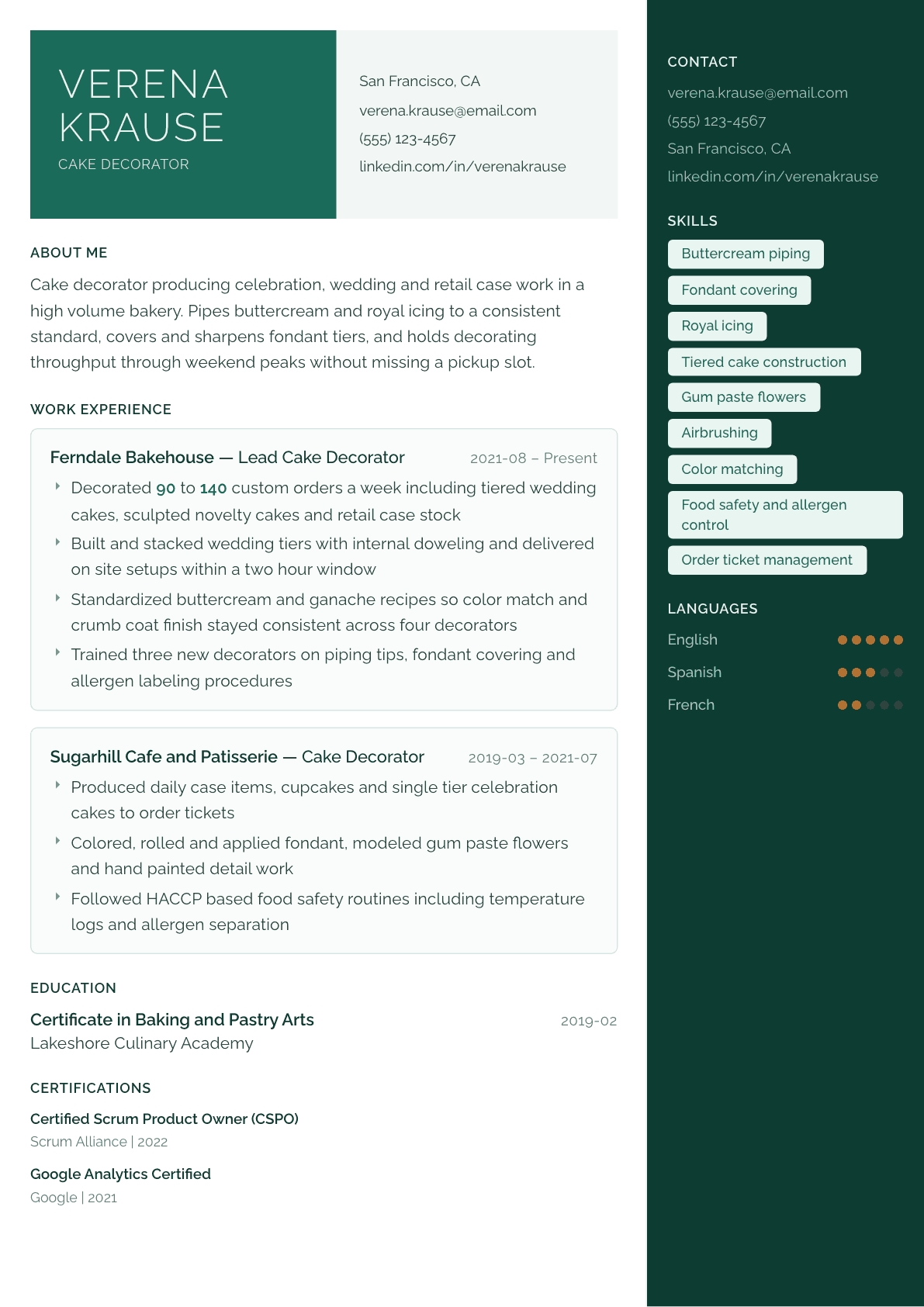
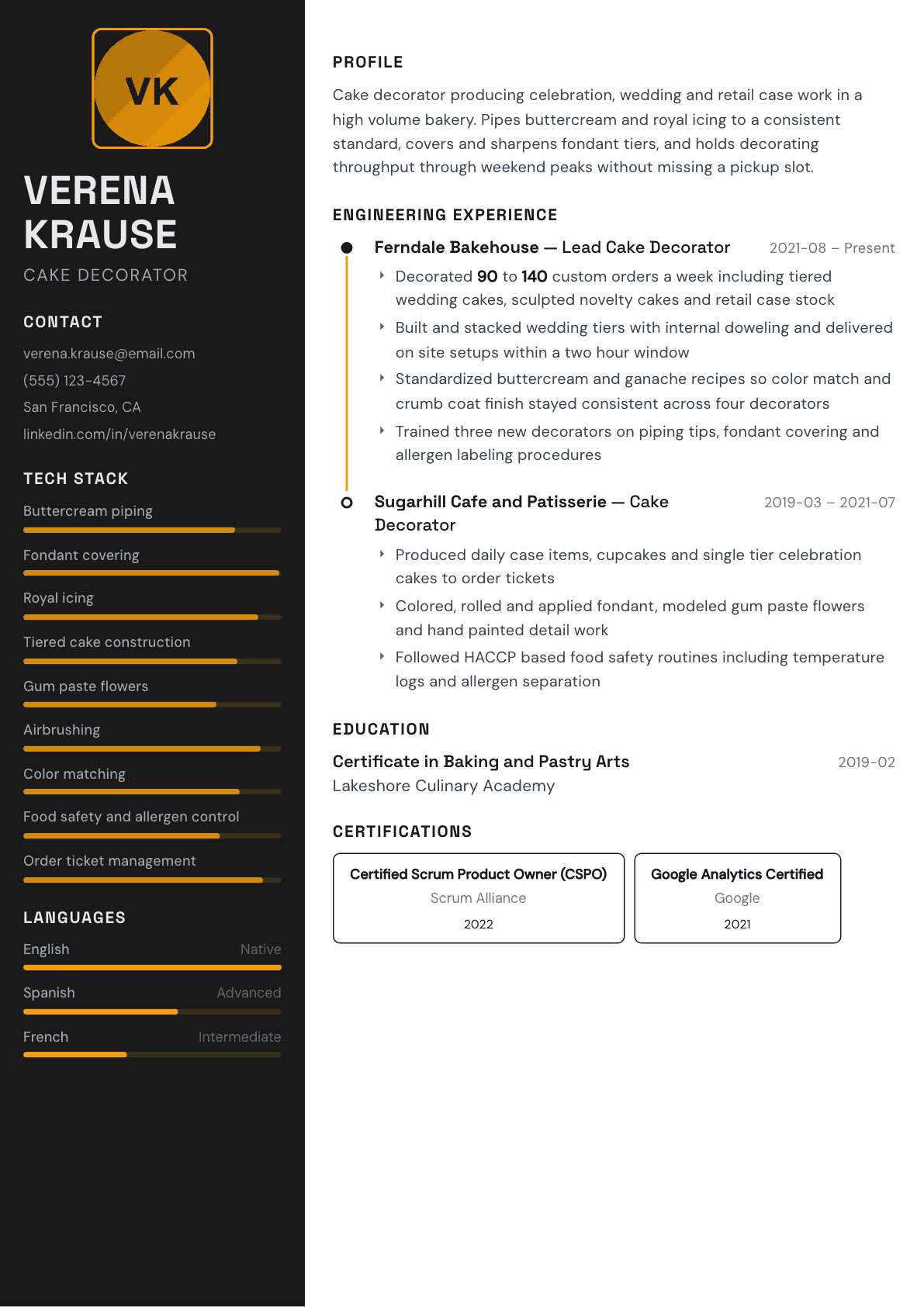
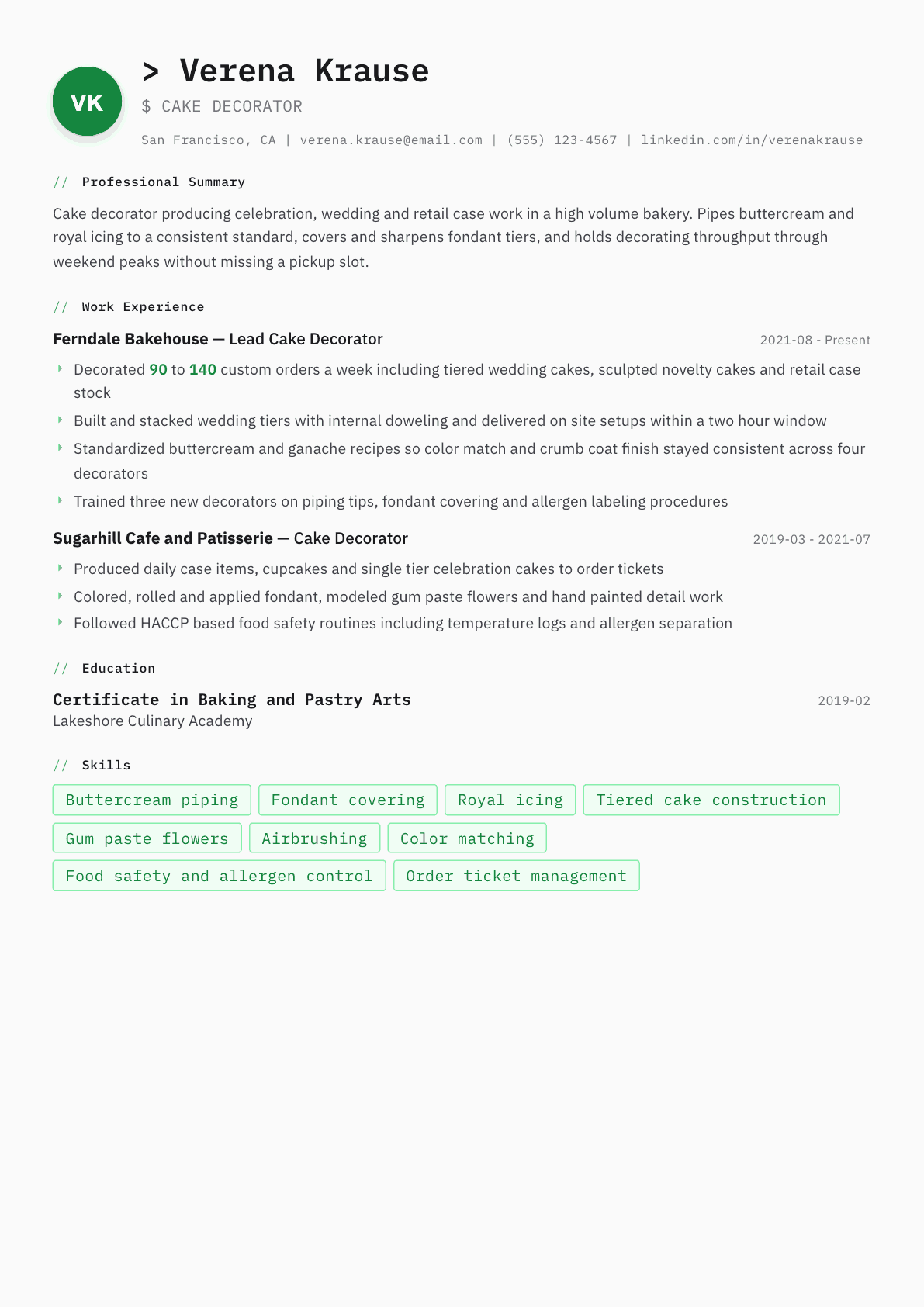
Example Cake Decorator summary
Cake decorator with five years in high volume bakery production covering custom celebration orders, wedding tiers and retail case work. Pipes and covers to a consistent finish, builds structured tiers that travel, and keeps color and recipe standards steady across a decorating team. Works to food safety routines including temperature logs and strict allergen separation.
Skills to list on a Cake Decorator resume
- Buttercream piping
- Royal icing work
- Fondant covering and sharp edges
- Tiered cake construction and doweling
- Gum paste and sugar flowers
- Modeling and sculpted cakes
- Airbrushing and hand painting
- Color theory and matching
- Ganache and crumb coating
- Recipe scaling and consistency
- Order ticket and production planning
- Food safety and HACCP routines
- Allergen labeling
- On site cake delivery and setup
What actually gets this resume read
- Give weekly order volume and the mix of custom, wedding and case work, because bakeries hire on throughput.
- List the specific techniques you own: fondant, buttercream, royal icing, isomalt, airbrush, hand painting, modeling.
- Show tiered and structured cake work with doweling, internal supports and any delivery or on site setup you did.
- Put your food safety credential and allergen handling practice on the resume, since it is a legal hiring filter.
- Include consistency work, such as standardized recipes or color matching, which is what a lead decorator is paid for.
- Add a portfolio link and keep bullets factual, because the pictures sell the taste and the resume sells the reliability.
How to write a cake decorator resume
A cake decorator resume is read by a bakery owner or head baker doing arithmetic. They have a weekly order book, a pickup schedule and a decorating bench with a certain number of hands on it. Your resume has to tell them how many orders you can decorate in a week, at what standard, and whether the tiered wedding cakes will still be standing when they reach the venue.
The second filter is legal rather than artistic. Food safety and allergen handling are hiring requirements, not nice extras, and a resume that never mentions temperature logs, allergen separation or a food handler credential creates doubt in a reader who is responsible for the shop when an inspector walks in.
This guide covers how to state volume and order mix, which techniques to name, how to write bullets on structured cakes and delivery, what a lead decorator does that a decorator does not, and the questions decorators ask when moving from a cafe bench into high volume production or into custom wedding work.
Format: one page, volume and techniques near the top
One page, reverse chronological, plain layout, one portfolio link. Photographs sell the craft and the resume sells reliability, so keep prose factual and let the pictures carry the finish quality.
Put a short technique block under the header listing what you own: buttercream piping, royal icing, fondant covering with sharp edges, gum paste flowers, modeling and sculpted work, airbrushing and hand painting. A bakery hiring for wedding season is scanning for a specific subset of those words.
- Header: name, city, phone, email, portfolio link, and your food handler credential.
- Sections in this order: summary, techniques, experience with weekly volume, food safety, training.
- Note availability for weekend and early morning shifts, which decides many bakery hires.
Summary: volume, order mix, consistency
Name the weekly order volume, the mix of custom, wedding and retail case work, and one thing you do that keeps a bench consistent. Standardized buttercream and ganache recipes so color match and crumb coat finish hold across several decorators is a lead level claim and it reads as one.
If you are moving from a small cafe into high volume production, say it directly and name the transferable technique depth, then acknowledge the change in pace. Owners respect a candidate who knows the difference between decorating six cakes carefully and clearing a hundred and forty against pickup slots.
Experience: throughput, techniques, structure
Lead each job with weekly order volume and the mix, then break out the harder work. Tiered wedding cakes with internal doweling and boards, sculpted novelty cakes with supports, hand painted detail, gum paste sugar flowers built over days. Those are the pieces that take real time and they justify the bench hours you are asking to be paid for.
Delivery and setup should be its own bullet if you have done it. A tiered cake that travels and is assembled on site inside a venue window is a different risk from a cake collected at the counter, and decorators who can do it are worth more to a shop taking wedding orders.
Consistency work is what separates a lead decorator. Standardizing recipes, matching colors across batches, setting up crumb coat and chill routines, and training new decorators on piping tips and fondant covering are all bench management, and a reader hiring a lead is looking for exactly those lines.
Food safety and allergens: state it, do not imply it
Put your food handler credential on the resume with the issuing program, and describe the routines you follow: temperature logs, cooling and storage practice, cross contact prevention, and labeling for the major allergens. Bakeries carry real liability here and a reader will not assume competence you did not claim.
Allergen work has a decorating specific side. Nut free gum paste, gluten free tiers built alongside standard ones, dedicated tools and separate work surfaces. Saying you have run allergen orders in a shared bench area tells an owner you can take those orders without creating a recall.
Production planning and the order book
Decorating is a production job with deadlines attached to a customer standing at a counter. Describe how you work the order book: reading tickets, sequencing bakes and fills against pickup times, batching colors to avoid remixing, and staging chilled components so the bench never waits.
If you have handled the ordering side, say so. Tracking fondant, sprinkles, boards, boxes and color stock, and flagging shortages before a weekend, is the kind of practical ownership that gets a decorator promoted ahead of a purely artistic candidate.
Cake Decorator resume summary examples
Bench decorator
Cake decorator with two years producing daily case items, cupcakes and single tier celebration cakes to order tickets. Colors, rolls and applies fondant, models gum paste flowers and hand paints detail work. Follows food safety routines including temperature logs and allergen separation.
Custom decorator
Cake decorator with five years in high volume bakery production covering 90 to 140 custom orders a week across celebration, wedding and retail case work. Builds and stacks tiered cakes with internal doweling and delivers on site setups within a two hour venue window.
Lead decorator
Lead cake decorator with nine years running a four person decorating bench through weekend peaks. Standardizes buttercream and ganache recipes so color match and crumb coat finish stay consistent, builds sculpted and structured cakes, and has trained six decorators on piping and fondant covering.
Work experience bullets: before and after
Before: Decorated cakes for customers.
After: Decorated 90 to 140 custom orders a week including tiered wedding cakes, sculpted novelty pieces and retail case stock, all cleared against booked pickup slots.
Weekly volume, order mix and the pickup deadline give a bakery owner the throughput number they staff on.
Before: Made wedding cakes.
After: Built and stacked tiered wedding cakes with internal doweling and boards, then delivered and assembled them on site inside a two hour venue window.
Structure, transport and on site assembly are the parts that carry risk, and they replace an unqualified claim.
Before: Kept quality consistent across the team.
After: Standardized buttercream and ganache recipes and set a crumb coat routine so color match and finish stayed consistent across four decorators.
The mechanism and the team size turn consistency from an aspiration into a documented bench standard.
Before: Followed food safety rules.
After: Worked to food safety routines including temperature logs, cooling and storage checks, dedicated tools for allergen orders and clear labeling on every custom box.
Naming the specific controls proves practice, which matters because an owner carries the liability.
Before: Trained other decorators.
After: Trained three new decorators on piping tips, fondant covering to a sharp edge and allergen labeling procedures until each worked a full order list unsupervised.
The skills taught and the standard reached make the training claim verifiable at the bench.
Hard skills
- Buttercream piping
- Royal icing work
- Fondant covering and sharp edges
- Tiered cake construction and doweling
- Gum paste and sugar flowers
- Modeling and sculpted cakes
- Airbrushing and hand painting
- Color theory and matching
- Ganache and crumb coating
- Recipe scaling and consistency
- Order ticket and production planning
- Food safety and HACCP routines
- Allergen handling and labeling
- On site cake delivery and setup
Soft skills
- Steady hand under time pressure
- Customer order consultation
- Bench organization
- Training and coaching
- Weekend peak stamina
- Careful communication on order details
Certifications worth listing
- ServSafe Food Handler (National Restaurant Association)
- ServSafe Food Protection Manager (National Restaurant Association)
- Food Protection Manager Certification (National Registry of Food Safety Professionals)
Mistakes that cost cake decorator candidates the interview
- Leaving out weekly order volume, which is the throughput number a bakery uses to decide how many hands it needs.
- Listing decorating as one skill instead of naming fondant, royal icing, gum paste, airbrush and modeling separately.
- Skipping food safety and allergen practice, which reads as a gap to anyone responsible for an inspection.
- Never mentioning structure, doweling or delivery on a resume aimed at a shop that takes wedding orders.
- Relying on photographs to carry everything and writing bullets that add no facts the pictures cannot show.
- Omitting weekend and early morning availability when that is what decides most bakery bench hires.
Cake Decorator resume questions
Do cake decorators need a certification to get hired?
A food handler credential is usually required by the employer or local health rules, so list it with the issuing program. Pastry or baking coursework helps for a first bench role, but volume, technique range and portfolio quality carry the decision after that.
How do I show wedding cake experience on a resume?
Give the annual or seasonal number of wedding cakes, tier counts, the internal supports you build, and whether you delivered and assembled on site. Venue setup inside a fixed window is the risk a shop worries about, so state it explicitly.
Should a cake decorator resume include a portfolio link?
Yes, one link in the header. Keep the resume itself to volume, techniques, food safety and consistency, because the photographs already prove finish quality and cannot show whether you clear an order book on time.
How do I move from a cafe bench into high volume bakery production?
Name your technique depth first, then address pace directly: batching, sequencing against pickup times, staging chilled components and working from a printed order list. Owners hesitate over speed, so answer that doubt before the interview does.
What makes a lead decorator resume different?
Bench management rather than more techniques. Standardized recipes, color matching across batches, training new decorators, sequencing the weekly order book and flagging stock shortages before a weekend all signal that you can run the station rather than occupy it.