Baker Resume Examples: what a hiring manager reads first
Write a Baker Resume That Shows Craft and Consistency
By Mustafa Tarabya, founder of CVBooster · Published · Updated
A baker resume example with production keywords, sample bullets on volume and fermentation, and tips for retail, hotel and wholesale kitchens.
Sample resumes for a baker
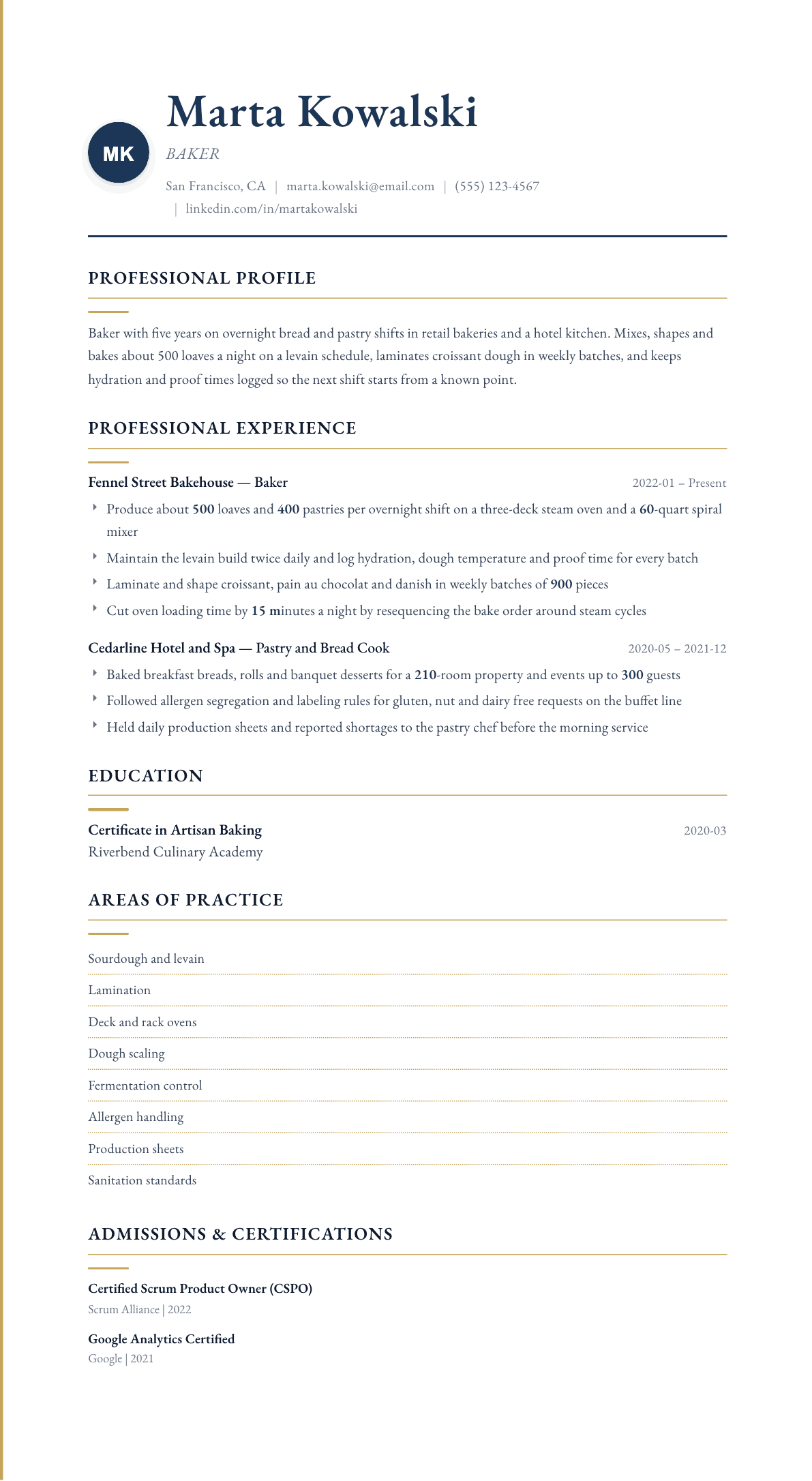
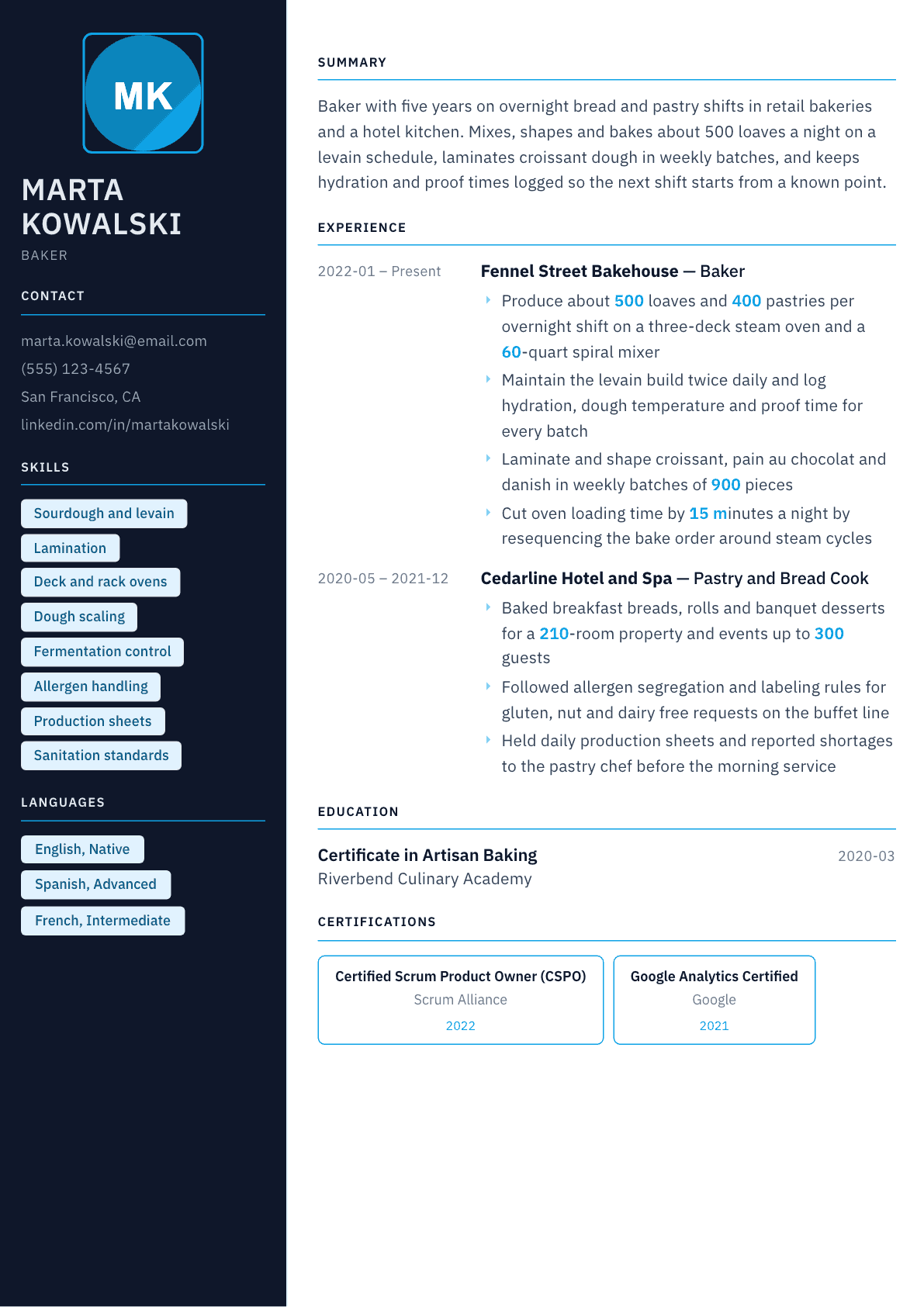
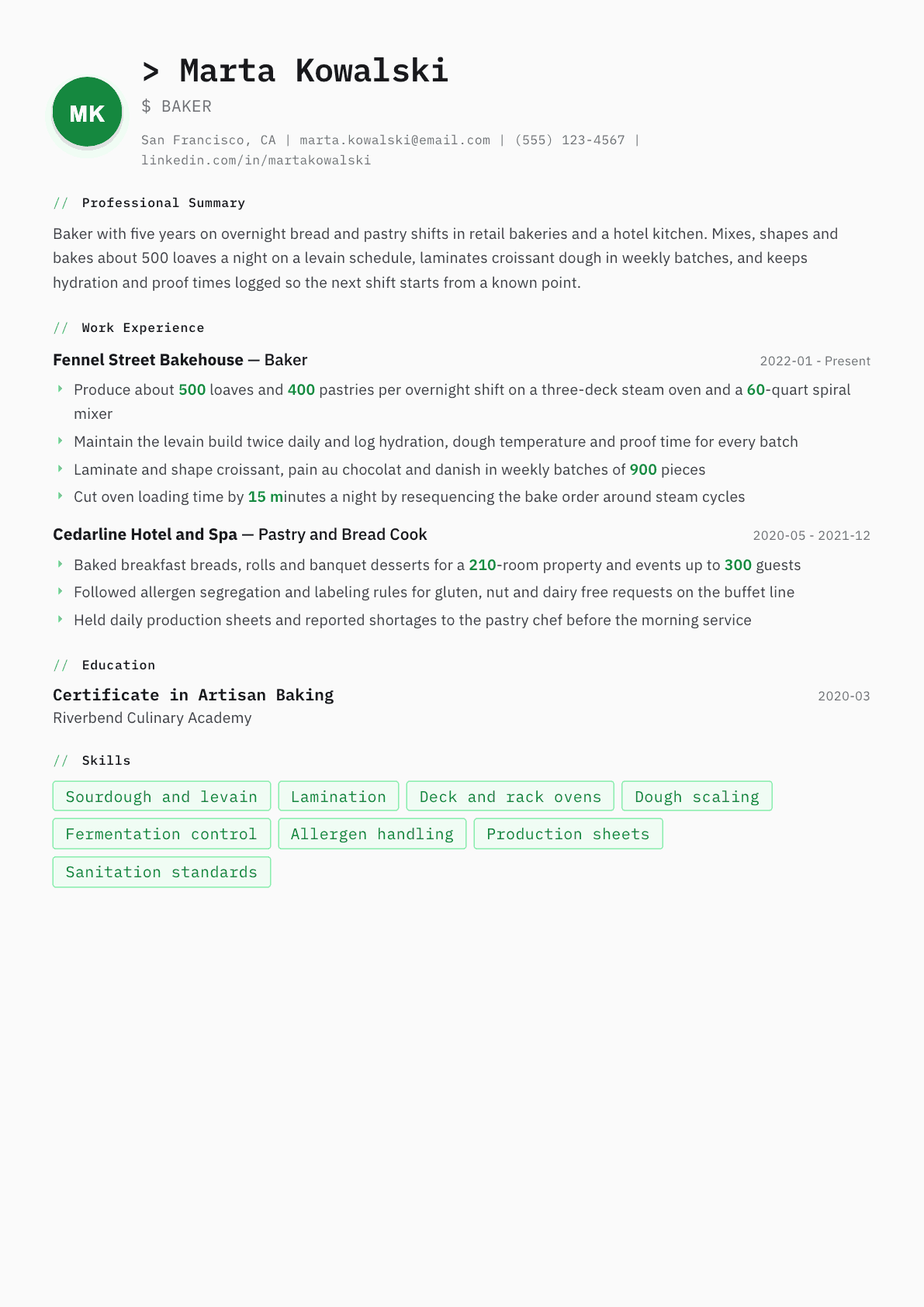
The same baker content laid out in three CVBooster templates, so you can see what the finished document looks like before you write a word.
Example Baker summary
Baker with five years of overnight production in artisan retail and a hotel pastry kitchen. Runs a levain schedule for about 500 loaves a night, laminates croissant dough in large weekly batches, and logs hydration and proof times so quality holds between shifts. Comfortable on deck ovens, spiral mixers and sheeters, and certified in food handling. Seeking a lead baker position.
Skills to list on a Baker resume
- Bread mixing and shaping
- Sourdough starter maintenance
- Lamination
- Enriched dough
- Dough scaling
- Fermentation and proofing
- Deck oven operation
- Rack oven operation
- Production sheets
- Allergen handling
- Sanitation and cleaning schedules
- Inventory rotation
- Cake and pastry finishing
What actually gets this resume read
- Say what you produce per shift in loaves, pieces or trays, because volume is the first thing a head baker checks.
- Name the equipment you have worked on: spiral mixer size, deck or rack oven, retarder and sheeter.
- Show fermentation knowledge with concrete practice: levain builds, dough temperature targets, and retard schedules.
- List the product families you can run alone, such as lean bread, enriched dough, lamination and cake.
- State your availability for overnight or 4 a.m. starts near the top, since scheduling decides many bakery hires.
- Include food handler certification and any allergen training with the issuing body and the date.
How to write a baker resume
A baker resume is screened by a head baker or a chef who is short-staffed and needs to know two things before he reads a single sentence: what you can produce alone on a shift, and whether you can start at three in the morning. Everything else on the page is secondary to those two answers, and a resume that makes the reader hunt for them tends to lose to one that puts them in the first two lines.
The work itself is technical, which helps you. Loaves or pieces per shift, the mixer and oven you have run, the fermentation schedule you follow, the product families you can execute without supervision: these are checkable claims, and a head baker will test them in the interview. Vague craft language does the opposite, because it reads as someone describing baking rather than doing it.
This guide covers how to structure a baker resume around production evidence, how to write about fermentation and lamination so a professional believes you, three worked summaries across career stages, and rewrites that turn a task list into proof you can hold a station.
Format: one page, production facts at the top
One page, single column, reverse chronological. A head baker reads resumes between a mix and a bake, so the file has to survive a fast scan. No columns, no icons, no photograph. The header carries your name, city, phone, email and your shift availability, because shift availability is a screening question in this trade rather than a detail.
Under each job title, give the kitchen profile in one line: type of operation, output per shift, product categories, and how many bakers were on with you. A hotel pastry kitchen, an artisan retail bakehouse and a wholesale plant look identical on a resume unless you spell out which one you were in.
- Header: name, city and state, phone, email, and availability for overnight or early morning starts.
- Sections in this order: summary, production experience, equipment, food safety, certifications, education or apprenticeship.
- Keep an equipment block listing mixers, ovens, sheeters and retarders with sizes.
- Culinary or baking school goes above experience only in your first year out.
Summary: output, product families, equipment, availability
Three lines. What you produce in a shift, which product families you run without supervision, the main equipment you are comfortable on, and your availability. A baker who says he is passionate about bread and detail oriented has told the reader nothing that helps him fill a hole in the schedule.
If you are early in the trade, lead with the technical foundation you do have: a starter you maintain daily, dough temperature targets you hit, or a station you cover alone. A short honest summary beats an inflated one, because the interview usually starts with a practical question about hydration or a bake schedule.
Experience: the schedule, the dough, the bake
Write bullets that follow the shift. Mix and scaling first, with batch sizes and how many mixes you run. Then fermentation: levain build and feeding schedule, bulk times, dough temperature targets and how you adjust when the kitchen is cold. Then shaping and proofing, with piece counts and how you manage the retarder. Then the bake, with oven type, loading order, steam and how you judge doneness.
Show that quality survives your absence. A baker who logs hydration, dough temperature and proof times, and who writes a handover for the morning shift, is telling the reader that the product does not depend on his mood. That is what a head baker is really buying.
Name the product families explicitly: lean bread, enriched dough, laminated pastry, cake, cookies, and any gluten-free or par-baked lines. Say which of them you have run alone, because that distinction decides where you slot into the rotation.
- Give piece counts per shift, not just a product list.
- Name your levain routine by feed frequency and the ratio you build at.
- State dough temperature targets and what you change to hit them.
- Describe the retard schedule and how many racks you manage overnight.
- Say plainly which stations you can run with nobody else in the bakehouse.
Equipment, sanitation and allergen handling
List equipment with capacity and type: spiral mixer with a stated bowl size, planetary mixer, deck oven with steam, rack oven, reversible sheeter, dough divider, retarder proofer. A head baker reads this block to work out whether you need a week of orientation or an afternoon.
Sanitation and allergen work belongs on the page even for a line baker. Cleaning schedules, equipment breakdown and washdown, dated and rotated ingredient storage, and allergen segregation between wheat, nut, dairy and seed products are all things a chef has to trust you with on your first solo shift.
A food handler card is usually required before your first shift, so list it with the issuing health authority and the expiry. Allergen training and any hazard analysis coursework are worth listing when the target kitchen supplies wholesale customers.
Keywords bakery postings use, and what to leave out
The phrases that recur in baker postings are production sheets, dough scaling, sourdough and levain, lamination, fermentation and proofing, deck oven, rack oven, allergen handling, sanitation and overnight shift. Put the true ones inside bullets where they are demonstrated, then mirror the strongest in a compact skills block.
Leave out competition ambitions, personal blog projects and long descriptions of your favorite grain unless the job is at a bakery that trades on exactly that. Space on a one-page baker resume is expensive, and a head baker will always choose the candidate whose piece counts are clear over the one with the better story.
Baker resume summary examples
First year in a bakehouse
Baking school graduate with a year on the overnight bench at an artisan retail bakery, scaling and mixing for about 200 loaves a night and shaping under a lead baker. Maintains the levain on a twice-daily feed, holds dough temperature targets, and is certified in food handling. Available for 3 a.m. starts.
Five years, artisan and hotel
Baker with five years of overnight production across artisan retail and a hotel pastry kitchen, running a levain schedule for roughly 500 loaves a night and laminating croissant dough in large weekly batches. Comfortable alone on deck ovens, spiral mixers and sheeters, and logs hydration and proof times every shift.
Lead baker
Lead baker running a four-person overnight bench producing around 1,200 pieces a night across lean bread, enriched dough and laminated pastry. Owns the mix order, the retard plan and the morning handover, trained six bakers to solo shaping, and rebuilt scaling sheets so formulas hold at full spiral capacity.
Work experience bullets: before and after
Before: Baked bread and pastries on the night shift.
After: Produced about 500 loaves a night across country sourdough, baguette and rye, plus a laminated run of croissant and danish, on a solo bench from 11 p.m. to 7 a.m.
Piece counts, product families and the shift window let a head baker see exactly what you can carry.
Before: Worked with sourdough starter.
After: Maintained a rye and wheat levain on a twice-daily feed, built preferments to the next day mix schedule, and adjusted bulk times to hold a 78 degree final dough temperature year round.
A feeding rhythm, a build tied to the schedule and a temperature target prove real fermentation control.
Before: Used ovens and mixers in the bakery.
After: Ran a 140-quart spiral mixer and a three-deck steam oven, sequencing loads so lamination cleared the decks before the bread bake and the retarder emptied by first delivery.
Equipment with capacity plus load sequencing shows planning rather than button pressing.
Before: Followed recipes and production sheets.
After: Scaled from production sheets for 30 formulas, logged hydration, dough temperature and proof times each shift, and left a written handover so the morning crew could finish any dough in the retarder.
Documentation and handover show the product is repeatable when you are not in the building.
Before: Kept the bakery clean and organized.
After: Broke down and washed the mixer, sheeter and divider nightly, ran allergen separation for nut and seed products, and kept dated ingredient rotation with no expired stock at any monthly check.
Naming the equipment, the allergen practice and the audit result makes cleanliness a verifiable standard.
Hard skills
- Dough scaling and mixing
- Levain and preferment maintenance
- Bulk fermentation control
- Dough temperature management
- Shaping lean and enriched dough
- Lamination
- Retard and proof scheduling
- Deck oven operation with steam
- Rack oven operation
- Production sheet execution
- Allergen segregation
- Sanitation and equipment breakdown
- Ingredient rotation and stock control
Soft skills
- Overnight consistency
- Speed without waste
- Written handover
- Following specification exactly
- Working alone unsupervised
- Physical stamina
Certifications worth listing
- ServSafe Food Handler (National Restaurant Association)
- Certified Journey Baker (CJB) (Retail Bakers of America)
- Certified Baker (CB) (Retail Bakers of America)
Mistakes that cost baker candidates the interview
- Writing a menu of products with no piece counts, so the reader cannot judge your output.
- Leaving shift availability off the page when overnight starts decide most bakery hiring.
- Using craft language such as artisanal and handcrafted instead of hydration, temperature and timing.
- Listing equipment without sizes, which hides whether you have worked at production scale.
- Claiming stations you have only assisted on, which the practical part of the interview exposes.
- Omitting the food handler card, which many kitchens require before your first shift is scheduled.
Baker resume questions
What should a baker put at the top of the resume?
Output per shift, the product families you can run alone, and your availability for early or overnight starts. A head baker is filling a specific slot in a rotation, and those three facts tell him in seconds whether you fit it.
Do I need baking school on a baker resume?
No. Production experience outranks school for almost every hiring baker. If you did attend, list it briefly and let the bench work carry the page. If you did not, an apprenticeship, a stage or a long run on the overnight bench does the same job.
How do I move from home baking into a professional bakery?
Apply for an overnight scaling or bench assistant role and write the resume around what transfers: repeatable formulas, a maintained starter, weighing in grams, and comfort with early starts. Add a food handler card before you apply, since it removes the first objection.
Should a pastry background go on a bread baker resume?
Yes, in its own line, because kitchens that run both value a baker who can cover either. Keep the emphasis on the family the job needs and give the other one or two bullets so the reader sees range without doubting your focus.
How do I explain leaving a bakery after a short time?
State the reason in a short neutral line: a seasonal contract, a closure, a schedule change, or a move. Bakery hiring managers know the trade has high turnover, and a plain explanation costs far less than an unexplained three-month entry.
Related resume examples
- Pastry Chef Resume example
- Chef Resume example
- Bakery Manager Resume example
- Prep Cook Resume example
- Fast Food Worker Resume example
- Hotel Housekeeper Resume example