Pastry Chef Resume Examples: free ATS score and gap list
Create a Pastry Chef Resume That Showcases Your Sweet Expertise
By Mustafa Tarabya, founder of CVBooster · Published · Updated
Build a delightful Pastry Chef resume highlighting dessert program management, creative menu development, production skills, and pastry artistry.
Sample resumes for a pastry chef
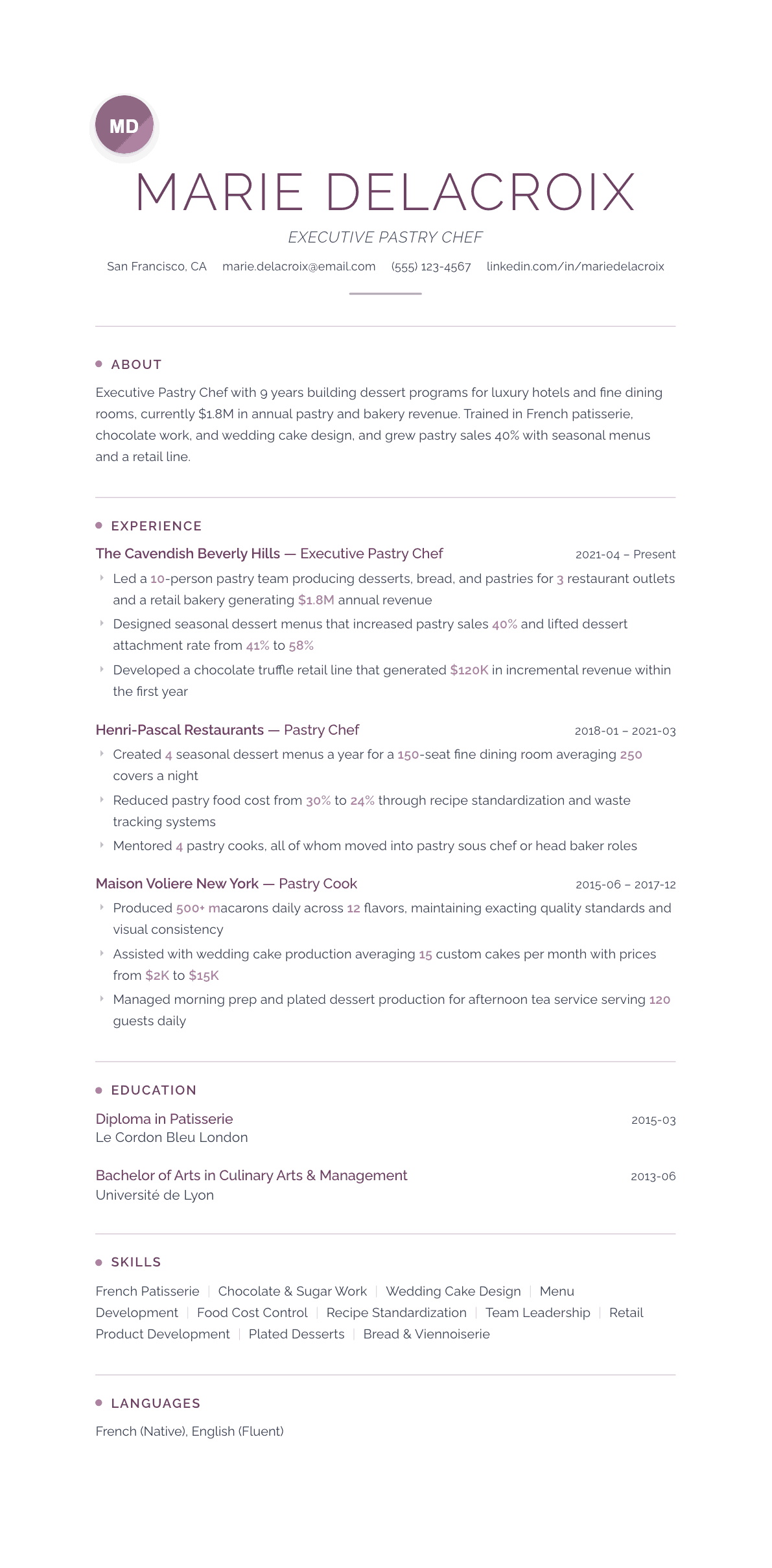
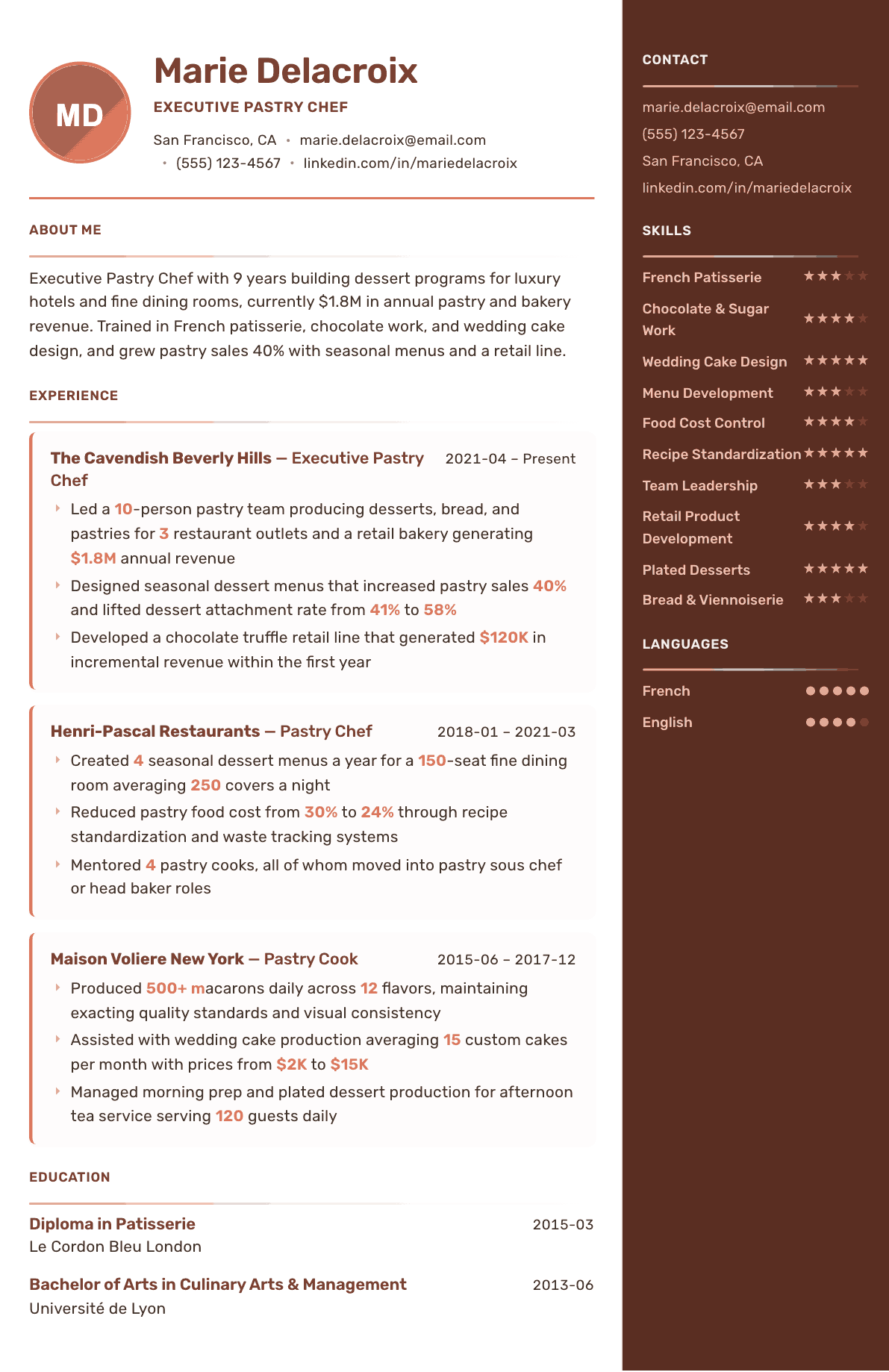
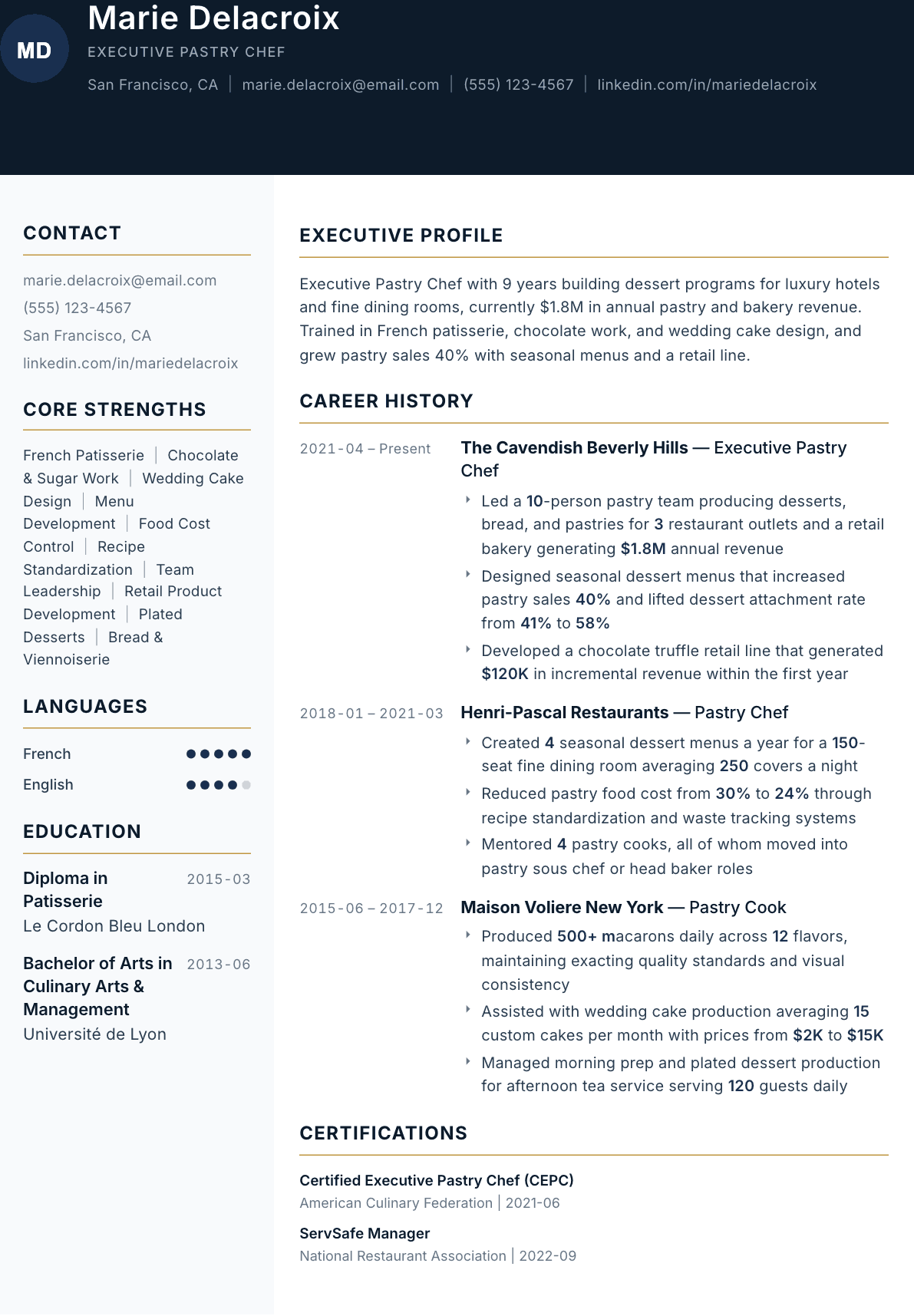
The same pastry chef content laid out in three CVBooster templates, so you can see what the finished document looks like before you write a word.
Example Pastry Chef summary
Executive Pastry Chef leading a 10-person team across three outlets and a retail bakery, $1.8M in annual pastry revenue. Grew sales 40% with seasonal menus and cut pastry food cost from 30% to 24%. CEPC certified, trained in French patisserie and chocolate work.
Skills to list on a Pastry Chef resume
- French Patisserie
- Chocolate Work
- Sugar Art
- Wedding & Special Occasion Cakes
- Plated Desserts
- Menu Development
- Food Cost Optimization
- Recipe Standardization
- Bread & Viennoiserie
- Team Leadership
- Retail Product Development
- Allergen-Friendly Baking
- Production Planning
- Quality Control
What actually gets this resume read
- Highlight the revenue contribution of your pastry program, not just the creative elements.
- Include production volume metrics: covers per night, items produced daily, and wedding cakes per month.
- Showcase food cost management with specific before-and-after percentages.
- Mention media features, awards, or social media following that demonstrate public recognition.
- List specific techniques (tempering, lamination, sugar work, isomalt) to demonstrate technical depth.
How to write a pastry chef resume
A pastry chef resume is read by an executive chef, a food and beverage director or a bakery owner who is trying to work out one thing quickly: what does this person produce, at what volume, and to what standard. Pastry is a production discipline as much as a creative one, and a resume that only talks about passion for desserts answers neither half of the question.
The strongest files read like a production sheet. The kind of operation, the covers or units per day, the outlets served, the size of the team on each shift, whether you baked viennoiserie and bread as well as plated desserts, the equipment you worked on, and the cost and yield discipline behind it. A hotel banquet pastry kitchen making 600 plated desserts for a gala and a two-person artisan patisserie making laminated dough at four in the morning are both pastry chef jobs and almost nothing transfers between them without being spelled out.
This guide covers the section order kitchens expect, how to write production bullets that show skill rather than menu poetry, the numbers that matter to an executive chef, three summaries from commis to executive pastry chef, and the mistakes that cost interviews.
Format: one page, production profile under each kitchen
One page is right for almost every pastry career, two only once you have run multiple properties or a wholesale operation. Reverse chronological, clean and text based. Kitchens rarely use elaborate software to screen, but hotel groups and restaurant groups do, so keep the layout parseable and keep decorative fonts for your portfolio instead.
Under each job, give a production profile: type of operation, number of outlets served, covers or units per day, team size and shift, and whether the kitchen produced bread, viennoiserie, plated desserts, celebration cakes, chocolates or retail product. That line does more work than any adjective.
- Header: name, city, phone, email, and a portfolio link kept as plain text rather than an embedded image.
- Order: summary, kitchen experience with production profiles, technical skills, education and stages, certifications and food safety.
- Formal culinary or pastry school and named stages belong in their own section; a stage at a serious house is worth listing even when it was short.
Summary: the operation, the repertoire, the standard
Three lines. Say what type of kitchen you run pastry for, your core repertoire, the volume you are used to, and one recognized standard: a guide rating, an award, a review, a competition placing, or a program you built from nothing.
Name your technical center of gravity. French patisserie, laminated doughs and viennoiserie, sourdough and bread, chocolate and confectionery, sugar showpieces, wedding and celebration cakes, or plated restaurant desserts. Chefs hire for a specific gap and a summary that claims all of it reads as claiming none of it.
Experience: write the production, not the menu
Every job needs volume. Covers a night, plated desserts per service, units produced per morning, banquet headcounts, wedding cakes per month, wholesale accounts supplied. Volume is the single fastest way to establish credibility in a pastry kitchen and it is missing from most resumes.
Then technique. Tempering and chocolate work, laminated dough production and lamination schedule, entremets and mousse work, ice cream and sorbet, sugar and pulled work, gluten free and allergen adapted production, and the fermentation schedule for bread if you baked it. Say what you actually made, not that you were creative.
Then the business bullets, because these are what separate a pastry chef from a talented pastry cook: costing and recipe standardization, food cost percentage held, waste tracking, ordering and vendor relationships, menu changes tied to season, and how new items were tested before they hit service. Add a bullet on the team: who you trained, how the station was set up, how the prep list carried across shifts.
Technical skills, equipment and allergen control
List the equipment. A deck oven, a rack oven, a sheeter, a spiral or planetary mixer, a blast chiller, a tempering machine, a guitar cutter and a chocolate enrober all signal what kind of kitchen you are comfortable in. An executive chef reading a resume that mentions a sheeter and a blast chiller knows you have run real production.
Allergen handling belongs on the page. Gluten free and dairy free production, cross contact control, labeling for retail, and any packaging or shelf life work you have done. Pastry is the department most exposed to allergen risk and a chef who can speak to it is easier to hire.
- Production equipment: deck and convection ovens, dough sheeter, spiral mixer, blast chiller, tempering machine, ice cream machine, proofer.
- Repertoire: viennoiserie, entremets, plated desserts, breads, chocolates and bonbons, sugar work, celebration and wedding cakes.
- Controls: recipe standardization and scaling, yield testing, food cost tracking, waste logs, allergen and labeling procedures.
The numbers an executive chef looks for
Pastry is judged on cost and consistency as much as on flavor, so quote both. Keep the figures to things you personally influenced and be ready to explain the method behind each one.
- Covers and plated desserts per service, and peak banquet output for a single event.
- Dessert food cost against target, and the movement you achieved through standardization or yield work.
- Waste and overproduction reduction, and shelf life extended through process or packaging changes.
- Dessert attachment rate, retail units sold per day, or growth in a wholesale account base.
- Team: cooks trained, stations opened, and anyone you developed into a lead or sous position.
Pastry Chef resume summary examples
Pastry commis
Pastry cook with two years in a hotel pastry kitchen producing viennoiserie, plated desserts and afternoon tea for 120 guests daily. Trained in laminated dough, mousse work and tempering, and completed a six-week stage in a Michelin-starred pastry section. Certified in food protection management.
Pastry chef de partie
Pastry chef for a 150-seat restaurant averaging 250 covers a night, building four seasonal dessert menus a year and running the station alone through service. Cut dessert food cost from 30% to 24% through recipe standardization and yield testing, and trained four cooks who moved into sous roles.
Executive pastry chef
Executive pastry chef leading a 10-person team supplying three restaurant outlets, banquets for up to 600 and a retail bakery counter. Built a chocolate and bonbon retail line from scratch, grew pastry sales by 40% over two seasons, and holds the pastry department food cost inside budget every period.
Work experience bullets: before and after
Before: Made desserts and pastries for the restaurant.
After: Produced plated desserts for 250 covers a night solo on the pastry station, alongside a morning bake of croissant, pain au chocolat and brioche for the breakfast service.
Volume plus the actual products tell a chef whether you can hold her station; made desserts does not.
Before: Created new dessert menu items each season.
After: Developed four seasonal dessert menus a year, costing and yield testing every item before service and retiring the two lowest-selling desserts each change.
Costing, testing and a retirement rule show a menu process rather than a burst of inspiration.
Before: Reduced food costs in the pastry department.
After: Brought dessert food cost from 30% to 24% in two quarters by standardizing recipes to gram weights, introducing a daily waste log and repurposing trim into a petit four program.
The three specific actions make the cost reduction believable and portable to another kitchen.
Before: Trained junior pastry staff.
After: Trained four pastry cooks on lamination, tempering and mise en place standards, writing station guides for each and moving two of them into pastry sous chef roles.
Naming the techniques and the outcome for the people you trained is evidence of leadership rather than a claim.
Before: Handled wedding cakes and special orders.
After: Delivered an average of 15 custom wedding and celebration cakes a month, running client consultations, tasting boxes, structural builds and on-site assembly with zero missed delivery dates.
The volume, the client process and the reliability record are what a special-order operation is actually buying.
Hard skills
- French patisserie
- Laminated doughs and viennoiserie
- Chocolate tempering and bonbons
- Entremets and mousse work
- Bread and fermentation schedules
- Sugar work and showpieces
- Wedding and celebration cake construction
- Plated dessert composition
- Recipe standardization and scaling
- Yield testing and food cost control
- Allergen and gluten free production
- Banquet and volume production planning
- Ice cream and frozen desserts
Soft skills
- Timing under service pressure
- Precision and consistency
- Station organization
- Teaching technique to cooks
- Client consultation for special orders
- Collaboration with the savory kitchen
Certifications worth listing
- Certified Pastry Culinarian (CPC) (American Culinary Federation)
- Certified Working Pastry Chef (CWPC) (American Culinary Federation)
- Certified Executive Pastry Chef (CEPC) (American Culinary Federation)
- ServSafe Food Protection Manager (National Restaurant Association)
- ServSafe Allergens (National Restaurant Association)
Mistakes that cost pastry chef candidates the interview
- Writing menu poetry instead of production. Adjectives about elegant desserts tell a chef nothing about whether you can hold the station.
- Leaving out volume, so the reader cannot tell whether you plated 40 desserts a night or 600.
- Listing every technique in existence. A repertoire that claims mastery of bread, chocolate, sugar and cake at once reads as unfocused.
- Skipping cost and waste entirely, which makes you look like a cook rather than a department head.
- Sending photos embedded in the resume file. Keep a portfolio separate and put a plain text link on the page.
- Forgetting food safety and allergen certification, which is a hard requirement at most hotels and multi-unit groups.
Pastry Chef resume questions
Should a pastry chef resume include photos of my work?
Not inside the document. Keep the resume text based so it parses and reads cleanly, and put a plain link to a portfolio or an online gallery in the header. Bring printed photos or a tablet to the interview and the stage instead.
How do I show pastry skill without a culinary degree?
Lead with production and technique: the volume you produced, the doughs and chocolate work you handled, the stages you completed and the chefs you trained under. Named kitchens and named techniques outweigh a diploma in almost every pastry hiring conversation.
Do I list stages on a pastry chef resume?
Yes. Give the house, the city, the length and the section you worked in. A short stage at a respected pastry kitchen signals ambition and exposure to a standard, and it is one of the few short assignments nobody in the industry treats as job hopping.
How much detail should I give about equipment?
Enough to place the kind of production you have run. Deck ovens, a sheeter, a blast chiller, a tempering machine and a spiral mixer each imply a different operation, and an executive chef reads that list to work out whether you will be comfortable in her kitchen.
What if my pastry experience is all in retail bakery and I want a restaurant job?
Say it in the summary and translate the overlap: production planning, consistency at volume, laminated dough discipline and cost control all carry across. Then lead your bullets with anything plated, anything made to order and any evening or service work you have done.
Related resume examples
- Executive Chef Resume example
- Chef Resume example
- Catering Manager Resume example
- Bakery Manager Resume example
- Private Chef Resume example
- Head Chef Resume example