Executive Chef Resume Examples: the lines they read
Build an Executive Chef Resume That Earns a Seat at the Top Table
By Mustafa Tarabya, founder of CVBooster · Published · Updated
Create a standout Executive Chef resume showcasing kitchen leadership, menu innovation, cost control, and culinary achievements that impress restaurant owners and hotel groups.
Sample resumes for a executive chef
The same executive chef content laid out in three CVBooster templates, so you can see what the finished document looks like before you write a word.
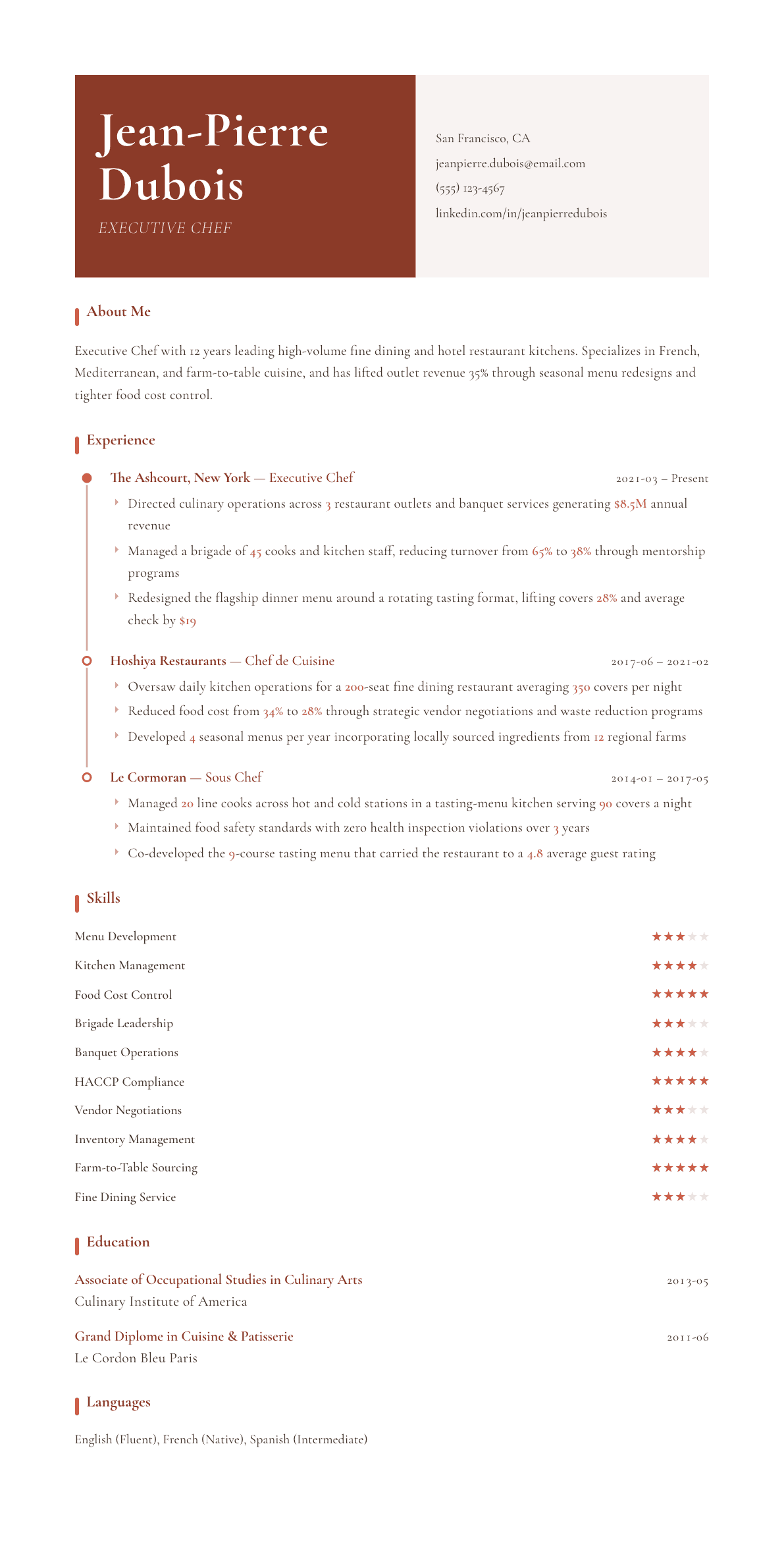
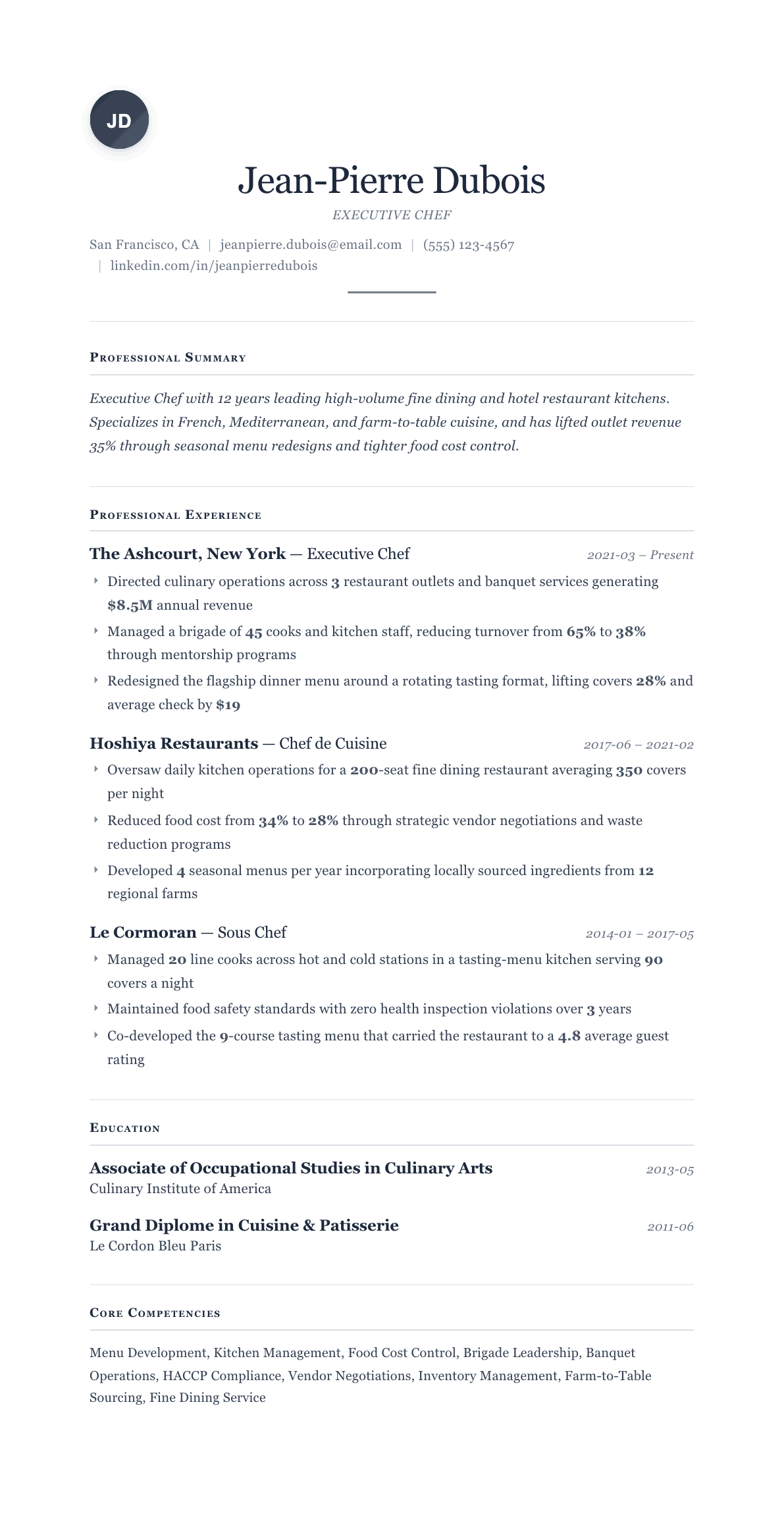
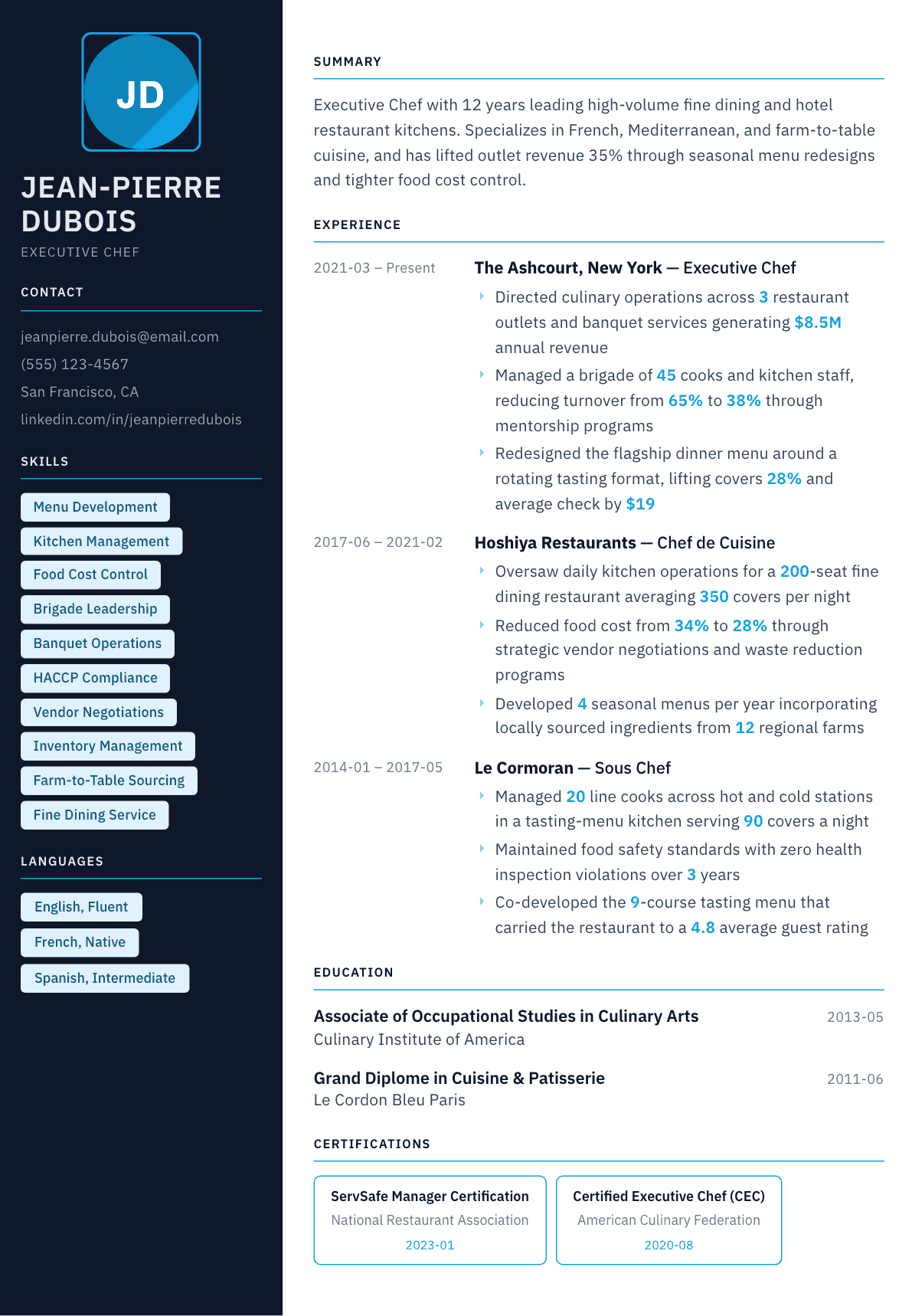
Example Executive Chef summary
Executive Chef running $8.5M in annual outlet and banquet revenue across three restaurants. Cut food cost from 34% to 28% and leads a brigade of 45 across fine dining and hotel kitchens. Looking to own the culinary direction of a growing restaurant group.
Skills to list on a Executive Chef resume
- Menu Development & Innovation
- Kitchen Management
- Food Cost Optimization
- Brigade Leadership
- Banquet & Catering
- HACCP & Food Safety
- Vendor Management
- Inventory Control
- Farm-to-Table
- Fine Dining Operations
- Recipe Standardization
- Staff Training & Mentorship
- Wine Pairing
- Allergen Management
What actually gets this resume read
- Lead with revenue impact, food cost percentages, and covers per night to demonstrate business acumen beyond culinary skill.
- Name your cuisine specialties and the service style you have run (a la carte, tasting menu, banquet volume) so a chef reading it knows your kitchen.
- Include team size managed and turnover improvement metrics to show leadership capability.
- Mention food safety certifications (ServSafe, HACCP) and compliance records prominently.
- Describe menu innovation with specific outcomes like increased revenue, positive reviews, or awards.
- List vendor relationship management and cost reduction achievements with dollar or percentage figures.
How to write a executive chef resume
An executive chef resume is read by an owner, a hotel director of food and beverage or a restaurant group president, and the question in their mind is commercial before it is culinary. They assume you can cook. What they need to know is whether you can hold a food cost line, keep a brigade staffed in a market where nobody is staffed, open a room on schedule, and put a plate on the table that the concept promised.
That means an executive chef resume looks different from a working chef resume. Stations and technique move down. Outlets, covers, revenue responsibility, brigade size, turnover, food and labor cost, opening experience and menu engineering move up. A resume that still reads like a chef de cuisine application is the most common reason an experienced candidate is passed over for a bigger kitchen.
This guide covers how to structure the document for an ownership-level reader, with example summaries for a first executive chef role, a multi-outlet executive chef and a corporate or group level chef, before and after bullets that put a number behind every claim, and the questions chefs ask when they step from one kitchen to a portfolio.
Format: two pages, with the operation described before the bullets
Two pages is correct at this level. Reverse chronological. Open each position with a short operating profile: property or group type, number of outlets and banquet space, total seats, annual food and beverage revenue scale, brigade headcount, and who you reported to. An owner reads that profile to decide whether your last job was bigger or smaller than the one they are filling.
Add a selected achievements block near the top if your career includes openings, concept launches, awards or turnarounds. Those are the events that justify a senior salary, and burying them inside chronological bullets means a skimming reader misses them entirely.
- Header: name, certifications, city and state, phone, email.
- Order: summary, selected achievements, experience with operating profiles, certifications, education.
- State reporting line and span of control in every job, including sous chefs and chefs de cuisine below you.
Summary: outlets, revenue scale, brigade, and the cuisine you own
Four lines. Give the number of outlets and banquet operation you have run, the revenue scale, the brigade size, and the cuisines and service styles you are credible in. An owner is matching you to a business, so a candidate who says three outlets plus banquets at a resort and a candidate who says a single 70-seat tasting-menu room are answering different postings even at the same title.
Name one commercial proof in the summary itself. Food cost brought down and held, turnover reduced, an opening delivered on schedule, or a room whose covers grew after a menu rewrite. Culinary awards are worth a mention but they belong after the operating proof, not in front of it.
Experience: cost, people, concept, and the plate
Cost first, because it is what you are accountable for. Food cost percentage by outlet and the movement you produced. Menu engineering by contribution margin and popularity, not by personal preference. Purchasing: vendor consolidation, contract pricing, bid comparison, receiving discipline and yield testing. Waste programs and cross-utilization. Kitchen labor cost, overtime control and productivity against covers.
People second, because it is the constraint. Brigade size and structure, how many sous chefs and chefs de cuisine reported to you, your turnover rate and what you did to it, your training program and its length, internal promotions you produced, and any apprenticeship or externship pipeline you built with a school. Staffing a kitchen is the hardest part of this job right now and an owner will read that section closely.
Concept and the plate third. Menus written and how often they turn. Openings and pre-opening work: equipment specification, kitchen design input, recipe documentation, hiring and training a brigade from zero, and the opening date you hit. Awards, ratings and press, stated plainly and without inflation. Guest satisfaction and food quality scores from whatever system the property uses.
Menu engineering and the standards that scale
The step from chef to executive chef is the step from cooking a dish to guaranteeing a dish across shifts, outlets and cooks you did not hire. Show the documentation: costed recipe cards, plating standards with photographs, batch and prep specifications, and the line check routine that catches drift before a guest does.
Then show the analysis. Classifying items by margin and popularity, cutting or repricing the ones that fail on both, and re-engineering the menu around what the kitchen can produce at volume. An owner who sees that vocabulary knows you will treat the menu as a commercial instrument.
- Name the systems you run: inventory and recipe costing software, purchasing platforms, scheduling tools.
- Give the audit or line check cadence you enforce.
- Include the food safety program you own and the inspection record under it.
Certifications, awards and how to state them honestly
Food protection manager certification and HACCP are baseline for a chef with authority over multiple kitchens. American Culinary Federation certification at the executive chef or executive pastry chef level is a real, verifiable credential and worth listing with the correct designation.
Be exact about awards and ratings. A restaurant recognized in a guide, a rating held under your tenure, a competition medal or a chef of the year award from a named body are all checkable. Vague phrasing about a starred kitchen when you were one of thirty cooks is the fastest way to lose credibility with an owner who knows the room.
Executive Chef resume summary examples
First executive chef role
Chef de cuisine of 4 years stepping into an executive role, leading a 20-cook brigade in a 200-seat restaurant at 350 covers a night. Owns the menu, purchasing and schedule, holds food cost at 28%, and has trained four cooks into sous positions. American Culinary Federation certified.
Multi-outlet executive chef
Executive chef directing three restaurant outlets and banquet production at a resort, with a 45-person brigade and combined food and beverage revenue in the eight figures. Cut food cost from 34% to 28%, reduced kitchen turnover from 65% to 38%, and opened one new outlet on schedule.
Group or corporate chef
Corporate executive chef for a six-restaurant group, responsible for culinary standards, purchasing contracts and every opening. Built the costed recipe library and line check program used across all units, led three openings from equipment specification to first service, and mentors six chefs de cuisine.
Work experience bullets: before and after
Before: Oversaw kitchen operations for multiple restaurants.
After: Directed culinary operations across three restaurant outlets and banquet service at a resort, with a 45-cook brigade, three chefs de cuisine reporting in, and combined annual food revenue in the eight figures.
Outlet count, brigade size and reporting structure give an owner the span of control, which oversaw never does.
Before: Reduced food costs through better purchasing.
After: Cut food cost from 34% to 28% in four quarters by consolidating to three primary vendors on contract pricing, running weekly yield tests and re-engineering nine low-margin menu items.
Three named levers behind the number turn a result into a method the next owner can expect you to repeat.
Before: Improved kitchen staff retention.
After: Brought kitchen turnover from 65% to 38% over two years with a documented four-week station training path, a posted schedule two weeks out and an internal promotion track that filled five sous roles from the line.
Staffing is the constraint in this industry, so naming the mechanisms is more persuasive than the number alone.
Before: Opened a new restaurant.
After: Led the culinary opening of a 140-seat restaurant from equipment specification and kitchen layout review through hiring and training an 18-cook brigade, serving first covers on the scheduled opening date.
Pre-opening scope plus hitting the date is the specific proof an owner needs before trusting you with a build.
Before: Created seasonal menus using local ingredients.
After: Wrote four seasonal menus a year around twelve regional farms, costing every dish to a target margin and documenting each with a recipe card and plating photograph so the standard held across two kitchens.
Documentation is what makes a menu survive contact with a brigade, and it separates an executive chef from a cook.
Hard skills
- Multi-outlet kitchen leadership
- Food cost and menu engineering
- Purchasing and vendor contract negotiation
- Kitchen labor cost and scheduling
- Costed recipe documentation
- Restaurant opening and pre-opening
- Banquet and volume production
- Inventory and yield testing
- HACCP program ownership
- Line check and plating standards
- Brigade training and succession
- Equipment specification and kitchen layout
Soft skills
- Brigade leadership
- Hiring and retention
- Owner and stakeholder communication
- Standards enforcement without churn
- Mentoring chefs de cuisine
- Judgment under cost pressure
Certifications worth listing
- Certified Executive Chef (CEC) (American Culinary Federation)
- Certified Master Chef (CMC) (American Culinary Federation)
- ServSafe Food Protection Manager (National Restaurant Association)
- HACCP Manager Certification (International HACCP Alliance accredited program)
- Certified Food and Beverage Executive (CFBE) (American Hotel & Lodging Educational Institute)
Mistakes that cost executive chef candidates the interview
- Writing a line cook resume with a bigger title, all technique and no cost, labor or headcount.
- Leaving out outlet count, seats and revenue scale, so an owner cannot tell whether your last operation was their size.
- Claiming a rating or award earned by a kitchen where you were not the chef in charge.
- Ignoring turnover and hiring, which is the constraint every restaurant owner is living with.
- Never mentioning openings, documentation or standards, which are the reasons a group hires above unit level.
- Burying menu engineering under creative language when the reader is looking for margin and popularity analysis.
Executive Chef resume questions
What separates an executive chef resume from a chef resume?
Scope and accountability. An executive chef resume leads with outlets, revenue scale, brigade size, food and labor cost, turnover and openings. Technique and station history stay on the page but move underneath, because the reader is buying management of a kitchen business.
How do I show food cost improvement credibly?
Give the starting and ending percentage, the time it took, and the two or three levers that moved it, such as vendor consolidation, yield testing, portion control or menu re-engineering. A number with no mechanism behind it reads as something that happened around you.
Should I list restaurant awards and ratings?
Only where you can state your actual role and the awarding body. A rating held during your tenure as executive chef is a strong line. Association with a famous kitchen where you were one cook among many should be listed as the position you held, nothing more.
Is opening experience worth a separate section?
Yes if you have more than one. Openings prove you can specify equipment, document recipes, hire a brigade from zero and hit a date, which is the highest-risk work an owner will ever ask of a chef. Give each opening its concept, size and outcome.
How do I move from a single restaurant to a hotel or resort kitchen?
Lead with volume, banquet production and anything you have run across more than one service period or outlet. Hotel food and beverage leaders worry that a restaurant chef cannot handle a 900-cover banquet alongside an outlet, so answer that concern directly with production numbers.
Related resume examples
- Chef Resume example
- Pastry Chef Resume example
- Food & Beverage Director Resume example
- Head Chef Resume example
- Sous Chef Resume example
- Private Chef Resume example