Florist Resume Examples: free score, then the gap list
Create a Florist Resume That Sells Design and Shop Sense
By Mustafa Tarabya, founder of CVBooster · Published · Updated
Florist resume examples with wedding, funeral and retail design keywords, conditioning and wastage bullets, plus a complete writing guide.
Sample resumes for a florist
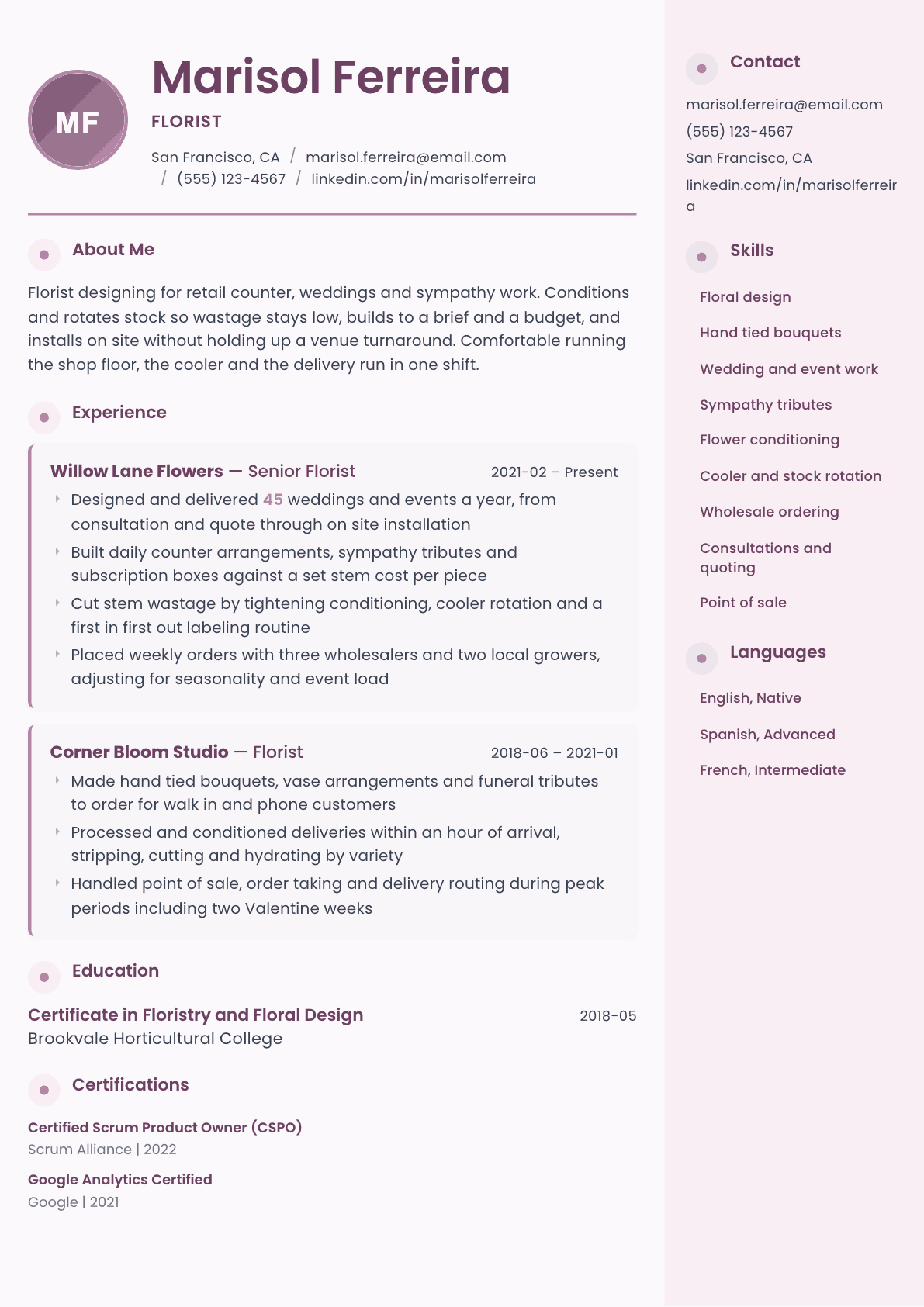
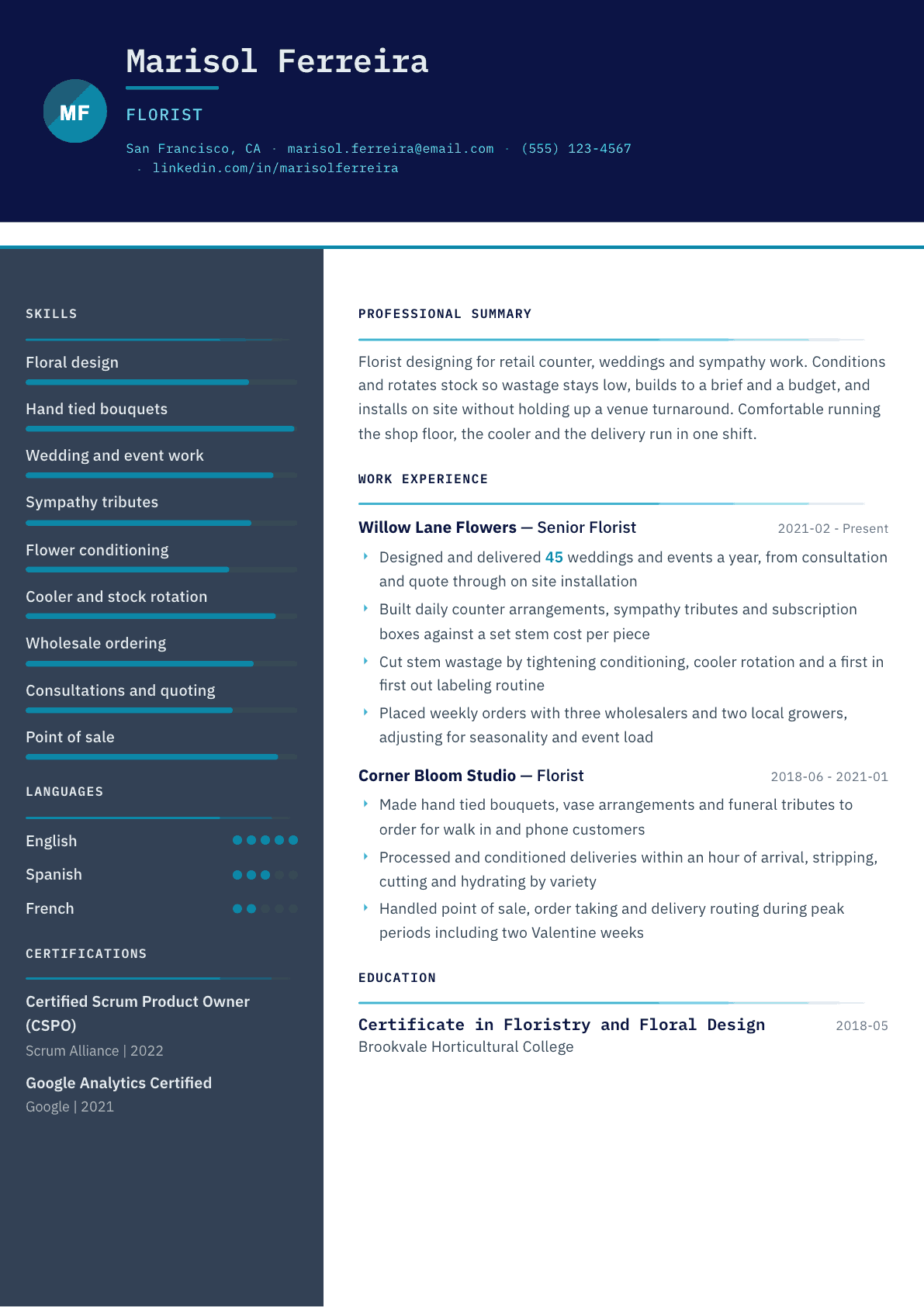
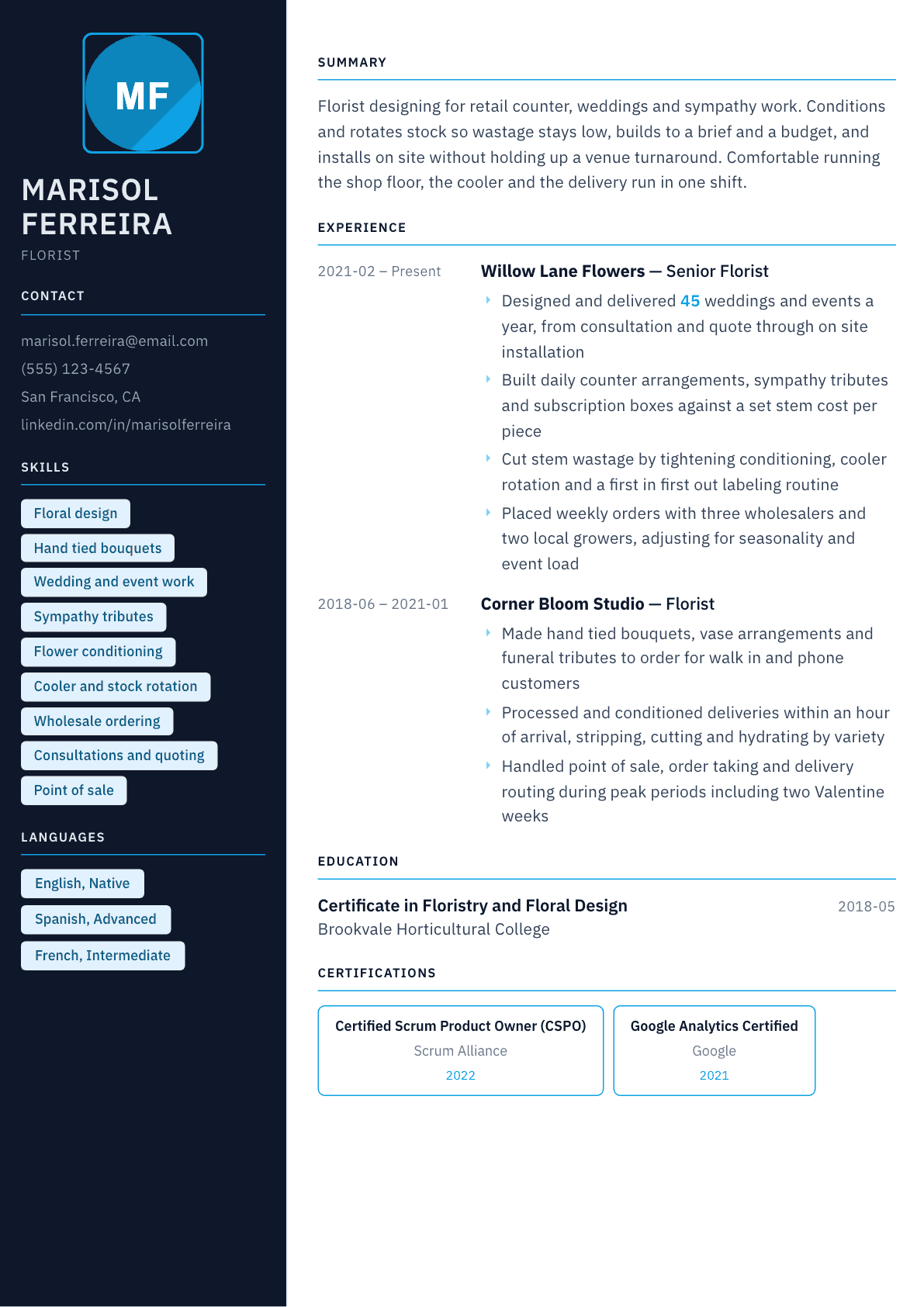
The same florist content laid out in three CVBooster templates, so you can see what the finished document looks like before you write a word.
Example Florist summary
Florist with six years across retail counter, wedding and sympathy work. Designs to a brief and a stem cost, conditions and rotates stock so wastage stays low, and installs on site inside tight venue windows. Runs wholesaler and grower ordering to the week ahead, handles consultations and quotes, and holds up through peak weeks without letting counter quality slip.
Skills to list on a Florist resume
- Floral design
- Hand tied bouquets
- Wedding and event florals
- Ceremony and reception installs
- Sympathy and funeral tributes
- Flower conditioning and hydration
- Cooler management and rotation
- Wastage and stem cost control
- Wholesale and grower sourcing
- Client consultations and quoting
- Mechanics and armature building
- Delivery routing
- Point of sale and order taking
- Seasonal buying
What actually gets this resume read
- Separate retail counter work, weddings and sympathy design, because shops hire for a specific gap in one of them.
- Give event volume and average order value ranges instead of saying you designed many beautiful arrangements.
- Show conditioning, cooler management and wastage control, which is the commercial half of the job owners care about.
- List mechanics you work with: floral foam alternatives, chicken wire, kenzan, armatures, structures and hanging installs.
- Name your wholesalers and growers relationships and any seasonal or locally grown sourcing you have run.
- Mention peak period stamina explicitly, since Valentine and Mother Day weeks are the real test of a shop florist.
How to write a florist resume
A florist resume is read by a shop owner or studio lead who has a specific gap to fill. Sometimes it is counter and delivery work, sometimes it is a wedding and event designer, sometimes it is sympathy work that has to be right the first time. Those are three different hires, and a resume that describes beautiful arrangements in general terms answers none of them.
The other half of the job is commercial and it is where resumes go quietest. Flowers are perishable stock. Conditioning, cooler rotation, stem cost per piece and wastage are what decide whether a shop makes money, and an owner reading your resume is looking for evidence that you understand the cooler as well as the design table.
This guide covers how to split retail, wedding and sympathy work, how to write bullets on conditioning and wastage, what mechanics and installation experience to name, and the questions florists ask when moving from a counter role into event design or from a studio into a shop.
Format: one page, work types separated
One page, reverse chronological, plain layout with a portfolio link. The photographs sell the design, so the resume should carry the working facts: volumes, conditioning practice, sourcing relationships and the installations you have executed.
Group your experience by work type inside each job rather than in one undifferentiated list. Counter and daily orders, weddings and events, sympathy and funeral tributes, and any subscription or corporate contract work. An owner hiring for weddings will read only the wedding bullets, so make them findable.
- Header: name, city, phone, email, portfolio link, and a driver license if you handle delivery.
- Sections in this order: summary, experience by work type, design and technical skills, training.
- Add a short line on availability through peak weeks if you are applying near a holiday season.
Summary: work mix, volume, commercial habit
Name the three work types you cover and their weighting, then the years, then the commercial practice you are known for. Designing to a brief and a stem cost is a specific claim, and it separates a florist an owner can trust with a quote from one who designs to whatever is in the bucket.
If you are moving from studio event work into a shop, or the other way, name the transferable core, conditioning, mechanics and design speed, and be honest about the part that will be new, usually retail pace on one side or client consultation and site logistics on the other.
Experience: design, conditioning, and the money
Give volume for each work type: weddings and events a year, daily counter arrangements, sympathy tributes in a week. Then attach the difficulty. A wedding is a consultation, a quote, a stem list, a build, a delivery and an on site install inside a venue turnaround window, and saying so shows you have done the whole cycle rather than only the pretty part.
Conditioning and cooler management are where the commercial argument lives. Processing deliveries within an hour of arrival, stripping and cutting by variety, hydrating to the right depth, and running first in first out labeling are all specific practices, and a bullet that ties them to falling stem wastage speaks directly to an owner reading margin.
Sourcing belongs on the page too. Weekly ordering from wholesalers and local growers, adjusting quantity for seasonality and event load, and substituting intelligently when a variety fails to arrive are the buying instincts a shop needs and cannot teach in a week.
Mechanics and installation: the technical vocabulary
Name the mechanics you build with: chicken wire armatures, kenzan pin holders, reusable structures, foam free construction, hanging installs and arch or chuppah frames. Foam free methods are an active hiring topic in event work, and a florist who can build without it has an advantage worth stating explicitly.
Installation experience should say where and inside what constraint. A ceremony piece rigged in a two hour venue window before guests arrive, or a reception flip between ceremony and dinner, tells an event lead you can work to a schedule with a venue manager standing beside you.
Shop floor: consultations, quoting and peak weeks
Consultation and quoting are the commercial skills that get a florist promoted. Say that you have run client consultations, translated a mood into a stem list, priced to a budget and held the design when the budget did not move. That is the work an owner most wants to hand over.
Peak weeks are the real test of a shop florist. Valentine and Mother Day weeks compress a month of orders into days, and an owner reading your resume wants to know you have stood through them. Name the peaks you have worked and what you ran during them, whether that was the bench, the delivery routing or the phone.
Florist resume summary examples
Junior florist
Florist with two years on a shop bench making hand tied bouquets, vase arrangements and funeral tributes to order. Processes and conditions deliveries within an hour of arrival, strips and cuts by variety, and has worked two Valentine weeks on bench and delivery routing.
Shop florist
Florist with six years across retail counter, wedding and sympathy work. Designs 45 weddings and events a year from consultation and quote through on site installation, builds daily counter pieces to a set stem cost, and places weekly orders with three wholesalers and two local growers.
Lead florist
Senior florist with ten years leading a studio bench and a delivery team through peak seasons. Runs event consultations and quoting, builds foam free armatures and hanging installs to venue schedules, and has cut stem wastage through tighter conditioning and first in first out cooler rotation.
Work experience bullets: before and after
Before: Created beautiful floral arrangements for customers.
After: Built daily counter arrangements, sympathy tributes and subscription boxes against a set stem cost per piece, holding design standards without exceeding the costed recipe.
Work types plus a cost constraint show commercial design, where beautiful is an unverifiable adjective.
Before: Worked on weddings and events.
After: Designed and delivered 45 weddings and events a year, from first consultation and quote through build, transport and on site installation inside the venue turnaround window.
Volume and the full cycle prove event ownership rather than assisting on a wedding someone else designed.
Before: Reduced flower waste in the shop.
After: Cut stem wastage by tightening conditioning on arrival, enforcing cooler rotation and labeling every bucket on a first in first out routine.
The three specific practices explain how the waste fell, which is what an owner needs to trust the result.
Before: Ordered flowers from suppliers.
After: Placed weekly orders with three wholesalers and two local growers, adjusting quantities for seasonality and the event book, and substituting varieties when a line failed to arrive.
Supplier mix, the planning input and the substitution judgment turn ordering into buying.
Before: Handled busy periods well.
After: Worked two Valentine weeks and three Mother Day weeks on bench, phone and delivery routing, holding same day fulfillment through the peak order volume.
Naming the peaks, the stations covered and the standard held gives evidence in place of a self assessment.
Hard skills
- Floral design
- Hand tied bouquets
- Wedding and event florals
- Ceremony and reception installs
- Sympathy and funeral tributes
- Flower conditioning and hydration
- Cooler management and rotation
- Wastage and stem cost control
- Wholesale and grower sourcing
- Client consultations and quoting
- Armatures and foam free mechanics
- Delivery routing
- Point of sale and order taking
- Seasonal buying
Soft skills
- Customer consultation
- Sensitivity in sympathy work
- Speed under order pressure
- Color and proportion judgment
- Team coordination on installs
- Reliability through peak weeks
Mistakes that cost florist candidates the interview
- Describing arrangements in adjectives instead of naming work types, volumes and the stem cost you designed to.
- Leaving out conditioning, cooler rotation and wastage, the commercial half of the job an owner reads margin into.
- Failing to separate counter, wedding and sympathy work when a shop is hiring for one specific gap.
- Skipping installation detail such as venue windows, rigging and reception flips on event resumes.
- Not mentioning sourcing relationships with wholesalers and growers, which is real buying knowledge.
- Omitting a driver license and delivery experience when most shop roles include the delivery run.
Florist resume questions
Do florists need a formal qualification?
Many shops hire on a bench trial rather than a certificate, so training is worth listing but rarely decides the job. A floristry or horticulture certificate helps for a first role, while volumes, conditioning practice and event experience carry the hire after that.
How do I move from counter work into wedding and event design?
Show the pieces you already own: consultations you have taken, quotes you have priced, mechanics you can build, and any wedding you assisted on with your specific role named. Then add installation experience, since venue logistics is the part shops most doubt.
Should a florist resume include a portfolio link?
Yes, one link in the header, and keep the resume itself factual. Owners want to see color sense, proportion and finished installs, but they hire on volume, conditioning discipline and reliability, which photographs cannot demonstrate at all.
What should I say about foam free design?
Name the mechanics you can actually build: chicken wire armatures, kenzan pin holders, moss and reusable structures, and hanging installs without foam. Many event clients now ask for it directly, so the specific techniques matter more than a general commitment.
How do I show I can handle a peak week?
Name the holiday weeks you have worked, the station you covered, and the standard you held, such as same day fulfillment or on time delivery through the volume. Owners hire heavily on peak season reliability because that is when a bench breaks.