Bakery Manager Resume Examples: the lines they read
Craft a Bakery Manager Resume That Shows Production Control
By Mustafa Tarabya, founder of CVBooster · Published · Updated
A bakery manager resume example with production keywords, sample bullets on scaling and shrink, and tips for retail and wholesale hiring.
Sample resumes for a bakery manager
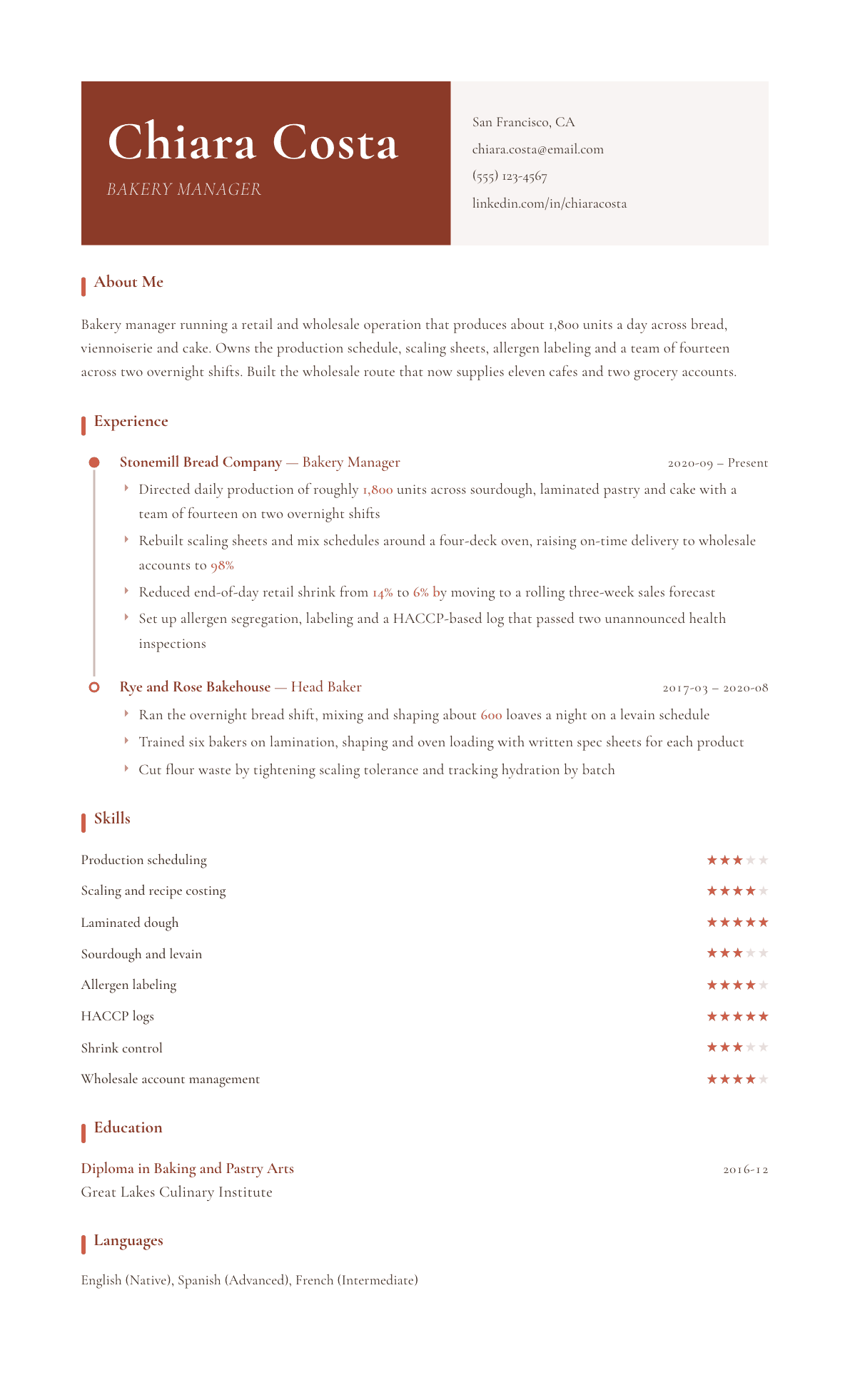
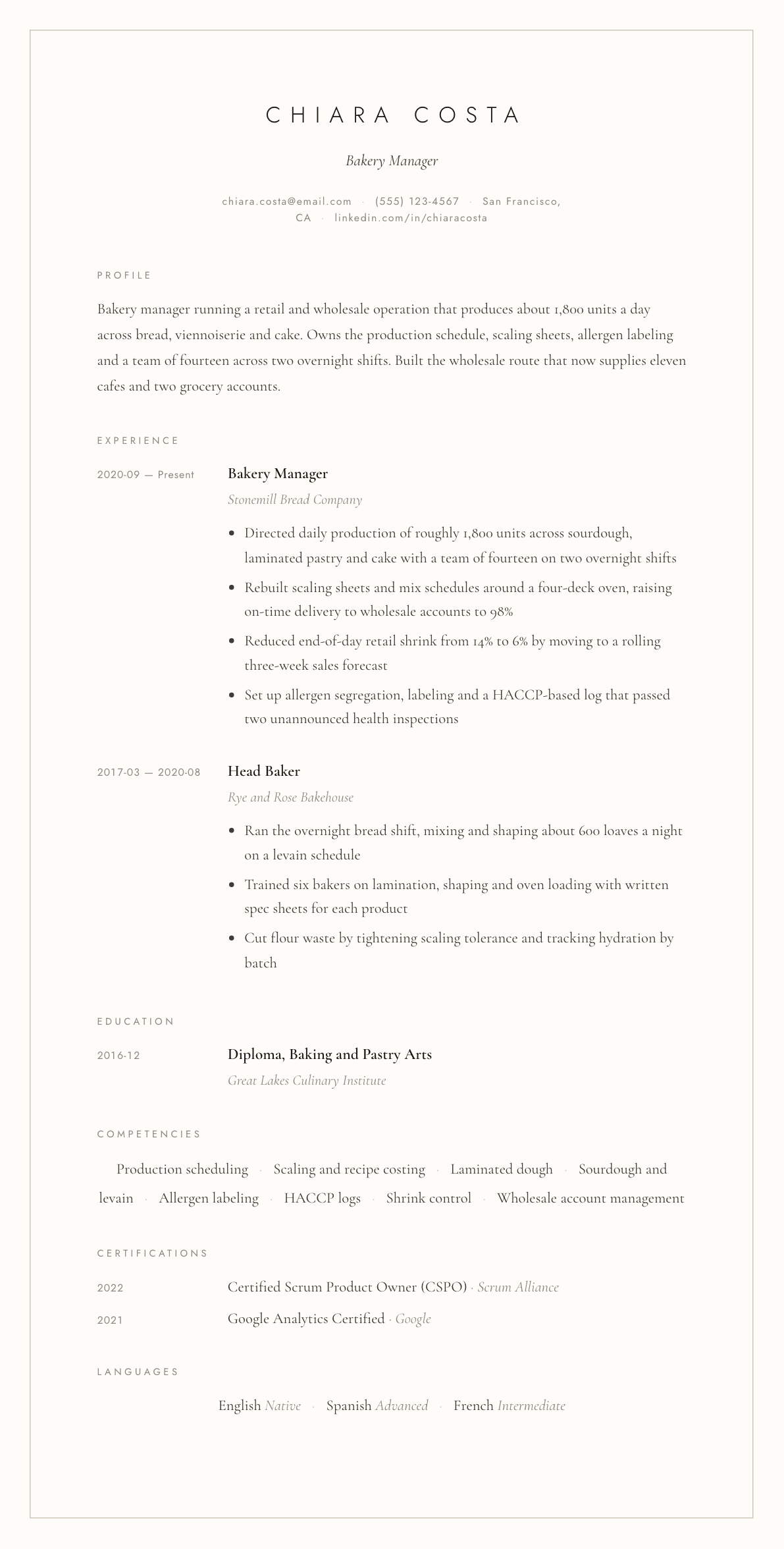
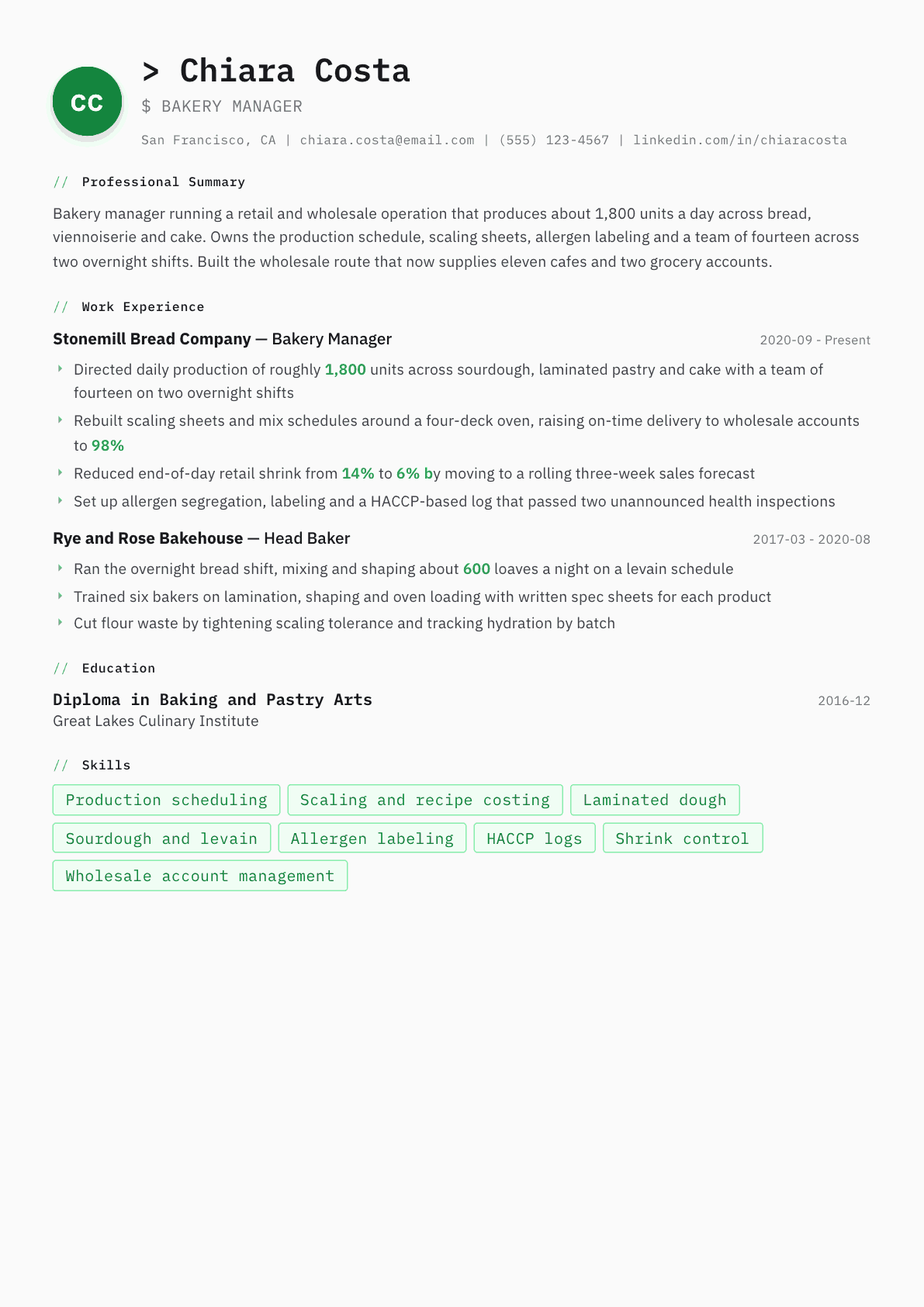
The same bakery manager content laid out in three CVBooster templates, so you can see what the finished document looks like before you write a word.
Example Bakery Manager summary
Bakery manager with eight years in production baking and four leading a retail and wholesale bakehouse. Directs fourteen bakers over two overnight shifts producing about 1,800 units a day, owns scaling sheets and mix schedules, and keeps wholesale on-time delivery near 98%. Cut retail shrink by more than half with forecast-driven par levels. Seeking a production manager role at a larger bakehouse.
Skills to list on a Bakery Manager resume
- Production planning
- Recipe scaling
- Recipe costing
- Laminated dough
- Bread fermentation
- Cake and decorating oversight
- Allergen management
- HACCP documentation
- Inventory and ordering
- Shrink and waste control
- Wholesale account management
- Team training
- Equipment maintenance
- Labor scheduling
What actually gets this resume read
- Open with production volume: units per day, product categories, and how many bakers you direct.
- Separate retail and wholesale results, because those two sides of a bakery are managed very differently.
- Name your oven type, mixer capacity and proofing setup, since equipment tells a hiring baker what you can run.
- Show shrink, waste and on-time delivery numbers, which are the metrics a bakery owner checks first.
- Put allergen control, labeling and food safety logs in their own section, especially for wholesale roles.
- Note overnight or early-start availability directly, because bakery schedules screen candidates on this.
How to write a bakery manager resume
A bakery manager resume is read by someone who will be awake at three in the morning if you get the mix schedule wrong. Whether the reader is an owner, a production director or the head of a wholesale bakehouse, the question underneath every line is the same: can this person build a production plan that lands the right units, at the right quality, on the right truck, without burning through labor or throwing product away.
The answer lives in four kinds of evidence. Volume, expressed in units or trays a day and the number of bakers you direct. Equipment, because a manager who has only run a rack oven cannot walk into a deck house on day one. Numbers on the two lines a bakery owner watches, which are shrink on the retail side and on-time delivery on the wholesale side. And documentation, meaning allergen control, labeling and the food safety logs that keep the wholesale accounts.
This guide lays out how to separate retail results from wholesale results, how to write about equipment and scaling so a working baker believes you, three summaries at different stages, and the bullet rewrites that turn a description of a bakehouse into proof of a manager.
Format: production facts in the job header, two pages once you run wholesale
Reverse chronological, single column, and every job header carries the bakehouse profile: daily unit volume, product categories, number of bakers, number of shifts, and whether the site is retail, wholesale or both. That line does more work than any bullet, because it lets a production director place your experience against his own plant in a second.
Keep the resume to one page while you are a lead or a single-shift supervisor. Move to two once you direct multiple shifts, hold wholesale accounts, or have commissioned equipment, since those need dates, budgets and outcomes that will not compress.
- Header: name, city and state, phone, email, and your availability for overnight starts.
- Sections in this order: summary, production experience, equipment, food safety and allergen control, certifications, education.
- Give equipment its own short block rather than scattering oven names through the bullets.
- Add a wholesale accounts line when you have held named accounts, with the category and the order rhythm.
Summary: volume, team, shifts, and the metric you moved
Four lines. Units a day, product families, how many bakers across how many shifts, and one number that moved because of a decision you made. Bakery owners are numerate and impatient, so a summary that leads with a love of craft and no volume is set aside quickly.
Name the split between retail and wholesale in the summary when both exist. They demand different management: retail lives on forecasting and shrink, wholesale lives on order accuracy, delivery windows and documentation. A reader who runs one of the two needs to know which half you are strong in.
Experience: the plan, the mix, the truck
Write each job as a production cycle. Start with how the plan is built: forecast source, order cutoff, scaling sheets and mix schedule. Then the execution: mixer sizes, oven loads, proofing capacity and how you sequence products so the retarder and the ovens are never the bottleneck at the same time. Then the finish: pack, label, load and the delivery window you had to hit.
Keep retail and wholesale results in separate bullets. Retail bullets carry shrink, forecast accuracy, par levels by day and end-of-day markdown policy. Wholesale bullets carry on-time delivery, order accuracy, credit rate and how you handled a short. Mixing them makes both look vague.
Give recipe scaling and costing real estate. A manager who rebuilt scaling sheets so a formula holds from a small test batch to a full spiral load, and who priced each formula against current flour and butter, is doing the work that keeps a bakehouse solvent. Say it plainly, and say what it changed.
- One bullet on planning: forecast basis, mix schedule and how you handle a spike order.
- One bullet on quality: dough temperature targets, fermentation windows and how you hold them across shifts.
- One bullet on cost: shrink, yield, flour and butter price moves you absorbed or passed on.
- One bullet on people: bakers directed, training path, and coverage when someone calls out at midnight.
- One bullet on compliance: allergen segregation, labeling, sanitation logs and any audit you passed.
Equipment, food safety and the documentation wholesale demands
List equipment with capacity, not just type. A 140-quart spiral, a three-deck steam-injected oven, a double rack oven, a reversible sheeter, a retarder proofer with programmable steps: those specifics tell a hiring baker exactly which of his products you could run unsupervised on day one.
Treat food safety as a system with names attached. Hazard analysis plans, sanitation standard operating procedures, allergen changeover between wheat, nut and dairy runs, metal detection where it exists, temperature and cooling logs, and the label review that keeps a mislabeled allergen off a wholesale pallet. Wholesale accounts and third-party audits turn on this, so it deserves a section rather than a passing mention.
When you have held an audit result, put the scheme name and the outcome on the page. A manager who has been through a customer audit and closed the corrective actions is buying the next employer a large amount of peace.
Keywords a bakery manager posting actually contains
The recurring terms are production planning, recipe scaling, laminated dough, fermentation, hazard analysis documentation, allergen control, wholesale accounts, shrink control, inventory ordering, staff scheduling and equipment maintenance. Use the ones that are true of you inside bullets where they are demonstrated, and repeat the strongest in the skills block.
Availability is a screening keyword in this trade even though it is not a skill. Overnight and early start availability, weekend coverage and holiday season willingness decide bakery hiring more often than any other single line, so put it in the header where nobody has to search for it.
Bakery Manager resume summary examples
Lead baker moving to supervisor
Lead baker with five years of overnight production, currently directing three bakers on a retail bakehouse shift producing about 900 units a night across lean bread, laminated pastry and cake. Owns scaling sheets, mix order and the sanitation log, and covers ordering when the manager is off. Seeking a bakery supervisor role.
Eight years, retail and wholesale
Bakery manager directing fourteen bakers over two overnight shifts at a bakehouse producing around 1,800 units a day for a retail counter and eleven wholesale accounts. Owns mix scheduling, recipe costing and allergen changeover, holds wholesale on-time delivery near 98%, and cut retail shrink by more than half.
Production manager, multi-shift plant
Bakery production manager running three shifts and 40 bakers in a wholesale plant supplying grocery and food service, accountable for the master schedule, labor budget and food safety program. Commissioned a second tunnel line, passed two customer audits with no major findings, and lifted yield on the core bread formula.
Work experience bullets: before and after
Before: Managed daily bakery production and staff.
After: Directed fourteen bakers across two overnight shifts producing roughly 1,800 units a day in lean bread, laminated pastry, cake and par-baked wholesale product.
Headcount, shifts, volume and product families let a production director judge the scope instead of guessing it.
Before: Reduced waste in the retail bakery.
After: Rebuilt daily par levels from day-of-week sales history and moved end-of-day markdowns two hours earlier, cutting retail shrink from 9% to 4% over two quarters.
Two concrete changes and a before and after make the shrink number something the reader can trust.
Before: Made sure wholesale orders went out on time.
After: Resequenced the mix schedule around oven capacity so pastry cleared the decks before the bread bake, lifting wholesale on-time delivery to 98% across eleven accounts.
The bottleneck and the fix explain a delivery number that would otherwise read as luck.
Before: Followed food safety rules and kept records.
After: Ran allergen changeover between wheat, nut and dairy production with documented line clearance, and maintained cooling and sanitation logs that cleared a customer audit with no major findings.
Naming the changeover, the records and the audit outcome turns compliance into a verified result.
Before: Trained new bakers on recipes and equipment.
After: Built a six-week training path taking new bakers from scaling and mixing through shaping, deck oven loading and lamination sign-off, and qualified five bakers to run a shift alone.
A staged path with an end state proves you can create bakers, which is the scarcest thing in the trade.
Hard skills
- Production planning and mix scheduling
- Recipe scaling and costing
- Laminated dough production
- Bread fermentation control
- Dough temperature management
- Deck and rack oven operation
- Spiral mixer and sheeter operation
- Allergen control and changeover
- Hazard analysis documentation
- Inventory and par ordering
- Shrink and yield control
- Wholesale account management
- Labor scheduling across shifts
- Preventive equipment maintenance
Soft skills
- Overnight reliability
- Training and sign-off
- Problem solving under a delivery window
- Communication across shift handover
- Attention to specification
- Calm during peak season
Certifications worth listing
- Certified Journey Baker (CJB) (Retail Bakers of America)
- Certified Baker (CB) (Retail Bakers of America)
- Certified Master Baker (CMB) (Retail Bakers of America)
- ServSafe Food Protection Manager Certification (National Restaurant Association)
- HACCP Certificate of Course Completion (International HACCP Alliance accredited provider)
Mistakes that cost bakery manager candidates the interview
- Writing product lists instead of production numbers, so the reader never learns the volume you can run.
- Naming equipment without capacity, which hides whether you have handled a real plant or a small kitchen.
- Merging retail and wholesale results into one bullet, which weakens both halves of the story.
- Leaving allergen control and labeling off the page when the target job supplies wholesale customers.
- Hiding overnight availability at the bottom, when it is the first thing a bakehouse screens for.
- Claiming a shrink improvement with no ordering or markdown change to explain how it happened.
Bakery Manager resume questions
How do I show bakery volume when we count in different units?
Pick the unit your target employer uses and stay with it. Retail bakehouses usually count pieces or units a day, wholesale plants count cases or pounds, and hotel kitchens count covers. Convert once, state the unit clearly, and add trays or oven loads if it helps.
Does a bakery manager need formal certification?
It is not required in most jobs, but a food protection manager certificate is often a condition of employment and a baking certification helps when you have no culinary school on the page. For wholesale roles, hazard analysis training carries more weight than any baking title.
Should I list the formulas I have developed?
Name the categories and a few signature items rather than a catalog. A reader wants to know you can develop, scale and cost a formula, so pair one product with what it did commercially, such as a laminated item that became a standing wholesale order.
How do I write about equipment I trained on but never ran alone?
Split the equipment block into what you have run in production and what you have trained on. Overstating this is caught in the first week, and honest separation reads as professional judgment rather than a gap, especially with an unusual oven or line.
What if my bakery experience is inside a grocery store?
That is production experience and should be written as such, with daily units, thaw and bake schedules, scratch versus par-baked mix, shrink and markdown policy. Add the merchandising and labeling responsibilities, since grocery bakery managers own compliance that scratch shops do not.
Related resume examples
- Pastry Chef Resume example
- Executive Chef Resume example
- Baker Resume example
- Kitchen Manager Resume example
- Head Chef Resume example
- Cafe Manager Resume example