Carpenter Resume Examples: free ATS score and gap list
Build a Carpenter Resume That Showcases Your Craft
By Mustafa Tarabya, founder of CVBooster · Published · Updated
Create a carpenter resume that highlights your woodworking skills, project experience, and craftsmanship with construction-focused templates.
Sample resumes for a carpenter
The same carpenter content laid out in three CVBooster templates, so you can see what the finished document looks like before you write a word.
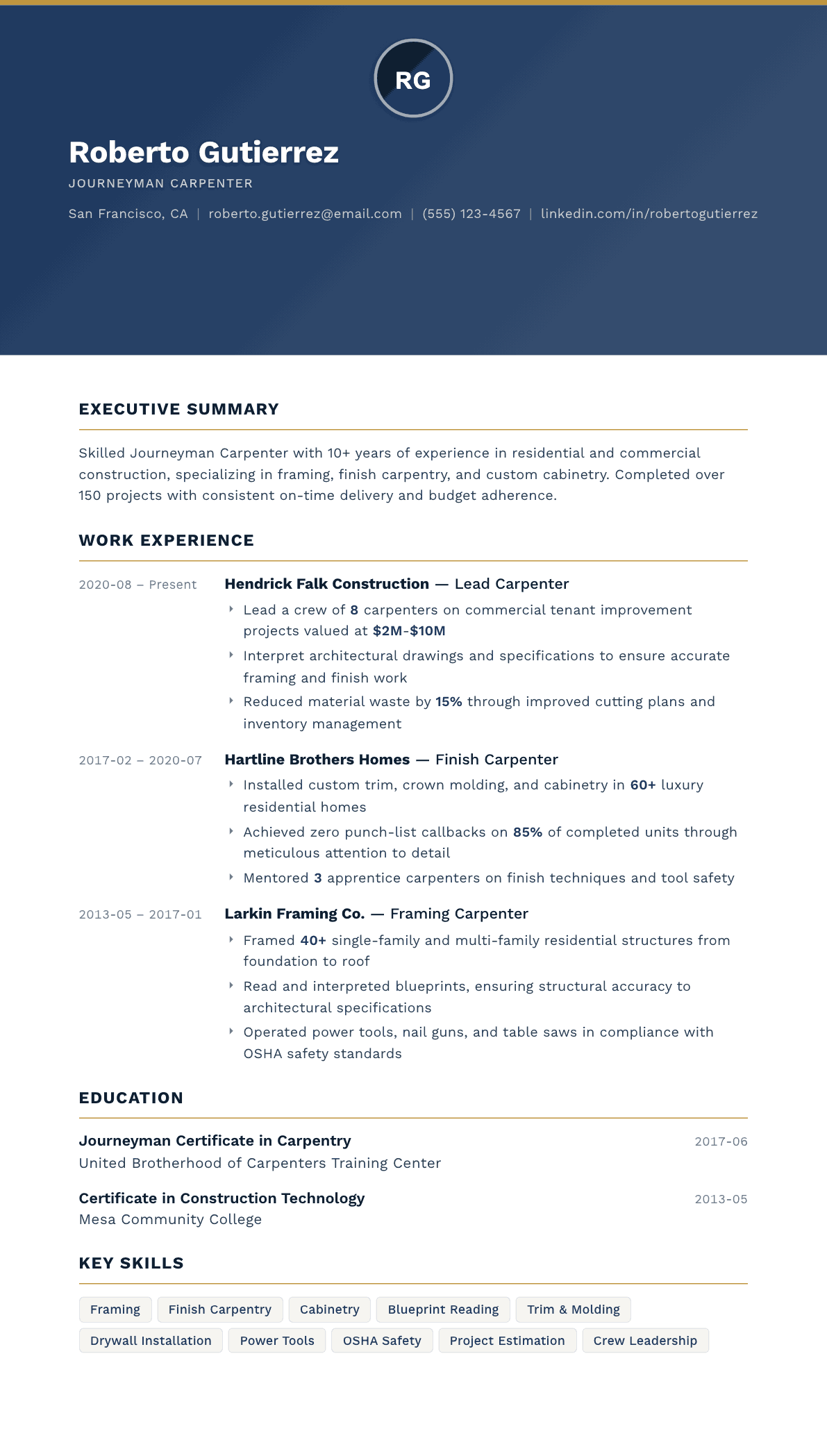
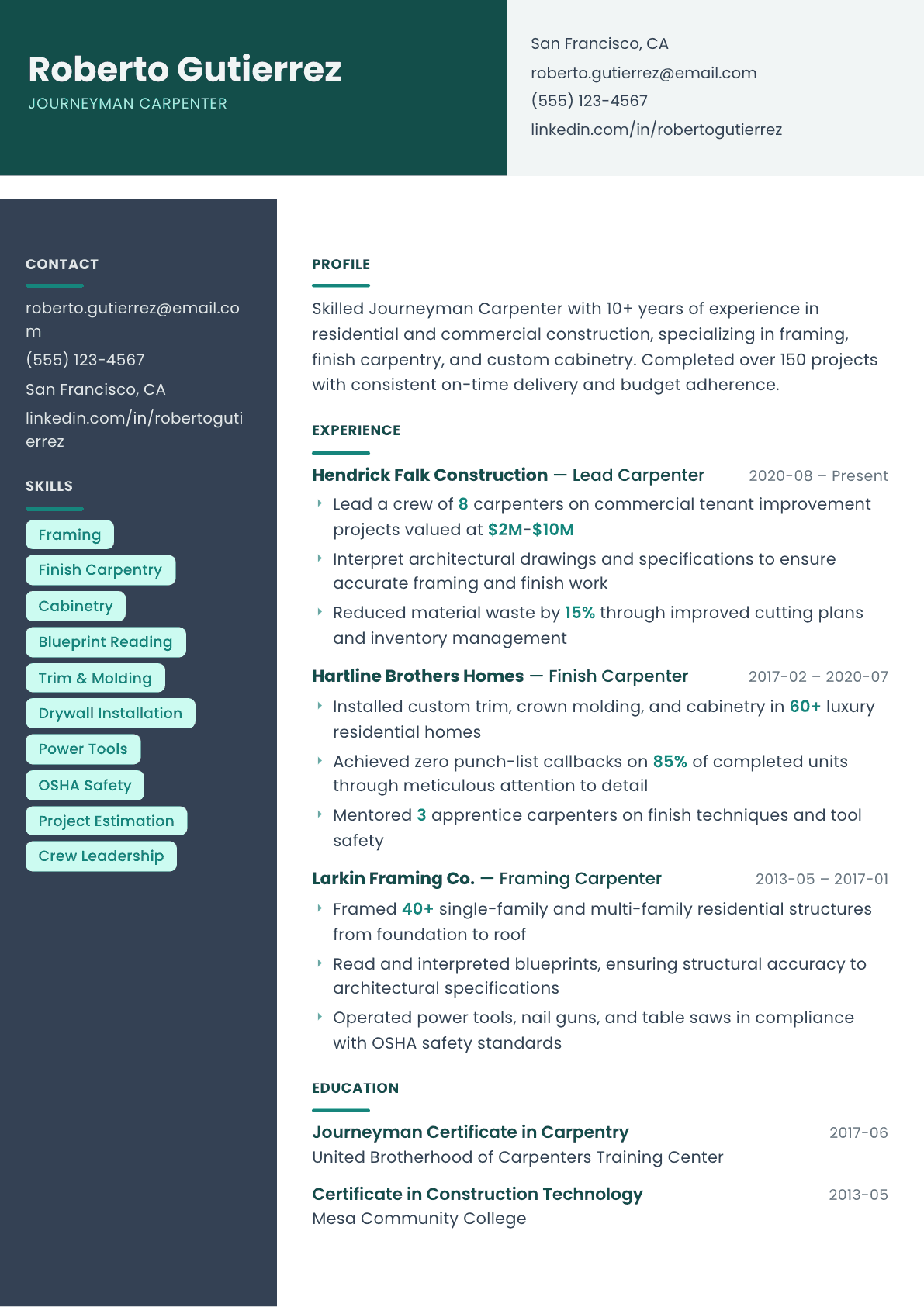
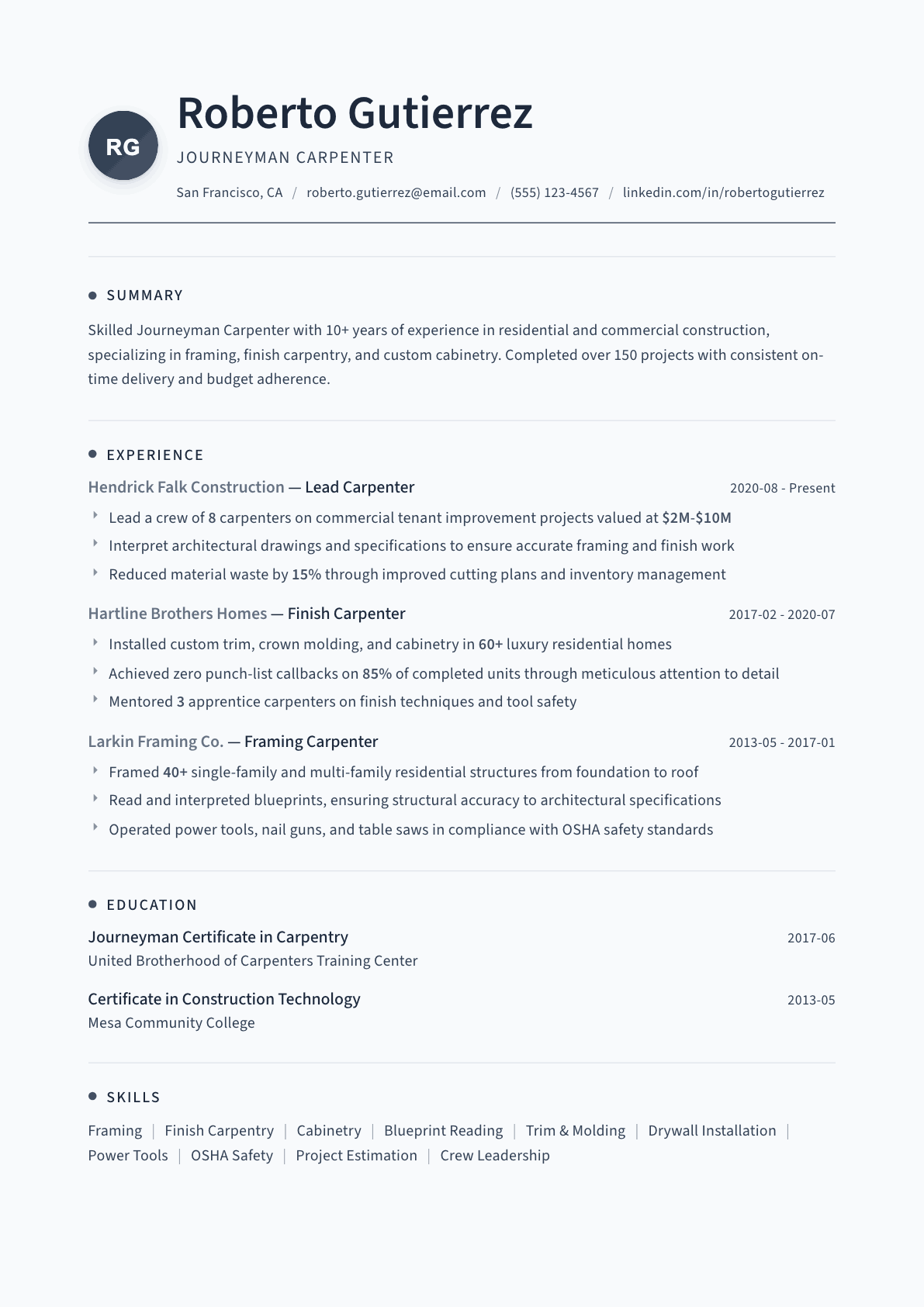
Example Carpenter summary
Journeyman Carpenter with 10 years of experience in residential and commercial construction, specializing in framing and finish carpentry. Led crews of up to 8 on projects valued at $10M+, consistently delivering on time and under budget. Seeking a lead carpenter role with a top-tier general contractor.
Skills to list on a Carpenter resume
- Rough Framing
- Finish Carpentry
- Custom Cabinetry
- Blueprint Reading
- Crown Molding
- Trim Installation
- Drywall & Taping
- Formwork
- Door & Window Installation
- Power Tool Operation
- Project Estimation
- Crew Supervision
- OSHA Compliance
- Material Takeoffs
What actually gets this resume read
- Specify your carpentry specialization: rough framing, finish, cabinetry, formwork, or millwork.
- Quantify projects: number of homes framed, square footage completed, or project dollar values.
- Highlight zero-defect records, punch-list performance, and on-time completion rates.
- Include union membership or journeyman status if applicable. These carry significant weight.
- List power tools and equipment you are proficient with (table saw, miter saw, CNC router).
- Mention blueprint reading and estimation skills to show you can handle lead carpenter responsibilities.
How to write a carpenter resume
A carpenter resume goes to a superintendent or a shop foreman who wants one thing before anything else: what kind of carpentry, on what kind of work. Rough framing on tract housing, commercial metal stud layout, finish and millwork, formwork for concrete, and shop cabinetry are separate trades that happen to share a job title.
The second thing he checks is whether you can be left alone. Layout from prints, a crew of two apprentices, a punch list closed without a callback, and the safety training that lets you on his site on day one. Everything else on the page is decoration.
This guide covers how to organize a trades resume so a general contractor can read it in under a minute, how to describe project work by type and value band, what training and cards to list, three summaries, before and after bullets, and the questions carpenters ask when they sit down to write one.
Format: one page, projects and cards where they can be seen
One page until you are running crews on large commercial work, then two at most. Reverse chronological by employer, with the project types under each one. Skip the graphics and the two-column layouts, because contractor offices run resumes through basic parsers and then print them for the superintendent.
Union carpenters should give the local and the classification, which settles the wage scale and the dispatch question in one line. Nonunion carpenters should give the classification anyway: apprentice, journeyman, lead or foreman.
- Header: name, city, phone, email, classification, and your local if you carry one.
- Order: summary, certifications and cards, experience, tools and skills, apprenticeship or training.
- Under each employer: project types, typical project value band, crew size, and the scope you handled.
- List your safety card, plus site requirements you already hold such as scaffold or fall protection training.
Summary: trade, years and the work you are best at
Two or three lines. Name the classification, the years, the sectors and the specialties: framing and layout, doors and hardware, casework installation, formwork, or historic restoration. A superintendent staffing a hospital interior fit-out is looking for different hands than one framing apartments.
Experience: describe the work, not the trade
The most common failure in a carpentry resume is describing carpentry itself: cut lumber, used power tools, followed blueprints. Every carpenter does that. Write what you specifically handled: wall layout from a dimensioned print, stair stringers, curved soffits, cabinet installation with scribe work, concrete forms held to a tolerance the inspector checked.
Give each employer a project profile: building type, unit count or floor count, value band, and your role. Then two to four bullets on what you built and what you were trusted with. If you ran a crew, say how many and for how long.
Quality signals matter more here than volume. Punch list callbacks, first-time inspection passes, tolerances held, and finishing ahead of the next trade are the things a superintendent raises in a reference call.
Tools, layout and reading the print
Say which tools you own and can run safely, because on many jobs you are expected to arrive with a bag. Then say what you can lay out from, since print reading and layout is the line between a helper and a journeyman.
- Hand and power tools: track saw, miter saw, table saw, router, framing and finish nailers, laser level, transit.
- Layout: dimensioned architectural prints, shop drawings, control lines, benchmark elevations.
- Materials: dimensional lumber, engineered joists, metal stud, plywood and fiberboard, hardwood, solid surface.
- Access: scaffold erection, ladders, aerial and scissor lifts, and the lift training if you hold it.
Apprenticeship, training and cards
A completed apprenticeship is the strongest single line on a carpenter resume. Give the program, the sponsor and the completion, then the safety cards. A ten hour card gets you onto a residential site; a thirty hour card is expected of anyone leading a crew. Add first aid and CPR, forklift, aerial lift, and manufacturer training for hardware or specialty systems.
Keywords a contractor posting repeats
Contractor postings use plain trade language: framing, finish carpentry, blueprint reading, layout, formwork, millwork installation, punch list, safety compliance, and the sector words commercial, residential, tenant improvement or institutional. Use their words, and put the sector in your summary so a recruiter can sort you in seconds.
Carpenter resume summary examples
Apprentice finishing out
Fourth-year carpentry apprentice with 3 years on commercial interiors: metal stud layout, door and hardware installation, and blocking for casework. Holds a thirty hour safety card, scaffold trained, and works comfortably from dimensioned prints. Seeking a journeyman position with a commercial general contractor.
Journeyman
Journeyman carpenter with 8 years split between residential framing and commercial finish work. Frames from prints without supervision, installs casework and hardware to a punch list standard, and has led 2-person crews on tenant improvement jobs. Thirty hour safety card and aerial lift certified.
Lead carpenter or foreman
Lead carpenter with 14 years in commercial construction, running crews of up to 8 on tenant improvement and institutional projects. Handles layout, sequencing with other trades, material takeoffs and punch list closeout, with a record of first-time inspection passes on interior framing and door hardware.
Work experience bullets: before and after
Before: Framed houses and other structures.
After: Framed 40 single-family homes from mudsill to roof, including engineered floor systems, stair stringers and cut-and-stack roofs on 3 custom plans.
Counts plus the hard parts of framing tell a superintendent which tasks you can be handed unsupervised.
Before: Used power tools and hand tools safely.
After: Ran track saw, miter saw and framing nailers daily on occupied hospital floors, working under an infection control permit with containment in place.
The context proves you can work where the rules are tight, which is what separates commercial hands from residential ones.
Before: Read blueprints and followed plans.
After: Laid out interior partitions across 3 floors of an office fit-out from dimensioned prints, setting control lines and checking every door opening against the hardware schedule.
Layout, control lines and the hardware schedule show print work at journeyman level rather than following another carpenter's marks.
Before: Installed trim and cabinets.
After: Installed crown, base and custom casework in 60 luxury units, scribing to out-of-plumb walls and turning over each unit with no punch list callback.
Scribe work and a callback record are the details a finish foreman actually screens for.
Before: Trained new workers.
After: Mentored 3 apprentices through layout and door hardware installation, and signed off their tool safety checks before they worked unsupervised.
Naming what you taught and the accountability you took converts a vague claim into supervisory evidence.
Hard skills
- Rough framing and wall layout
- Finish carpentry and trim
- Blueprint and shop drawing reading
- Door, frame and hardware installation
- Cabinet and casework installation
- Concrete formwork
- Metal stud framing
- Stair construction
- Material takeoff and estimating
- Laser level and transit use
- Scaffold erection and fall protection
- Punch list closeout
- Roof framing and rafter cutting
Soft skills
- Crew leadership
- Coordination with other trades
- Reliability and attendance
- Problem solving on site
- Clear communication with the superintendent
- Mentoring apprentices
Certifications worth listing
- OSHA 10-Hour Construction (OSHA Training Institute)
- OSHA 30-Hour Construction (OSHA Training Institute)
- Journeyman Carpenter (United Brotherhood of Carpenters and Joiners of America)
- Scaffold User and Erector Training (Scaffold and Access Industry Association)
- First Aid and CPR (American Red Cross)
Mistakes that cost carpenter candidates the interview
- Not saying which kind of carpentry you do, which forces a superintendent to guess between framing, finish and formwork.
- Describing the trade in general terms instead of naming the assemblies you have built and the tolerances you held.
- Leaving off the safety card, which on many sites is the difference between starting Monday and waiting a week.
- Using a designed template with icons and columns, when contractor offices print resumes and the layout works against you.
- Listing every short call from a decade of work without grouping them, which reads as someone who does not stay.
- Skipping the apprenticeship or training program, which is the credential most general contractors ask about first.
Carpenter resume questions
Should a carpenter resume list every project?
No. Group them by employer and describe the project types, sizes and your role. Then name three or four projects that match the work you are applying for. A complete job list crowds out the detail a superintendent is actually reading for.
Do I need a resume for union carpentry work?
Dispatch through a local runs on your book position rather than a resume, but contractors requesting a named carpenter, foreman openings and nonunion shops all ask for one. Keep it current with your local, classification, hours and safety cards.
How do I show quality on a carpenter resume?
Use the measures your foreman uses: punch list callbacks, first-time inspection passes, tolerances held on layout, and whether the next trade could start on schedule. Those beat adjectives such as meticulous, which every resume in the stack already claims.
What if I have gaps between construction jobs?
Seasonal and project-based gaps are normal in construction and rarely cost you an interview. Use years rather than months for older roles, and if a gap was long, name the reason briefly: a layoff at project close, school, or a family situation.
How do I move from residential framing to commercial carpentry?
Lead with layout and print reading, add any metal stud, fire-rated assembly or hardware experience you have, and put your safety and lift training high on the page. Commercial superintendents worry about site discipline more than about your ability to cut wood.
Related resume examples
- Construction Manager Resume example
- Painter Resume example
- Roofer Resume example
- Masonry Worker Resume example
- Construction Worker Resume example
- Carpenter Apprentice Resume example