Carpenter Apprentice Resume Examples: what gets the call
Write a Carpenter Apprentice Resume Crews Actually Read
By Mustafa Tarabya, founder of CVBooster · Published · Updated
Carpenter apprentice resume examples with apprenticeship hours, framing and forming skills, tool lists and the words builders screen for.
Sample resumes for a carpenter apprentice
The same carpenter apprentice content laid out in three CVBooster templates, so you can see what the finished document looks like before you write a word.
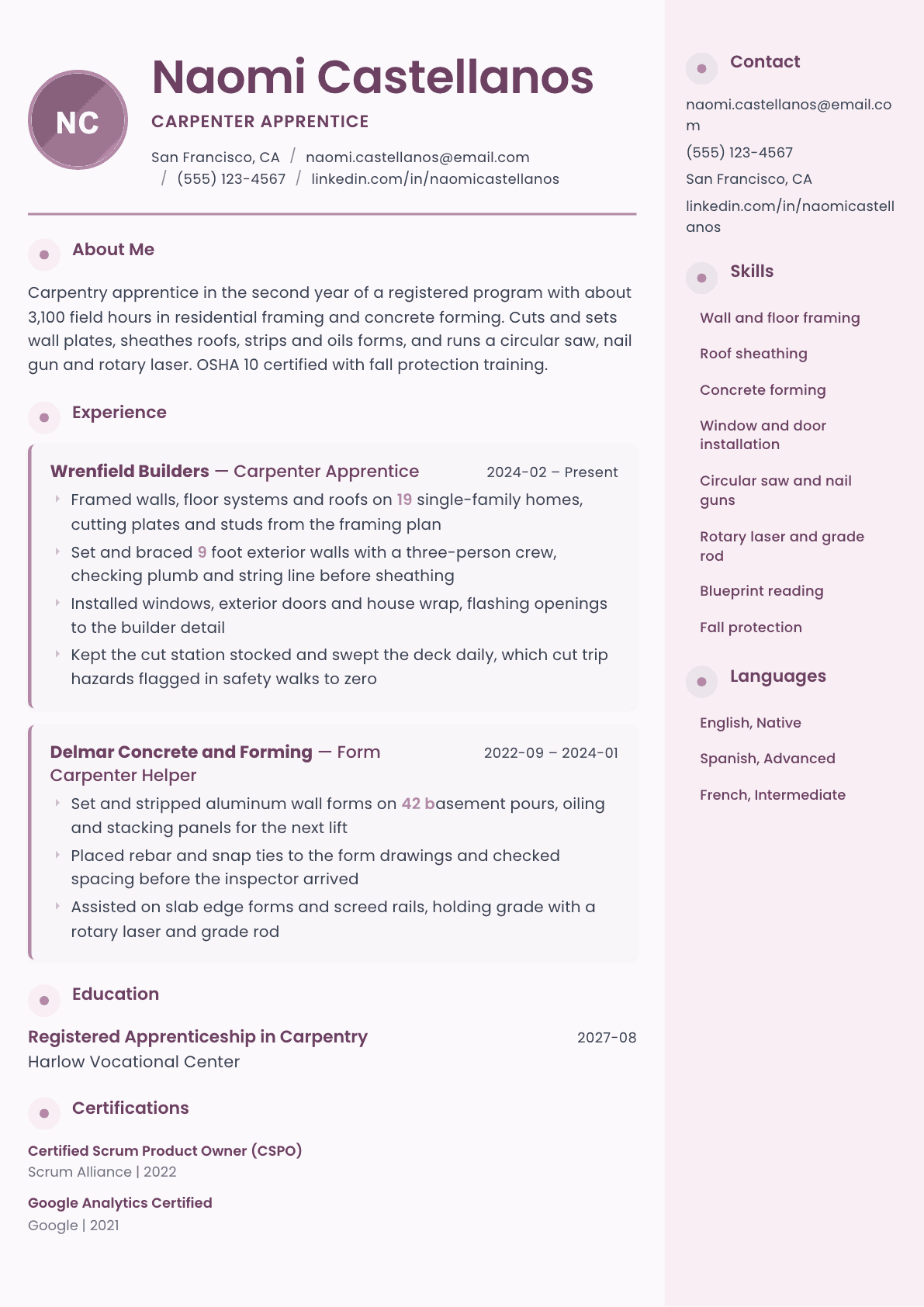
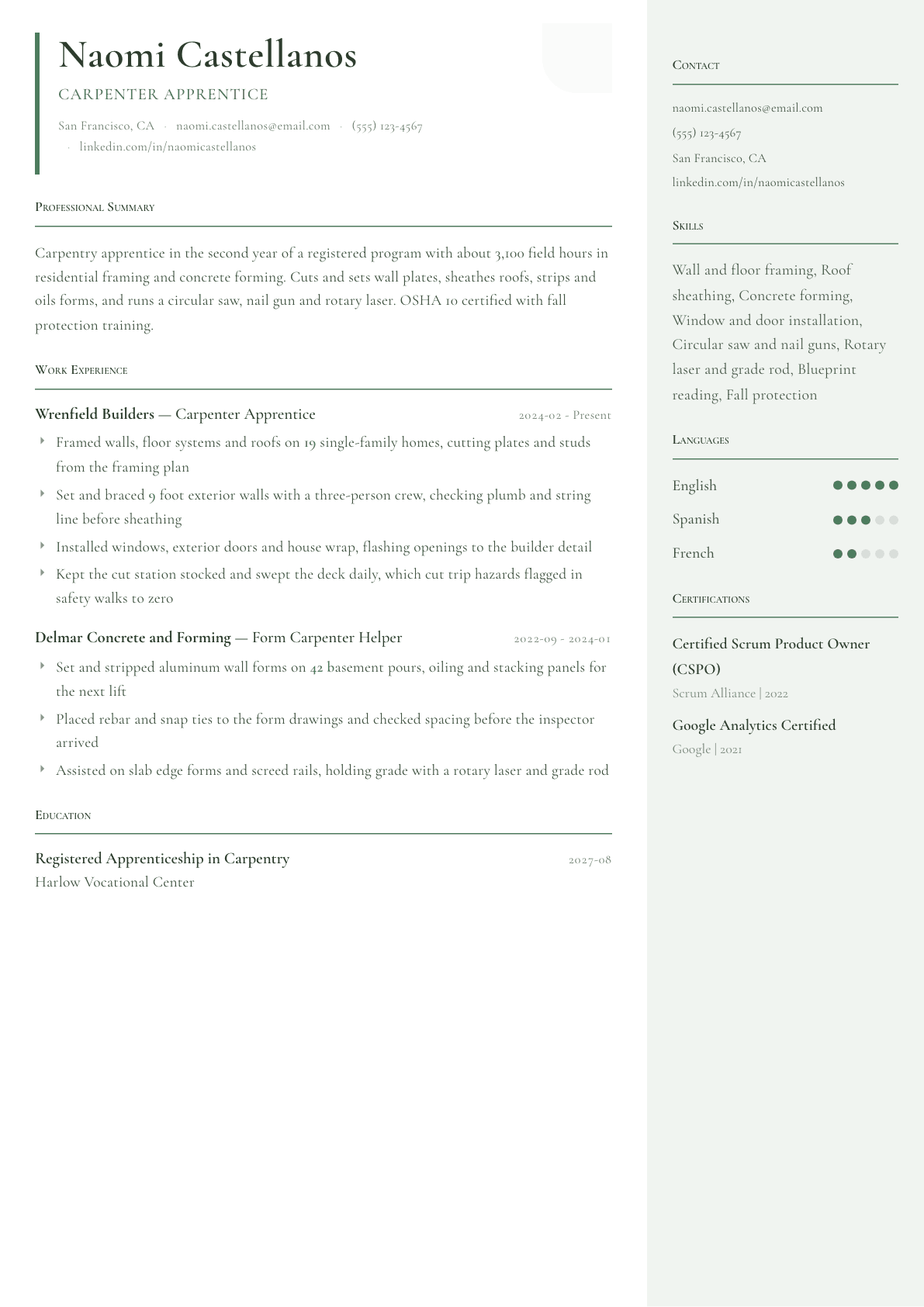
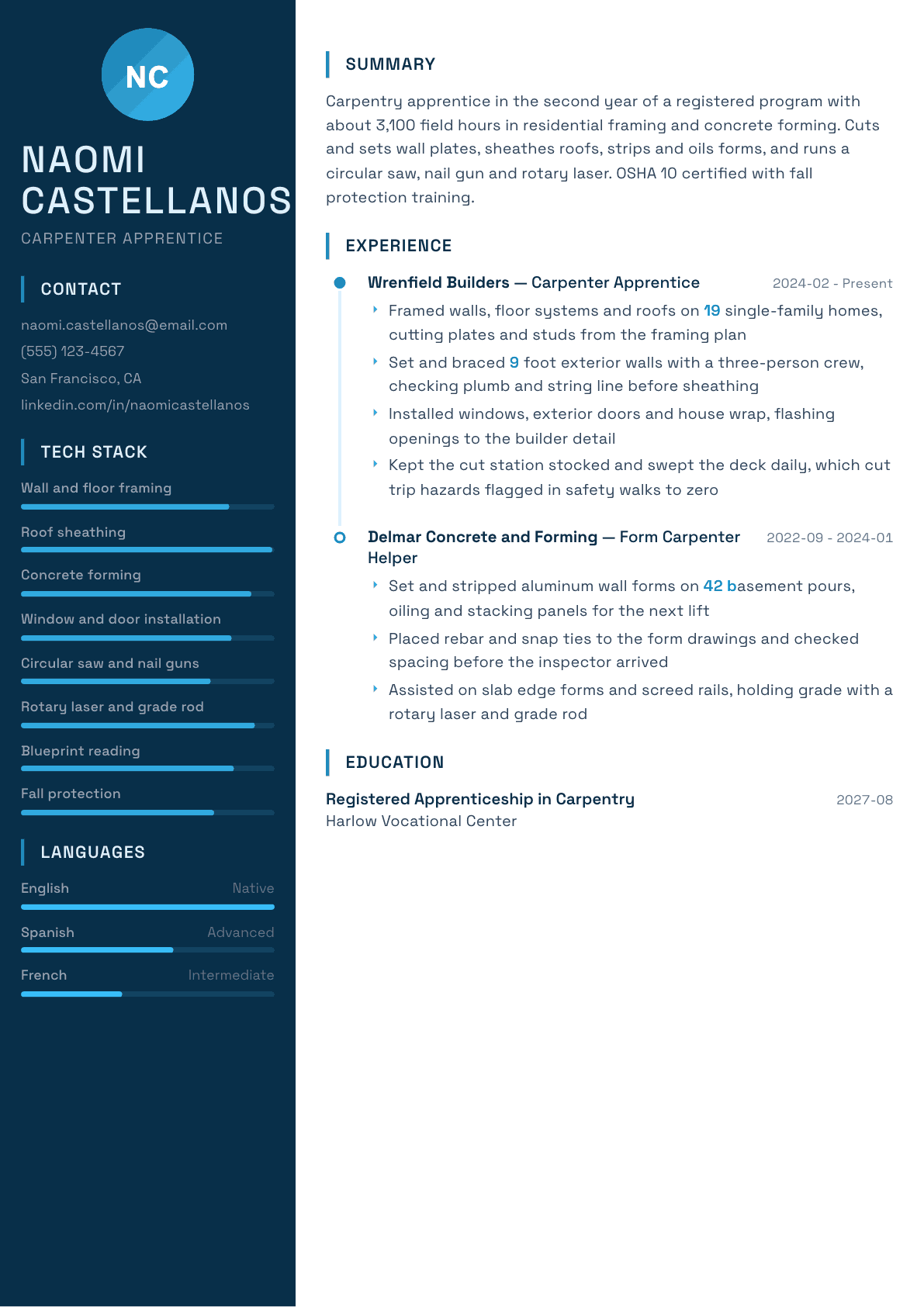
Example Carpenter Apprentice summary
Second-year carpentry apprentice in a registered program with roughly 3,100 documented hours between residential framing and concrete forming. Cuts and sets walls from framing plans, sheathes roofs, installs windows and doors, and strips and stacks aluminum forms. Runs a circular saw, framing nailer and rotary laser without direction. Looking for a builder that frames year round and will sign the remaining apprenticeship hours.
Skills to list on a Carpenter Apprentice resume
- Wall and floor framing
- Roof framing and sheathing
- Concrete wall forms
- Rebar placement
- Window and door installation
- Blueprint and framing plan reading
- Circular and miter saw
- Framing and finish nailers
- Rotary laser and grade rod
- Layout and measuring
- Fall protection
- Scaffold safety
- Material handling
- Site cleanup and staging
What actually gets this resume read
- Lead with the apprenticeship year, the registered program and your logged hours, since those hours are the credential.
- Split your experience into framing, forming and finish, because crews hire for one of those three at a time.
- List the tools you own and the ones you run daily, from a worm drive saw to a rotary laser and framing nailer.
- Name the plans you work from, such as framing plans, form drawings or truss layouts, to show you can read them.
- Put fall protection, OSHA 10 and any scaffold or aerial lift training in a short certifications block.
- Add reliable transportation, a valid driver license and your willingness to travel between job sites.
How to write a carpenter apprentice resume
A carpenter apprentice resume is usually read on a phone by a lead carpenter standing on a deck. They want three things: how much field time you have, which kind of carpentry it was, and whether you show up. Everything else is decoration. If your apprenticeship year and your hour count are not in the first few lines, the reader has already scrolled past.
Carpentry splits into lanes that hire separately. Framing crews, concrete form crews, interior systems and finish crews all call themselves carpentry and all want different hands. An apprentice with form hours is a strong hire for a foundation contractor and an unknown quantity to a trim outfit, so the lane has to be labeled rather than left implied.
What follows is the section order that works for apprentices, how to write field work so a lead can price it, three summaries across an apprenticeship, before and after bullets, and the questions apprentices ask when a crew is hiring on Monday.
Format: one page, hours and lane first
One page, single column, reverse chronological. The header should carry your name, city and state, phone, email, driver license class, and a short line stating that you own hand tools and have reliable transportation to a job site. Crews start early and often move between sites, so transportation is a real screening question.
Under the header, add an apprenticeship block naming the registered program, your year, your documented on-the-job hours and your classroom hours. If your hours split across framing, forming and finish, list them separately, because that split is the fastest way for a lead to decide you belong on their crew.
- Header: contact details, driver license class, own tools, transportation.
- Apprenticeship block: program, year, hours by category, classroom hours.
- Then experience by lane, safety cards, education, skills.
Experience: the structure, the count and the tool
Every job gets the contractor, your title with the apprenticeship year, and the type of work. Then write bullets around what you built and how many. Houses framed, walls stood, forms set and stripped, doors and windows installed, decks sheathed. Counts matter for an apprentice because they stand in for the speed a lead cannot observe from a resume.
Attach a tool or a method to each task. Cutting plates and studs from a framing plan, standing and bracing walls with a string line, sheathing with a coil nailer, holding grade with a rotary laser and rod, oiling and stacking aluminum forms. A lead reads those and knows what you can be handed on the first morning.
Include the parts of the day that are not building. Staging material, keeping the cut station stocked, sweeping the deck, loading and unloading the trailer. Crews notice apprentices who keep the site moving, and it is fair to say so as long as it is one line rather than four.
Safety cards and site readiness
Give safety training its own short block. Construction outreach training, fall protection, scaffold user, aerial and scissor lift, and first aid and CPR are the ones that come up. Framing at height and forming near excavations both put an apprentice into training requirements immediately, so a lead wants to see them before the interview rather than after.
Add any equipment you have been checked out on, such as a telehandler, a forklift or a skid steer. Even limited time on a machine changes how a crew can use you on a delivery day.
Skills: name the work, not the qualities
Write skills as tasks and tools grouped by lane. Framing skills in one group, forming in another, tools in a third. Include measuring and layout explicitly, since layout is where an apprentice earns responsibility, and include the saws and nailers you run daily by type rather than by brand alone.
Leave out adjectives about being hardworking or a fast learner. Every apprentice resume claims them, so they carry no information. A line saying you can lay out a wall from a framing plan carries a great deal.
Keywords builders and crews search on
The searchable vocabulary here is short: apprentice, carpenter, framing, forming, layout, sheathing, trusses, joists, plates, rebar, blueprint, nailer, laser, fall protection, OSHA card. Put each term where the work is described. A term that appears only in a list looks copied, and a lead carpenter can tell within one question in the interview.
Carpenter Apprentice resume summary examples
First year
First-year carpentry apprentice with 1,300 hours on residential framing crews. Cuts plates and studs from the framing plan, carries and stands walls, sheathes decks with a coil nailer, and keeps the cut station stocked. Holds an OSHA 10 card and fall protection training, owns hand tools, and starts on time.
Second year
Second-year apprentice with about 3,100 hours split between residential framing and concrete forming. Sets and braces exterior walls, sheathes roofs, installs windows and exterior doors to the builder flashing detail, and strips, oils and stacks aluminum wall forms after a pour.
Fourth year
Fourth-year carpentry apprentice with 6,800 hours across framing, forming and interior systems. Snaps plate layout from prints without direction, cuts common and hip rafters, sets floor trusses, and runs a two-person section of the crew when the lead is on another lot.
Work experience bullets: before and after
Before: Helped build houses with a framing crew.
After: Framed walls, floor systems and roofs on 19 single-family homes, cutting plates and studs from the framing plan and standing 9 foot exterior walls with a three-person crew.
The house count, the assemblies and the crew size tell a lead exactly what stage of framing you have carried.
Before: Worked with concrete forms.
After: Set and stripped aluminum wall forms on 42 basement pours, placing snap ties to the form drawings and oiling and stacking panels for the next lift.
Pour count, form type and the placement detail turn a general statement into a repeatable production skill.
Before: Installed windows and doors.
After: Installed windows and exterior doors and applied house wrap, flashing every opening to the builder detail so the units passed the weatherization walk.
Naming the detail sheet and the inspection outcome shows the work was done to a standard, not just done.
Before: Used a laser to check levels.
After: Held grade on slab edge forms and screed rails with a rotary laser and grade rod, checking each run before the pour crew arrived.
The instrument plus the check point proves layout ability rather than the ability to hold a rod for someone else.
Before: Cleaned up the job site.
After: Swept and cleared the deck at the end of every shift and stacked cutoffs at the saw, which took trip hazards off the safety walk list entirely.
Linking cleanup to a safety outcome earns it a line instead of reading as filler at the bottom of a job.
Hard skills
- Wall and floor framing
- Roof framing and sheathing
- Plate layout from framing plans
- Concrete wall forms and stripping
- Rebar and snap tie placement
- Window and exterior door installation
- Rotary laser and grade rod
- Circular, miter and track saws
- Framing and coil nailers
- Measuring, squaring and bracing
- Blueprint and detail reading
- Fall protection and scaffold safety
Soft skills
- Early and consistent attendance
- Following layout instructions exactly
- Keeping the crew supplied
- Working safely at height
- Asking before cutting
Certifications worth listing
- OSHA 10-Hour Construction (OSHA Outreach Training Program)
- Carpentry Level One (NCCER)
- Adult First Aid, CPR and AED (American Red Cross)
Mistakes that cost carpenter apprentice candidates the interview
- Leaving the apprenticeship year and hour split off the page, which is the first thing a lead carpenter looks for.
- Calling everything carpentry without naming the lane, so neither a framing crew nor a trim outfit claims you.
- Writing duties in the passive voice so no line names a structure you personally cut, stood or sheathed.
- Skipping fall protection and outreach training, which stops you being put to work above the first floor.
- Filling the page with unrelated jobs when one page of framing and forming work would read stronger.
- Listing brand names of tools instead of the tasks they were used for, which tells a lead nothing about ability.
Carpenter Apprentice resume questions
How do I get a carpentry apprenticeship with no experience?
Put physical, tool-based work first, whether that is landscaping, moving, warehouse or farm work. Add your application status with a registered program, your driver license class, and the hand tools you already own.
Should I list framing and forming work separately?
Yes. They are hired by different contractors and the hours are judged differently. Split them by employer or by hour category so a reader can see at a glance which lane holds most of your field time.
Do carpentry apprentices need certifications on a resume?
Safety cards are the ones that matter early: construction outreach training, fall protection, scaffold user and first aid. Trade level certificates from a training program are a useful addition but rarely the deciding factor.
How do I show speed without exaggerating?
Use counts and cycles rather than adjectives. Houses framed in a season, pours per month, or walls stood in a day with a stated crew size all convey pace and can be checked against a former lead.
What should a carpenter apprentice avoid putting on the resume?
Objective statements, generic personal qualities and long lists of coursework. Those crowd out field hours. Keep unrelated employment to one line each and give the space to the tasks you can perform on a crew.
Related resume examples
- Carpenter Resume example
- Construction Worker Resume example
- Framer Resume example
- Construction Laborer Resume example
- Construction Foreman Resume example
- Finish Carpenter Resume example