Painter Resume Examples: free score, then the gap list
Paint a Picture of Success with a Professional Painter Resume
By Mustafa Tarabya, founder of CVBooster · Published · Updated
Create a painter resume that highlights your surface preparation skills, coating expertise, and project completion record.
Sample resumes for a painter
The same painter content laid out in three CVBooster templates, so you can see what the finished document looks like before you write a word.
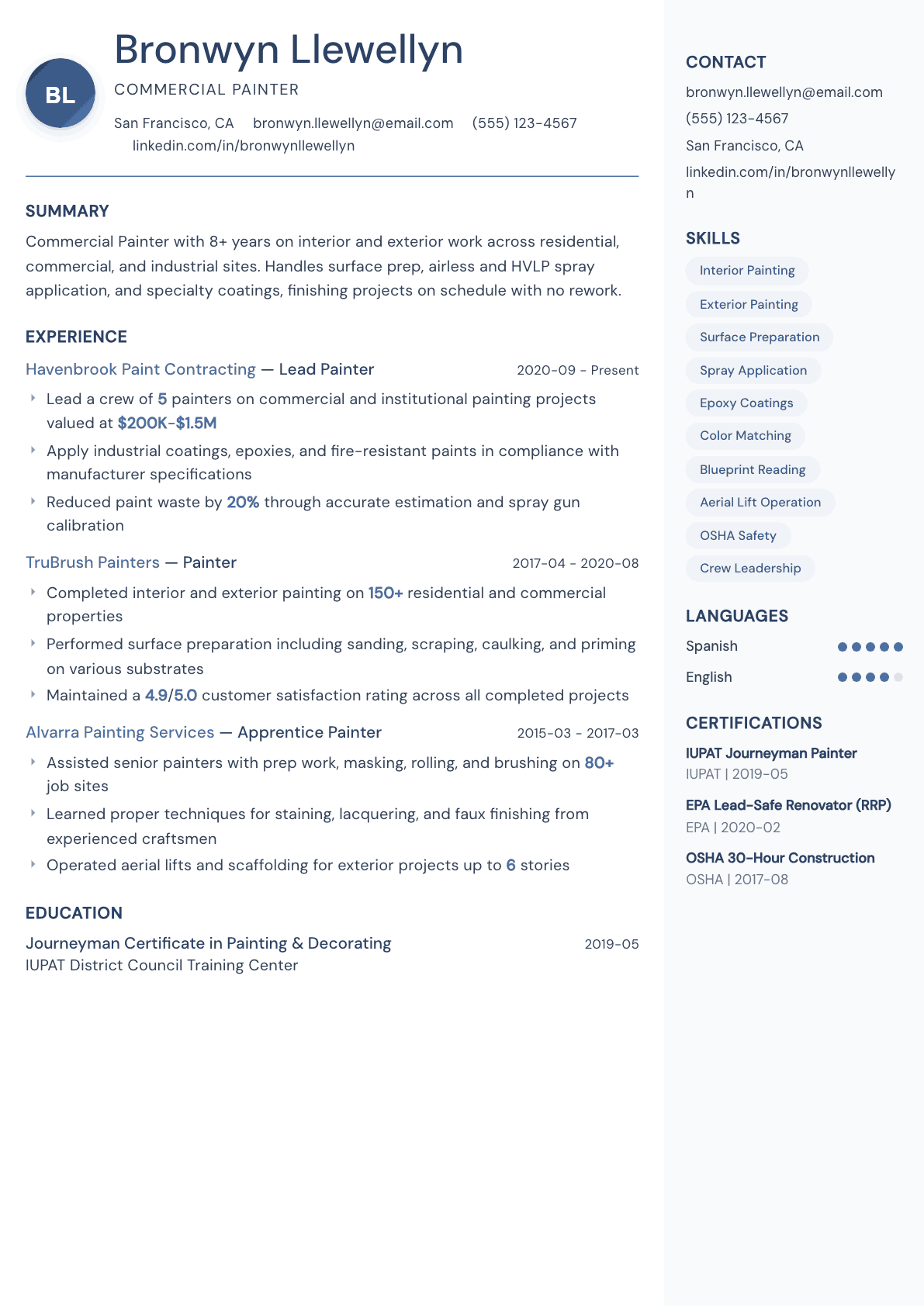
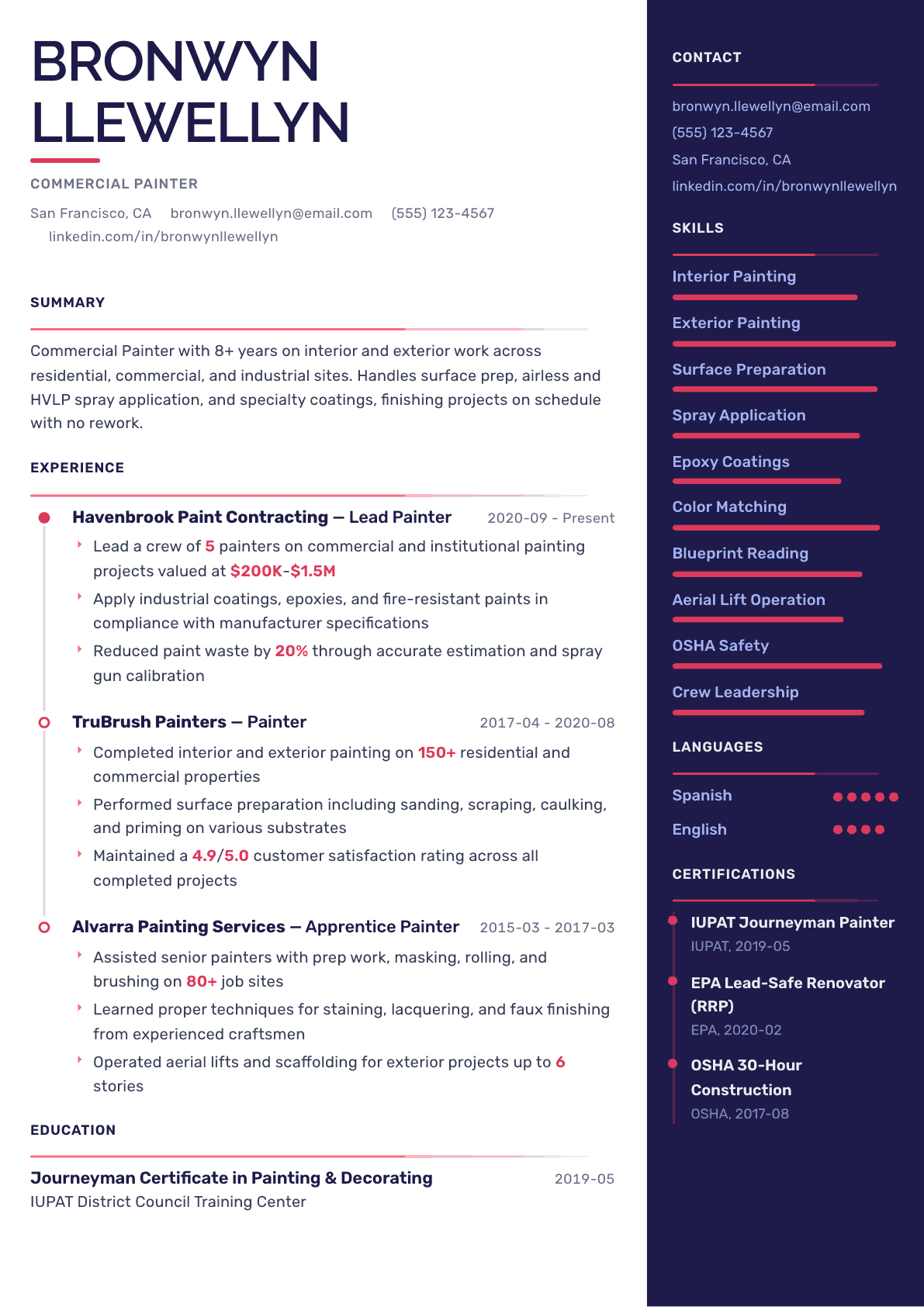
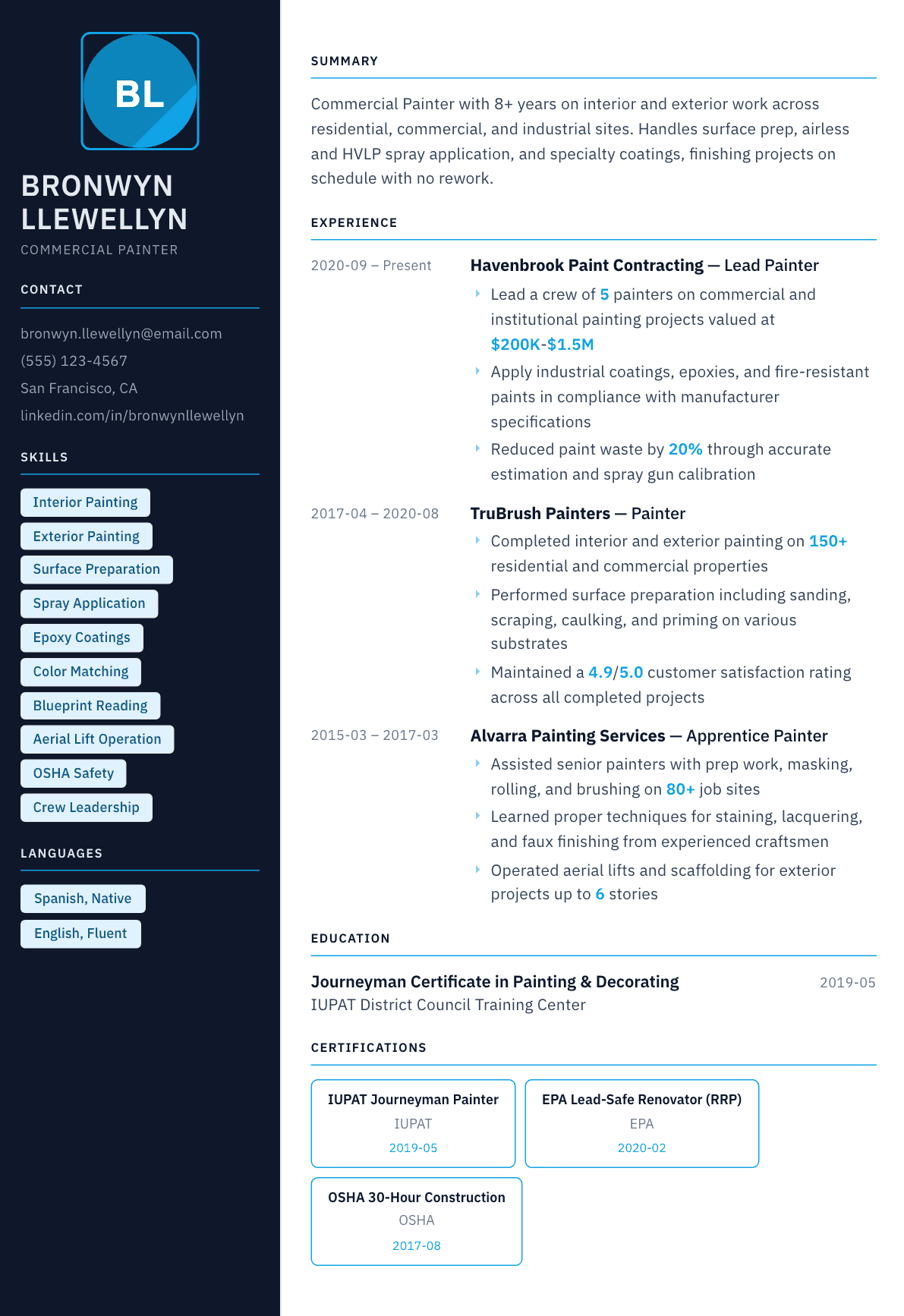
Example Painter summary
Journeyman Commercial Painter with 8 years of experience in interior and exterior painting for residential, commercial, and industrial projects. Skilled in spray application, epoxy coatings, and surface preparation with a 4.9/5.0 customer satisfaction rating. Seeking a lead painter role on large-scale commercial projects.
Skills to list on a Painter resume
- Interior Painting
- Exterior Painting
- Surface Preparation
- Airless Spray Application
- HVLP Spraying
- Epoxy & Industrial Coatings
- Color Matching
- Faux Finishing
- Wallpaper Installation
- Drywall Repair
- Caulking & Sealing
- Aerial Lift Operation
- OSHA Compliance
- Lead-Safe Practices (RRP)
What actually gets this resume read
- Specify your painting specialization: residential, commercial, industrial coatings, or decorative finishes.
- Quantify your work: number of properties painted, square footage covered, or project dollar values.
- Highlight specialty skills: epoxy flooring, spray finishing, faux painting, lead abatement.
- Include equipment proficiency: airless sprayers, HVLP guns, aerial lifts, scaffolding.
- Mention EPA lead-safe certification (RRP) as it is required for pre-1978 building work.
- Emphasize customer satisfaction ratings and zero-rework records.
How to write a painter resume
A painter resume is read by an estimator or a lead who wants to know which surfaces you prepare, what you can spray, and whether your work comes back on the punch list. Residential repaint, new commercial construction, industrial coatings and specialty finishes are four different trades hiding under one word.
The resumes that lose out describe the obvious: painted walls, prepared surfaces, cleaned up afterward. The ones that win name the substrates, the coating systems, the spray equipment, the film thickness and the environments the work happened in, from occupied medical offices to tank interiors.
This guide covers how to organize a painting resume for a commercial contractor, how to write preparation and application work so it demonstrates skill, the certifications that actually exist in coatings, three summaries, before and after bullets, and the questions painters ask most.
Format: one page, sector and equipment up front
One page, single column, no design flourishes. State the sector in the summary: residential, commercial, institutional or industrial. Then add an equipment and coatings block, because a contractor bidding warehouse work searches for airless spray and dry fall, while a hospital job wants low odor systems and containment.
Under each employer, add a project profile: building types, project value bands or approximate area, crew size, and whether the work was new construction, repaint or restoration. That line lets an estimator place you without reading every bullet.
- Header: name, city, phone, email, classification and years in the trade.
- Order: summary, certifications and cards, experience, coatings and equipment, training.
- Equipment: airless and air-assisted sprayers, high volume low pressure guns, texture rigs, sanders, pressure washers, lifts.
- Coatings: latex and alkyd systems, epoxies, urethanes, elastomerics, intumescent coatings, stains and lacquers.
Summary: surfaces, systems and the standard you hold
Two or three lines. Years, sector, the surfaces you prepare, the systems you apply, and one standard you hold: a clean cut line without tape, a specified dry film thickness, or a finish that survived a white glove walk on a hotel handover.
Experience: preparation is the job
Preparation is where painting is won or lost and it is what estimators screen for. Name what you do to a substrate before the first coat: scraping, sanding, patching and skim coating, caulking, degreasing, power washing, abrasive preparation, priming for the specific substrate, and dealing with existing failures such as peeling or chalking.
Application bullets should name the method, the equipment and the specification. Brush and roll, back-rolling a sprayed coat, tip sizes and pressures, the number of coats, wet and dry film thickness, and the recoat windows you worked inside.
Site conditions belong on the page too. Occupied buildings, night work, containment and masking, lead safe practices in older properties, ventilation, and coordination with other trades so the finish is genuinely the last thing touched.
Coatings, substrates and quality checks
What separates an industrial painter from a residential one is the system and the measurement, so name both rather than leaving the reader to guess from the employer names.
- Substrates: drywall, plaster, wood, concrete and block, structural steel, galvanized metal, and previously coated surfaces.
- Systems: primer and topcoat combinations, epoxy and urethane systems, elastomeric coatings, fireproofing, and specialty finishes.
- Measurement: wet and dry film thickness gauges, adhesion testing, surface profile, moisture readings before coating.
- Conditions: temperature and humidity limits, dew point, and the manufacturer data sheet you worked from.
Certifications, safety and training
Painting has real credentials on the industrial side. Coating applicator and inspector programs exist through the industry association, and lead safe renovator certification is a legal requirement for work that disturbs paint in older housing. Add the site safety card, respirator fit testing and lift training.
Manufacturer training on a specific coating line is worth listing when a contractor sells or specifies that line, since it removes a training cost and signals that you can read a product data sheet and work to it.
Keywords a painting posting repeats
These postings use direct language: surface preparation, airless spray, drywall repair, caulking, priming, coatings application, film thickness, containment, lead safe practices, punch list, and the sector word. Match them, and name the equipment, because that is the fastest filter an estimator has.
Painter resume summary examples
Second year in the trade
Painter with 2 years on residential repaint and light commercial work: surface preparation, patching, caulking, cutting in and rolling. Runs an airless sprayer under supervision, keeps a clean and well masked work area, and holds lead safe renovator certification for older homes.
Commercial painter
Commercial painter with 8 years on interior and exterior work for offices, schools and multifamily buildings. Sprays and back-rolls, applies epoxy floor and wall systems, works to a specified dry film thickness, and turns over units with almost no punch list rework.
Lead painter or foreman
Lead painter with 14 years running crews of up to 5 on commercial and institutional projects. Applies industrial coatings, epoxies and fire-resistant systems to manufacturer specification, estimates material from takeoffs, and sequences the crew around other trades on occupied sites.
Work experience bullets: before and after
Before: Painted interior and exterior surfaces.
After: Painted interiors and exteriors on 40 multifamily units, preparing drywall, trim and previously coated stucco and applying 2 finish coats to a written specification.
Substrates, unit count and the coat schedule show the work at the level a contractor is actually pricing.
Before: Prepared surfaces before painting.
After: Prepared failing exterior stucco by pressure washing, scraping chalked coating, patching cracks and applying a masonry primer ahead of the elastomeric topcoat.
A preparation sequence for a named failure proves you understand why coatings fail, not only how to apply them.
Before: Used spray equipment.
After: Sprayed dry fall on open warehouse ceilings with an airless rig, selecting tip size and pressure for the coating and back-rolling walls for uniform build.
Equipment choices and the reasoning behind them are what an estimator uses to judge a sprayer.
Before: Applied industrial coatings.
After: Applied epoxy and urethane systems on structural steel to a specified dry film thickness, verifying with a gauge and logging the readings for the inspector.
The specification and the verification step move the work from painting into coatings, which pays differently.
Before: Kept the job site clean.
After: Masked and contained work areas inside an occupied medical office, ran night shifts to avoid patient hours, and returned every space usable by the next morning.
Containment and scheduling around occupancy are the conditions that make commercial repaint work genuinely difficult.
Hard skills
- Surface preparation and substrate assessment
- Drywall patching and skim coating
- Caulking and sealing
- Airless and high volume low pressure spray application
- Back-rolling and brush and roll finishing
- Epoxy and urethane coating systems
- Elastomeric and masonry coatings
- Fire-resistant and intumescent coatings
- Dry film thickness measurement
- Pressure washing and abrasive preparation
- Wood staining and finishing
- Color matching and tinting
- Material takeoff and estimating
- Scaffold, ladder and lift work
Soft skills
- Working clean around occupants
- Steady hand and patience on detail work
- Crew coordination
- Scheduling around other trades
- Customer communication
- Reliability on night and weekend shifts
Certifications worth listing
- Coating Application Specialist (Association for Materials Protection and Performance)
- Coating Inspector Program Level 1 (Association for Materials Protection and Performance)
- Lead Safe Renovator Certification (United States Environmental Protection Agency)
- OSHA 10-Hour Construction (OSHA Training Institute)
- Aerial and Scissor Lift Operator Training (Scaffold and Access Industry Association)
Mistakes that cost painter candidates the interview
- Describing painting instead of preparation, when preparation is what an estimator is really buying from you.
- Leaving out the sector, so a commercial contractor cannot tell whether you have worked anywhere but houses.
- Skipping the spray equipment, which is the single fastest filter an estimator applies to production work.
- Never naming a coating system, which keeps you out of the industrial work that pays considerably more.
- Omitting lead safe certification when a large share of the available repaint work sits in older housing.
- Claiming perfect finishes with no punch list or callback evidence anywhere on the page to support it.
Painter resume questions
What should a painter put on a resume with no formal training?
Lead with the surfaces, coatings and equipment you have handled, the sectors you have worked in, and the leads you have worked under. Painting is largely learned on the job, and a specific equipment and coatings list carries more weight than a certificate.
Do painters need certification?
Not for general residential and commercial work. Lead safe renovator certification is legally required for disturbing paint in older housing, and coating applicator or inspector credentials matter on industrial and infrastructure projects where a written specification governs the work.
How do I show quality without exaggerating?
Point at checkable things: punch list results, film thickness readings that met specification, first-time acceptance on a walkthrough, and a clean containment record in occupied buildings. Those hold up in a reference call in a way that flawless never does.
Should I list residential and commercial work separately?
If you have both, group them so a reader sees each clearly, and lead with the one that matches the posting. The skills overlap but the environments do not, and an estimator hiring for institutional work needs to see that side without hunting.
How do I move into industrial coatings work?
Show any steel, concrete, epoxy or tank work you have done, learn to read a product data sheet properly, and add a coating applicator credential. Industrial contractors hire on specification discipline, meaning surface profile, thickness and conditions, more than on brush skill.
Related resume examples
- Carpenter Resume example
- Masonry Worker Resume example
- Roofer Resume example
- Drywall Installer Resume example
- Handyman Resume example
- Arborist Resume example