Masonry Worker Resume Examples: the lines they read
Build a Masonry Worker Resume That Lays a Strong Foundation
By Mustafa Tarabya, founder of CVBooster · Published · Updated
Create a masonry worker resume showcasing your bricklaying, stone setting, and concrete skills with industry-appropriate templates.
Sample resumes for a masonry worker
The same masonry worker content laid out in three CVBooster templates, so you can see what the finished document looks like before you write a word.
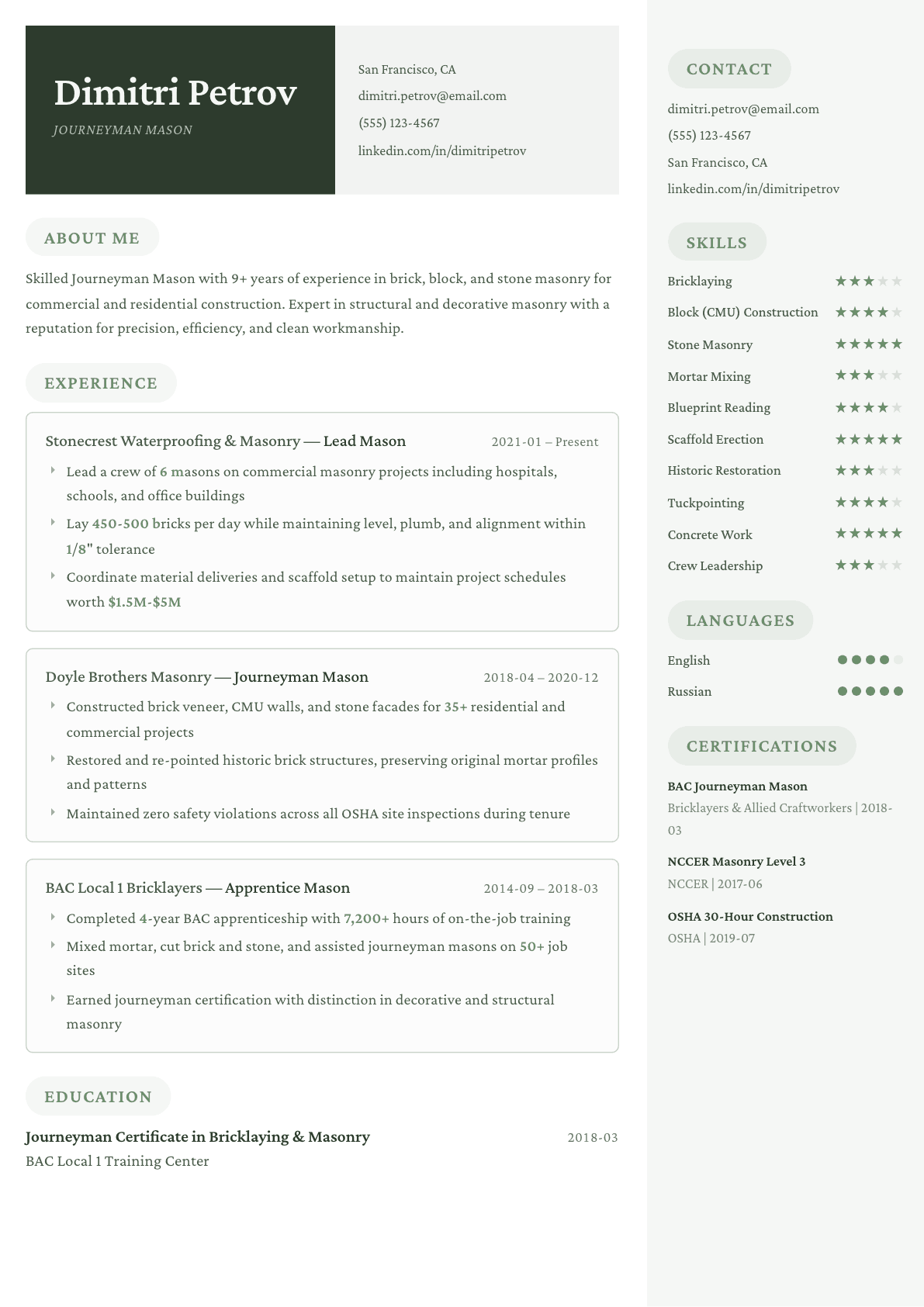
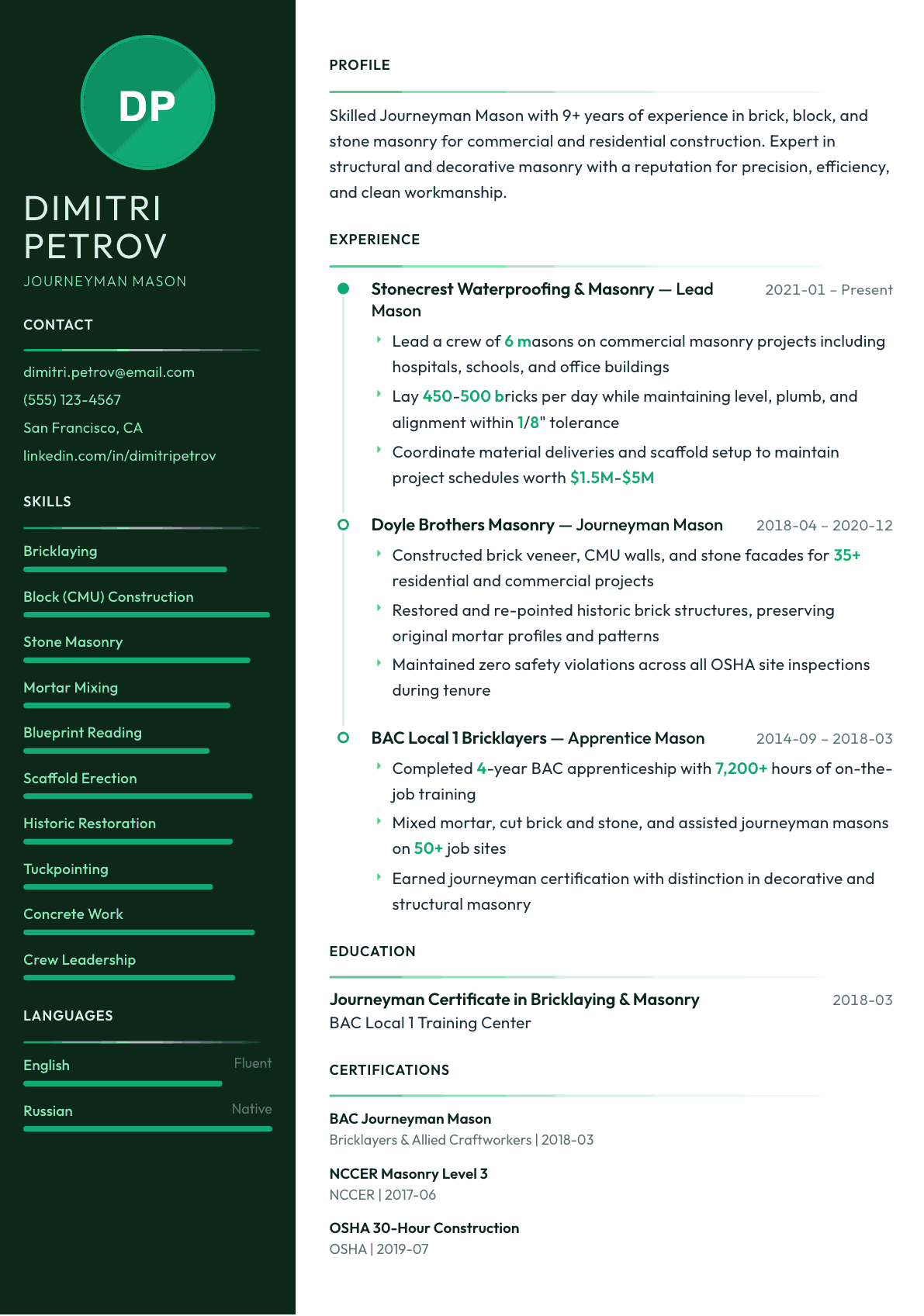
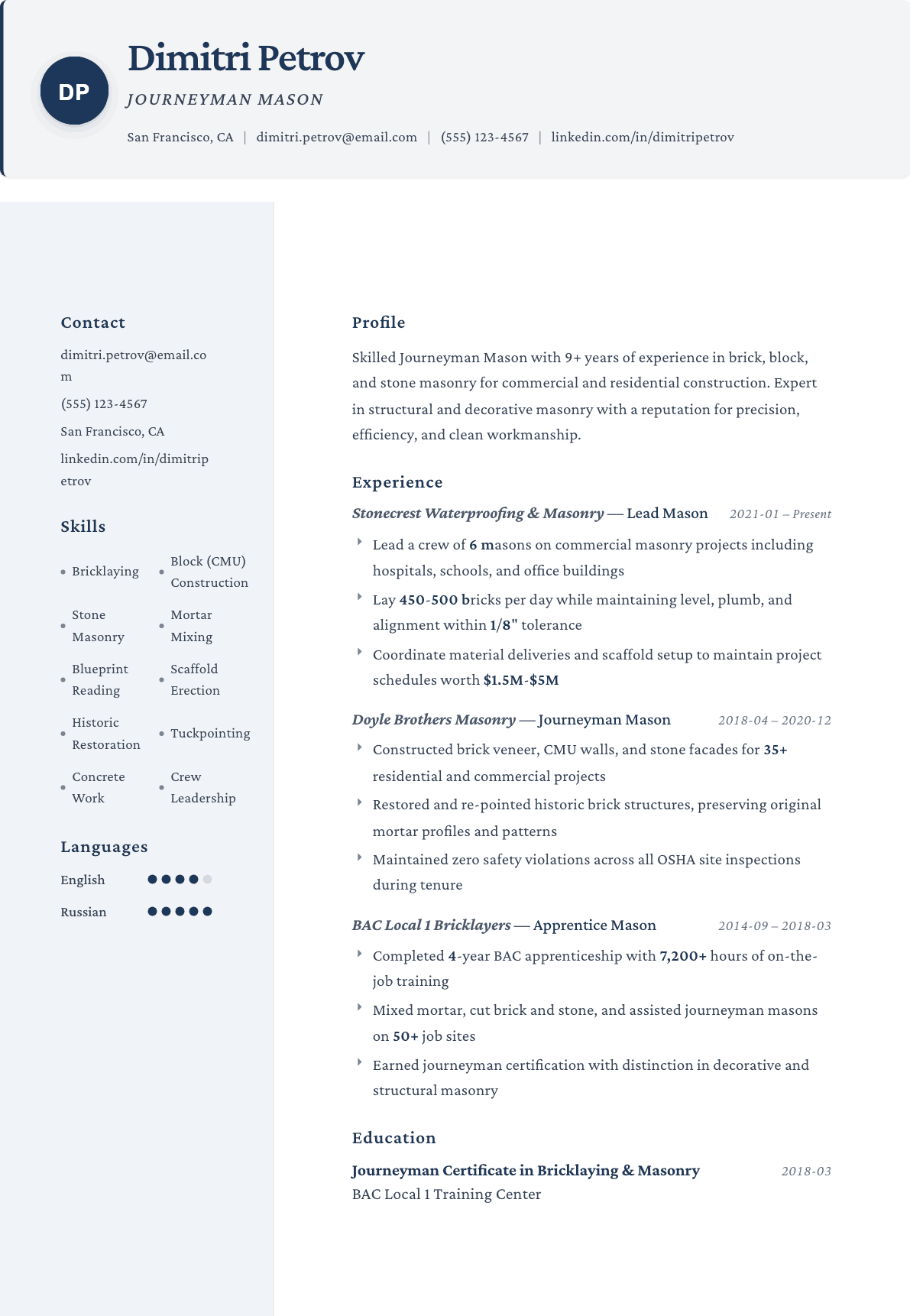
Example Masonry Worker summary
Journeyman Mason with 9 years of experience in brick, block, and stone construction for commercial and residential projects. Known for precision craftsmanship, laying 500+ bricks per day with tight tolerances. Seeking a lead mason role on large-scale commercial construction projects.
Skills to list on a Masonry Worker resume
- Bricklaying
- CMU Block Construction
- Natural Stone Setting
- Mortar Mixing
- Tuckpointing
- Historic Masonry Restoration
- Blueprint Reading
- Scaffold Erection
- Concrete Finishing
- Veneer Installation
- Crew Leadership
- OSHA Compliance
- Material Estimation
- Decorative Masonry
What actually gets this resume read
- Quantify your productivity: bricks per day, square footage completed, or number of projects finished.
- Highlight specialized masonry skills: decorative stone, historic restoration, tuckpointing, or veneer work.
- Include union membership and journeyman certification details prominently.
- Mention your ability to read blueprints and architectural drawings for masonry layouts.
- Emphasize your safety record and OSHA compliance history.
How to write a masonry worker resume
A masonry resume is read by a foreman who has a wall to build and a schedule to protect. He wants the materials you work in, whether the scope was structural or veneer, the production you hold in a day, and whether your work passes inspection without rework.
Most masonry resumes read like a description of the trade itself: laid brick and block, mixed mortar, followed safety procedures. The ones that get calls name the units, the bond patterns, the tolerances, the daily production and the kind of buildings the work went into.
This guide covers the way trades resumes get read in masonry, how to describe production and quality honestly, what training and cards belong on the page, three summaries, before and after bullets, and the questions masons ask when they write one.
Format: one page, classification and scope visible
One page unless you run crews on large commercial work. Reverse chronological, single column, no graphics. Put your classification near the top: apprentice with hours, journeyman, or foreman. Union masons should name the local, because that answers the wage scale question immediately.
Under each employer, add a work profile line: building types, materials, whether the scope was structural, veneer or restoration, and the crew size you worked in or led. A foreman reads that line before he reads a single bullet.
- Header: name, city, phone, email, classification, and local if you carry one.
- Order: summary, certifications and cards, experience, materials and skills, apprenticeship.
- Materials: clay brick, concrete masonry units, cut stone, manufactured stone, glass block, terra cotta.
- Scopes: load-bearing walls, veneer over stud or block, foundations, chimneys, paving, tuckpointing and restoration.
Summary: material, scope and the standard you hold
Two or three lines. Classification, years, the materials you are strongest in, the sectors, and one quality standard you hold yourself to: a unit count per day at a stated tolerance, consistent joint tooling, or restoration work matched to a historic mortar.
Experience: production, tolerance and the finished wall
Production is a real number in this trade and it belongs on the page. Give a daily unit count together with the material and the wall type, since a hundred large blocks and five hundred modular bricks can each be an honest day depending on the work.
Pair production with quality or the number reads as a boast. Level, plumb and alignment tolerances, joint profiles tooled consistently, clean faces, correct flashing and weep placement, and inspection results are what separate a mason from a bricklayer who is merely fast.
Say what surrounded the work: the scaffold you erected, the mixers and mortar you managed, the deliveries and stocking you coordinated, and the cold or hot weather protection you applied. Foremen hire masons who keep their own work moving.
Mortar, detailing and finishes
Naming mortar types and detailing is what shows depth here, because a masonry wall fails at the details long before the units themselves fail.
- Mortar: the types you have mixed and used, and how their application differs.
- Detailing: flashing, weeps, control and expansion joints, lintels, ties and reinforcement, grouting of cells.
- Finishes: joint profiles, cleaning and washdown methods, sealers and water repellents, efflorescence treatment.
- Restoration: tuckpointing, unit replacement, matching historic mortar, and gentle cleaning of old masonry.
Training, cards and equipment
A completed apprenticeship carries real weight, so give the program, the sponsor and the completion. Then the cards: a ten hour safety card for the site, a thirty hour card if you lead, scaffold user or erector training, and silica awareness training, which contractors ask about specifically because of the dust rules on cutting and grinding.
List the equipment you can run: masonry saws, mixers, mortar pumps, forklifts and telehandlers, and mast climbing or swing stage platforms. Lift certifications remove a scheduling obstacle for the foreman, which is worth real money to him.
Keywords a masonry posting repeats
These postings use trade language directly: bricklaying, block laying, stone setting, mortar mixing, tuckpointing, scaffold safety, blueprint reading, level and plumb, and the sector words commercial, residential, institutional or restoration. Use them, and put the material list where a keyword search will find it.
Masonry Worker resume summary examples
Apprentice or tender moving up
Masonry apprentice with 3 years on commercial block and brick veneer work, including mixing, stocking, scaffold setup and laying under a journeyman. Reads elevations, sets leads with guidance, and holds a ten hour safety card plus silica awareness training. Working toward journeyman classification.
Journeyman mason
Journeyman mason with 9 years in brick, block and stone across commercial and residential projects. Lays structural block and brick veneer to tight alignment, handles flashing, weeps and control joints, and works clean enough that washdown rarely turns up rework.
Lead mason or foreman
Lead mason with 15 years running crews of up to 6 on hospitals, schools and office buildings. Sets leads and controls layout, coordinates material deliveries and scaffold with the general contractor, and keeps walls level, plumb and aligned across long elevations.
Work experience bullets: before and after
Before: Laid bricks and blocks on construction sites.
After: Laid 450 to 500 modular bricks per day on commercial veneer, holding level, plumb and alignment within an eighth of an inch across every lift.
A production rate paired with a tolerance shows both speed and control, which is exactly how a foreman judges a mason.
Before: Worked on commercial masonry projects.
After: Built load-bearing block walls and brick veneer on hospitals, schools and office buildings, including grouted and reinforced cells at the engineer's specified spacing.
Building types and structural detail place you on the commercial side of the trade rather than on garden walls.
Before: Made sure the work looked good.
After: Tooled concave joints consistently across a long elevation and washed down with a diluted cleaner that left no burn on the units or the adjacent glazing.
Finish detail is what the owner sees, and naming the method shows you know where masonry actually gets rejected.
Before: Followed safety rules on site.
After: Erected and inspected frame scaffold to the required height, cut wet with a vacuum shroud on the masonry saw, and kept the mixing area clear of trip hazards.
Naming silica controls and scaffold practice speaks to the two hazards this trade is most often cited for.
Before: Led a crew of masons.
After: Ran a crew of 6 masons and 2 tenders, setting leads each morning, sequencing deliveries with the general contractor and keeping 3 elevations moving at once.
Crew composition and the daily mechanics of running the wall separate a lead from an experienced hand.
Hard skills
- Brick laying and bond patterns
- Concrete masonry unit installation
- Stone setting and cutting
- Mortar selection and mixing
- Setting leads and running lines
- Flashing, weeps and control joints
- Reinforcement and grouting
- Tuckpointing and restoration
- Masonry saw and grinder operation
- Scaffold erection and inspection
- Blueprint and elevation reading
- Cleaning, washdown and sealing
- Cold and hot weather masonry protection
Soft skills
- Physical stamina across a full shift
- Crew coordination
- Attention to line and level
- Working to a schedule
- Communication with the general contractor
- Training apprentices
Certifications worth listing
- OSHA 10-Hour Construction (OSHA Training Institute)
- OSHA 30-Hour Construction (OSHA Training Institute)
- Journeyman Bricklayer (International Union of Bricklayers and Allied Craftworkers)
- Scaffold User Training (Scaffold and Access Industry Association)
- Telehandler Operator Certification (National Commission for the Certification of Crane Operators)
- First Aid and CPR (American Red Cross)
Mistakes that cost masonry worker candidates the interview
- Describing the trade rather than your own work, so the materials, the scope and the buildings never appear.
- Giving a production number with no tolerance or quality detail beside it, which reads as speed at the cost of the wall.
- Leaving out silica training when contractors are asking about dust control on every cutting operation.
- Omitting the classification and hours, which decide the rate a contractor is able to put you on.
- Ignoring restoration and tuckpointing experience, which is a separate market with steady year-round work.
- Listing a long string of short jobs without grouping them under the contractors who actually hired you.
Masonry Worker resume questions
Should I put a daily brick count on my resume?
Yes, with the unit type and the wall it applies to, because production is how this trade measures a day. Pair it with a tolerance or a quality note so a foreman reads a controlled rate rather than a rushed one.
How do I show masonry quality on paper?
Use the checks an inspector uses: level, plumb and alignment tolerances, joint consistency, correct flashing and weep placement, and a clean washdown with no burn on the units. Add inspection results when your walls passed without rework.
Do I need a certification to work as a mason?
There is no universal license for masonry in most places, so employers weigh apprenticeship completion, hours and site cards instead. A safety card, scaffold training and silica awareness are the ones contractors ask for before you set foot on site.
How do I present restoration and historic work?
Give it its own group of bullets. Name the building age or type, the units you replaced, the mortar you matched and the cleaning method you used. Restoration clients care about the judgment behind those choices far more than about speed.
What if my masonry work has been seasonal?
Seasonal work is normal in this trade and does not read as instability. Group short calls under the contractors who hired you, use years rather than months for older entries, and note any off-season work you took to stay employed.
Related resume examples
- Carpenter Resume example
- Painter Resume example
- Construction Manager Resume example
- Bricklayer Resume example
- Construction Worker Resume example
- Roofer Resume example