Construction Worker Resume Examples: what gets the call
Write a Construction Worker Resume That Gets You on the Crew
By Mustafa Tarabya, founder of CVBooster · Published · Updated
Construction worker resume example with trade, tool and safety card bullets, plus a guide to writing for residential and commercial crews.
Sample resumes for a construction worker
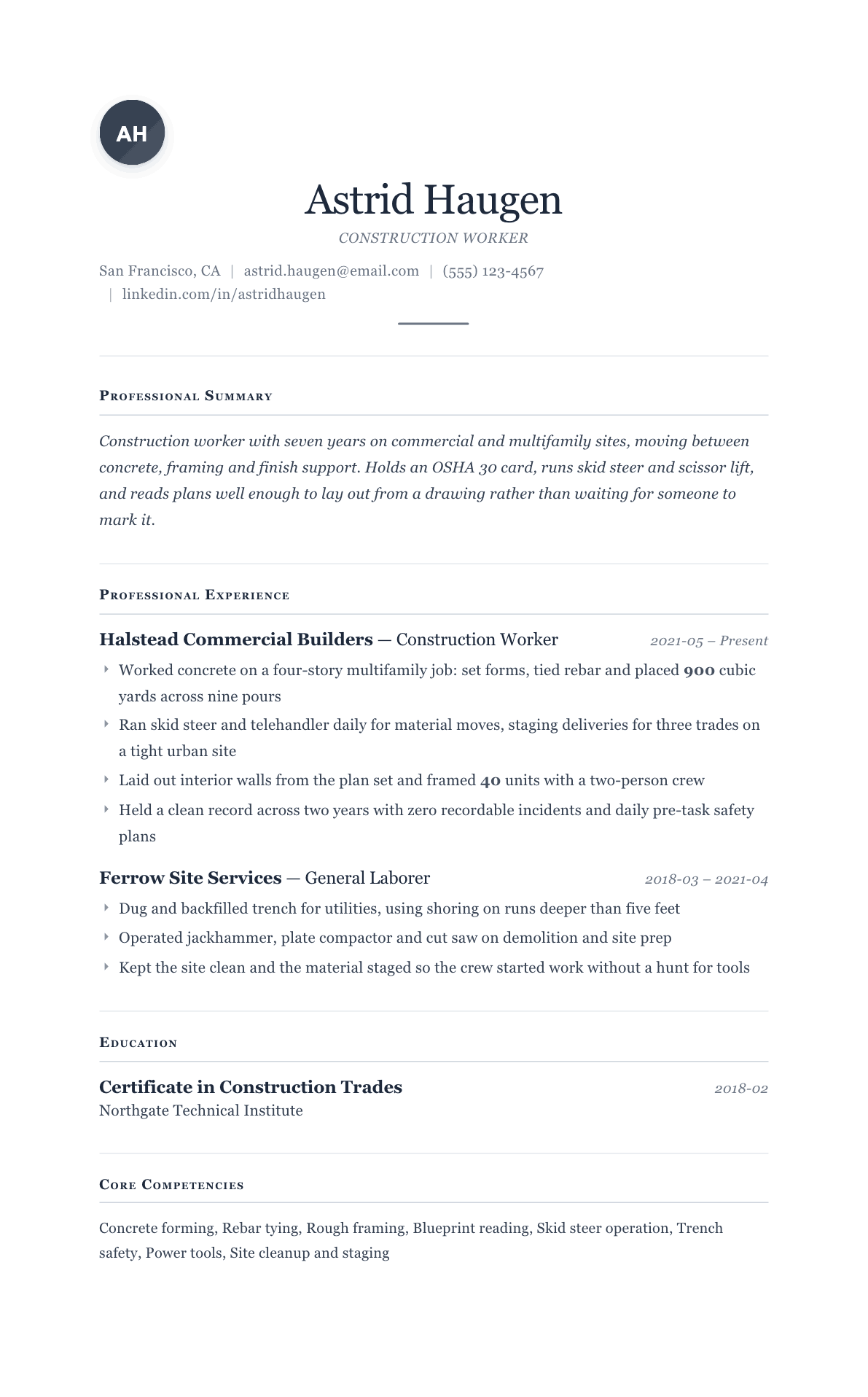
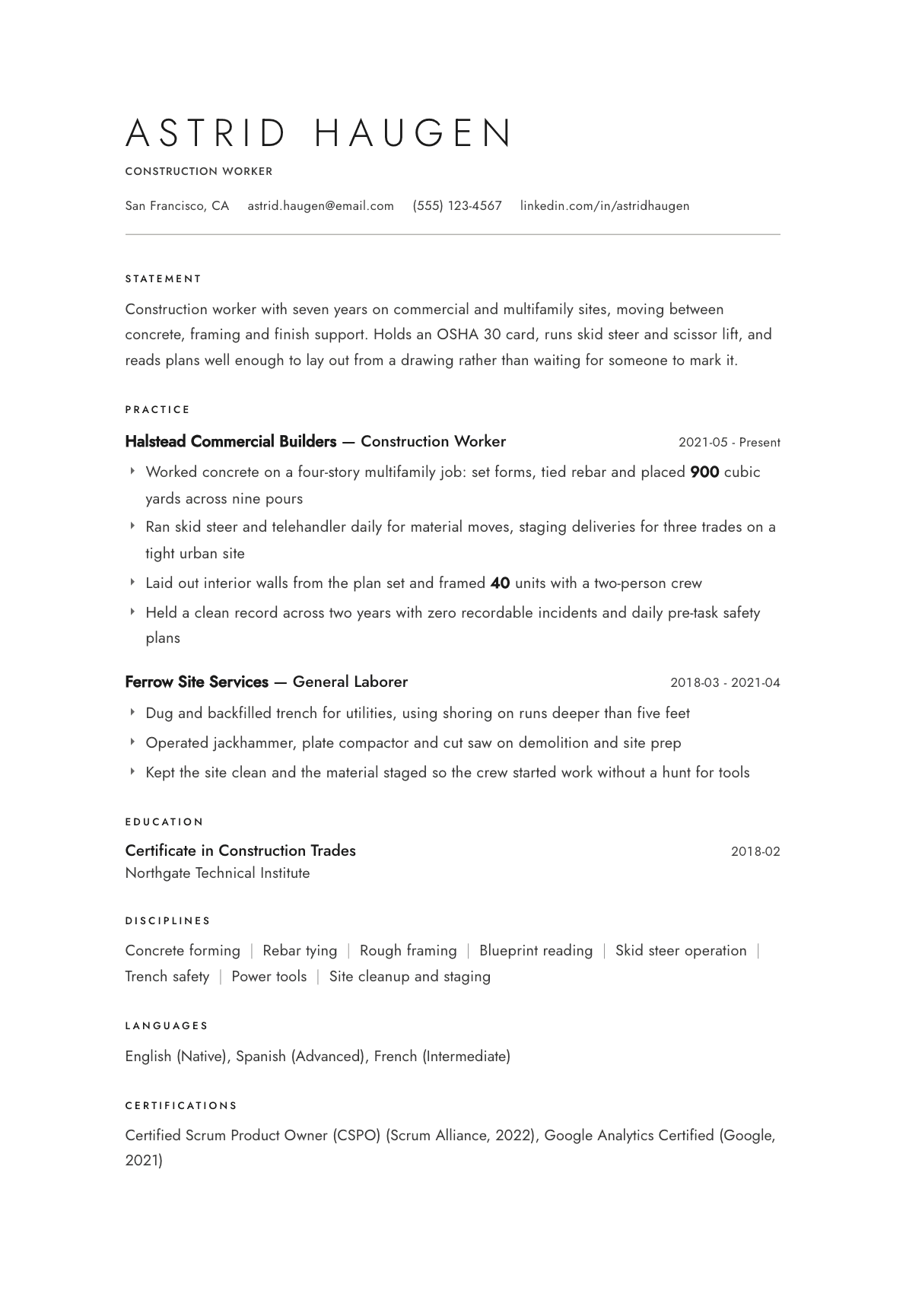
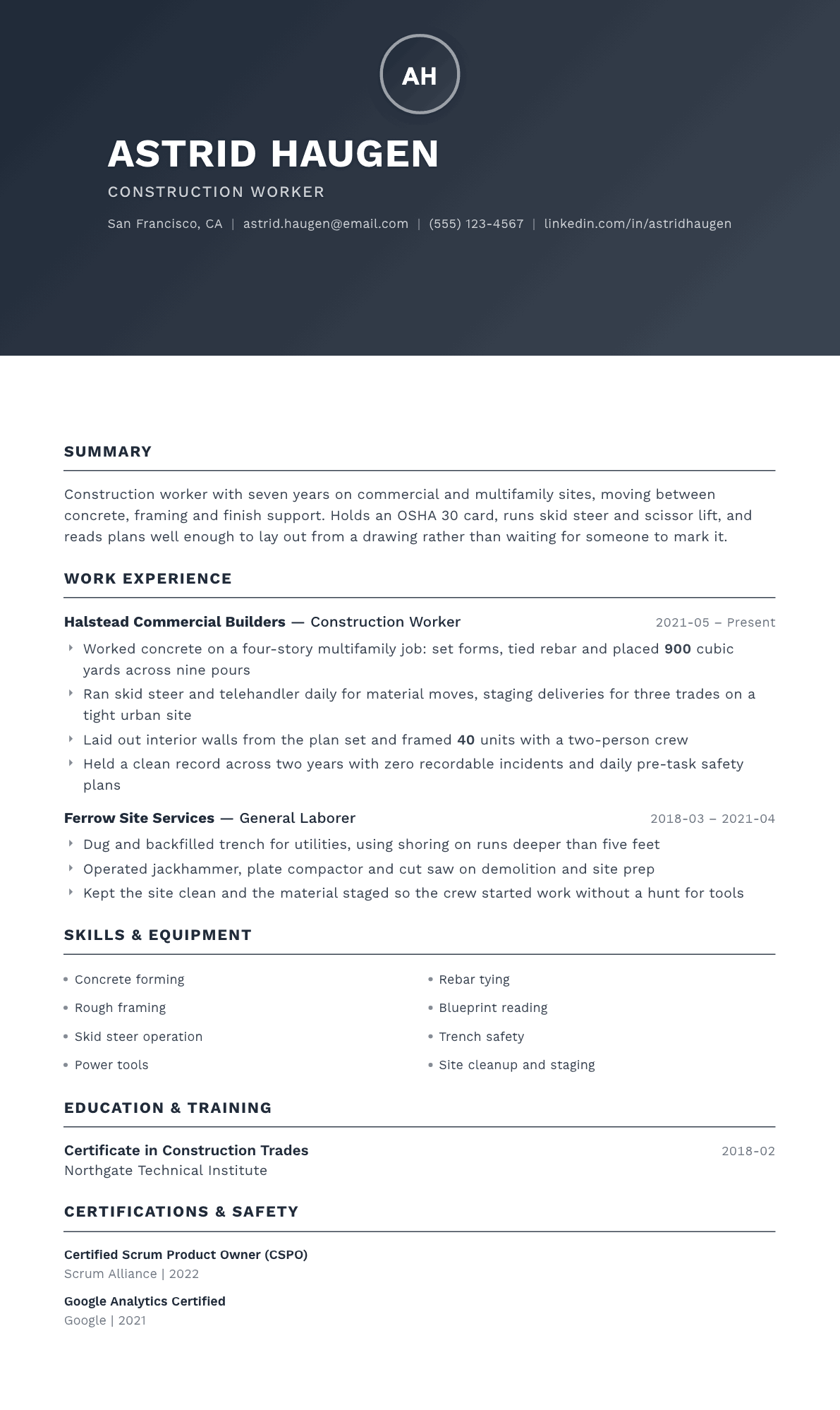
The same construction worker content laid out in three CVBooster templates, so you can see what the finished document looks like before you write a word.
Example Construction Worker summary
Construction worker with seven years on commercial and multifamily jobs across concrete, framing and site work. OSHA 30 carded, runs skid steer and telehandler, and lays out interior walls straight from the plan set. Placed 900 cubic yards on a recent four-story job and finished two years with no recordable incidents. Looking for full-time crew work with a commercial general contractor.
Skills to list on a Construction Worker resume
- Concrete placement and forming
- Rebar installation
- Rough framing
- Demolition
- Trenching and backfill
- Blueprint reading
- Skid steer operation
- Telehandler operation
- Scissor and boom lift
- Power and hand tools
- Fall protection
- Material staging
- Site cleanup
- Measuring and layout
What actually gets this resume read
- Put your OSHA card, first aid card and any equipment certificates in a block near the top of the page.
- Name the type of work on each job: commercial, multifamily, residential, industrial or heavy civil.
- List the equipment you can run by name, including skid steer, telehandler, scissor lift and boom lift.
- Give volumes where you have them: cubic yards placed, units framed, linear feet of trench, square feet of deck.
- Say if you can read a plan set and lay out from it, because that separates you from a general helper.
- Include your reliability record: attendance, years with one contractor and any incident-free stretch.
How to write a construction worker resume
A construction worker resume is read fast, often on a phone in a job trailer, by a superintendent who needs bodies on a site next Monday. He is looking for three things before anything else: what safety cards you hold, what you can physically do without supervision, and whether your dates suggest you show up every day.
The mistake most applicants make is writing the job generically. Construction work covers concrete, framing, demolition, utilities, roofing, drywall and site prep, and a crew leader hiring for a concrete pour does not want to guess whether you have tied rebar before. Naming the scope of work you have done is the difference between a callback and a file nobody opens twice.
This guide covers how to build the credentials block, how to describe scopes and equipment so a superintendent can place you immediately, how to write reliability into the page, and the questions workers ask when they move between residential, commercial and heavy civil work.
Format: plain, one page, cards near the top
Use a single column with no graphics, no icons and no color blocks. These resumes get printed, photographed and forwarded, and anything decorative gets lost. One page is right for almost everyone in this role.
Put a short credentials block directly under your contact details: safety training, first aid, equipment cards, driver license class and whether you have your own transportation and hand tools. That block answers the superintendent's first four questions before he reaches your work history.
- Credentials block: safety card, first aid and CPR, equipment cards, license class, tools and transportation.
- Order: summary, credentials, experience, skills and equipment, education or trade training.
- Add the trades or scopes you have worked in one line so a crew leader can match you to a need.
Name the sector and the scope on every job
Start each employer entry with the type of work: commercial ground-up, multifamily, single-family residential, tenant improvement, industrial or heavy civil. A worker who spent four years on high-rise concrete brings different habits from one who framed houses, and both are valuable to the right contractor.
Then list the scopes you personally performed. Setting and stripping forms, tying rebar, framing walls, hanging and finishing drywall, installing blocking, trenching and backfill, demolition, or roof deck work. Write what your hands did, not what the company did.
Include the site conditions if they were demanding. Occupied buildings, night work windows, tight urban sites with no lay-down area and phased turnovers all take skills that a superintendent will pay for.
Equipment, tools and layout ability
List equipment by name: skid steer, telehandler, scissor lift, boom lift, mini excavator, plate compactor, walk-behind saw, jackhammer, and the powder-actuated tools if you are trained on them. Say which ones you are certified or evaluated on rather than lumping everything together.
Then say whether you can read a plan set and lay out from it. Being able to pull dimensions off a drawing, snap lines and set wall layout without being marked in is the single biggest step up from helper to hand, and most resumes never mention it.
Safety and reliability, written as facts
Safety is a hiring filter, not a personality trait. Give the training you hold and the practices you actually follow: daily pre-task planning, fall protection above six feet, trench protection and shoring on deep runs, lockout procedures, confined space awareness, and hazard reporting. If you have gone a long stretch with no recordable incident, say the number of years.
Reliability is the second filter. Dates without gaps, a long run with one contractor, and a line about attendance or early call times do more for you than any adjective. If you have gaps from seasonal layoffs, say seasonal layoff plainly and the reader will move on.
Keywords contractors and staffing offices search
General contractors and construction staffing offices search on scope and card language: OSHA 10, OSHA 30, fall protection, concrete forming, rebar, framing, demolition, trenching, skid steer, telehandler, scissor lift, blueprint reading and site cleanup. Use the exact terms you have earned.
Add the union local or apprenticeship if you belong to one, along with your classification. That single line answers questions about pay scale, dispatch and training that would otherwise take a phone call.
Construction Worker resume summary examples
First year on site
Construction worker with one season on residential framing and site prep, OSHA 10 carded and first aid trained. Comfortable with hand and power tools, material handling and site cleanup, and learning layout from the plan set. Reliable on 6 a.m. call times with my own transportation and basic tools.
Several years in
Construction worker with seven years on commercial and multifamily sites across concrete, framing and site work. OSHA 30 carded, runs skid steer and telehandler, and lays out interior walls straight from the drawings. Placed 900 cubic yards on a recent four-story job with no recordable incidents in two years.
Lead hand
Lead hand with twelve years in commercial construction, running small crews on concrete and rough carpentry scopes. Holds OSHA 30, competent person training for excavation, and equipment cards for telehandler and boom lift. Trains new hands on layout, fall protection and tool safety on every job.
Work experience bullets: before and after
Before: Performed general construction duties on job sites.
After: Worked concrete on a four-story multifamily job, setting forms, tying rebar and placing 900 cubic yards across nine pours.
The scope, the building type and the volume let a superintendent picture exactly where you would fit on his crew.
Before: Operated heavy equipment.
After: Ran skid steer and telehandler daily for material moves, staging deliveries for three trades on an urban site with no lay-down area.
Naming the machines and the site condition proves the skill rather than claiming a category.
Before: Read blueprints.
After: Laid out interior walls from the plan set and framed 40 units with a two-person crew, checking dimensions against the drawings before each floor.
Layout ability is a pay grade, so it needs a scope and a volume behind it to be believed.
Before: Followed all safety rules.
After: Completed daily pre-task plans, tied off above six feet and used shoring on trench runs deeper than five feet, closing two years with no recordable incidents.
Specific practices and a clean record turn a compliance sentence into evidence of habit.
Before: Cleaned up the job site.
After: Kept material staged by trade and the deck clear each afternoon so the next crew started without hunting for tools or clearing debris.
It shows you understand why housekeeping matters to the schedule, not only that you did it.
Hard skills
- Concrete forming and placement
- Rebar installation
- Rough framing
- Demolition
- Trenching and backfill
- Blueprint reading and layout
- Skid steer operation
- Telehandler operation
- Scissor and boom lift
- Fall protection systems
- Power and hand tools
- Material staging and site cleanup
Soft skills
- Attendance and punctuality
- Taking direction on the first pass
- Crew communication
- Hazard awareness
- Physical endurance
- Working through weather
Certifications worth listing
- OSHA 10-Hour Construction (OSHA Outreach Training Program)
- OSHA 30-Hour Construction (OSHA Outreach Training Program)
- Core Curriculum: Introductory Craft Skills (NCCER)
- Adult First Aid and CPR (American Red Cross)
- Certified Operator, Mobile Crane (National Commission for the Certification of Crane Operators)
Mistakes that cost construction worker candidates the interview
- Writing general construction duties instead of the scopes your hands actually performed.
- Burying the safety cards at the bottom when they are the first thing a superintendent checks.
- Leaving equipment unnamed, so a crew leader cannot tell a skid steer operator from a helper.
- Ignoring date gaps that a plain seasonal layoff note would explain in four words.
- Using a designed template with columns and icons that print badly and read worse on a phone.
- Skipping the sector, so a residential framer and a heavy civil hand look identical on paper.
Construction Worker resume questions
Do I need an OSHA card to get hired as a construction worker?
Many commercial sites require at least the ten-hour card before you can badge in, and some owners require thirty. Getting the card before you apply removes a real barrier, and listing it at the top of the page saves the superintendent a phone call.
How do I write a construction resume with no experience?
Lead with the safety card, your license class, transportation and tools. Then list any physical or hands-on work you have done, including warehouse, landscaping, farm, moving or auto work, and describe the tools and loads involved in plain terms.
Should I list every job if I worked through a staffing agency?
List the agency as the employer with your full date range, then name the general contractors and site types you were placed on underneath. That keeps your timeline clean while still showing the range of sectors you have worked.
How do I explain gaps from seasonal layoffs?
Write seasonal layoff and the months directly in the entry. Weather-driven gaps are normal in this trade and cause no concern when they are labeled, while an unexplained hole makes a reader assume something worse than the truth.
Is a resume even necessary for construction work?
Larger general contractors and staffing offices now require an application with an attachment, and a clear one-page file moves you ahead of applicants who send nothing. It also gives you a place to list cards and equipment that a phone call would miss.
Related resume examples
- Carpenter Resume example
- Construction Manager Resume example
- Construction Laborer Resume example
- Site Supervisor Resume example
- Carpenter Apprentice Resume example
- Construction Foreman Resume example