City Employee Resume Examples: free ATS score and gap list
Write a City Employee Resume That Clears Civil Service Screening
By Mustafa Tarabya, founder of CVBooster · Published · Updated
City employee resume example, keyword list and writing guide covering minimum qualifications, civil service exams and municipal hiring portals.
Sample resumes for a city employee
The same city employee content laid out in three CVBooster templates, so you can see what the finished document looks like before you write a word.
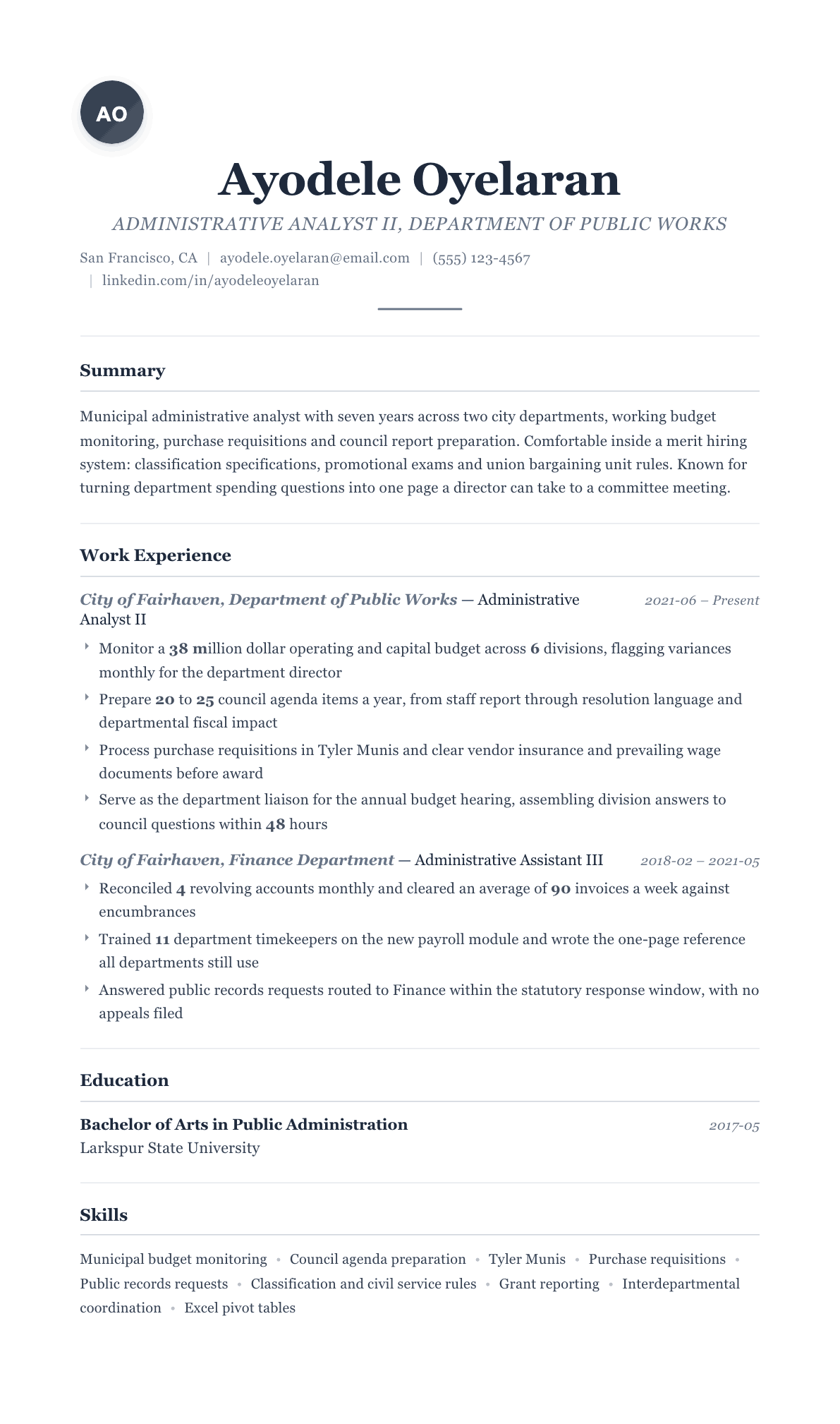
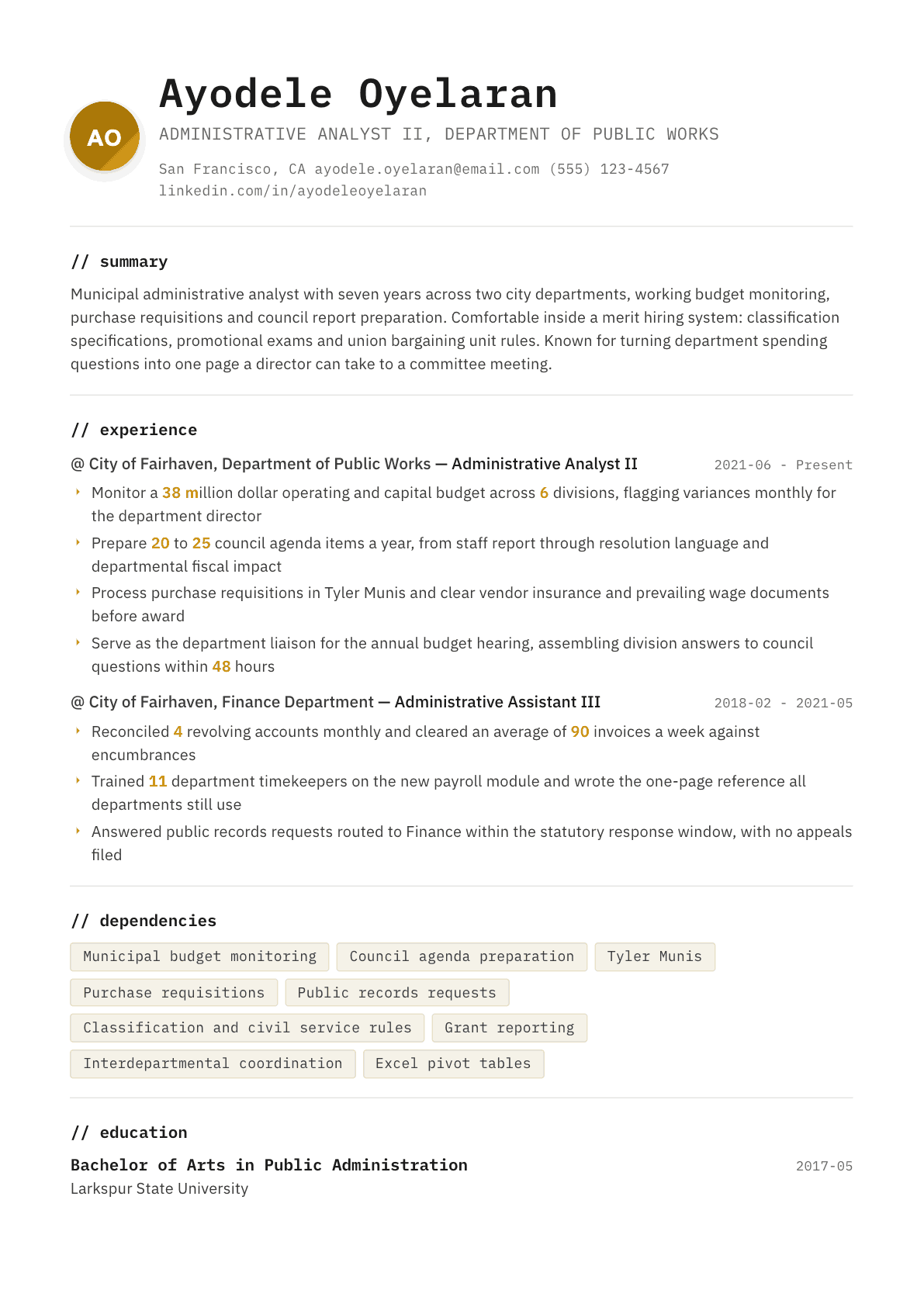
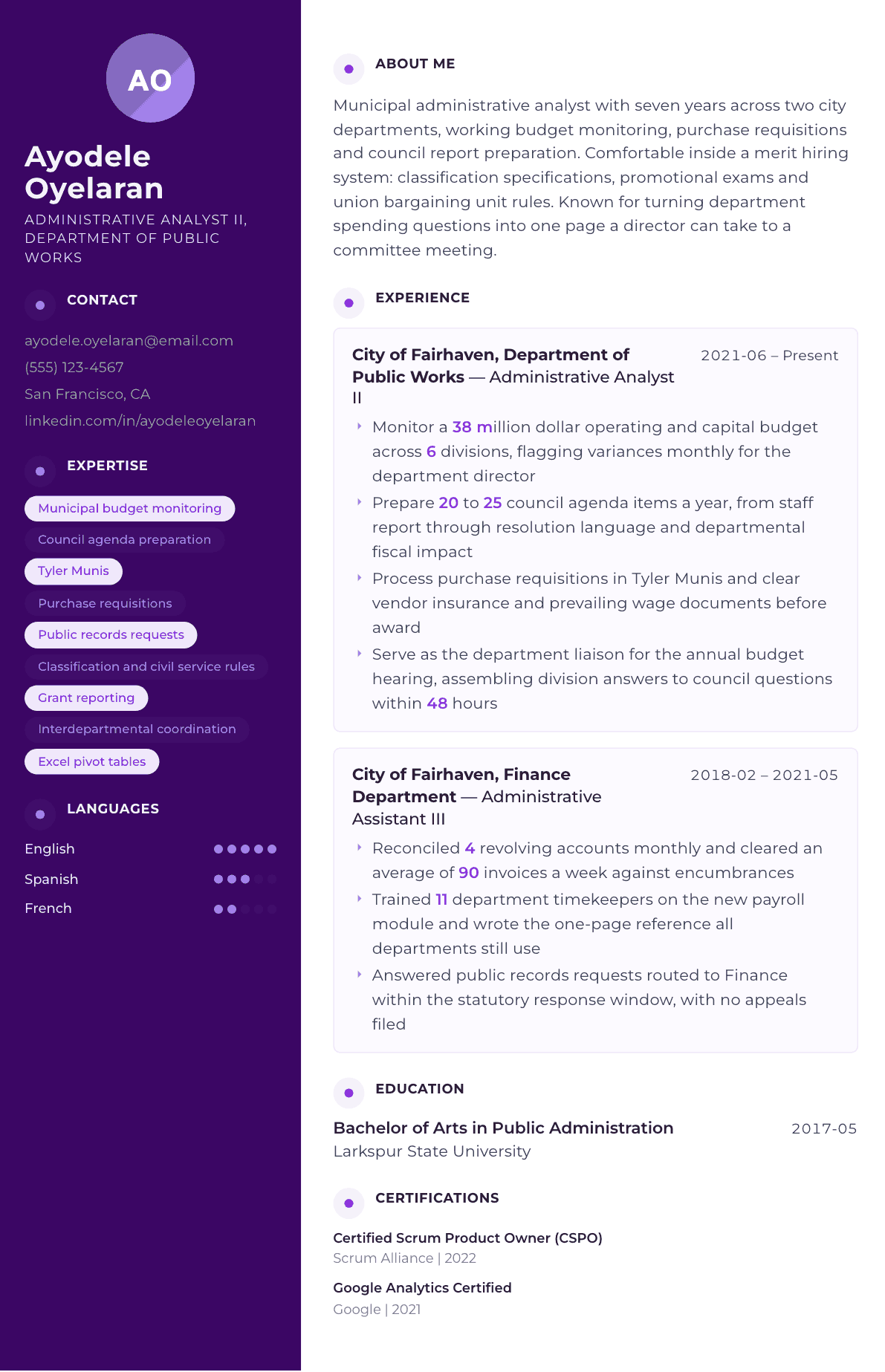
Example City Employee summary
Municipal employee with seven years in two city departments, moving from administrative support into budget and council report work. Familiar with classification specifications, promotional exams and bargaining unit rules, and used to writing for a council audience that reads one page before a vote. Looking for an analyst classification in a mid-size city finance or public works department.
Skills to list on a City Employee resume
- Municipal budget monitoring
- Council agenda and staff reports
- Public records request handling
- Purchase requisitions and procurement
- Civil service and classification rules
- Tyler Munis
- Accela permitting
- Grant compliance reporting
- Union bargaining unit administration
- Public meeting support
- Interdepartmental coordination
- Excel reporting
- Records retention schedules
- Constituent service
What actually gets this resume read
- Answer every minimum qualification in the posting explicitly, because a city HR analyst screens against that list before anyone reads your prose.
- Name the department, the division and the classification title you held, not just the city, so the reviewer can place you on the org chart.
- Give the size of what you handled: budget, caseload, permits, work orders or square footage of facilities.
- List any civil service exam you have passed and the eligibility list you sit on, with the classification name.
- Name the municipal systems you work in, since a city that runs Tyler Munis or Accela will look for those words.
- Repeat dates as month and year for every job, because a government application cross-checks them against your supplemental questionnaire.
- Add residency, bilingual ability or a required driver license class when the posting asks for them.
How to write a city employee resume
Applying to a city is not applying to a company. Your resume goes into a municipal applicant portal, and the first reader is a human resources analyst whose only job at that stage is to decide whether you meet the minimum qualifications printed in the job bulletin. That analyst is not looking for personality. She is looking for the exact years of experience, the exact degree or equivalency, and the exact license the bulletin names.
Only after you clear that screen does the hiring department see you. The division manager who reads next wants something different: proof you have run a real workload inside a public agency, with the constraints that come with it. Purchase orders that need three quotes. Council deadlines that do not move. A bargaining unit contract that governs who does which task.
This guide covers how to write for both readers in one document: the qualification language that clears the screen, the departmental detail that wins the interview, and the parts of a municipal application that people leave blank and then wonder why they never heard back.
Format: mirror the job bulletin, not a private sector template
Reverse chronological, two pages is normal, and longer is accepted in local government far more often than in the private sector. Municipal reviewers are reading for completeness rather than brevity, and a gap with no explanation reads worse than an extra half page.
Skip columns, graphics and skill rating bars. City portals such as NEOGOV parse a plain document reliably and mangle a designed one. Keep one font, clear section headers, and month and year on every entry, because a supplemental questionnaire will ask you to total your months of qualifying experience and the two must agree.
- Header: your name, city and state, phone, email, and any required driver license class on the same line.
- Then a short qualifications summary written against the bulletin, followed by experience, education, licenses and technical systems.
- Give each job the city, the department, the division and the exact classification title you held.
- If you are an internal candidate, state your current classification, step and department, because promotional lists are scored differently.
Answer the minimum qualifications directly
Every municipal bulletin ends with a minimum qualifications block: a number of years of increasingly responsible experience, a level of education, and sometimes a substitution clause. Treat that block as a checklist and make each item findable. If the bulletin asks for three years of professional administrative experience in a public agency, the reader should be able to add your dates and reach three without doing arithmetic across four jobs.
Use the bulletin vocabulary. Cities write bulletins from classification specifications that change slowly, so the phrases repeat: increasingly responsible, journey level, lead direction, under general supervision. When your work genuinely matches one of those phrases, use it rather than a private sector synonym.
Experience: department, scale and the public-facing part
Open each job with the operating context. A reader needs to know whether you handled a general fund department, an enterprise fund utility, or a grant-funded program, because the rules governing each are different and the interview will go there.
Then quantify what passed through your hands. Budget monitored, invoices processed, permits issued, work orders closed, records requests answered, meetings staffed. Municipal work is volume work, and volume is the only honest way to show it.
Reserve at least one bullet for the public-facing half of the job. Cities hire people who can hold a counter, take a call from a resident who is angry about a water bill, and stay polite when a council member forwards the same complaint. Say what you handled and how it ended.
Systems, certifications and the civil service record
Name the enterprise systems you have worked in by product name: Tyler Munis, Accela, OpenGov, Laserfiche, a computerized maintenance management system. A city rarely retrains someone who already knows its stack, so these words carry weight out of proportion to their length.
Add a short line on your civil service standing. If you have passed a written or oral examination and sit on an eligibility list, name the classification and say so. If you hold a certification such as a Certified Public Purchasing Buyer or a notary commission, list the issuing body next to it.
- Financial and permitting systems by product name, not as a generic mention of software.
- Any required license class, forklift or equipment card, or first aid certification the bulletin lists.
- Language ability when the city offers bilingual pay, with the language and the level.
- Residency, if the city has a residency preference and you already live inside the boundary.
The supplemental questionnaire is part of the application
Most city applications include supplemental questions, and in many jurisdictions those answers are scored before the resume is read at all. Write them in full sentences, repeat the qualifying language from the bulletin, and point to the job on your resume where the experience lives. An answer that says see resume is often scored as no answer.
Keep the two documents consistent. If your questionnaire claims four years of contract administration, the resume must show four years of it in dates and duties, or the file gets flagged and set aside without a call.
City Employee resume summary examples
First municipal job
Administrative professional with 3 years of front counter and records experience, seeking an office specialist classification with the city. Handled 60 walk-in customers a day, maintained filing under a retention schedule, and processed cash receipts with daily reconciliation. Bilingual in English and Spanish, notary commissioned.
Journey level analyst
Municipal administrative analyst with 7 years across finance and public works, monitoring a departmental operating budget, preparing council agenda items, and processing requisitions in Tyler Munis. Reduced invoice aging by restructuring the encumbrance review. Currently on the eligibility list for Administrative Analyst III.
Division supervisor
Municipal supervisor with 14 years in local government, now leading a 9-person division within a general fund department. Owns the division budget, the annual work plan and the performance measures reported to council quarterly. Experienced negotiating work assignments within two bargaining unit agreements.
Work experience bullets: before and after
Before: Handled the department budget.
After: Monitored a 38 million dollar operating and capital budget across 6 divisions, producing a monthly variance report the director took to the finance committee.
The dollar figure, the division count and the reporting audience turn a vague duty into a measurable scope.
Before: Wrote reports for the city council.
After: Prepared 22 council agenda items a year from staff report through resolution language and fiscal impact statement, coordinating legal review before each posting deadline.
Naming the full product, from staff report to resolution, shows you know what a council item actually contains.
Before: Responsible for purchasing.
After: Processed purchase requisitions in Tyler Munis, verified vendor insurance and prevailing wage documentation, and cleared 90 invoices a week against open encumbrances.
Public purchasing has compliance steps a private buyer never touches, and naming them proves you have done the public version.
Before: Answered public records requests.
After: Answered 140 public records requests a year as the department point of contact, tracking each against the statutory response clock with no appeals filed.
The volume and the clean appeal record show reliability on a duty that creates legal exposure for the city.
Before: Trained other staff.
After: Trained 11 department timekeepers on the new payroll module and wrote the one-page reference guide that every department still issues to new supervisors.
A durable artifact, still in use, is stronger evidence than the claim that training happened.
Hard skills
- Municipal budget monitoring
- Council agenda and staff report preparation
- Public records request handling
- Purchase requisitions and public procurement
- Tyler Munis
- Accela permitting
- Grant compliance reporting
- Records retention schedules
- Payroll and timekeeping systems
- Bargaining unit contract administration
- Cash receipting and reconciliation
- Excel reporting and pivot tables
Soft skills
- Counter service under pressure
- Written clarity for a council audience
- Interdepartmental coordination
- Discretion with confidential files
- Patience with repeat complainants
- Deadline discipline
Certifications worth listing
- Notary Public Commission (Secretary of State (issuing state))
- Certified Public Finance Officer (CPFO) (Government Finance Officers Association)
- Certified Professional Public Buyer (CPPB) (Universal Public Procurement Certification Council)
Mistakes that cost city employee candidates the interview
- Leaving the supplemental questionnaire thin, when in many cities those answers are scored before anyone opens the resume.
- Naming only the city and not the department, division and classification title, so the reviewer cannot place the work.
- Using private sector job titles for public work, which breaks the match against the classification specification.
- Uploading a designed two-column resume into a portal that reads the columns out of order and drops the dates.
- Omitting month and year, which makes it impossible for the analyst to total qualifying months of experience.
- Skipping the systems list, so a city running the same financial software has no reason to prefer you.
- Describing municipal work as generic office work, which hides the compliance steps that make you cheaper to hire.
City Employee resume questions
How long should a city employee resume be?
Two pages is standard and three is acceptable for a long municipal career. Local government reviewers screen for completeness against posted qualifications, so trimming detail to reach one page usually costs you the screen rather than winning points.
Do I need to apply through the city portal or can I email a resume?
Apply through the portal, always. Municipal recruitment rules generally require an application of record, and an emailed resume outside the system usually cannot be scored or added to an eligibility list even if a manager likes it.
What is a supplemental questionnaire and how much does it matter?
It is a set of scored questions attached to the job bulletin that establishes whether you meet the qualifications. In many cities the questionnaire produces the ranking that decides who gets interviewed, so answer each one in full sentences with specifics.
Should I mention that I am an internal candidate?
Yes. State your current classification, department and hire date near the top. Many cities run promotional and open recruitments differently, and an internal candidate on a promotional list can be certified to the hiring manager ahead of outside applicants.
How do I show private sector experience translates to a city job?
Translate the constraint, not the task. Show where you worked under audit requirements, procurement thresholds, public deadlines or regulated recordkeeping, because those are the parts of municipal work that trip up new hires from the private sector.
Related resume examples
- City Manager Resume example
- Federal Resume example
- Municipal Clerk Resume example
- Public Administrator Resume example
- Mail Carrier Resume example
- Court Administrator Resume example