Municipal Clerk Resume Examples: the lines they read
A Municipal Clerk Resume Built on Records, Minutes and Meetings
By Mustafa Tarabya, founder of CVBooster · Published · Updated
Municipal clerk resume example with keywords and a writing guide covering minutes, agenda packets, records retention, licensing and open meeting law.
Sample resumes for a municipal clerk
The same municipal clerk content laid out in three CVBooster templates, so you can see what the finished document looks like before you write a word.
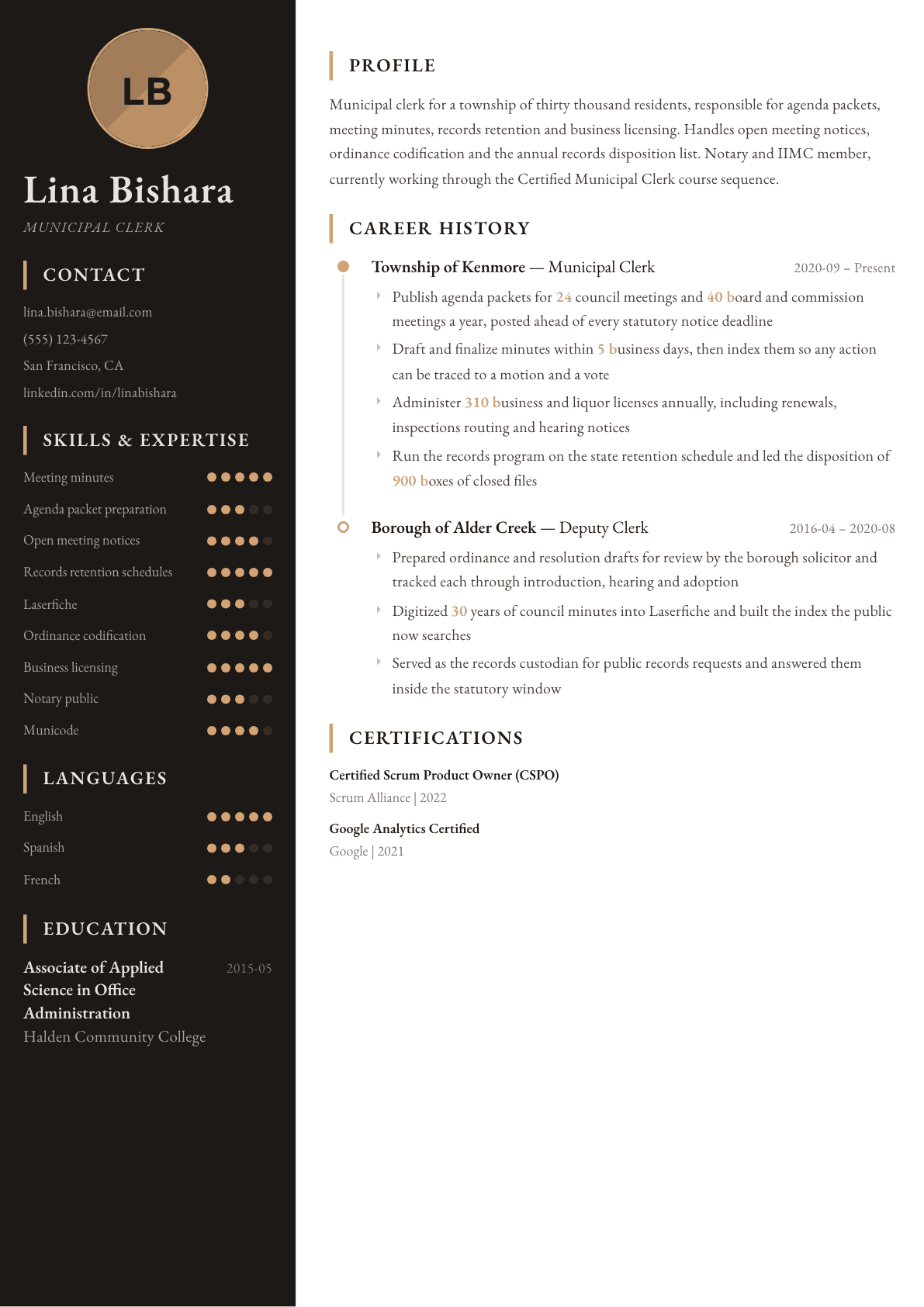
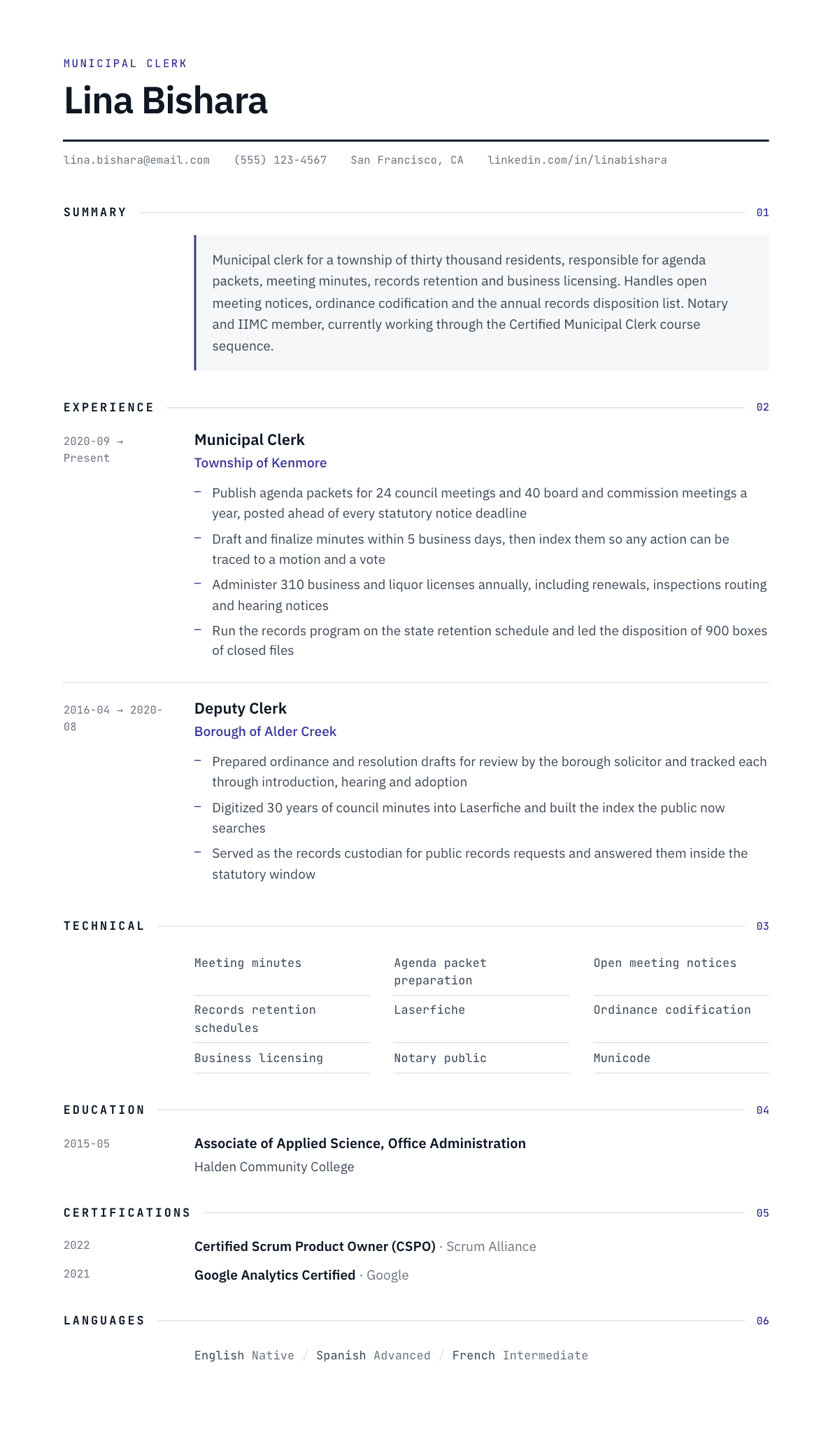
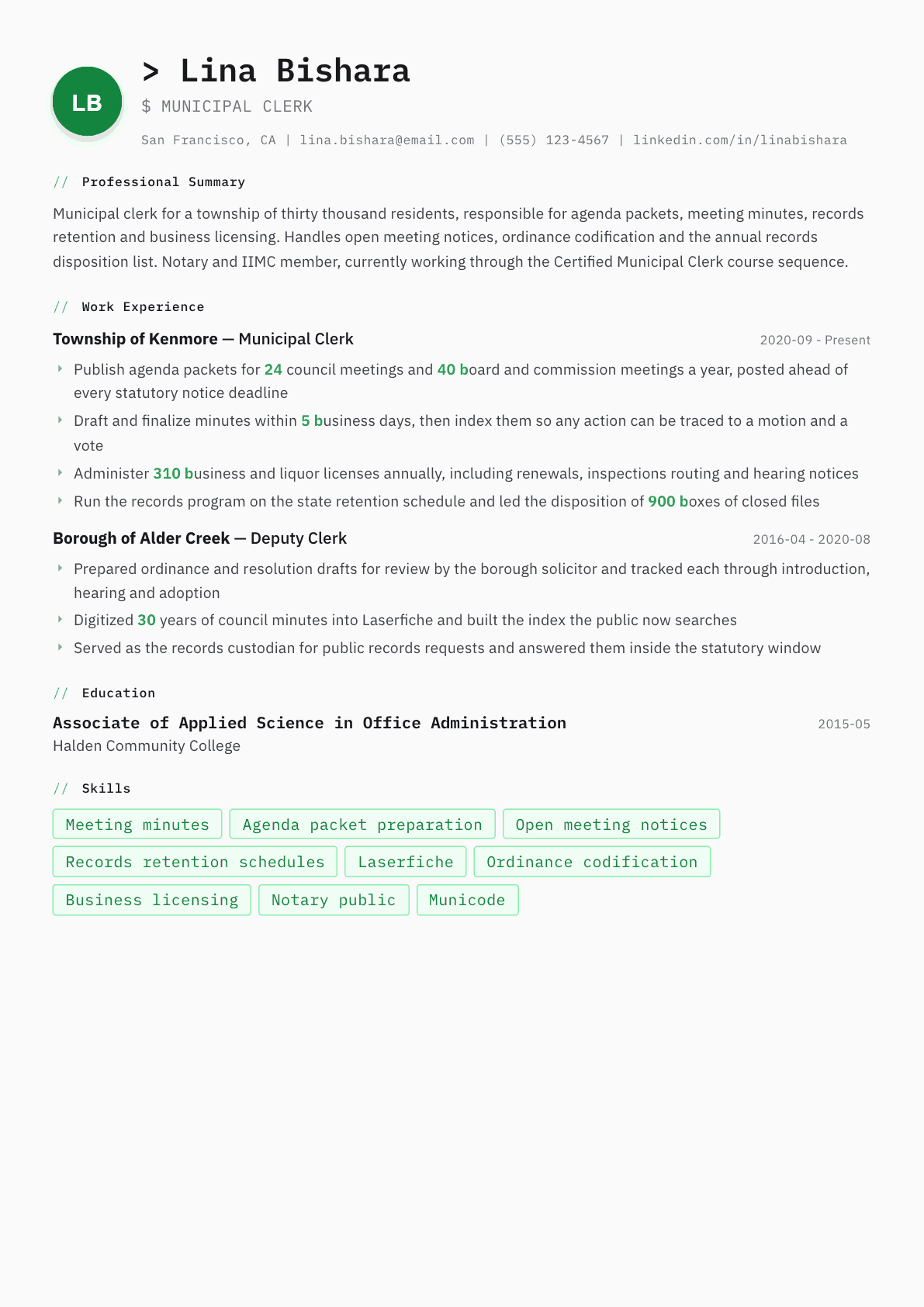
Example Municipal Clerk summary
Municipal clerk with nine years across a borough and a township, clerking council, planning board and zoning board meetings. Owns agenda packets, minutes, codification and the records retention program, and answers public records requests as the designated custodian. Notary and IIMC member working toward the Certified Municipal Clerk designation.
Skills to list on a Municipal Clerk resume
- Meeting minutes and motions
- Agenda packet assembly
- Open meeting law notices
- Public records request response
- Records retention and disposition
- Ordinance and resolution drafting support
- Codification and code supplements
- Business and liquor licensing
- Laserfiche
- Municode
- Notary public services
- Board and commission appointments
- Oath administration
- Vital records
What actually gets this resume read
- Say how many meetings you clerk each year and which bodies, because a council schedule is very different from a planning board schedule.
- State your minutes turnaround in business days, since that is the single number a manager uses to judge a clerk.
- Name the records system you work in, whether Laserfiche, OnBase or a state-hosted archive, and the retention schedule you follow.
- List your notary commission and your IIMC membership or Certified Municipal Clerk progress with the year of each step.
- Describe the licensing types you administer: business, liquor, peddler, dog, rental registration, short-term rental.
- Show that you know the open meeting and public records statutes by naming the notice deadlines you meet.
How to write a municipal clerk resume
The municipal clerk is the office where the legal record of a local government actually lives. Minutes, ordinances, resolutions, notices, licenses, oaths, appointments and retention. A town administrator hiring a clerk is not hiring an administrative assistant with a nicer title. She is hiring the person who will be named in the affidavit when someone challenges whether a meeting was properly noticed.
That changes what belongs on the resume. The reader wants to see that you have kept a statutory clock, that your minutes are traceable from motion to vote, and that you have run a records program against a real retention schedule rather than a filing cabinet habit.
What follows is how to structure the document, which numbers to include, how to write about licensing and codification without turning it into a list of nouns, and the questions clerks ask when they move from deputy to clerk of record.
Format: a record keeper document, plain and complete
Two pages, reverse chronological, no design flourishes. A clerk resume that looks like a marketing brochure works against you, because the job is precision and the document is your first sample of it.
Give every position the jurisdiction type as well as the name. Township, borough, village, town and city clerks operate under different statutes and carry different duties, so a reader in a township needs to know at a glance whether your experience transfers.
- Open with a credentials line: notary commission, IIMC membership, and your Certified Municipal Clerk status or progress.
- Follow with experience, then a records and technology block, then education and continuing education hours.
- For each job, name the governing body and the boards and commissions you clerked.
- Close with the professional associations you belong to at the state and national level.
Meetings: how many, which bodies, and your minutes turnaround
Meeting load is the first thing a hiring manager wants sized. A clerk covering a council twice a month is doing a different job from a clerk who also carries planning, zoning, historic preservation and a library board. Give the annual count and list the bodies.
Then state your minutes turnaround in business days. It is the cleanest performance measure the profession has. Say whether you draft summary minutes, action minutes or verbatim, because the workload differs by an order of magnitude and a reader in a verbatim jurisdiction will assume the lighter version if you leave it out.
Mention agenda packet assembly explicitly, including how you collect departmental submittals, run legal review and hit the posting deadline. That coordination is the part that fails in practice, not the typing.
Records, retention and public records requests
Say which retention schedule governs your program, whether a state general schedule or a locally adopted one, and describe a disposition you actually completed. Boxes destroyed under an approved certificate is real evidence; saying you value organization is not.
Describe your role as records custodian. Give an annual request volume, the statutory response window you work to, and how you handle redaction and denial letters. If you have never had a request appealed or overturned, that is worth one clause.
Name the document management platform: Laserfiche, OnBase, Docuware or a state hosted archive. If you led a digitization project, say how many linear feet or how many years of records you converted and what people can now search.
Ordinances, codification and licensing
Clerks rarely draft ordinances alone, so describe the process accurately: you prepare drafts with the solicitor or attorney, track introduction, publication, public hearing and adoption, then certify and transmit for codification. Naming the codification publisher and the supplement cycle shows you have run that loop more than once.
Licensing is the other half of the desk in most small jurisdictions. List the license types you administer and the annual counts, then say what you do beyond issuing them: hearing notices, inspection routing, renewal campaigns, delinquency follow up.
- License types by name: business, liquor, peddler and solicitor, rental registration, dog, short-term rental, going out of business.
- Election duties if your jurisdiction assigns them to the clerk, even partially.
- Oaths of office administered and the appointment roster you maintain.
- Cemetery, vital records or dog tag duties where local statute puts them on the clerk.
Credentials and continuing education
The International Institute of Municipal Clerks runs the Certified Municipal Clerk and Master Municipal Clerk designations, and state clerk associations run institutes that feed them. Say where you are in that sequence and how many institute sessions you have completed. A manager reading two similar resumes will take the one that shows the profession is a career and not a placeholder.
Municipal Clerk resume summary examples
Deputy clerk, first years
Deputy municipal clerk with 2 years supporting a borough council, preparing agenda packets, posting notices and drafting minutes for 3 boards. Notary commissioned and enrolled in the state clerk institute. Digitized 12 years of resolutions into a searchable index used daily by staff and residents.
Clerk of a small township
Municipal clerk for a township of thirty thousand residents, clerking 24 council and 40 board meetings a year with a 5 day minutes turnaround. Administers 310 business and liquor licenses, runs the records program on the state retention schedule, and answers public records requests as designated custodian.
Certified Municipal Clerk
Certified Municipal Clerk with 15 years across two jurisdictions, supervising a deputy and two records technicians. Owns codification, the appointment roster and the retention program, and has completed 4 code supplements and a full records center reorganization. Active in the state clerk association education committee.
Work experience bullets: before and after
Before: Took minutes at council meetings.
After: Drafted and finalized action minutes for 24 council and 40 board meetings a year within 5 business days, indexed so any action traces to a motion, a second and a recorded vote.
Turnaround, meeting count and traceability are the three things a manager checks before trusting a clerk with the record.
Before: Posted meeting notices.
After: Posted every regular, special and emergency meeting notice within the statutory window across the physical board, the website and the newspaper of record, with no meeting challenged for defective notice.
Defective notice can void an action, so the strong version names the channels and the clean outcome.
Before: Managed records for the township.
After: Ran the records program on the state general retention schedule and completed the disposition of 900 boxes of closed files under approved destruction certificates.
A completed disposition with certificates proves the program was real and auditable rather than aspirational.
Before: Helped with ordinances.
After: Prepared ordinance drafts with the solicitor, tracked each through introduction, publication, hearing and adoption, then certified 60 adopted ordinances into the biennial code supplement.
Describing the full legislative path shows the reader you have handled the sequence that trips up new clerks.
Before: Issued business licenses.
After: Administered 310 business, liquor and rental registrations annually, including renewal notices, inspection routing and hearing scheduling for contested denials.
The count plus the downstream steps shows license administration rather than counter transactions.
Hard skills
- Meeting minutes and motion tracking
- Agenda packet assembly
- Open meeting notice compliance
- Public records custody and response
- Records retention and disposition
- Ordinance and resolution processing
- Codification and code supplements
- Business and liquor licensing
- Laserfiche
- Municode
- Notary services and oath administration
- Board and commission appointment tracking
Soft skills
- Neutrality in a political room
- Accuracy under a statutory deadline
- Plain language explanation to residents
- Institutional memory
- Composure during contested hearings
Certifications worth listing
- Certified Municipal Clerk (CMC) (International Institute of Municipal Clerks)
- Master Municipal Clerk (MMC) (International Institute of Municipal Clerks)
- Certified Records Manager (CRM) (Institute of Certified Records Managers)
- Notary Public Commission (Secretary of State (issuing state))
Mistakes that cost municipal clerk candidates the interview
- Writing the resume as general office support, which hides the statutory duties that make a clerk hard to replace.
- Leaving out the minutes turnaround, the one number every hiring manager in this profession asks about.
- Failing to name the boards and commissions clerked, so a reader assumes council only and undercounts the workload.
- Listing a document management system without saying what you migrated into it or what became searchable.
- Omitting the notary commission and IIMC standing, both of which are quick filters in clerk recruitments.
- Claiming records management without naming a retention schedule or a completed disposition.
Municipal Clerk resume questions
Do I need a degree to become a municipal clerk?
Many small jurisdictions require a high school diploma plus experience, while larger ones ask for an associate or bachelor degree. Professional certification through the clerk institutes often carries more weight in practice than the degree field does.
How do I show minutes experience if I only wrote summary minutes?
Say so plainly and name the style. Summary, action and verbatim minutes are different products with different risks, and a hiring jurisdiction would rather train you on their format than discover the mismatch after you start.
Should a deputy clerk apply for a clerk of record position?
Yes, if you have carried the statutory duties in the clerk absence. Make that explicit on the resume: which meetings you clerked alone, which notices you signed, and how long you acted in the role during vacancies or leave.
Where do I put my Certified Municipal Clerk progress?
Near the top, in a credentials line under your name, with the institute sessions completed and the expected designation date. Clerk recruitments frequently list the certification as preferred, so it should not be buried at the bottom.
How much detail should I give about public records requests?
Enough to show volume and control: the annual number, the statutory response window you meet, whether you handle redaction and denial letters yourself, and whether any response has been appealed or overturned.
Related resume examples
- Legislative Assistant Resume example
- City Manager Resume example
- City Clerk Resume example
- Court Administrator Resume example
- City Employee Resume example
- Government Employee Resume example