Federal Resume Examples: free score, then the gap list
Navigate the Federal Resume Process with Confidence
By Mustafa Tarabya, founder of CVBooster · Published · Updated
Federal resume examples with expert tips, ATS keywords, and professional templates. See exactly what a winning federal hr manager resume looks like.
Sample resumes for a federal
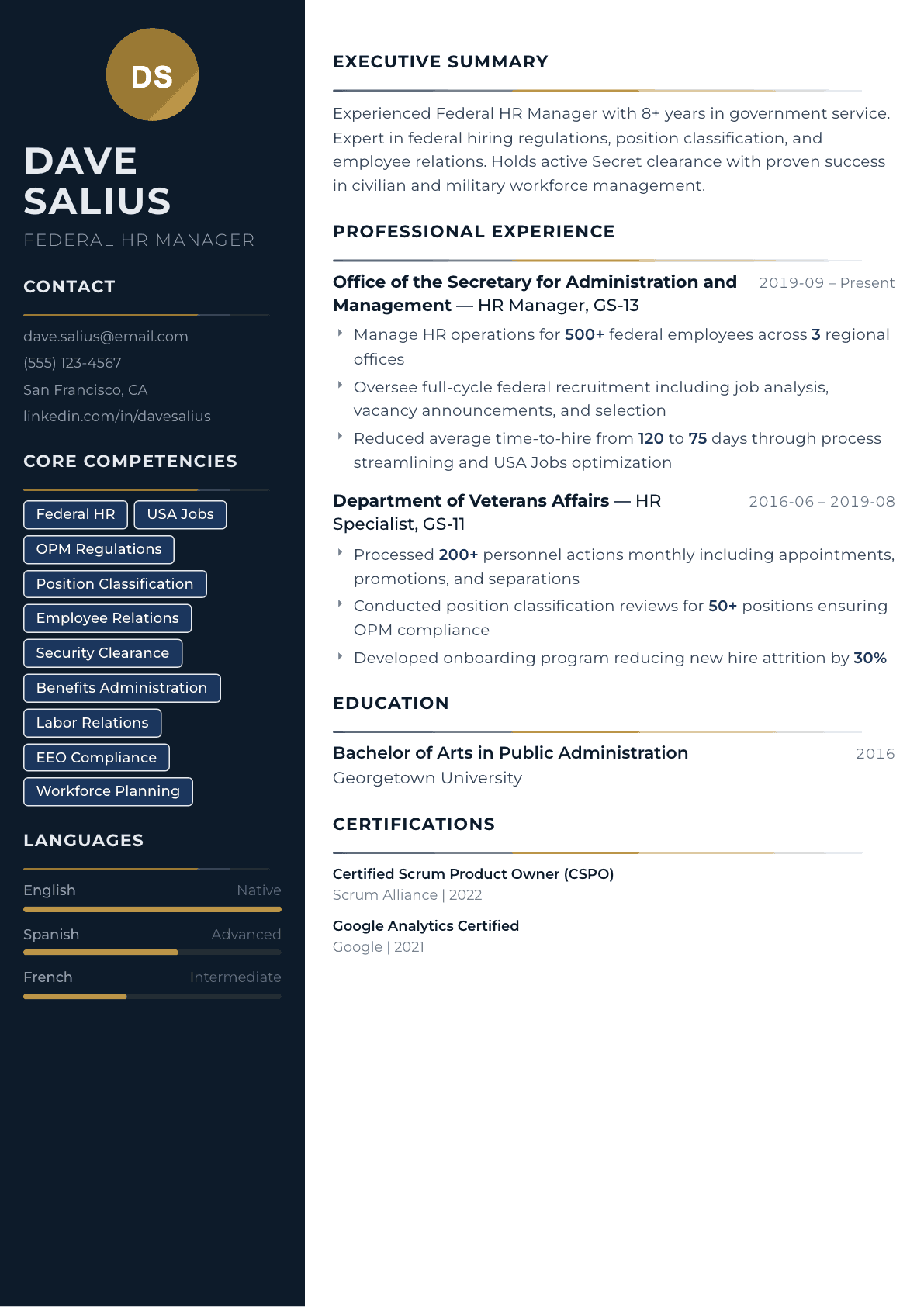
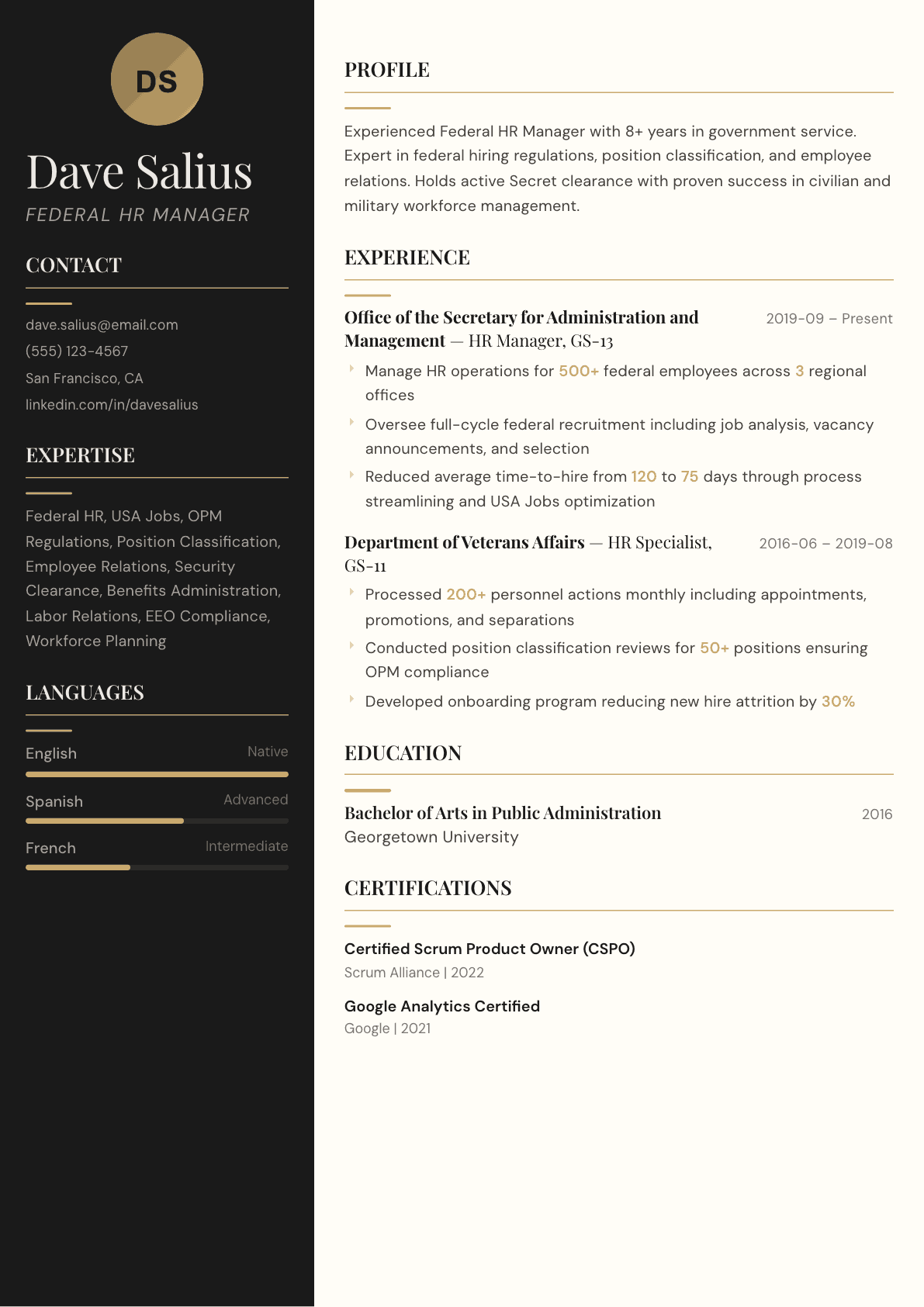
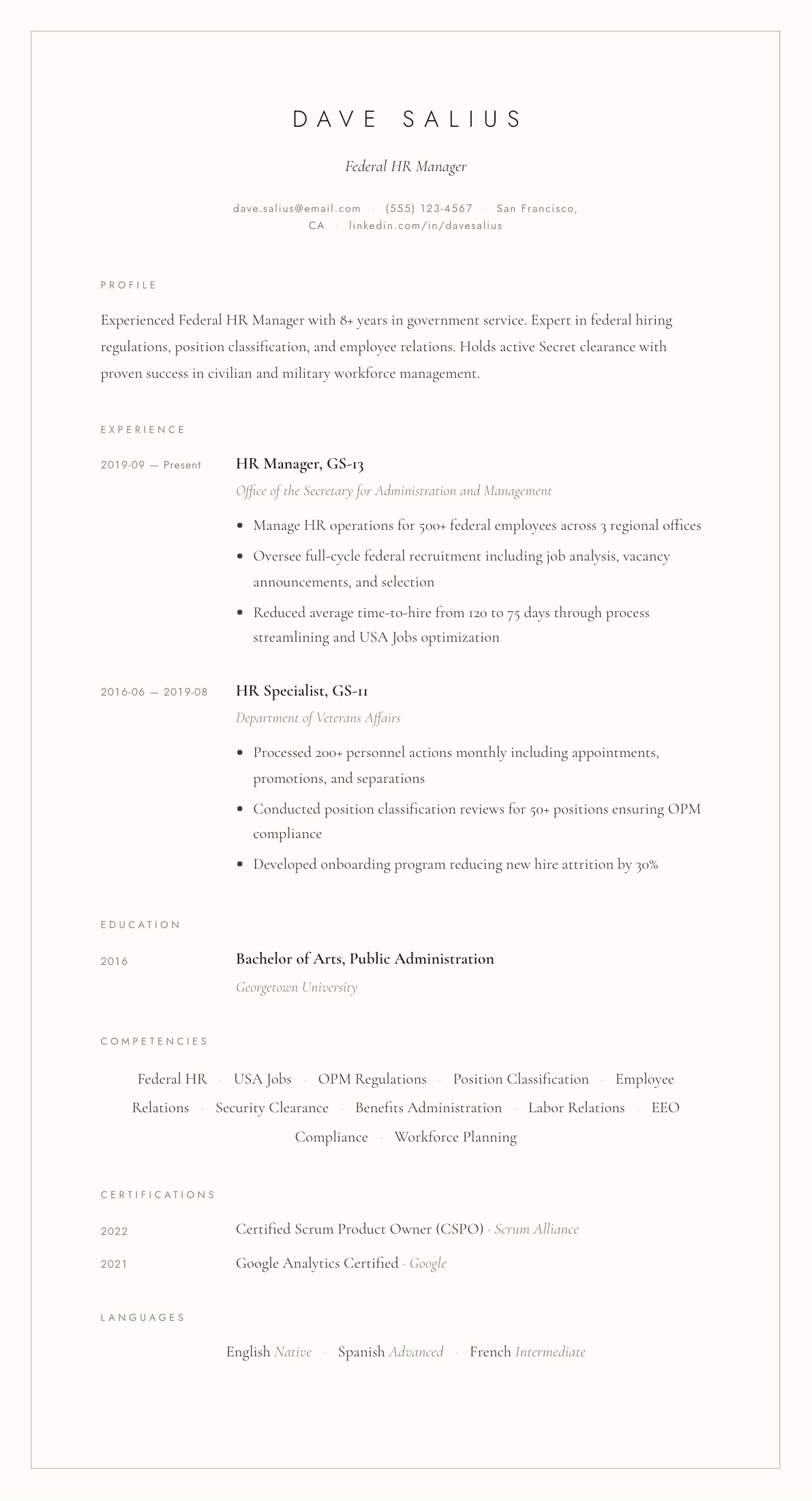
The same federal content laid out in three CVBooster templates, so you can see what the finished document looks like before you write a word.
Example Federal summary
Federal HR manager at GS-13 with 8 years of government service and an active Secret clearance. Covers 500 employees across three regional offices, took time to hire from 120 days to 75 through job analysis and announcement rewrites, and classifies positions to OPM standards.
Skills to list on a Federal resume
- Federal HR
- USA Jobs
- OPM Regulations
- Position Classification
- Employee Relations
- Security Clearance
- Benefits Administration
- Labor Relations
- EEO Compliance
- Workforce Planning
What actually gets this resume read
- Use the federal resume format (longer than private sector, include hours/week and supervisor info).
- List GS level, series, and specific pay grades.
- Include KSAs (Knowledge, Skills, and Abilities) relevant to the announcement.
- Mention security clearance level and status.
- Show experience with federal-specific systems (USA Staffing, eOPF, NFC).
How to write a federal resume
A federal resume follows rules that no private sector recruiter would recognize, and almost every rejection at the first stage comes from breaking one of them. A human resources specialist reads your document against a written qualification standard and a specific announcement. She is not looking for a compelling narrative. She is looking for proof that you performed the specialized experience described in the announcement, at the next lower grade, for at least one year.
The one page rule does not apply here. A federal resume commonly runs three to five pages because each position needs dates with months and years, hours per week, the grade or salary level, the supervisor, and enough narrative detail for the specialist to match your work to the duties in the announcement. A tight one page resume reads as insufficient evidence and gets rated ineligible.
This guide covers the required fields, how to mirror the specialized experience statement without copying it word for word, how the occupational questionnaire and the resume have to agree, how veterans preference and eligibility documents fit in, and the questions applicants ask when moving from industry into the civil service.
Format: the required fields, and why omitting one ends the application
Every position entry needs the employer name, the city and state, your official job title, the start and end dates with the month and the year, the hours worked per week, and the grade or level if the job was federal. A missing hours per week line is one of the most common reasons a strong candidate is rated ineligible, because the specialist cannot calculate whether your experience was full time.
Write in plain text with clear headings and no tables, columns, graphics or headers and footers. Federal application systems parse text and the reviewer often reads a converted version. Use bold sparingly and keep bullet characters simple.
- Header: name, city and state, phone, email, citizenship, and veterans preference if claimed.
- Order: summary of qualifications, professional experience with full detail, education with credit hours, certifications, training, awards, and other relevant information.
- For each federal position add the series and grade, for example a program analyst position at the GS-0343-12 level.
Match the specialized experience statement in the announcement
Find the specialized experience paragraph in the qualifications section of the announcement. It is the rating standard. Read the verbs and the objects: analyzing program data, developing policy recommendations, administering contracts, advising management officials. Your resume has to show each of those, with an example, at the level and for the duration the announcement requires.
Mirror the vocabulary without pasting it. If the announcement asks for experience conducting program evaluations and presenting findings to senior officials, your entry should show a named evaluation, the method, and the audience for the briefing. A verbatim copy of the announcement text is obvious to the specialist and adds no evidence.
Where a duty in the announcement is something you did occasionally rather than routinely, say the frequency honestly. Federal reviewing is a matching exercise, and an unsupported claim raises a question the specialist resolves against you.
Write experience as detail, not as tight bullets
Private sector advice about ruthless brevity works against you here. Under each position, write a short paragraph describing the program, the size of the operation and your authority, then bullets that carry the specific work. Volume, systems, dollar authority described in general scale terms, number of people supported and the decisions you made all belong in.
Name federal systems and processes you have worked in, since they signal an applicant who will need less onboarding. Financial and acquisition systems, personnel and payroll systems, records systems, travel systems, and the reporting cycles that go with them. Current employees should reference their position description duties where they align with the announcement.
Awards and recognition carry more weight here than in industry because they are documented. Performance awards, time off awards, on the spot awards, unit citations and quality step increases can each be listed with the year and the reason.
Eligibility, preference and the documents that go with the resume
State your eligibility clearly. Citizenship, veterans preference with the correct claim and the supporting form, a disability appointment eligibility, a military spouse eligibility, current or former competitive service status, and reinstatement eligibility if you have left the government. Announcements are open to defined groups and the specialist verifies each claim against a document.
Current and former federal employees should keep their most recent notification of personnel action ready, since it proves series, grade, tenure and time in grade. Veterans need the correct discharge document and, for a preference claim above the basic level, the application for ten point preference with its supporting evidence. Missing documents fail the application even when the resume is strong.
Security clearance belongs on the resume when the position requires one. Give the level, whether it is currently active, the date of the last investigation if you know it, and whether a polygraph is included.
The questionnaire, the keywords and the assessment
Most announcements pair the resume with an occupational questionnaire where you rate yourself on each competency. The two documents must agree. If you claim the highest level on a competency, the resume needs an example of it. Specialists lower ratings when the questionnaire is confident and the resume is silent, and that is where most self inflicted rejections happen.
Recurring federal vocabulary worth mirroring where true includes program management, policy analysis, stakeholder coordination, budget formulation and execution, acquisition planning, regulatory compliance, data analysis, internal controls, and briefing senior leadership. Some announcements also use an online assessment, so read the announcement for whether one is required and give yourself time for it.
Federal resume summary examples
Entering the civil service
Public administration graduate with two years as a state agency analyst preparing program reports and tracking grant expenditures, applying for a federal program analyst position at the GS-0343-07 level under a recent graduates pathway. United States citizen with a completed background check from prior state employment.
Mid grade specialist
Program analyst at the GS-0343-12 level with six years supporting budget formulation, performance reporting and internal control reviews for a regional office of 340 staff. Led two program evaluations, briefed senior executives quarterly, and holds an active Secret clearance and a five point veterans preference.
Supervisory or senior grade
Supervisory program manager at the GS-0343-14 level with thirteen years of federal service, currently leading a branch of nine analysts across three program lines. Managed acquisition planning for two multi year service contracts, closed six audit recommendations and served as acting division chief for eight months.
Work experience bullets: before and after
Before: Analyzed program data and prepared reports for management.
After: Analyzed quarterly performance data for three grant programs serving 40 subrecipients, prepared the regional performance report, and briefed the deputy director on two programs trending below target.
Named programs, a volume and a specific audience give the human resources specialist evidence she can match to the announcement.
Before: Worked on the budget for my office.
After: Supported budget formulation and execution for an office of 340 staff, tracked obligations against the spend plan monthly, and prepared the reprogramming justification that funded a delayed system upgrade.
Formulation, execution and a concrete product show the full budget cycle rather than general involvement.
Before: Responsible for contract oversight.
After: Served as the contracting officer representative for two service contracts, reviewed monthly deliverables against the statement of work, documented past performance, and recommended one corrective action for late reporting.
The named role and the oversight actions map directly to the duties a contracting announcement lists.
Before: Improved office processes and efficiency.
After: Redesigned the internal review checklist after an audit finding on documentation, trained 12 staff on the new process, and closed the finding at the next annual review with no repeat.
A finding closed is verifiable, while efficiency improvement is a claim the specialist cannot score.
Before: Supervised staff and handled personnel matters.
After: Supervised nine analysts including performance plans, midyear and annual appraisals, two hiring actions through the merit promotion process, and a reasonable accommodation request handled with the servicing human resources office.
Supervisory announcements screen for these exact actions, and naming them proves the experience rather than implying it.
Hard skills
- Federal resume and announcement analysis
- Occupational questionnaire alignment
- Budget formulation and execution
- Program evaluation and performance reporting
- Acquisition planning and contracting officer representative duties
- Internal controls and audit response
- Policy and regulatory analysis
- Grant and subrecipient administration
- Merit promotion and hiring processes
- Records management and information requests
- Federal financial and personnel systems
- Briefing senior executives
Soft skills
- Written precision
- Working within layered approval chains
- Interagency coordination
- Patience with long hiring timelines
- Ethical judgment and impartiality
Certifications worth listing
- Certified Government Financial Manager (CGFM) (Association of Government Accountants)
- Project Management Professional (PMP) (Project Management Institute)
- Certified Public Manager (National Certified Public Manager Consortium)
- Federal Acquisition Certification in Contracting (Office of Federal Procurement Policy)
- Defense Acquisition Workforce Certification (Defense Acquisition University)
- CompTIA Security+ (CompTIA)
Mistakes that cost federal candidates the interview
- Submitting a one page private sector resume, which almost never carries enough evidence for a qualifications determination.
- Omitting hours per week or the month in a date, which prevents the specialist from crediting the experience at all.
- Rating yourself at the highest level on the questionnaire while the resume contains no example of that competency.
- Copying the announcement duties verbatim instead of answering them with your own examples.
- Applying without the supporting documents, since a missing discharge form or personnel action ends an otherwise qualified application.
- Using a designed template with columns and graphics that the application system garbles before a human ever sees it.
- Writing one general resume for every announcement rather than rebuilding it against each specialized experience statement.
Federal resume questions
How long should a federal resume be?
Three to five pages is normal, and longer is acceptable for senior candidates with many positions. Length itself is not the measure. Every line should be evidence against the specialized experience statement, and detail that does not serve the announcement should still be cut.
Do I need to include my supervisor for every job?
Include the supervisor name and contact where you can, and mark whether you consent to contact. Some announcements make it optional, but providing it removes a verification question and shows nothing is being avoided. Note it as a former supervisor no longer reachable when that is the case.
What is time in grade and does it affect my application?
For competitive promotions, current federal employees generally must have served a year at the next lower grade before moving up. It applies to status applicants rather than to first time hires from outside, and your most recent personnel action document is what proves it.
Should I list every training course I have taken?
List training that supports the announcement, with the provider and the year, and group the rest. Mandatory annual training adds nothing. Course work that demonstrates a competency the announcement rates, such as acquisition, supervision or data analysis, is worth the space.
How do I move from the private sector into a federal job?
Rewrite your experience in the longer federal format, add hours per week and supervisors, and translate industry terms into the language of the occupational series you are targeting. Then look for announcements open to the public rather than to status candidates only, since that filter blocks most outside applicants.
Related resume examples
- Human Resources Resume example
- Operations Manager Resume example
- Administrative Assistant Resume example
- Public Administrator Resume example
- Government Employee Resume example
- State Government Employee Resume example