Court Administrator Resume Examples: what gets the call
Build a Court Administrator Resume the Bench Will Trust
By Mustafa Tarabya, founder of CVBooster · Published · Updated
Court administrator resume example with case management, docket, jury and budget keywords, plus a guide to writing for a presiding judge.
Sample resumes for a court administrator
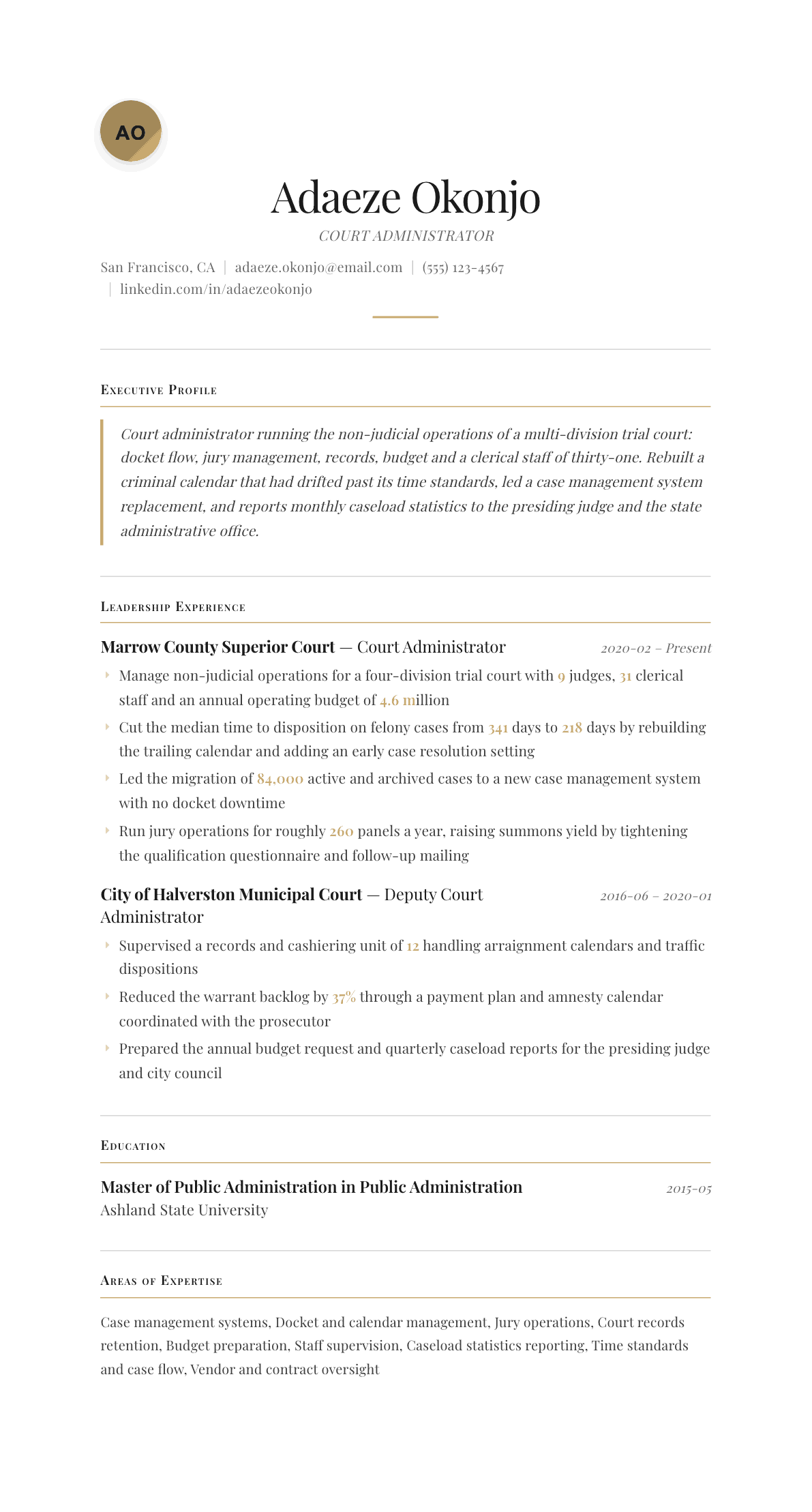
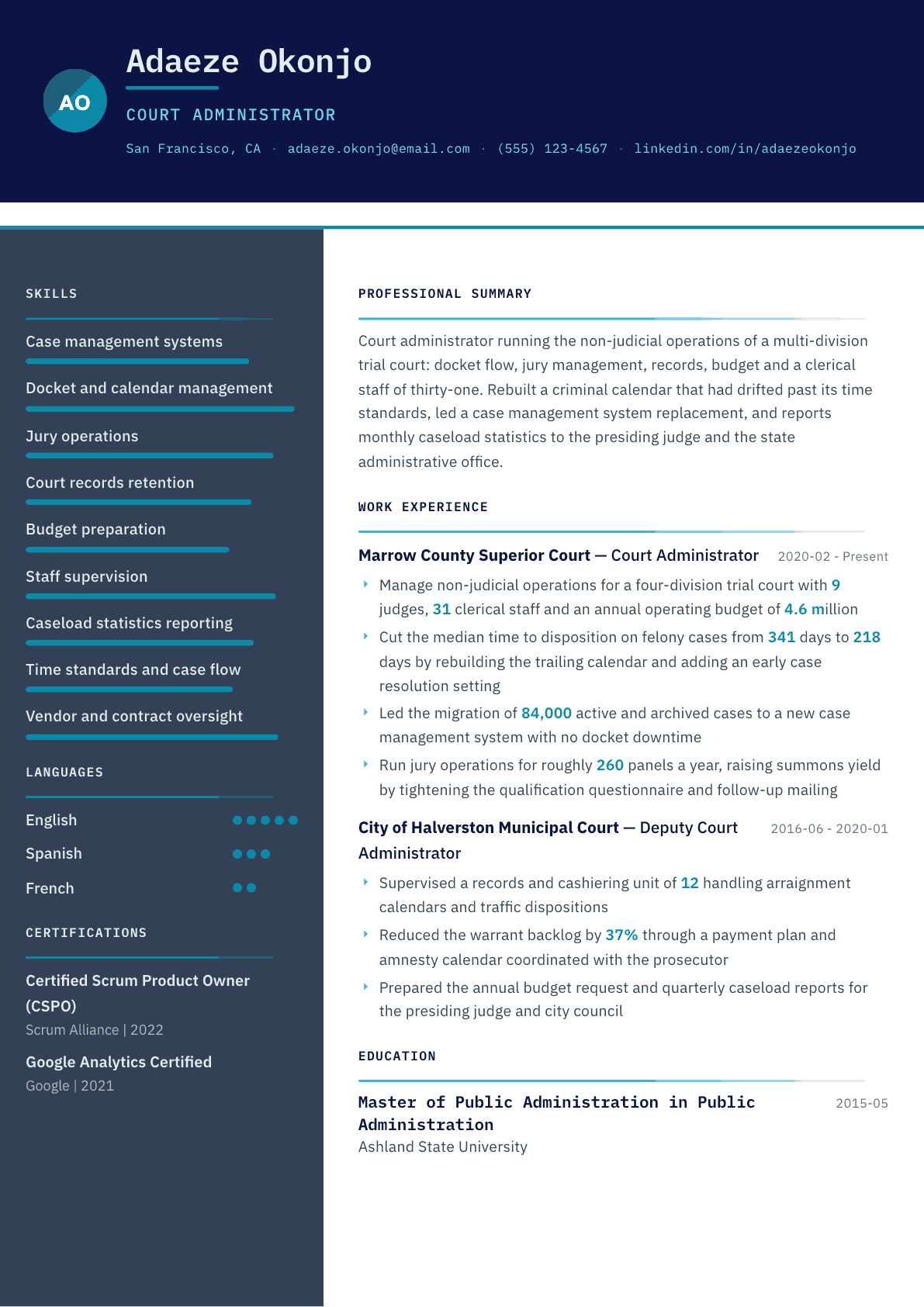
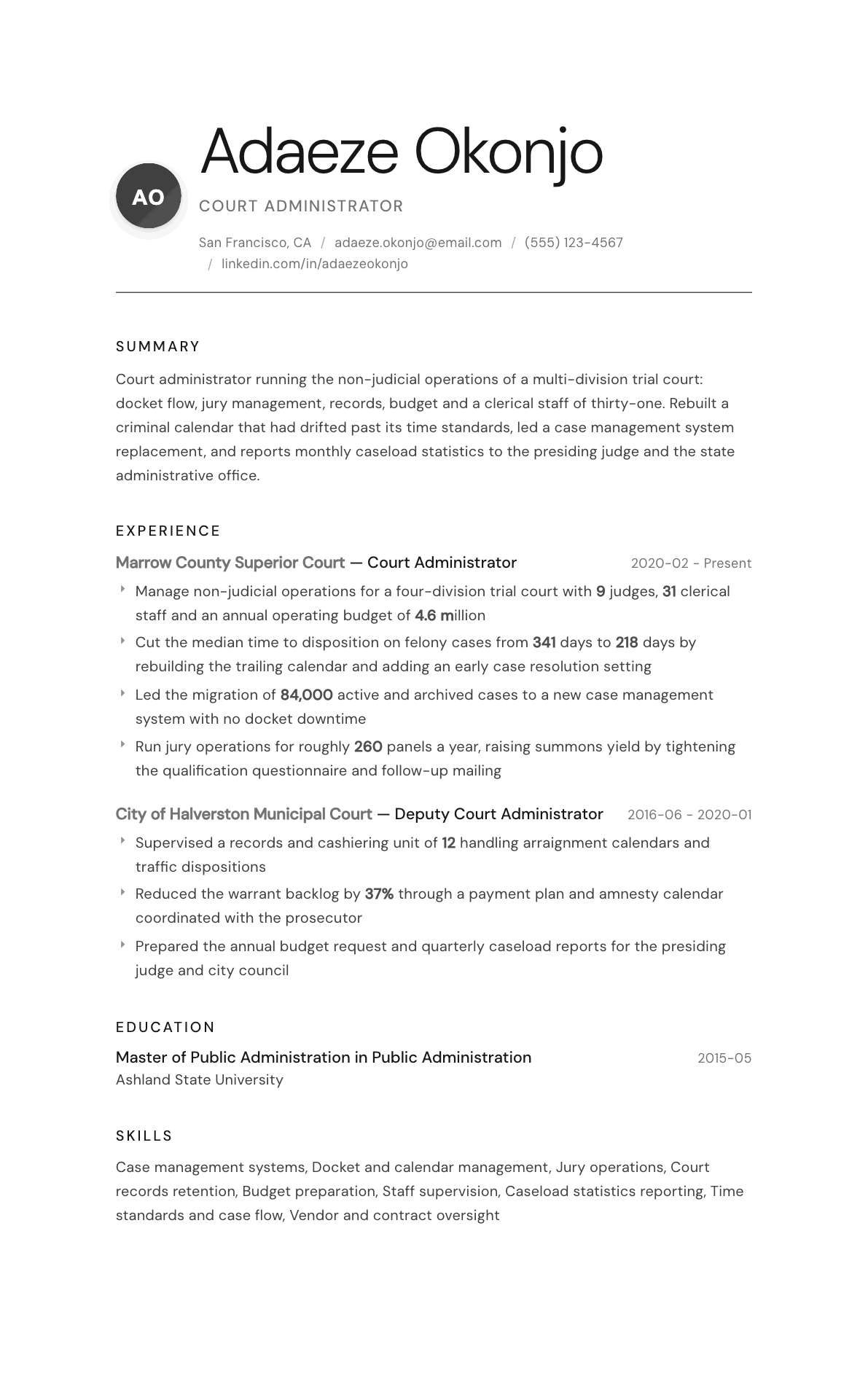
The same court administrator content laid out in three CVBooster templates, so you can see what the finished document looks like before you write a word.
Example Court Administrator summary
Court administrator with nine years running non-judicial operations for trial courts, most recently a four-division bench with thirty-one clerical staff and a multimillion operating budget. Rebuilt a felony calendar to bring median time to disposition back inside state standards, migrated a large case archive to a new case management system without docket downtime, and runs jury operations for hundreds of panels a year. Master of Public Administration.
Skills to list on a Court Administrator resume
- Case flow management
- Docket and calendar control
- Case management system administration
- Jury summons and panel management
- Court records and retention schedules
- Time standards reporting
- Budget development and monitoring
- Procurement and vendor oversight
- Clerical staff supervision
- Interpreter and accommodation coordination
- Courthouse security coordination
- Public records requests
- Grant administration
- Statistical reporting to a state office
- Policy and local rule drafting
What actually gets this resume read
- Open with the court level, the number of judges and the divisions you support, since scale defines the job.
- Give case flow numbers a presiding judge cares about: time to disposition, backlog age and clearance rate.
- Name the case management system by product, because a court replacing one wants someone who has done it.
- Show jury operations separately, including panels per year and how you improved summons yield.
- State budget size and whether you built the request, defended it, or only tracked spending against it.
- Describe your working relationship with the bench, the clerk of court and the state administrative office.
How to write a court administrator resume
A presiding judge hiring a court administrator is handing over everything that is not judging: the calendar, the clerical staff, the jury pool, the budget, the records, the vendors and the reports the state office demands every month. She is looking for someone who can absorb all of it and give her back a bench that runs on time.
That is why generic management language fails so completely on this page. "Oversaw daily operations and ensured efficiency" could describe a warehouse. A court runs on case flow: time to disposition, clearance rate, age of pending inventory, continuance patterns, and whether the felony calendar has quietly drifted six months past its standard. Numbers from that vocabulary are what a bench reads.
This guide works through the resume a trial court actually evaluates, with summaries for a deputy stepping up, a settled administrator and a multi-court executive, before and after bullets built from real court measures, and the questions administrators ask when they move between court levels.
Format: reverse chronological, court scale stated before anything else
One page under about eight years, two pages after that. Courts are hierarchical and dated institutions, so a functional layout that obscures your progression reads badly here. Keep it single column with conventional headings, because the human resources office of a county or a state judicial branch will parse it before the bench ever sees it.
Directly under your name, add one line giving the court level you currently serve, the number of judicial officers, the divisions covered and the annual filing volume. That line is the frame for everything after it. A reader who knows you run a four-division trial court with nine judges interprets your budget and staffing numbers correctly on the first pass.
- Top line: court name, court level, judicial officer count, divisions and annual filings.
- Order the page as summary, court operations experience, education, credentials from the Institute for Court Management, then technical systems.
- Give staffing as direct reports and total unit headcount, since the two numbers are read differently.
- Deputy administrators moving up put the functions they owned outright above the ones they supported.
Summary: court level, divisions, staff, and the problem you fixed
Four lines at most. Court level and divisions, staff supervised, budget size, and one specific operational problem you solved. Case backlog, a failed system migration, a jury yield collapse and a records retention mess are all recognizable to a presiding judge, and naming one of them signals that you have done the job rather than held the title.
If you are applying across court levels, say what transfers. Municipal court volume teaches speed and cashiering discipline. Superior court teaches complex civil scheduling and jury operations at scale. State the direction of your move openly instead of letting a screener assume you are overreaching.
Experience: case flow numbers, not activity descriptions
Each position needs the court, the divisions, the judicial officer count and the staff you supervised. Then the bullets carry case flow. Median and ninetieth percentile time to disposition by case type, clearance rate, age of the pending inventory, and continuance rate are the measures a judicial council reviews, and an administrator who quotes them is speaking the language of the people making the hire.
Show the mechanism alongside the number. Cutting median felony time to disposition is credible when you say how: a trailing calendar rebuilt, an early case resolution setting added, a differentiated case management track for simple matters, or a firm trial date policy negotiated with the prosecutor and the defense bar. Without the mechanism the number reads as something that happened near you.
Include the operational functions courts actually staff for: jury summoning and yield, interpreter scheduling, records retention and destruction, courthouse security coordination, exhibit custody, and self-represented litigant assistance. These are the areas where a new administrator either steadies the court or drowns.
Systems, budget and the state reporting relationship
Name the case management system by product and say what you did with it: administered it, configured local code tables, ran a data cleanup, or led a full replacement. A court considering a migration will interview anyone who has completed one, because the projects are long and they go wrong loudly. If you have moved a large archive without losing docket availability, that belongs in its own bullet.
On budget, be exact about your role. Building the request, defending it before a county commission or a legislative committee, and monitoring spending against it are three different jobs. Add grant work if you have it, since court improvement funding often pays for the very projects a bench wants to hire you to run. Then describe your reporting relationship with the state administrative office, because a court that files late statistics gets attention nobody wants.
Credentials and the keywords a judicial branch screens on
Court hiring uses a small, stable set of terms: case flow management, time standards, clearance rate, docket, calendar, jury management, records retention schedule, local rules, judicial council, chief judge, clerk of court, procurement, security committee and public records. Use each once where the work is shown. If you hold a certification from the Institute for Court Management, put the exact program name on the page, because it is one of the few credentials this field recognizes on sight.
A short technical line helps: the case management system, the jury management system, the electronic filing platform, the digital recording software and the financial system you have worked in. Courts run on a handful of vendor products, and a candidate who already knows one of them shortens the transition by months.
Court Administrator resume summary examples
Deputy stepping up
Deputy court administrator with four years supervising a records and cashiering unit of twelve in a municipal court handling arraignment and traffic calendars. Cut the warrant backlog by 37% through a payment plan calendar, prepared the annual budget request, and now seeking a full administrator role in a trial court.
Trial court administrator
Court administrator for a four-division trial court with nine judicial officers, thirty-one clerical staff and a multimillion operating budget. Brought median felony time to disposition from 341 days to 218 by rebuilding the trailing calendar, and led a case management system replacement covering the full active and archived inventory.
Court executive across a circuit
Court executive officer with fourteen years across municipal and superior courts, currently supporting a circuit of three counties, twenty-two judicial officers and a staff above one hundred. Owns budget development, jury operations, records policy and the statistical reporting relationship with the state administrative office.
Work experience bullets: before and after
Before: Oversaw daily operations of the court and supervised staff.
After: Directed non-judicial operations for a four-division trial court with nine judicial officers and thirty-one clerical staff across criminal, civil, family and probate calendars.
Court level, division count and staffing tell a presiding judge the scale you have already carried.
Before: Reduced case backlog in the criminal division.
After: Cut median time to disposition on felony cases from 341 days to 218 days by rebuilding the trailing calendar and adding a dedicated early case resolution setting each week.
A recognized case flow measure plus the mechanism turns a claim into something a judicial council can verify.
Before: Implemented a new case management system.
After: Led the migration of the full active and archived case inventory to a new case management system across four divisions with no interruption to docket availability or public search.
Scope and the absence of downtime are the two things a court about to migrate wants to know.
Before: Managed the jury process for the court.
After: Ran jury operations for roughly 260 panels a year, raising summons yield by rewriting the qualification questionnaire and adding a structured follow-up mailing before the failure to appear referral.
Panel volume and a named yield intervention show you understand where jury operations actually break.
Before: Prepared and monitored the court budget.
After: Built and defended the annual operating budget request before the county commission, then monitored spending by division and closed three consecutive years within the appropriation.
Separating building, defending and monitoring identifies which part of the budget job you have truly held.
Hard skills
- Case flow management and time standards
- Docket and calendar construction
- Case management system administration
- Jury summoning and panel operations
- Court records retention schedules
- Statistical reporting to a state administrative office
- Budget development and appropriation monitoring
- Procurement and vendor contract oversight
- Local rule and administrative order drafting
- Courthouse security committee coordination
- Interpreter and accommodation scheduling
- Public records request administration
- Grant application and administration
Soft skills
- Working with a bench without stepping into judicial territory
- Delivering unwelcome operational facts to a chief judge
- Steadying a clerical unit through a system change
- Negotiating calendar policy with prosecution and defense
- Discretion with sealed and confidential matters
Certifications worth listing
- Certified Court Manager (CCM) (Institute for Court Management, National Center for State Courts)
- Certified Court Executive (CCE) (Institute for Court Management)
- Fellow of the Institute for Court Management (National Center for State Courts)
Mistakes that cost court administrator candidates the interview
- Describing court work as general operations management, which erases the case flow vocabulary a bench hires on.
- Giving a backlog improvement with no mechanism behind it, so the reader cannot tell whether you caused it.
- Omitting the court level and judicial officer count, leaving every staffing and budget figure without a frame.
- Listing a case management system by category instead of naming the product a court may already be running.
- Claiming budget responsibility without saying whether you built the request, defended it, or only tracked it.
- Ignoring jury operations and records retention, the two functions that generate the loudest failures in a courthouse.
- Blurring the line between your work and the bench's decisions, which reads as someone who does not respect judicial independence.
Court Administrator resume questions
What is the difference between a court administrator and a clerk of court?
In many jurisdictions the clerk is an elected or separately appointed officer responsible for the official record, while the administrator is appointed by the bench to run operations. Say plainly which structure your court used and which functions actually reported to you.
How do I move from a municipal court to a superior or district court?
Lead with the functions that scale: calendar construction, staff supervision, budget and records. Then address the gap directly by naming any exposure you have to jury trial operations, complex civil scheduling and state reporting, since those are the parts municipal work rarely covers.
Do I need a certification from the Institute for Court Management?
It is not universally required, but it is the credential this field recognizes and many postings prefer it. If you are enrolled rather than finished, list the program and your expected completion so the bench knows you are already in it.
Which numbers belong on a court administrator resume?
Time to disposition, clearance rate, age of pending inventory, continuance rate, jury summons yield, staff headcount, filing volume and budget size. These come from the reports your court already files, so every one of them can be checked in an interview.
Should I mention conflict with judges or elected clerks?
Not on the resume. Write the outcome instead, such as a calendar policy adopted or a records agreement reached, and save the interpersonal history for an interview answer where you can describe how you resolved it professionally.
Related resume examples
- City Manager Resume example
- Public Administrator Resume example
- Municipal Clerk Resume example
- Court Clerk Resume example
- City Employee Resume example
- Government Employee Resume example