City Clerk Resume Examples: free ATS score and gap list
City Clerk Resume: Elections, Records and the Council Agenda
By Mustafa Tarabya, founder of CVBooster · Published · Updated
City clerk resume example plus keywords and a guide to writing about elections administration, council agendas, codification and records custody.
Sample resumes for a city clerk
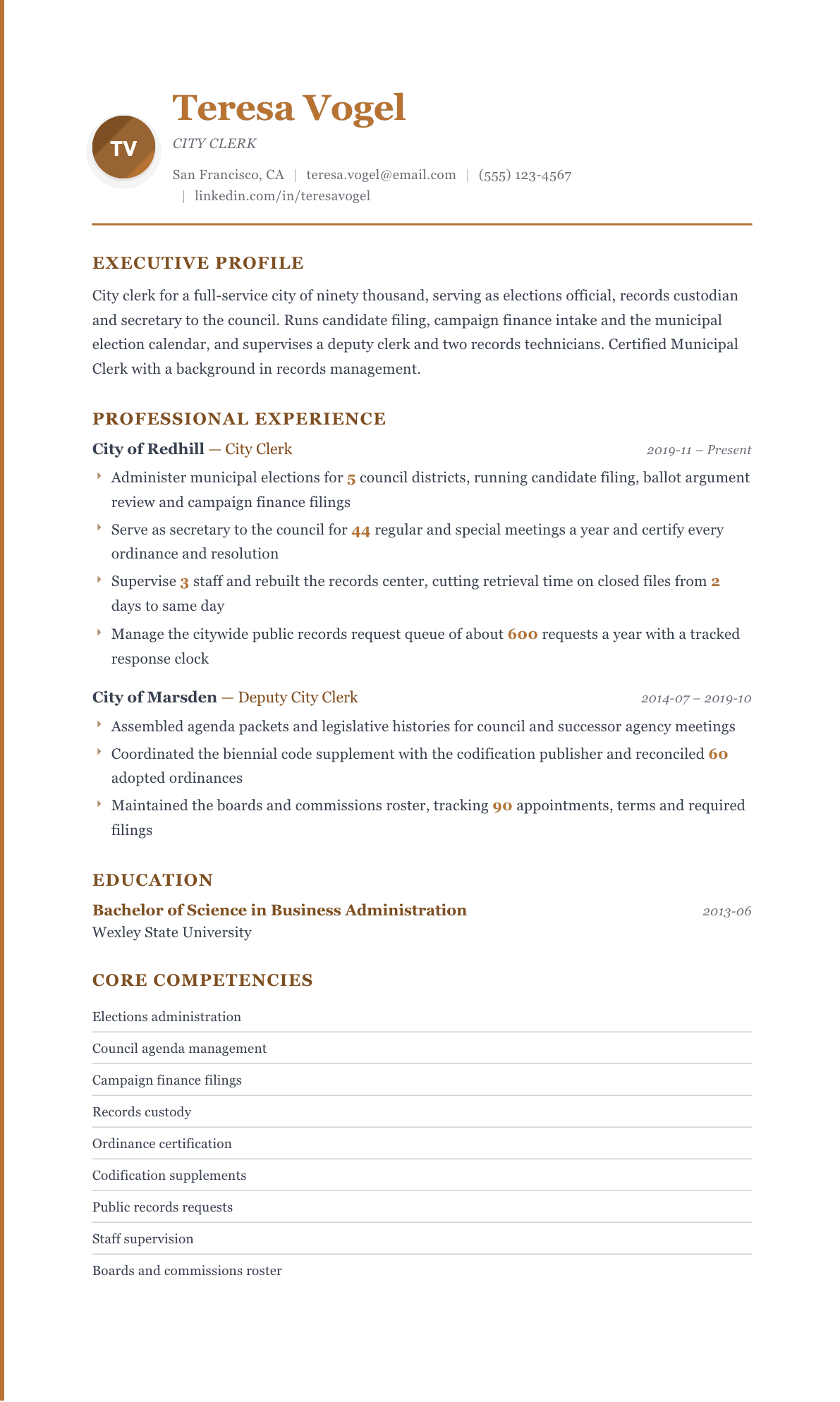
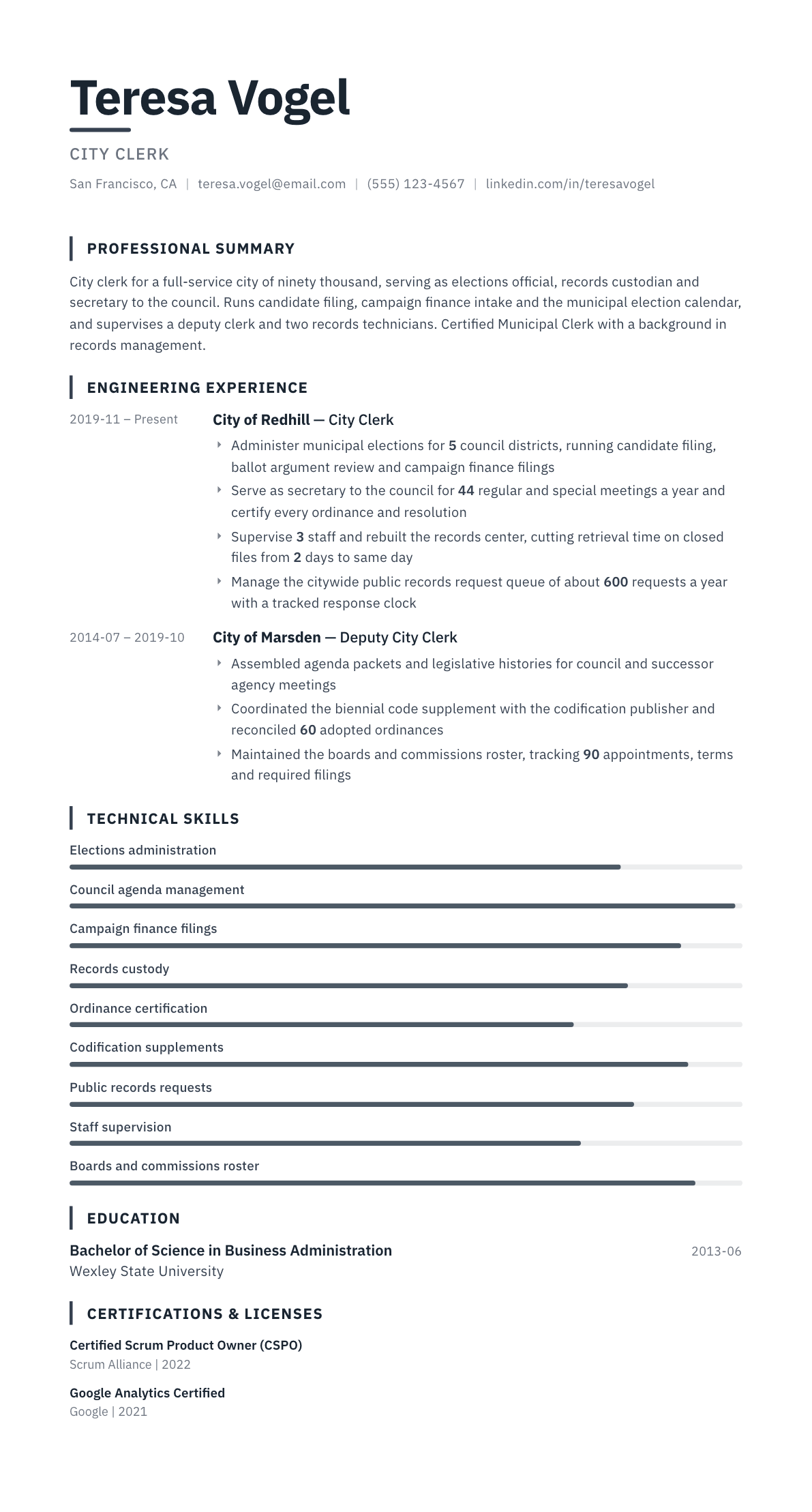
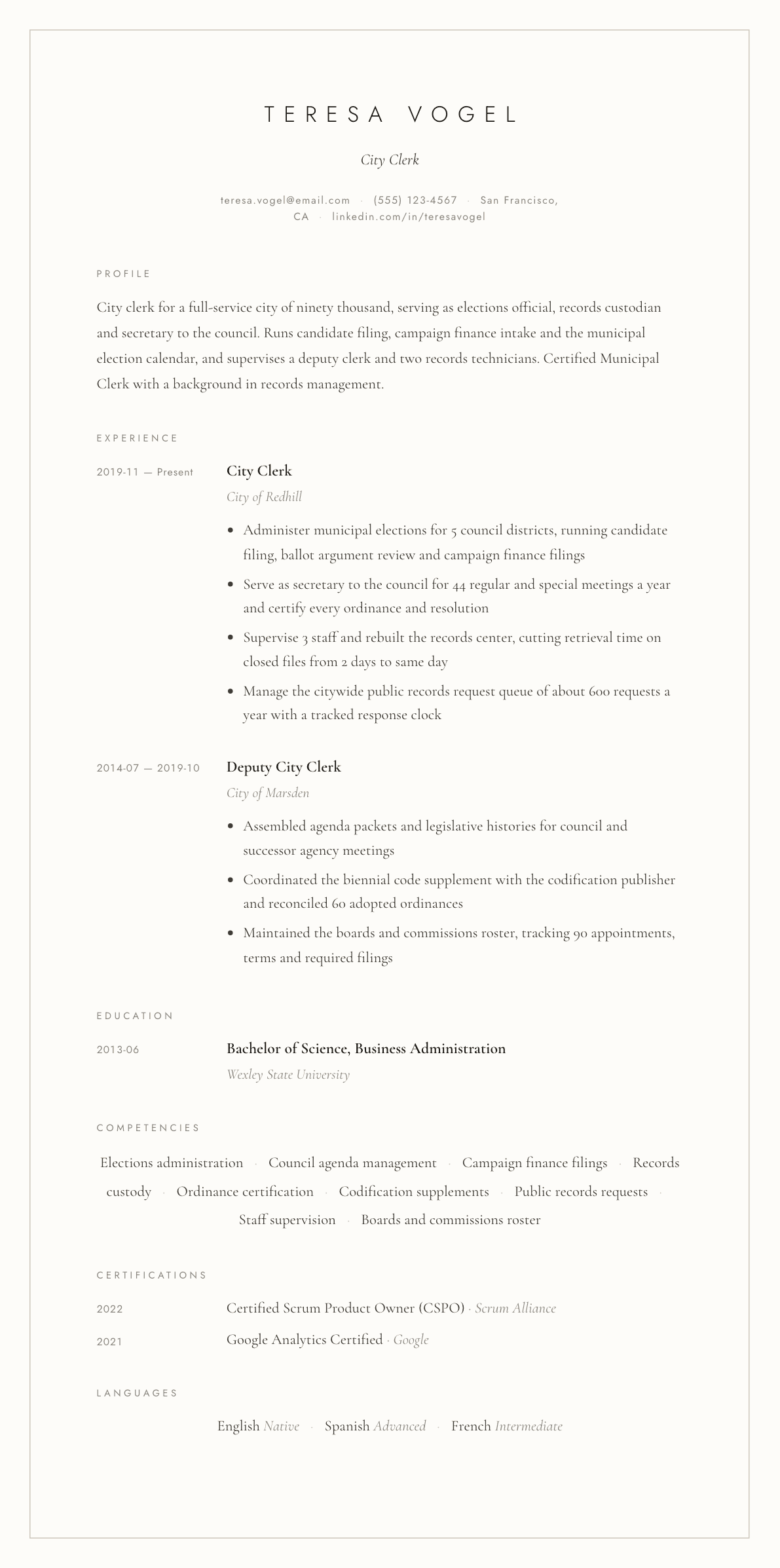
The same city clerk content laid out in three CVBooster templates, so you can see what the finished document looks like before you write a word.
Example City Clerk summary
City clerk for a city of ninety thousand, serving as elections official, secretary to the council and citywide records custodian. Runs candidate filing and campaign disclosure, certifies ordinances, and supervises a records team that answers roughly six hundred public records requests a year. Certified Municipal Clerk seeking a clerk role in a larger charter city.
Skills to list on a City Clerk resume
- Municipal elections administration
- Candidate filing and nomination papers
- Campaign finance and disclosure filings
- Council agenda and minutes
- Ordinance and resolution certification
- Legislative history research
- Public records act compliance
- Records center management
- Codification supplements
- Boards and commissions appointments
- Staff supervision
- Oath and notary services
- Municipal code interpretation
What actually gets this resume read
- Lead with elections if your city runs its own, because that duty separates a city clerk from an office manager.
- Give the city population and whether it is a charter or general law city, since the clerk duties differ between them.
- State how many council meetings you staff, how many staff you supervise, and your public records request volume.
- Name the campaign finance and disclosure filings you administer and the deadlines you enforce on candidates.
- Include your Certified Municipal Clerk or Master Municipal Clerk designation with the granting body.
- Describe the codification cycle you manage and the publisher you work with on code supplements.
How to write a city clerk resume
A city clerk sits at the point where three separate legal functions meet: the legislative record of the council, custody of the city public records, and in many cities the administration of municipal elections. Those three duties get bundled into one appointment, and a search committee reading resumes is trying to find out which of the three you have actually run rather than supported.
The mistake most applicants make is writing the resume around the office instead of around the authority. Assembling an agenda packet is support work. Certifying an ordinance, signing a nomination petition as sufficient, and denying a records request in writing are acts with legal consequence, and those are the ones a city manager or a council selection panel weighs.
This guide sets out how to structure a city clerk resume around elections, the council record and records custody, with example summaries at three career stages and the before and after bullets that separate a deputy from a clerk.
Format: authority first, tasks second
Two pages, reverse chronological, and a header that carries your designation. Under the header, put a four line qualifications block that names the three functions you own and the size of the city. A selection panel often reads only that block before deciding which resumes go into the second pile.
Say whether each city was a charter city or a general law city, and whether the clerk was appointed by the council, appointed by the manager or elected. Those distinctions change the reporting relationship and the scope of the office, and a panel notices immediately when a candidate does not mention them.
- Credentials line under your name: designation, notary commission, and any records management certification.
- A short block naming your three core functions with a scale figure for each.
- Experience with the city, the population served, the governance form and your appointing authority.
- A separate elections block if you serve as elections official, because that experience is scarce and gets searched for directly.
Elections: the duty that decides the shortlist
If your city conducts its own elections or contracts with a county while retaining the elections official role, put that first. Describe the cycle end to end: the calendar, candidate filing and nomination paper verification, ballot designation and argument review, campaign disclosure intake, canvass certification and the swearing in that follows.
Include the measures and initiatives you have handled, since petition sufficiency checks and impartial analysis coordination are the part of elections work that carries litigation risk. If you have run a recall, a special election or a district transition, name it, because those events are how clerks build reputations.
The council record: agendas, certification and legislative history
State the number of regular, special and closed session meetings you staff each year, and say whether you also serve successor agency, housing authority or financing authority boards that meet as the same body under a different hat. Cities layer those boards, and clerks who have handled them save a new employer a long orientation.
Certification is the sentence that matters. You attest that an ordinance was adopted, published and is in effect. Say that you do it, say how many instruments you certify in a year, and describe how you maintain legislative history so an attorney can reconstruct the path of a code section without calling you.
Records custody, codification and the team
Give the annual public records request volume for the whole city if you run the central queue, the tracking system you use, and how you coordinate departmental searches and legal review. Clerks who have built a routing workflow across departments should say so, since that is usually the difference between a compliant city and an exposed one.
Describe the codification cycle: how often supplements go out, which publisher you work with, and how you reconcile adopted ordinances against the published code. Then describe your team: how many staff, what classifications, and what you have changed about how the records center runs.
- Records request volume, tracking system and average response time against the statutory window.
- Codification publisher, supplement frequency and the ordinance reconciliation process.
- Staff supervised by classification, plus any recruitment or evaluation duties you carry.
- Boards and commissions roster: seats tracked, appointments processed and required filings monitored.
Credentials and professional standing
Certified Municipal Clerk and Master Municipal Clerk from the International Institute of Municipal Clerks are the recognized marks in this field, and state clerk associations run the institutes behind them. If you have held office in a state association, taught an institute session or served on a nominating committee, list it. City clerk recruitments are small worlds, and professional standing travels ahead of the resume.
City Clerk resume summary examples
Deputy city clerk
Deputy city clerk with 4 years supporting council agendas, legislative histories and the boards and commissions roster in a general law city. Coordinated a biennial code supplement covering 60 adopted ordinances and maintained 90 appointments with their required disclosure filings. Certified Municipal Clerk candidate.
City clerk, mid-size city
City clerk for a city of ninety thousand, serving as elections official, secretary to the council and citywide records custodian. Administers candidate filing and campaign disclosure across 5 districts, certifies every ordinance, and supervises 3 staff handling roughly 600 records requests a year.
Master Municipal Clerk
Master Municipal Clerk with 18 years in charter cities, appointed by council and reporting directly to it. Ran a district transition election, rebuilt the records center, and led the migration of 40 years of legislative history into a public search portal. Past president of the state clerk association.
Work experience bullets: before and after
Before: Ran city elections.
After: Administered municipal elections across 5 council districts, managing candidate filing, nomination paper verification, ballot argument review and campaign disclosure intake through certification of the canvass.
Elections work is a sequence of statutory steps, and naming them proves you have run the cycle rather than assisted with it.
Before: Prepared agendas for council meetings.
After: Served as secretary to the council for 44 regular and special meetings a year, assembling agenda packets, recording the vote on each item and certifying every adopted ordinance and resolution.
Certification is the clerk act with legal weight, and the strong version puts it in front of the packet assembly.
Before: Handled public records requests.
After: Managed the citywide public records queue of about 600 requests a year, routing departmental searches, coordinating legal review of exemptions and tracking each response against the statutory clock.
Running the citywide queue is a coordination role across departments, not a clerical task inside one office.
Before: Supervised clerk office staff.
After: Supervised a deputy clerk and 2 records technicians, and rebuilt the records center so retrieval of a closed file dropped from 2 days to the same business day.
A supervision claim gains force when it is attached to a specific operational change and its result.
Before: Worked on the municipal code.
After: Coordinated the biennial code supplement with the codification publisher, reconciling 60 adopted ordinances against the published code and resolving conflicting section numbering with the city attorney.
Reconciliation and conflict resolution show ownership of the code, while working on it says nothing at all.
Hard skills
- Municipal elections administration
- Candidate filing and nomination paper verification
- Campaign disclosure and conflict of interest filings
- Council agenda, minutes and vote records
- Ordinance and resolution certification
- Legislative history research
- Public records act compliance
- Records center and retention management
- Codification supplements
- Boards and commissions administration
- Oath administration and notary services
- Staff supervision and evaluation
Soft skills
- Political neutrality
- Composure at contested hearings
- Clear writing for a legal record
- Cross-department influence without authority
- Discretion with closed session material
Certifications worth listing
- Certified Municipal Clerk (CMC) (International Institute of Municipal Clerks)
- Master Municipal Clerk (MMC) (International Institute of Municipal Clerks)
- Certified Records Analyst (CRA) (Institute of Certified Records Managers)
Mistakes that cost city clerk candidates the interview
- Burying elections experience below general office duties when it is the scarcest qualification a clerk can hold.
- Omitting the governance form and appointing authority, which tells a panel nothing about your reporting relationship.
- Describing certification of ordinances as paperwork rather than as the legal act it is.
- Giving no citywide request volume, which leaves a reader unable to compare your office to theirs.
- Listing supervision without classifications or headcount, so the panel cannot size the team you ran.
- Skipping the professional designation, which appears as preferred in a large share of clerk recruitments.
City Clerk resume questions
Is a city clerk position appointed or elected?
Both exist. Some cities elect the clerk, some have the council appoint, and some place the office under the city manager. State which arrangement you worked under, because it shapes the independence and the political exposure of the job.
How much elections experience do I need to be competitive?
Running at least one full municipal cycle from the calendar through canvass certification puts you ahead of most applicants. If your county conducts the election, describe the elections official duties you retained, such as filing, arguments and disclosure.
What is the difference between a city clerk and a municipal clerk resume?
Scope. A city clerk resume usually needs elections administration, supervision of a records team and citywide records custody, while a smaller municipal clerk role concentrates on meetings, licensing and retention within one office.
Should I list closed session work on my resume?
List the function, never the content. Say that you keep the closed session minute book and track reportable action, which shows the panel you understand the boundary without disclosing anything protected by it.
How do I move from deputy to city clerk?
Document acting service and independent authority. Name the meetings you clerked alone, the notices and certifications you signed, the vacancies you covered, and your progress toward the Certified Municipal Clerk designation with completed institute sessions.
Related resume examples
- City Manager Resume example
- Federal Resume example
- Municipal Clerk Resume example
- Public Information Officer Resume example
- Postal Worker Resume example
- Government Employee Resume example