Health Inspector Resume Examples: the lines they read
Build a Health Inspector Resume Around Inspections and Findings
By Mustafa Tarabya, founder of CVBooster · Published · Updated
Health inspector resume example with food code keywords and a guide to inspection volume, violations, enforcement and outbreak response.
Sample resumes for a health inspector
The same health inspector content laid out in three CVBooster templates, so you can see what the finished document looks like before you write a word.
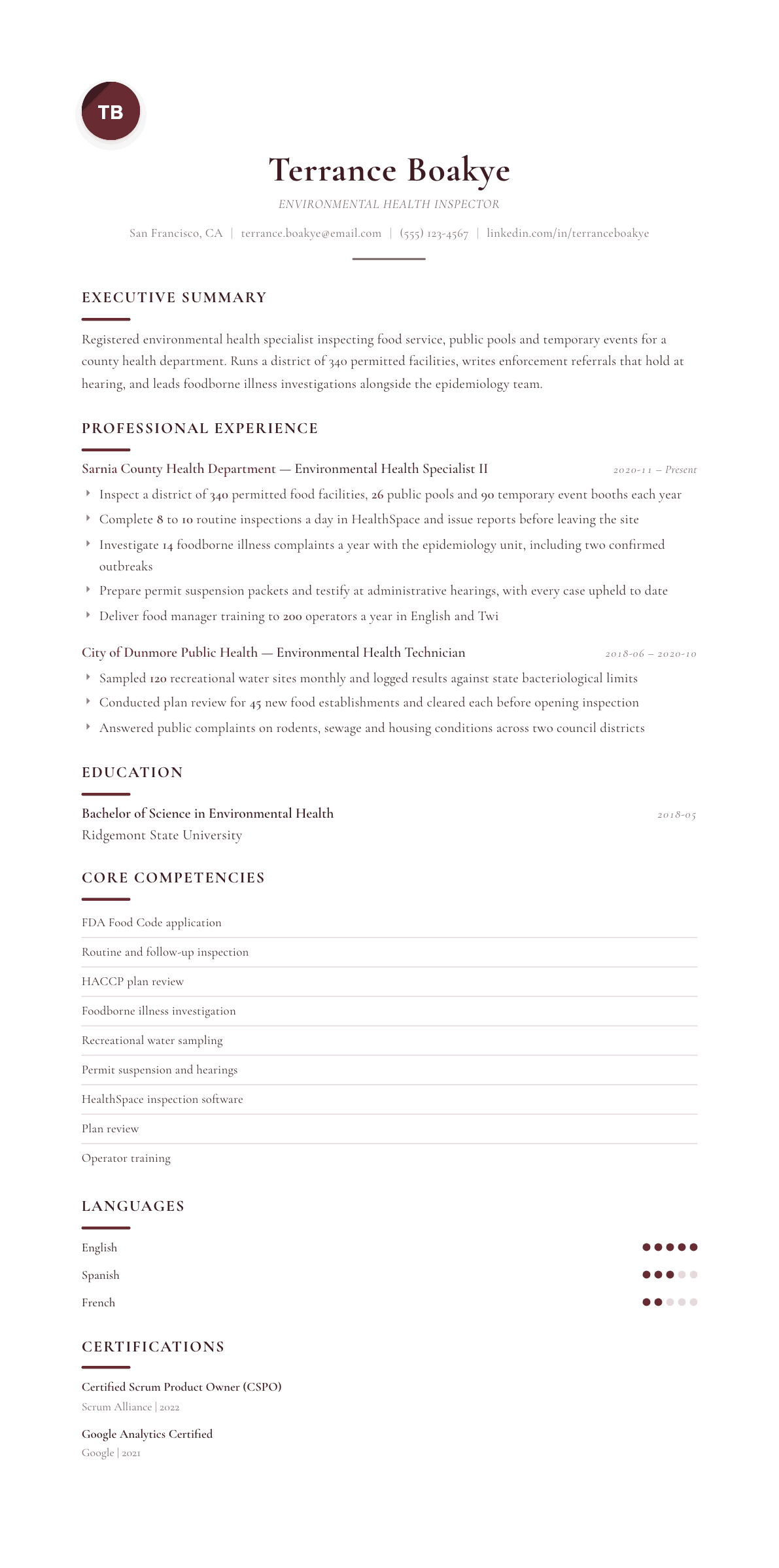
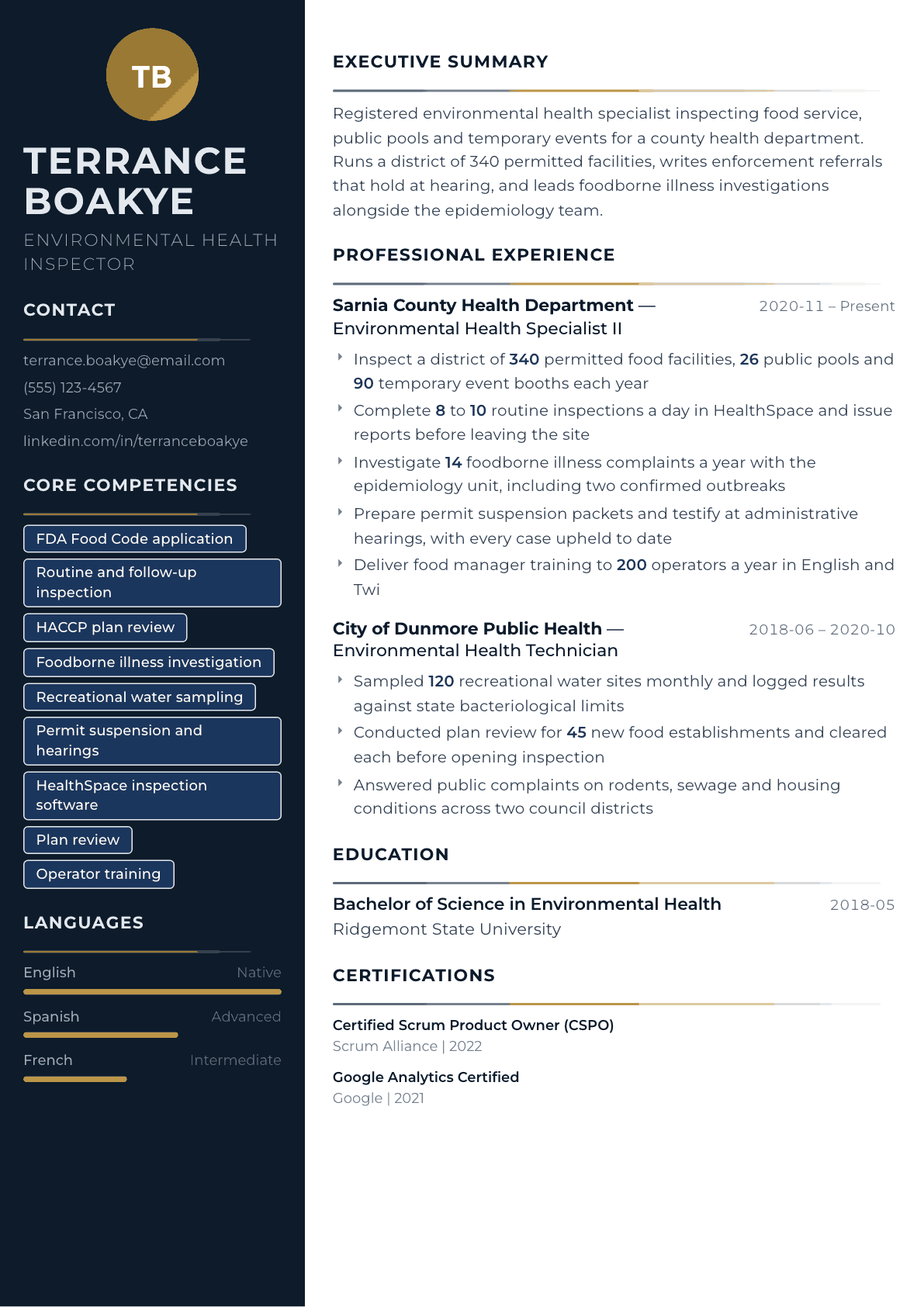
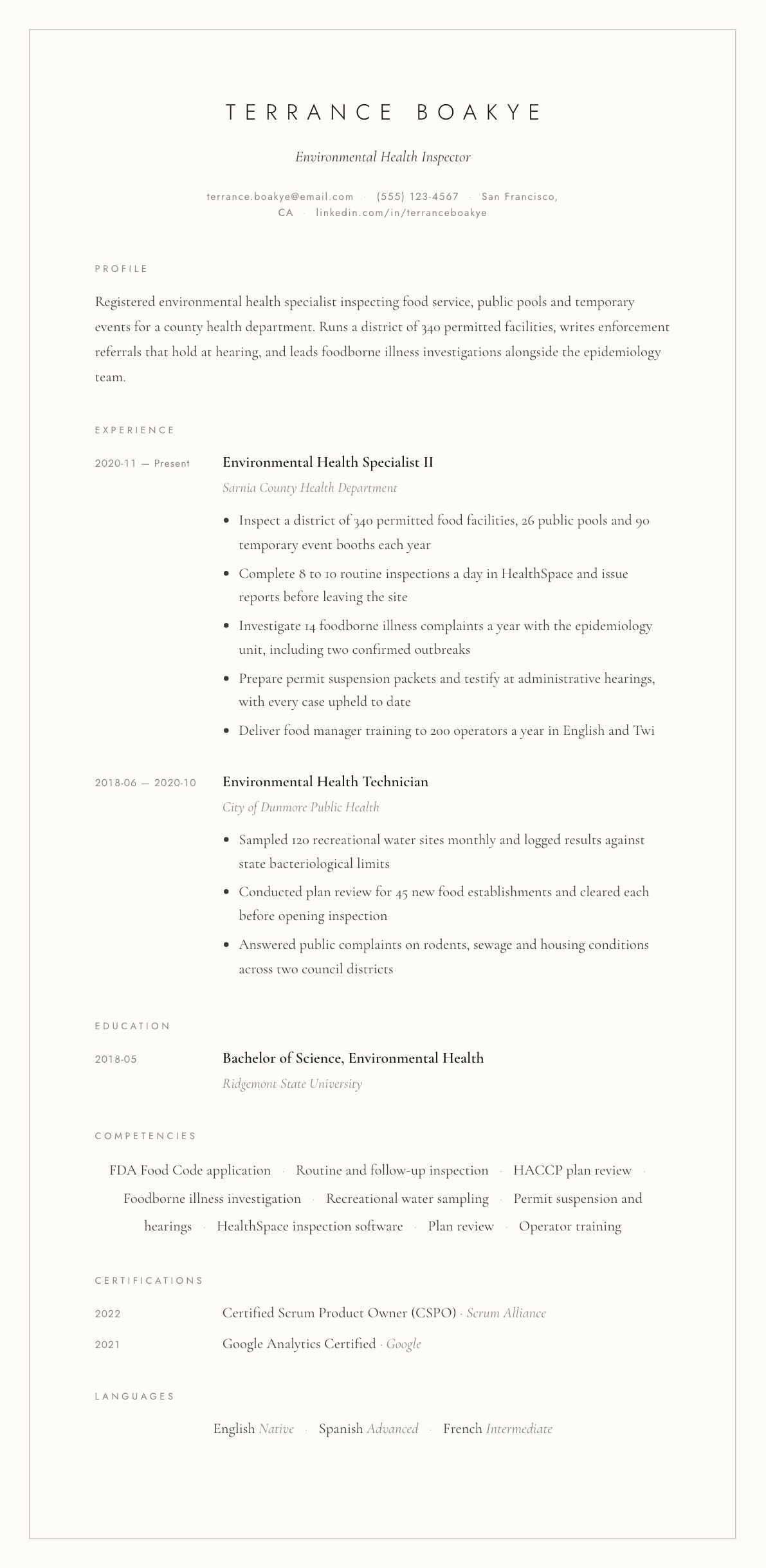
Example Health Inspector summary
Environmental health inspector with six years across a city public health office and a county health department, running a district of 340 permitted food facilities plus pools and temporary events. Completes eight to ten inspections a day, investigates foodborne illness complaints with the epidemiology unit, prepares suspension packets and testifies at hearings. Registered Environmental Health Specialist with a bachelor of science in environmental health.
Skills to list on a Health Inspector resume
- FDA Food Code enforcement
- Routine food facility inspection
- Risk-based inspection frequency
- HACCP and variance plan review
- Foodborne illness investigation
- Temporary event permitting
- Public pool and spa inspection
- Recreational water sampling
- Septic and onsite sewage review
- Vector and rodent complaints
- Permit suspension and revocation
- Administrative hearing testimony
- Inspection report writing
- Food manager training delivery
- Accela and HealthSpace records
What actually gets this resume read
- State the number of permitted facilities in your district and how many inspections you complete in a day.
- Name the food code version your jurisdiction adopted, because enforcement language differs between editions.
- Show enforcement outcomes, not just findings, since a health officer wants inspectors whose cases survive a hearing.
- Put the Registered Environmental Health Specialist credential near the top with the issuing body spelled out.
- List the inspection software you use, because agencies on HealthSpace or Accela do not want to retrain a hire.
- Include outbreak and complaint investigation work, which separates an inspector from a checklist reader.
- Mention plan review experience, since it is the piece most technicians never get and every supervisor needs.
How to write a health inspector resume
An environmental health supervisor hiring an inspector is handing over a district. That district has a fixed number of permitted facilities, a required inspection frequency for each risk category, and a complaint line that does not care how full the schedule already is. The resume that earns an interview shows you have carried a district like it before and closed the cases you opened.
The weak version of this resume says conducted inspections of food establishments and ensured compliance with health regulations. Every inspector does that. What a supervisor wants to know is how many facilities were in your district, how many inspections you closed in a day, what happened when an operator refused to correct, and whether your enforcement packets held up when a lawyer looked at them.
This guide sets out the format a health department expects, how to write inspection volume and enforcement outcomes into bullets, three summaries by career stage, before and after examples, and the questions inspectors ask when they move between jurisdictions or into a supervisory seat.
Format: one to two pages, credential and inspection types stated early
Reverse chronological with the registration or credential visible in the top third. Environmental health is a credentialed field and many postings list the Registered Environmental Health Specialist designation or an equivalent state registration as a minimum qualification, so a scoring panel needs to find it without hunting.
Under the summary, put a block listing inspection types and program areas: food service, retail food, temporary events, mobile units, public pools and spas, onsite sewage, body art, lodging, schools and child care. Health departments organize by program, and a supervisor filling a pool season vacancy is scanning for one word.
- Employer line: health department level, the district you carried, and the number of permitted facilities in it.
- Program block: each inspection type you have performed independently, separated from types you have observed.
- A health inspector resume names the food code edition the jurisdiction adopted, since enforcement language differs by edition.
- List the inspection software you work in, because agencies buy training time when a hire does not know theirs.
Summary: district size, daily volume, enforcement and investigation
Lead with district size and inspection volume, then add the two things that separate senior inspectors from new ones: enforcement work that reaches a hearing and outbreak investigation alongside epidemiology. Those four elements describe the full arc of the job.
If you hold the environmental health registration, name it in the first line with the issuing body. If you are working toward it, say candidate and give the exam window rather than implying you already hold it, because credential verification is standard in this field.
Experience: routine inspection, follow up, enforcement, investigation
Start each job with the district. Facility count, risk categories and required frequency give a supervisor the workload picture instantly, and adding the daily inspection count shows you can sustain it. An inspector completing eight to ten inspections a day with reports finished on site is describing a different level of skill from one completing four and writing up in the evening.
Then the technical content. Name the violations you cite most and the corrections you drive: cold holding temperatures, cooling and reheating procedures, cross contamination controls, handwashing and glove use, date marking, chemical storage, backflow prevention, sanitizer concentration. Risk factor violations and good retail practices are treated differently, and using that distinction correctly signals real code fluency.
Enforcement is where the strongest bullets live. Describe the escalation path you have run: re-inspection, compliance conference, administrative citation, permit suspension, closure and reopening. Say how many enforcement actions you have taken and whether they were upheld. A supervisor is looking for an inspector whose packet survives a hearing, because the ones that fail cost the department more than the violation ever did.
Add investigation and plan review. Foodborne illness complaints worked with the epidemiology unit, environmental sampling, trace back on a suspect product, and plan review for new construction all belong on the page. Plan review in particular is the piece many inspectors never get, and it is a common requirement for the next grade up.
Community work, training and the parts nobody advertises
A health inspector spends real time teaching. Food manager and food handler training, pre-opening consultations with new operators, and outreach to community kitchens and cottage food producers all reduce violations far more effectively than repeat citations. Put that work on the resume with counts and languages, because a department serving a diverse restaurant community needs inspectors who can explain a correction rather than only write it.
Emergency work deserves a line too. Inspectors get pulled into boil water advisories, power outage food safety assessments, shelter inspections during a storm response and mass gathering permitting. Naming that experience tells a supervisor you can be assigned to an incident without a briefing.
Keywords, credentials and moving between jurisdictions
Match the posting terms exactly: risk factor violation, imminent health hazard, priority item, corrective action, variance, HACCP plan, embargo, permit suspension, plan review, complaint investigation. These are code words in the literal sense, and panels score against them.
When moving between states, address the credential question directly in the summary rather than leaving it to chance. Say whether your registration is nationally recognized, whether the target state accepts reciprocity, and what your timeline is for meeting any additional requirement. A supervisor who can see a clear path will interview you; one left guessing will not.
- Name the inspection system: HealthSpace, Accela, Envision Connect or a state built application.
- Distinguish routine inspections from follow ups and complaint responses in your counts.
- Include sampling work with the media sampled, whether recreational water, food or environmental swabs.
- Name languages you inspect and train in, since an operator who understands the correction actually makes it.
Health Inspector resume summary examples
New environmental health specialist
Environmental health graduate with a field internship covering 120 accompanied food inspections and independent recreational water sampling at 40 sites. Trained in the current food code, risk factor identification and report writing. Registered Environmental Health Specialist candidate seeking a first inspector seat in a county health department.
Four years in a district
Environmental health inspector carrying a district of 340 permitted food facilities, 26 public pools and 90 temporary event booths. Completes eight to ten inspections a day with reports issued on site, investigates foodborne illness complaints with the epidemiology unit, and prepares permit suspension packets that have held at hearing.
Lead inspector
Lead environmental health specialist reviewing peer inspection reports, running plan review for new construction and remodels, and coordinating outbreak response with epidemiology and the state laboratory. Trains new inspectors through their field certification, delivers food manager courses in two languages, and staffs the department during emergency response activations.
Work experience bullets: before and after
Before: Conducted routine inspections of food establishments.
After: Inspected a district of 340 permitted food facilities on a risk based frequency, completing eight to ten routine inspections a day and issuing the report on site before leaving the establishment.
District size, risk based frequency, daily volume and on site reporting turn a job duty into a measured workload.
Before: Identified health code violations.
After: Cited and drove correction of risk factor violations including cold holding temperatures, cooling procedures, date marking and sanitizer concentration, verifying each at follow up rather than accepting a promise.
Naming actual risk factor violations and the verification step shows code fluency instead of a generic claim.
Before: Took enforcement action against non compliant businesses.
After: Prepared permit suspension packets for repeat risk factor violations and testified at 30 administrative hearings, with every case upheld and each facility reinspected before reopening.
The escalation path, the hearing count and the outcome prove enforcement that survives scrutiny.
Before: Investigated complaints from the public.
After: Investigated 14 foodborne illness complaints a year with the epidemiology unit, including two confirmed outbreaks, collecting food histories and menu items for laboratory follow up.
Complaint volume, the partner unit and the confirmed outbreaks show investigation experience rather than intake.
Before: Provided food safety education to operators.
After: Delivered food manager training to 200 operators a year in English and Twi, and ran pre-opening consultations that cut first inspection violations for new establishments in the district.
Counts, languages and the pre-opening work show teaching that changes inspection outcomes.
Hard skills
- Food code interpretation and enforcement
- Risk based inspection scheduling
- Retail and food service inspection
- Temporary event and mobile unit permitting
- Public pool and spa inspection
- Recreational water sampling
- Onsite sewage and well evaluation
- HACCP and variance plan review
- Construction and remodel plan review
- Foodborne illness investigation
- Permit suspension and closure procedure
- Administrative hearing testimony
- Inspection report writing
- Food manager training delivery
Soft skills
- Holding a finding while an owner argues in front of customers
- Explaining a correction so an operator can actually make it
- Neutrality across facilities with very different resources
- Field judgment when the code does not cover the situation
- Writing that a hearing officer can follow without you present
Certifications worth listing
- Registered Environmental Health Specialist (REHS/RS) (National Environmental Health Association)
- Certified Professional Food Safety (CP-FS) (National Environmental Health Association)
- Certified Pool Operator (CPO) (Pool and Hot Tub Alliance)
- FDA Standardization for Retail Food Inspection (US Food and Drug Administration)
Mistakes that cost health inspector candidates the interview
- Reporting inspections performed without the district size, so nobody can tell whether the workload was heavy or light.
- Listing violations found while omitting whether the violations were ever corrected and verified.
- Leaving enforcement outcomes off the page, which is the difference between an inspector and a report writer.
- Burying the environmental health registration below education where a scoring panel will miss it.
- Claiming plan review experience that amounts to watching someone else perform it.
- Ignoring training and outreach work, which is often what a supervisor values most in a diverse district.
Health Inspector resume questions
Do I need a Registered Environmental Health Specialist credential to be hired?
Many county and state postings require it or require you to obtain it within a set period after hire. If you do not hold it yet, state your degree in a qualifying science, your eligibility status and your planned exam date so the panel can score you fairly.
How do I show inspection volume without sounding like a checklist reader?
Pair volume with outcomes. Daily inspection counts show capacity, and the correction rate, enforcement actions and complaint investigations show that the inspections changed something. The combination reads as an inspector who moves a district rather than one who visits it.
Does restaurant management experience help when applying?
It helps a great deal and you should keep it on the page. Knowing how a kitchen runs under pressure makes your corrections practical, and supervisors value inspectors who can suggest a workable fix instead of only recording a failure.
How should I handle moving to a different state?
Address credential portability directly in your summary. Say which registration you hold, whether the target state recognizes it, and what additional requirement you will need to complete. A clear plan removes the main reason a panel would set your application aside.
Should I include the number of violations I have written?
A raw violation count is easy to misread, since a high number can mean a strict inspector or a difficult district. Report it with context: the facility count, the share resolved at follow up, and how many cases escalated to formal enforcement.
Related resume examples
- Food Safety Inspector Resume example
- Public Health Director Resume example
- Code Enforcement Officer Resume example
- Zoning Administrator Resume example
- City Planner Resume example
- Community Development Manager Resume example