Civil Servant Resume Examples: free ATS score and gap list
Civil Servant Resume Written for a Merit Hiring System
By Mustafa Tarabya, founder of CVBooster · Published · Updated
Civil servant resume example, keywords and a writing guide for merit hiring: grades, classification, exam scores, supplemental questions and duty statements.
Sample resumes for a civil servant
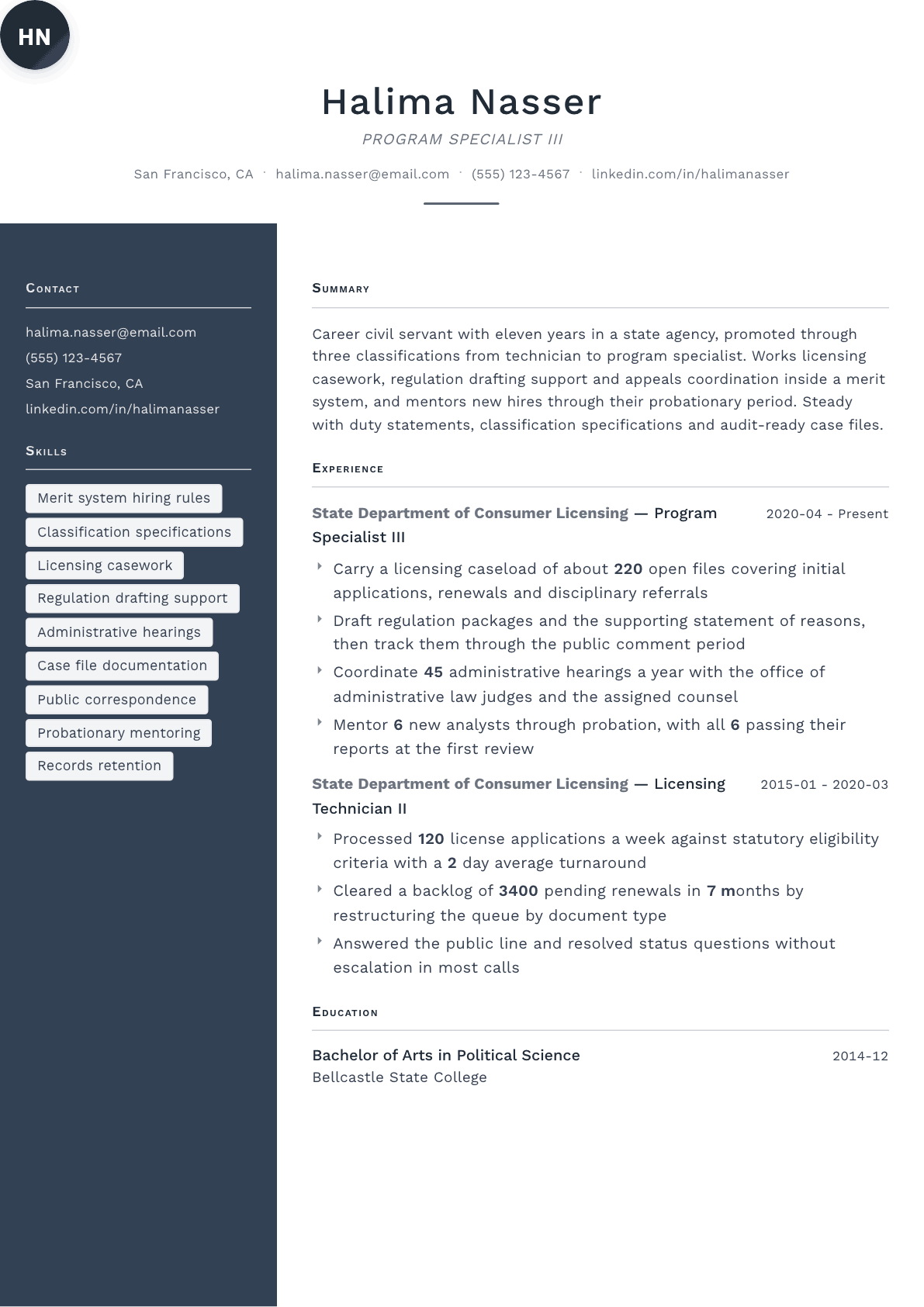
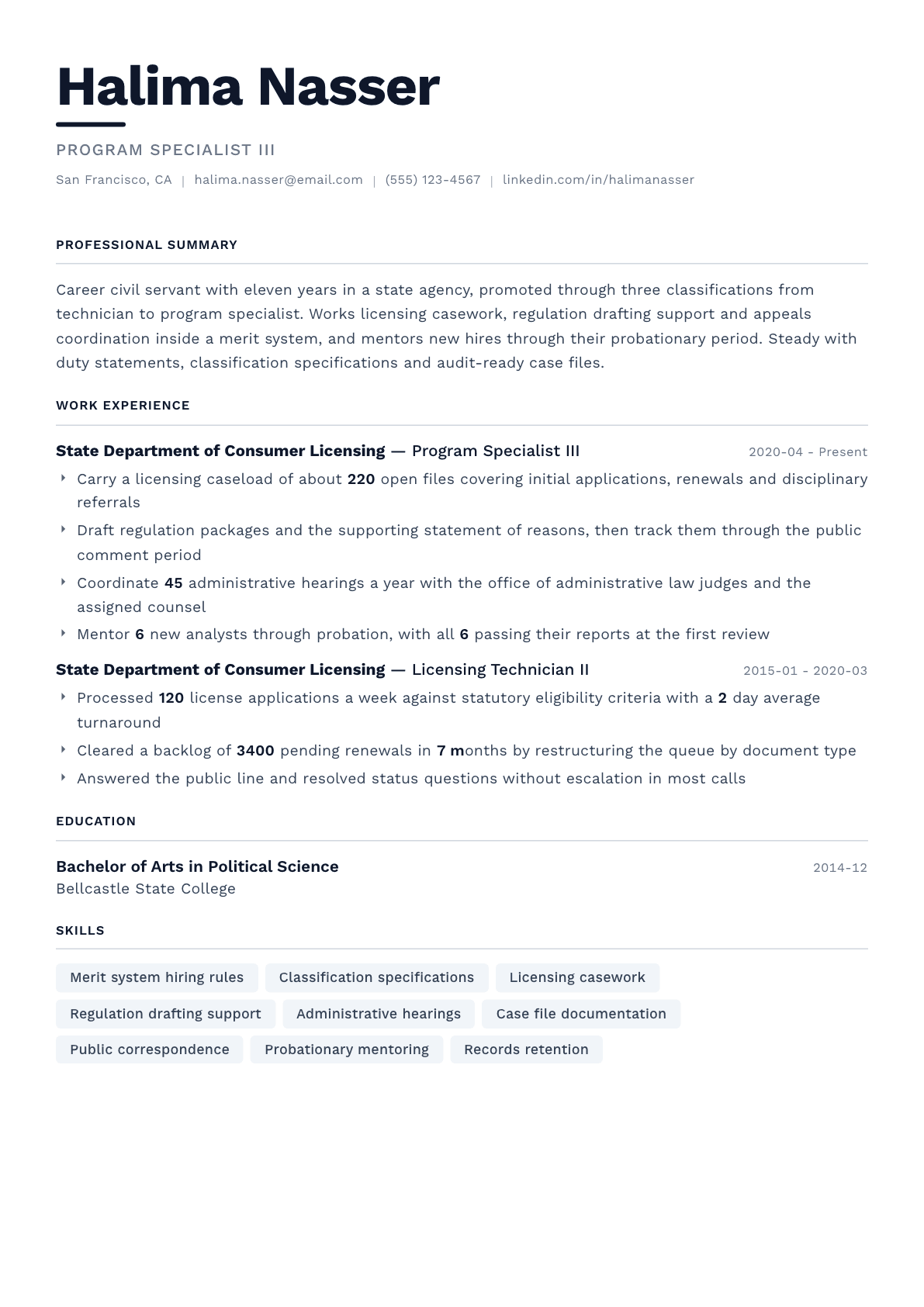
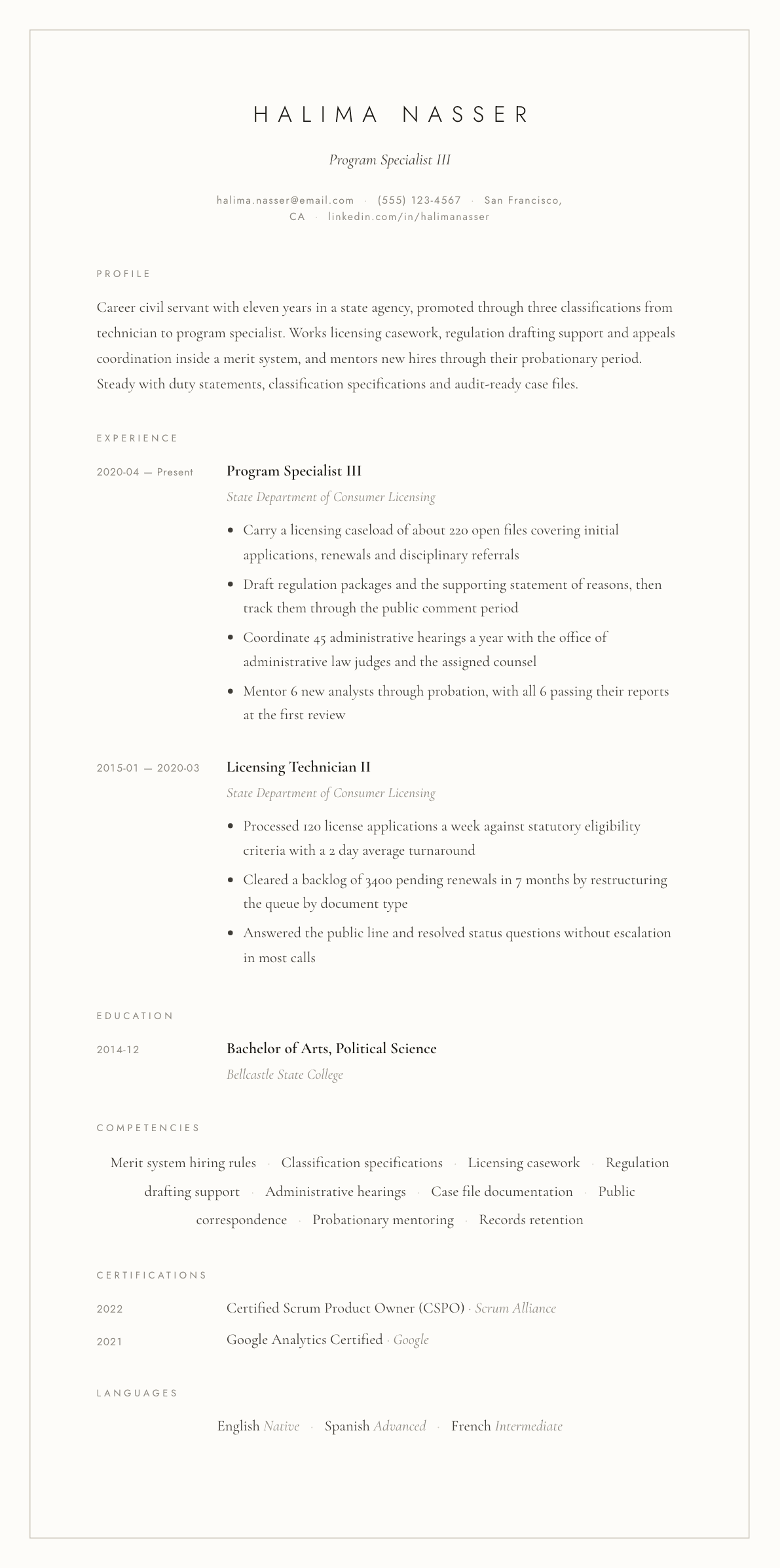
The same civil servant content laid out in three CVBooster templates, so you can see what the finished document looks like before you write a word.
Example Civil Servant summary
Civil servant with eleven years in one state agency, promoted from licensing technician to program specialist through the classification series. Carries a licensing caseload, drafts regulation packages with their statements of reasons, and coordinates administrative hearings. Comfortable with duty statements, eligibility lists and audit-ready case files, and looking for a supervising specialist classification.
Skills to list on a Civil Servant resume
- Merit system and civil service rules
- Classification and duty statements
- Examination and eligibility lists
- Licensing and permitting casework
- Regulation drafting support
- Administrative hearing coordination
- Statutory interpretation
- Case documentation and audit trails
- Public correspondence
- Records retention compliance
- Backlog reduction
- Probationary training and mentoring
- Union contract administration
What actually gets this resume read
- Match your resume to the duty statement line by line, since a merit system rates you against posted duties and not against style.
- List every classification you have held with its exact title and the dates, because promotions inside a series are evidence of standing.
- Report your exam result and the eligibility list you sit on when the agency requires an exam before certification.
- Answer supplemental questions in full sentences that repeat the qualifying language, then mirror those answers on the resume.
- Quantify caseload, turnaround time and backlog cleared, which are the numbers a public agency supervisor tracks weekly.
- Keep every claim verifiable, because reference checks in a merit system reach your personnel file and your supervisor.
How to write a civil servant resume
Merit hiring is a scoring exercise before it is a hiring decision. A civil servant applying inside a state or federal system is not competing on presentation. The application goes to an analyst who compares it against a classification specification and a duty statement, awards points or a qualifying rating, and produces a list. Charm does not enter the process until much later, if at all.
That is good news for anyone willing to write plainly. The system rewards a resume that states exactly what the specification asks for, in the vocabulary the specification uses, with dates that add up. It punishes creativity in titles, vague duty descriptions and any claim that cannot be corroborated by a personnel file.
This guide covers how to write against a duty statement, how to present a career built inside one agency, what to do with examination results and eligibility lists, and how to handle the supplemental questions that decide most merit competitions.
Format: written for a rater, not a recruiter
Reverse chronological, two to three pages, generous with detail. Merit systems generally do not reward brevity, and a rater who cannot find evidence of a required duty cannot award credit for it. Keep the layout plain so the document survives whatever parser sits behind the application portal.
Give every position the agency, the division or bureau, the exact classification title, the level or grade, and month and year dates. If you have moved through a classification series, show the progression as separate entries under the same employer so the promotions are visible rather than compressed into one block.
- Header: name, city and state, contact, and your current classification and agency if you are an internal candidate.
- A qualifications block written directly against the posted duty statement.
- Experience by classification, with grade or level and the supervision you received or exercised.
- A block for examinations passed, eligibility lists you sit on, and their classifications.
Write against the duty statement line by line
Print the duty statement and treat each numbered duty as a question you must answer. If duty one is interpreting statute and regulation to determine eligibility, there should be a bullet somewhere on your resume that shows you doing exactly that, using the words statute and regulation rather than a paraphrase.
Match the percentage weighting too. Duty statements usually show how much of the position each duty consumes, and the heavily weighted duties deserve the most space on your page. A resume that spends its best material on a duty worth a sliver of the job reads as a poor fit even when the candidate is strong.
Casework: volume, complexity and turnaround
Most civil service work is casework of some kind: applications, claims, licenses, inspections, appeals, benefit determinations. Give the size of the caseload you carry, the mix of case types, and how long a case takes you from receipt to decision. Those three figures are what a supervisor uses to predict whether you can absorb a queue.
Then show complexity. Routine renewals and contested disciplinary referrals sit at opposite ends of the same desk. Name the hardest category you handle independently, whether that is a hearing referral, a fraud investigation handoff or a determination that has been appealed and upheld.
Backlog work is worth a bullet of its own. Public agencies inherit backlogs constantly, and a candidate who has cleared one by restructuring a queue rather than by working weekends is telling a supervisor something useful about how he thinks.
Examinations, eligibility and internal standing
Merit systems reach candidates through lists. If you have taken and passed a written, oral or training and experience examination, name the classification, say you are on the eligibility list and give the rank band if the system publishes one. Applicants leave this off constantly, and hiring analysts have to dig for it.
For internal candidates, state your appointment status: permanent, probationary, limited term or temporary. Transfer and reinstatement rights depend on it, and a hiring manager who can appoint you by transfer rather than by list is looking at a much shorter process.
- Examinations passed, with classification and the date range the list is active.
- Appointment status and time in the current classification.
- Any out of class or acting assignment, with dates and the higher classification worked.
- Training completed through the agency academy or state training center, with hours.
Supplemental questions carry the score
In most merit competitions the supplemental questionnaire, sometimes called a statement of qualifications, is what actually gets scored. Answer in full paragraphs with a specific example for each claim, repeat the qualifying language, and point to where the experience appears on the resume. An answer that refers the reader to the resume is usually rated as no response, and the file drops out before a human manager ever sees it.
Civil Servant resume summary examples
Technician level
Licensing technician with 3 years in a state department, processing 120 applications a week against statutory eligibility criteria at a 2 day average turnaround. Cleared a backlog of 3400 pending renewals in 7 months by restructuring the queue by document type. Permanent status, seeking an analyst classification.
Journey analyst
Program specialist with 11 years in one state agency, promoted through 3 classifications. Carries about 220 open licensing files, drafts regulation packages with supporting statements of reasons, and coordinates 45 administrative hearings a year with assigned counsel. Mentors new analysts through probation.
Supervising specialist
Supervising program specialist directing a unit of 9 across licensing, enforcement referral and appeals. Owns the unit workload plan, the training curriculum and the audit response file, and has taken 2 regulation packages from concept through public comment to adoption. On the eligibility list for staff services manager.
Work experience bullets: before and after
Before: Processed license applications for the department.
After: Processed 120 license applications a week against statutory eligibility criteria, issuing deficiency notices and clearing determinations at a 2 day average turnaround.
Volume, the legal standard applied and turnaround give a rater three separate pieces of creditable evidence.
Before: Helped write regulations.
After: Drafted regulation packages with the supporting statement of reasons, tracked each through the public comment period, and prepared the response to comments filed with the rulemaking record.
The rulemaking artifacts are named, which is how a rater confirms the work was substantive rather than clerical.
Before: Reduced the backlog.
After: Cleared a backlog of 3400 pending renewals in 7 months by restructuring the queue by document type and reassigning routine files to technician review.
The method matters more than the number, because it shows the improvement will survive after you leave.
Before: Attended administrative hearings.
After: Coordinated 45 administrative hearings a year with the office of administrative hearings and assigned counsel, assembling the evidentiary file and the witness schedule for each.
Coordination with named parties and concrete deliverables replaces attendance with responsibility.
Before: Trained new employees.
After: Mentored 6 new analysts through their probationary period, wrote the unit desk manual, and all 6 passed their probation reports at the first review.
Probation outcomes are documented in the personnel file, so the claim is verifiable and carries weight.
Hard skills
- Merit system and civil service rules
- Classification specifications and duty statements
- Statutory and regulatory interpretation
- Licensing and permitting casework
- Regulation drafting and rulemaking records
- Administrative hearing coordination
- Case documentation and audit trails
- Eligibility determination
- Public correspondence and notices
- Records retention compliance
- Backlog and queue management
- Union contract administration
Soft skills
- Consistency across a large caseload
- Impartiality with applicants
- Written precision for a legal file
- Institutional patience
- Mentoring probationary staff
Certifications worth listing
- Certified Public Manager (CPM) (American Academy of Certified Public Managers)
- Project Management Professional (PMP) (Project Management Institute)
- Certified Government Financial Manager (CGFM) (Association of Government Accountants)
Mistakes that cost civil servant candidates the interview
- Referring the rater to the resume in the supplemental questions, which is usually scored as no answer.
- Compressing a long career in one agency into a single entry, which hides every promotion in the series.
- Using an informal working title instead of the classification title that appears in the personnel record.
- Ignoring the weighting on the duty statement and spending the page on a minor duty.
- Leaving out examination results and eligibility list standing, which the hiring analyst then has to chase.
- Writing achievements that no supervisor could confirm, when merit references reach the personnel file directly.
Civil Servant resume questions
How long should a civil servant resume be?
Two to three pages is normal and often expected, because raters award credit only for duties they can find. Cutting detail to fit one page removes the evidence that produces your score in a merit competition.
Do I need to pass an exam before applying?
It depends on the classification. Many state systems require you to pass a written or training and experience examination and reach an eligibility list before you can be certified to a hiring manager, so check the bulletin before you spend time on the application.
How do I explain moving sideways rather than upward?
Lateral moves are normal in public service and often deliberate, giving breadth across programs. Name what each move added, such as a new statute, a new population served or supervisory exposure, so the pattern reads as design rather than drift.
What is a statement of qualifications and how do I write one?
It is a scored narrative response to prompts drawn from the duty statement. Write one clear example for each prompt with the situation, your action and the result, using the exact qualifying language from the bulletin in your first sentence.
Does private sector experience count toward civil service qualifications?
Usually yes, if the duties match the specification. Describe the equivalent work in specification vocabulary, name the regulatory or audit conditions you operated under, and make the months of qualifying experience easy for the rater to total.
Related resume examples
- Federal Resume example
- Policy Analyst Resume example
- City Employee Resume example
- Eligibility Worker Resume example
- Tax Examiner Resume example
- Federal Government Resume example