Tax Examiner Resume Examples: free ATS score and gap list
Write a Tax Examiner Resume That Shows Case Volume and Accuracy
By Mustafa Tarabya, founder of CVBooster · Published · Updated
Tax examiner resume example, keywords and a writing guide covering return review, correspondence audits, assessments and taxpayer contact.
Sample resumes for a tax examiner
The same tax examiner content laid out in three CVBooster templates, so you can see what the finished document looks like before you write a word.
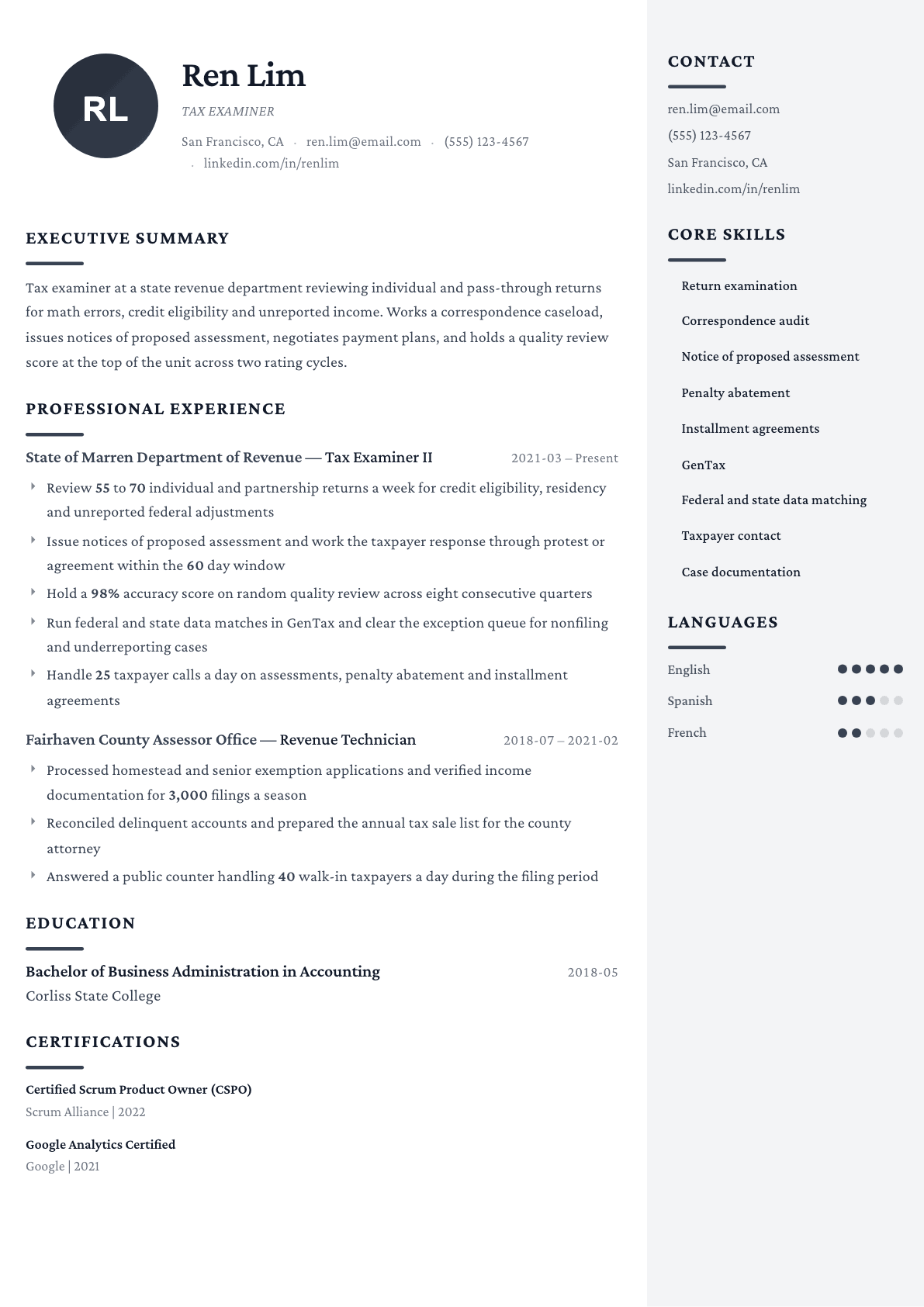
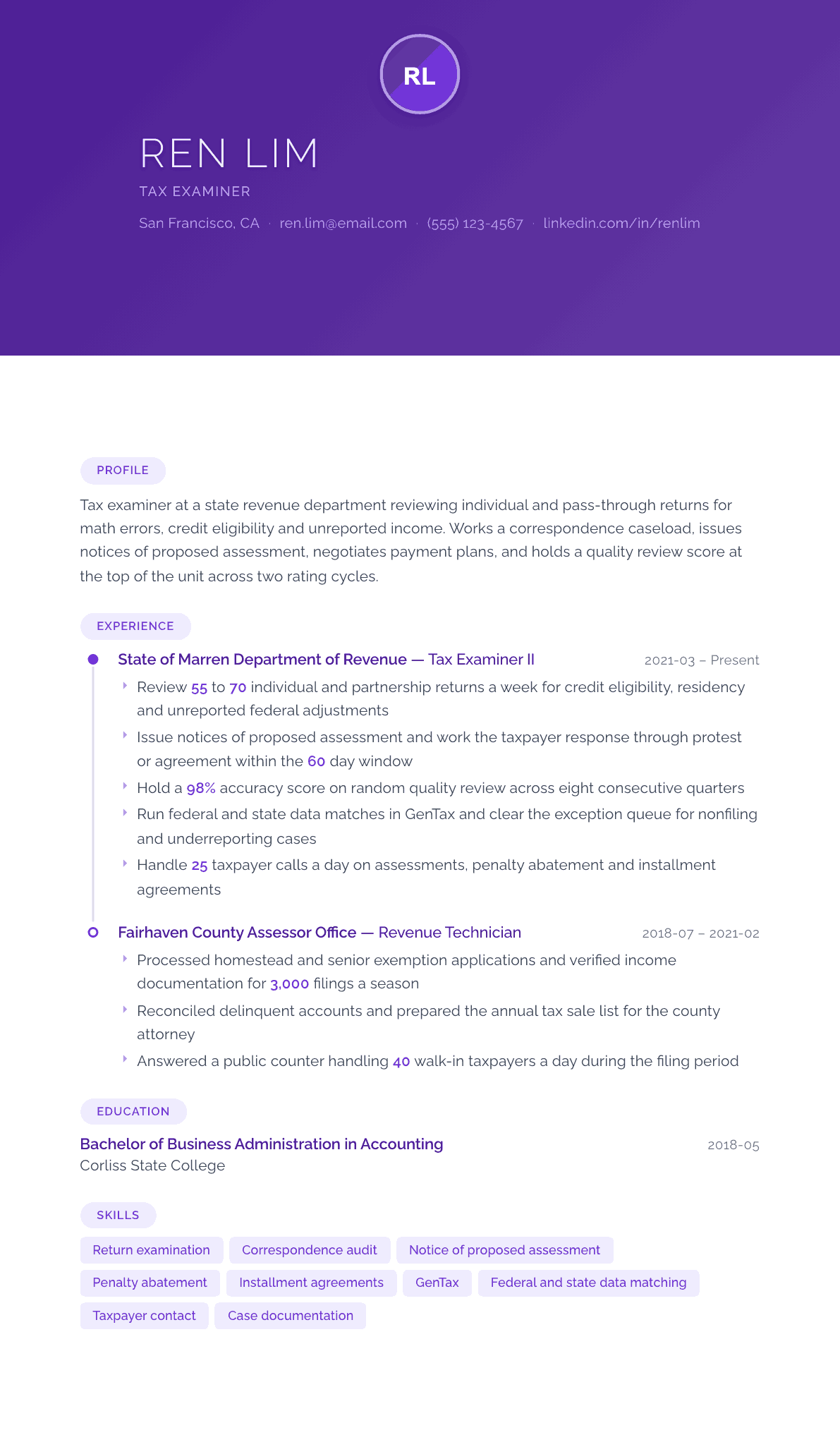
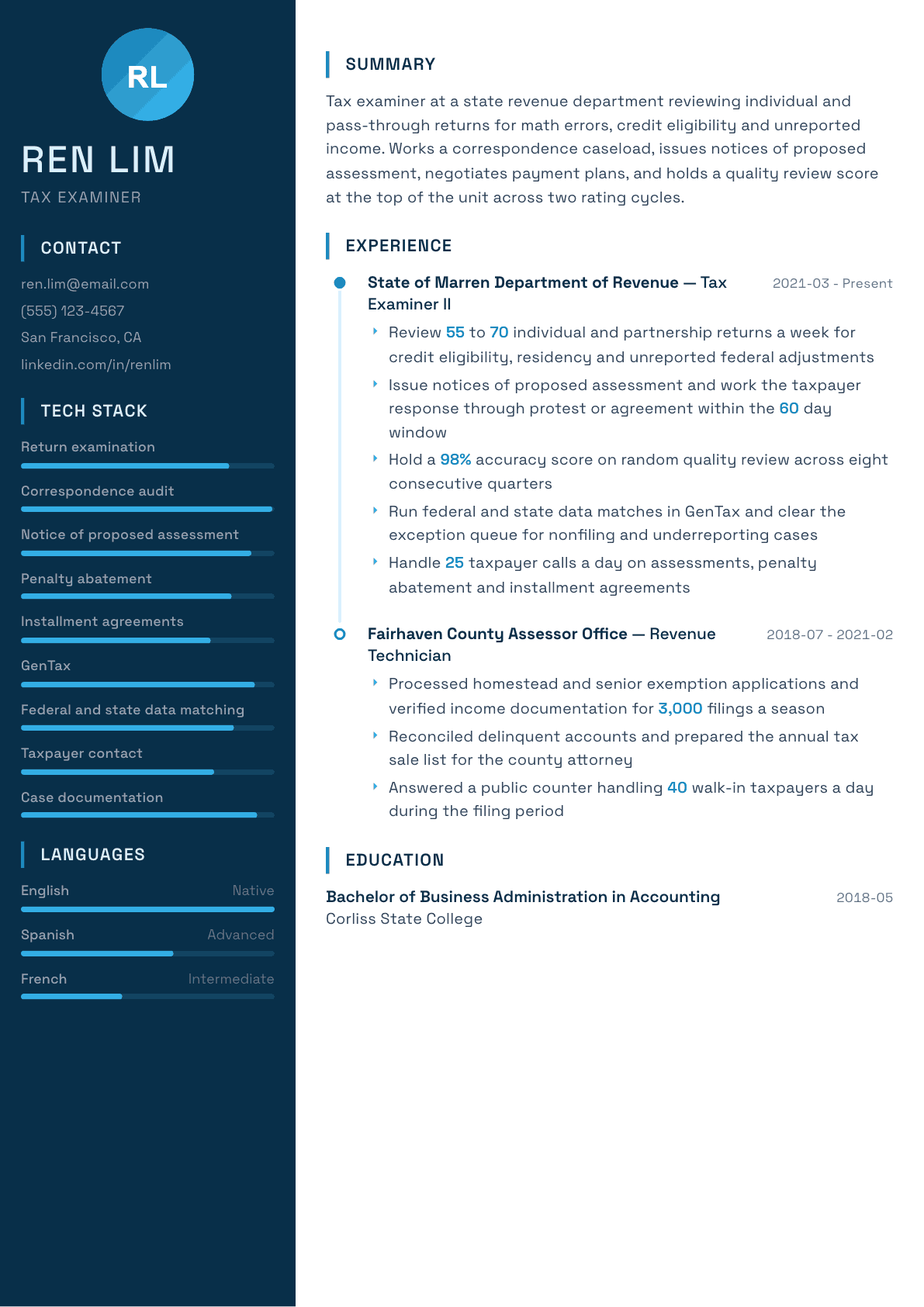
Example Tax Examiner summary
Tax examiner with five years across a county assessor office and a state revenue department, working a correspondence caseload of individual and partnership returns for credit eligibility, residency and unreported income. Issues proposed assessments, works protests, negotiates installment agreements, and holds a quality review score at the top of the unit. Bachelor of Business Administration in accounting, fluent in GenTax.
Skills to list on a Tax Examiner resume
- Individual return examination
- Pass-through entity returns
- Correspondence audit
- Unreported income analysis
- Credit and exemption verification
- Residency determination
- Notice of proposed assessment
- Penalty and interest computation
- Penalty abatement review
- Installment agreements
- Federal data match
- Case file documentation
- Taxpayer confidentiality rules
- Protest and appeal preparation
- Integrated tax system navigation
What actually gets this resume read
- Give your weekly case volume and the return types you examine, since individual and pass-through work are graded differently.
- State your quality review score and how many rating periods it held, because accuracy is the examiner metric.
- Name the tax system you work in, whether GenTax, Integrated Tax System or an in-house mainframe application.
- Show the taxpayer contact side, since examiners defend assessments by phone and in writing every single day.
- List the statutes and credits you know best, because a state posting is written around its own credit schedule.
- Include collection touchpoints like installment agreements and levy referrals if your unit handles them.
- Say whether you have worked protests or appeals, which is the step a supervisor promotes examiners into.
How to write a tax examiner resume
A revenue department supervisor hiring a tax examiner has a queue problem and an accuracy problem at the same time. Cases arrive faster than the unit clears them, and every case cleared wrong turns into a protest, an abatement or a refund with interest attached. The resume that gets a call proves you can move volume and be right about it.
Candidates usually describe the job at the wrong altitude. Reviewed tax returns for accuracy could describe a seasonal preparer, a bookkeeper or a software tester. An examiner works a specific inventory: math error notices, credit disallowances, residency questions, federal adjustment matches, nonfiler cases pulled from third party data. Naming the inventory is what separates a real examiner resume from a generic accounting one.
What follows is the structure a revenue department reads, how to write case volume and accuracy into bullets that survive a scoring panel, three summaries by career stage, before and after examples, and the questions examiners ask when they move between counties, states and federal service.
Format: one to two pages, tax types and case inventory near the top
Reverse chronological, one page early and two once you have worked more than one tax type across more than one agency. Revenue departments hire through structured recruitments where a panel scores the application against stated qualifications, so the tax types you have examined must appear as plain nouns rather than being implied by an employer name.
Put an inventory block under the summary: tax types, case types, systems and any collection tools you have used. Individual income, corporate, sales and use, withholding, excise and property are separate bodies of law, and a supervisor filling a sales tax desk will not read three jobs down to discover you have it.
- Employer line: agency level, the unit you sat in, and the tax type that unit worked.
- Inventory block: tax types examined, case types worked, and the systems you worked them in.
- A tax examiner resume states whether contact was correspondence, telephone, counter or field, since the skills differ.
- Keep confidentiality intact: never name a taxpayer, a business or a case in any form.
Summary: tax type, volume, accuracy and the contact you handle
Open with the tax types you examine, your weekly or monthly case volume, your quality review score, and whether you carry taxpayer contact. Those four facts describe the whole job, and a supervisor can staff a desk from them.
If you have worked protests, appeals or informal conferences, put it in the summary rather than deep in a bullet. Working a case past the initial assessment into the dispute stage is the step that qualifies an examiner for a senior grade, and it is the shortest path to a higher band on a public pay scale.
Experience: the case, the notice, the response, the resolution
Write each job as a case lifecycle. Where the cases come from matters first: an automated match, a discovery project, a referral from another unit, or a random selection sample. That origin tells a supervisor which skills you built, because a data match case is a documentation exercise and a discovery case is an investigation.
Then the examination itself. Name the issues you test: filing status and residency, credit eligibility and documentation, unreported federal adjustments, allocation and apportionment for a pass-through entity, exemption certificate validity on a sales tax case. A bullet naming three real issues is worth more than a paragraph about analyzing financial records.
The notice and response stage is where examiners are actually judged. Say how you write a proposed assessment, how you handle the response window, and what share of cases resolve by agreement rather than protest. A high agreement rate signals notices written clearly enough that taxpayers understand them, which is what a supervisor wants and rarely gets.
Close with resolution and collection touchpoints. Installment agreements, penalty abatement determinations, offset and levy referrals and closing a case for no change are all real outcomes, and no change cases belong on the page too. An examiner who only ever finds money is an examiner whose accuracy nobody trusts.
Volume, accuracy and how to state them honestly
Give volume in the same unit your agency measures it, whether cases per week, closures per month or dollars assessed per quarter, and pair it with the accuracy figure from quality review. Volume without accuracy reads as sloppy and accuracy without volume reads as slow, so the pair carries the meaning.
Never inflate. Revenue agencies verify performance ratings during reference checks more often than most employers, and a claim that does not match a rating record ends the process. If your unit does not score quality, describe what it does track: reopened cases, sustained protests or supervisory review outcomes.
Keywords, credentials and federal applications
Match the posting vocabulary exactly: examination, assessment, deficiency, abatement, statute of limitations, nexus, apportionment, exemption certificate, nonfiler, underreporter, offset, protest. Public applications are often keyword screened before a human reads them, and the terms are unusually standardized in tax work.
For federal roles, the application is longer than a private resume and the rules are different. Include hours worked per week, salary grade, supervisor contact permission and month and year for each position, because an incomplete entry can disqualify an otherwise strong application. If you hold an enrolled agent credential or a state accountancy license, list it with the issuing body.
- Name the tax system you use, whether GenTax, an integrated tax system or an agency mainframe application.
- State the tax types by statute name where your state uses one, since panels score against their own terms.
- Include any training you deliver to new examiners, which reads as senior grade work on a public pay scale.
- For a federal application, follow the announcement format precisely rather than submitting a private sector resume.
Tax Examiner resume summary examples
New to revenue work
Accounting graduate with a season in a county assessor office processing exemption applications and verifying income documentation for 3,000 filings. Comfortable reading returns, tracing supporting schedules and handling a public counter under filing deadline pressure. Seeking an entry tax examiner seat in a state revenue department.
Three years examining
Tax examiner reviewing 55 to 70 individual and partnership returns weekly for credit eligibility, residency and unreported federal adjustments. Issues proposed assessments, works the taxpayer response window through agreement or protest, and holds a 98% accuracy score on random quality review across eight quarters.
Senior examiner
Senior tax examiner working discovery and nonfiler inventory across individual and pass-through returns, carrying cases through informal conference and protest. Trains new examiners on notice writing and statute computation, reviews peer casework before issuance, and clears the exception queue from federal and state data matches each cycle.
Work experience bullets: before and after
Before: Reviewed tax returns for accuracy.
After: Examined 55 to 70 individual and partnership returns a week for residency, credit eligibility and unreported federal adjustments, documenting every issue in the case file before issuance.
Volume, return types and the actual issues tested replace a phrase that could describe any accounting job.
Before: Sent notices to taxpayers.
After: Issued notices of proposed assessment with the statute, computation and supporting documentation attached, and worked the response through agreement or protest inside the 60 day window.
It shows what goes into a defensible notice and that the case is carried past issuance to a resolution.
Before: Maintained a high accuracy rate.
After: Held a 98% accuracy score on random quality review across eight consecutive quarters while carrying a full case inventory and daily taxpayer contact.
Pairing the score with the review method and the sustained period makes it checkable rather than decorative.
Before: Answered taxpayer questions.
After: Handled 25 calls a day on assessments, penalty abatement and installment agreements, resolving most at first contact without a referral to the collection unit.
Call volume, the topics and the first contact resolution show the customer facing half of the job concretely.
Before: Worked on data matching projects.
After: Cleared the nonfiler and underreporter exception queue from federal and state data matches, converting matched cases into filed returns or proposed assessments within the project timeline.
Naming the queue and the two possible outcomes shows understanding of how discovery inventory actually closes.
Hard skills
- Individual income tax examination
- Pass-through entity return review
- Sales and use tax examination
- Correspondence audit technique
- Unreported income and adjustment analysis
- Credit and exemption documentation review
- Residency and domicile determination
- Notice of proposed assessment drafting
- Penalty and interest computation
- Statute of limitations tracking
- Installment agreement negotiation
- Nonfiler and underreporter case work
- Protest and informal conference preparation
- Integrated tax system case handling
Soft skills
- Staying even with a taxpayer who is frightened or furious
- Explaining a statute without using the statute language
- Working a queue without letting speed erode documentation
- Discretion with confidential taxpayer information
- Accepting a no change outcome when the evidence supports it
Certifications worth listing
- Enrolled Agent (Internal Revenue Service)
- Certified Public Accountant (CPA) (State Board of Accountancy)
- Certified Member of the Institute for Professionals in Taxation (CMI) (Institute for Professionals in Taxation)
Mistakes that cost tax examiner candidates the interview
- Describing the work as reviewing returns without naming the tax type or the issues actually examined.
- Giving case volume with no accuracy figure, which reads as speed without any control behind it.
- Omitting taxpayer contact, when defending an assessment by phone and in writing is half the job.
- Referring to specific taxpayers or businesses, which breaks confidentiality rules and ends the application.
- Submitting a one page private sector resume to a federal announcement that requires hours, grade and dates.
- Leaving out protest and conference work, which is the exact experience that qualifies an examiner for a senior grade.
Tax Examiner resume questions
How do I move from tax preparation into a tax examiner role?
Reframe your preparation work as examination skills: reading a return against source documents, testing credit eligibility, computing penalty and interest, and explaining a result to a client. Then name the tax types you know by statute so a scoring panel can match them.
What accuracy figure should I put on a tax examiner resume?
Use whatever your agency measures and name the method, whether random quality review, supervisory case review or reopened case rate. Reporting a number without saying how it was measured invites doubt, and reporting nothing leaves your best evidence off the page.
Is a federal tax examiner resume different from a state one?
Yes. Federal announcements require hours per week, month and year dates, grade level and often a narrative against each qualification. A state application is usually shorter but still scored, so both need the posting vocabulary reflected back rather than paraphrased.
Can I mention the dollar value of assessments I issued?
Aggregate figures for a period are acceptable and are commonly tracked by revenue units, but never tie an amount to a single case or an identifiable taxpayer. When in doubt, describe case counts and resolution outcomes instead of totals.
Do I need an accounting degree to be a tax examiner?
Many entry examiner postings accept a bachelor degree in any field plus accounting coursework, and some accept qualifying experience instead. Read the minimum qualifications carefully, then state your credit hours in accounting explicitly if the posting counts them.
Related resume examples
- Tax Preparer Resume example
- Internal Auditor Resume example
- Government Accountant Resume example
- Eligibility Worker Resume example
- Housing Authority Specialist Resume example
- Civil Servant Resume example