Eligibility Worker Resume Examples: the lines they read
Write an Eligibility Worker Resume That Proves Caseload and Accuracy
By Mustafa Tarabya, founder of CVBooster · Published · Updated
Eligibility worker resume example, keyword list and guide covering SNAP, Medicaid, caseload size, verification and error rate accuracy.
Sample resumes for a eligibility worker
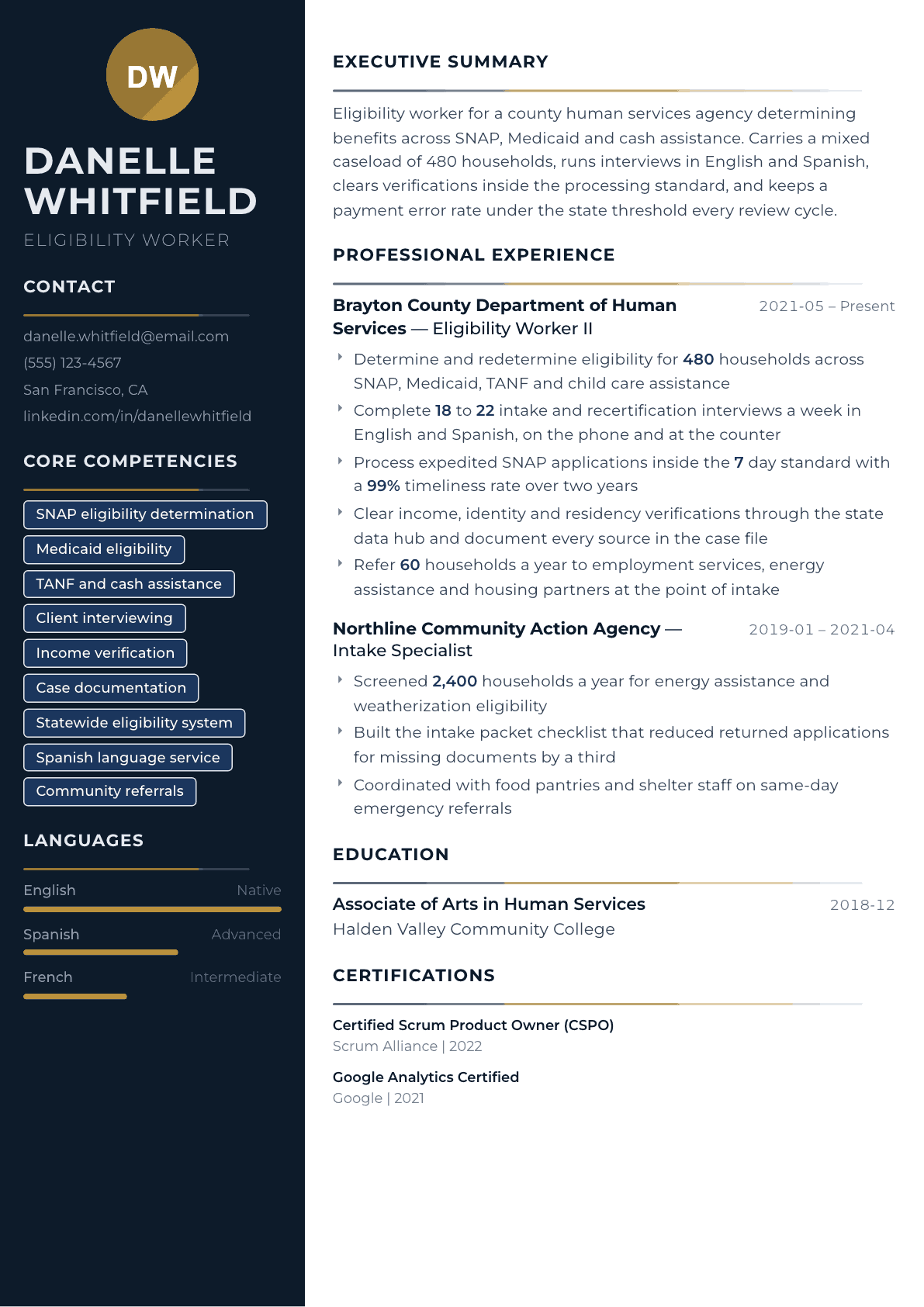
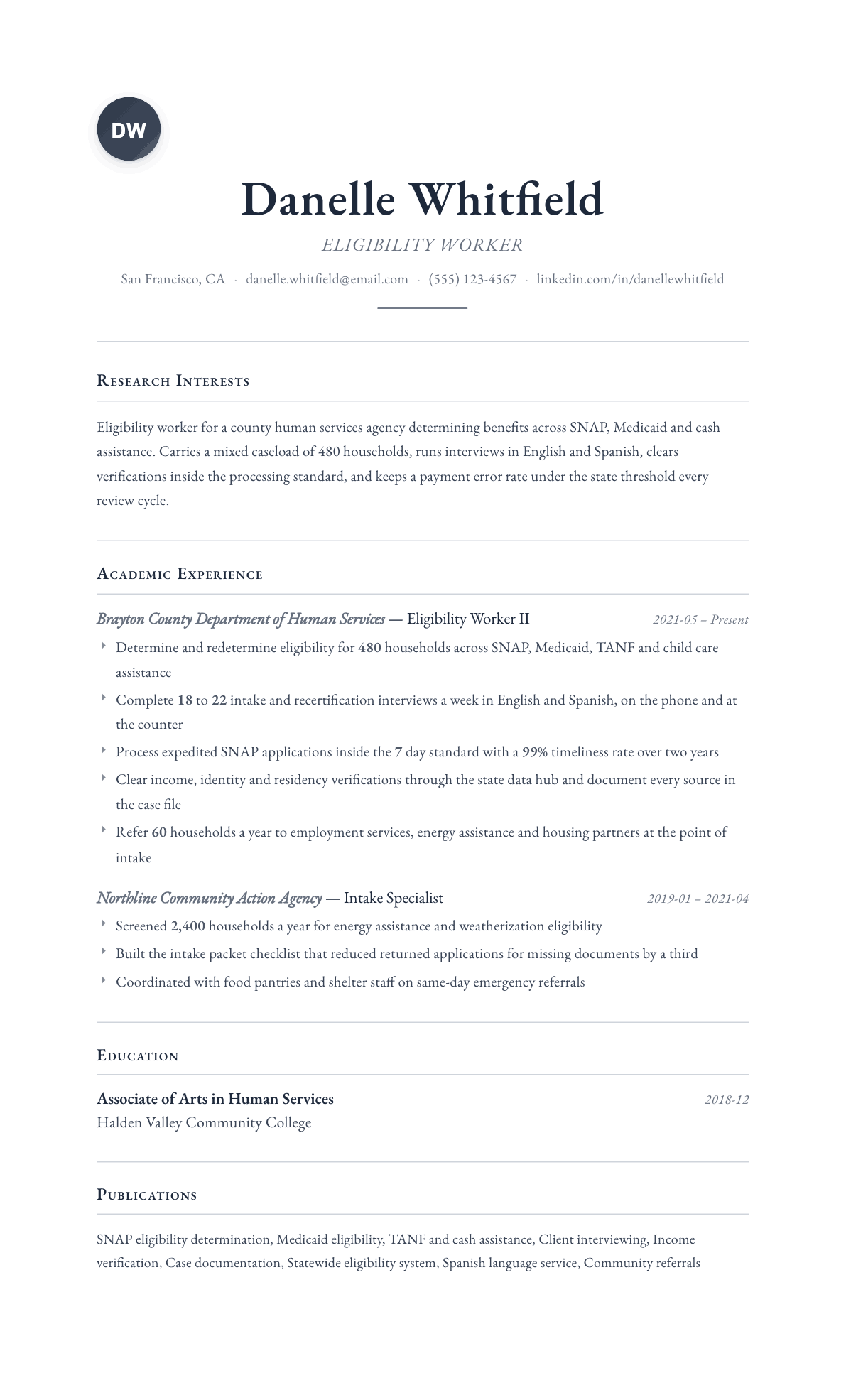
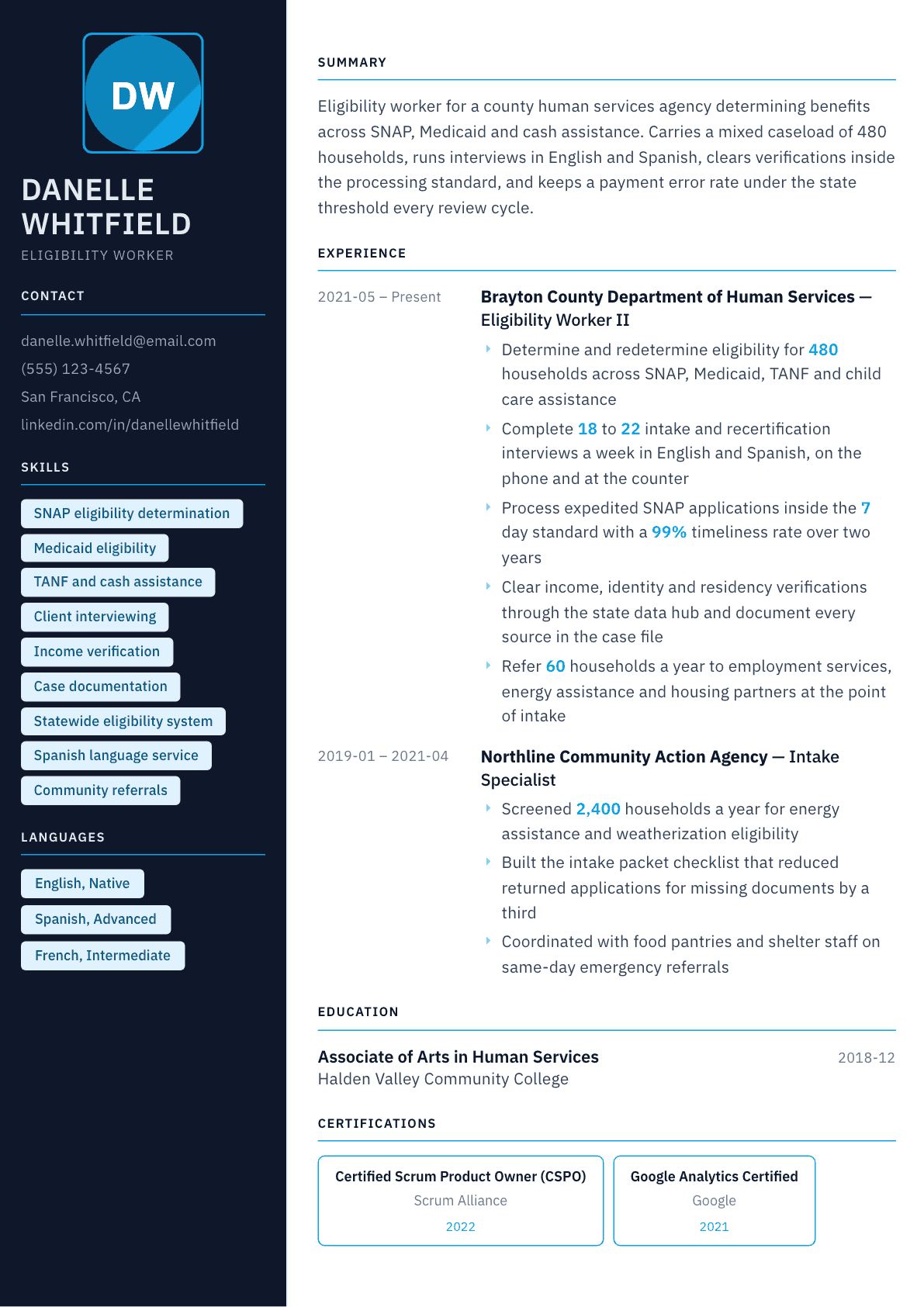
The same eligibility worker content laid out in three CVBooster templates, so you can see what the finished document looks like before you write a word.
Example Eligibility Worker summary
Eligibility worker with five years across a community action agency and a county human services department, carrying a mixed caseload of 480 households across SNAP, Medicaid, cash assistance and child care subsidy. Runs bilingual intake and recertification interviews, clears verifications through the state data hub, meets expedited processing standards, and holds payment accuracy above the state benchmark. Associate degree in human services.
Skills to list on a Eligibility Worker resume
- SNAP eligibility determination
- Medicaid and CHIP eligibility
- TANF and general assistance
- Child care subsidy eligibility
- Application intake and screening
- Client interviewing techniques
- Income and asset verification
- Household composition rules
- Expedited service standards
- Redetermination and recertification
- Overpayment and claim referral
- Fair hearing preparation
- Case narrative documentation
- Community resource referral
- Confidentiality and HIPAA rules
What actually gets this resume read
- Give your caseload size and the programs in it, because SNAP only and a mixed Medicaid caseload are different jobs.
- State your timeliness and payment accuracy figures, since those two numbers are how the state grades your county.
- Name the eligibility system you work in, whether a state built platform, Cúram or a legacy mainframe.
- Say how many interviews you complete a week and whether they run by phone, at a counter or in the home.
- List any second language you use with clients, because bilingual eligibility staff are hired ahead of the queue.
- Show your verification discipline, since audits find errors in documentation far more often than in arithmetic.
- Mention fair hearing preparation if you have done it, which signals you can defend a determination on the record.
How to write a eligibility worker resume
A human services supervisor hiring an eligibility worker is watching two clocks. One is the processing standard that says an application has to be decided inside a set number of days. The other is the accuracy review that samples closed cases and reports the error rate back to the state. A worker who is fast and wrong costs the agency more than one who is slow, so the resume has to speak to both clocks at once.
What sinks most applications is writing the job as customer service. Assisted clients with applications and provided excellent service could describe a call center. The work is a determination: household composition, countable income, resource tests, verification hierarchies, and a decision that can be appealed. Write it as a determination job and the supervisor recognizes a colleague.
This guide covers the format county and state agencies expect, how to write caseload and accuracy into your bullets, three summaries by career stage, before and after examples, and the questions eligibility staff ask when they move between programs or agencies.
Format: one to two pages, programs and caseload stated immediately
Reverse chronological with a program block directly under the summary. County and state recruitments are usually scored against minimum qualifications, so the programs you have determined must appear as named programs rather than as a phrase like public assistance benefits.
Keep the layout plain. Many agencies run applications through a system that strips formatting, and a resume that depends on columns or icons can arrive at a rating panel as a wall of text. Simple headings and short bullets survive that trip intact.
- Program block: each benefit program you determine, plus the eligibility system you determine it in.
- Employer line for an eligibility worker: agency type, unit, and whether the caseload was intake, ongoing or mixed.
- State your caseload as households or cases, and say whether the number is an assigned caseload or a monthly closure count.
- Note the languages you serve clients in, since bilingual determination work is scored separately in many recruitments.
Summary: programs, caseload, timeliness, accuracy
Four facts in three lines: the programs on your caseload, its size, your timeliness against the processing standard, and your accuracy in the review cycle. A supervisor reads that and knows whether you can be dropped onto a live caseload or need six months of training first.
If you carry an expedited service inventory, say so. Expedited food assistance runs on a much shorter clock than a standard application, and a worker who has held that clock consistently is proving the exact discipline the unit needs on its worst weeks.
Experience: intake, verification, determination, redetermination
Write each job around the case cycle. Intake first: how many interviews a week, whether they run by phone, at a counter, in a home or through a scheduled appointment block, and whether you screen for expedited service at the door. Interview volume is the honest measure of workload in this field.
Verification deserves its own bullets because it is where accuracy reviews find errors. Name the sources you use: pay stubs and employer statements, the state data hub, wage matches, self employment ledgers, landlord statements, school enrollment records. Then say what you do when a document is missing, because the rules on requesting and pending a verification are exactly what a reviewer tests.
Determination bullets should name the rules you apply rather than the outcome alone. Household composition, countable versus excluded income, deductions, resource limits, categorical eligibility and the treatment of self employment are the pieces that differ between programs, and naming them shows you know the difference between food assistance rules and medical assistance rules.
Close with the ongoing side: redeterminations and recertifications, change reporting, overpayment referrals and fair hearing preparation. An intake only worker and an ongoing worker are hired for different units, and the resume should make clear which you have been, or that you have carried both.
The numbers a county actually reviews
Timeliness and accuracy are the two figures worth putting on the page, and they should be stated with the standard they were measured against. A timeliness rate means nothing without the processing standard behind it, and an accuracy figure means nothing without saying whether it came from a state quality review sample or an internal supervisory check.
Where you cannot report an individual number because the agency only publishes unit results, say what you contributed and what the unit achieved. A worker who cleared a backlog, absorbed a vacant caseload for a quarter or held recertifications current during a system conversion has a real story to tell without borrowing a statistic.
Keywords, credentials and the supplemental questionnaire
Use the vocabulary the posting uses: determination, redetermination, verification, household composition, countable income, resource test, expedited service, change reporting, overpayment claim, fair hearing. If your state calls its workers eligibility specialists or income maintenance caseworkers, mirror that title in your summary.
Formal credentials are rare in this field, which makes documented training count for more. Name the state certification course you completed, the programs it covered, and any refresher training after a policy change. Add motivational interviewing, trauma informed practice or domestic violence screening training if you hold it, since agencies increasingly build those into intake.
- Name the eligibility system: a state built platform, Cúram, or a legacy mainframe still in use.
- Note whether you have worked during a system conversion, which is a genuinely hard skill to hire.
- Say whether you have prepared or testified at a fair hearing, which signals you can defend a determination.
- Answer the supplemental questionnaire with the same figures your resume carries, since panels compare them.
Eligibility Worker resume summary examples
Coming from community services
Human services graduate with two years screening households for energy assistance and weatherization at a community action agency, handling 2,400 screenings a year and building an intake checklist that cut returned applications. Bilingual in English and Spanish. Seeking a first eligibility worker seat in a county benefits unit.
Three years on a caseload
Eligibility worker carrying 480 households across food assistance, medical assistance, cash assistance and child care subsidy. Completes 18 to 22 intake and recertification interviews a week in two languages, processes expedited applications inside the 7 day standard, and holds a 99% timeliness rate over two review periods.
Lead worker
Lead eligibility worker reviewing peer determinations before authorization, mentoring four new workers through their first caseloads, and preparing fair hearing packets for the unit. Carries a mixed intake and ongoing caseload, absorbs vacant caseloads during turnover, and served on the county workgroup for the eligibility system conversion.
Work experience bullets: before and after
Before: Determined eligibility for public assistance programs.
After: Determined and redetermined eligibility for 480 households across food assistance, medical assistance, cash assistance and child care subsidy, applying household composition, countable income and resource rules for each program.
The caseload size, the named programs and the rules applied replace a phrase that gives a supervisor nothing to weigh.
Before: Interviewed clients about their applications.
After: Completed 18 to 22 intake and recertification interviews a week in English and Spanish, by phone and at the counter, screening every applicant for expedited service at first contact.
Interview volume, the channels and the expedited screen show the real intake workload and the discipline behind it.
Before: Processed applications in a timely manner.
After: Processed expedited food assistance applications inside the 7 day standard with a 99% timeliness rate across two consecutive review periods while carrying a full ongoing caseload.
Naming the standard, the rate and the period makes timeliness a measured result rather than a self assessment.
Before: Verified client information.
After: Cleared income, identity, residency and household composition verifications through the state data hub and employer contact, and documented the source and date of every item in the case narrative.
It shows the verification hierarchy and the documentation habit that accuracy reviews actually test.
Before: Referred clients to other services.
After: Referred 60 households a year at the point of intake to employment services, energy assistance and housing partners, and logged each referral so the outcome could be followed up at recertification.
A count plus a follow up mechanism turns a soft claim into a described process with a result attached.
Hard skills
- Food assistance eligibility determination
- Medical assistance and childrens coverage eligibility
- Cash assistance and general assistance rules
- Child care subsidy eligibility
- Household composition analysis
- Countable income and deduction calculation
- Resource and asset testing
- Expedited service screening
- Verification sourcing and pending rules
- Redetermination and recertification
- Change reporting processing
- Overpayment claim referral
- Fair hearing packet preparation
- Statewide eligibility system case entry
Soft skills
- Asking about income and household without making a person feel accused
- Holding a caseload steady when the queue does not empty
- Clear refusal language when a household does not qualify
- Cultural humility across households you did not grow up in
- Emotional recovery between back to back difficult interviews
Mistakes that cost eligibility worker candidates the interview
- Writing the job as customer service instead of as a benefit determination with appeal rights attached.
- Leaving out caseload size, which is the single number a supervisor uses to judge whether you can carry a unit assignment.
- Naming programs generically as public assistance rather than by the program the posting actually names.
- Reporting an accuracy figure with no indication of whether it came from a state review or an internal check.
- Skipping verification detail, when documentation is where quality reviews find most errors.
- Ignoring the supplemental questionnaire in a county recruitment, which is often scored before the resume is opened.
Eligibility Worker resume questions
How do I show my caseload if it changed constantly?
Give a range and say why it moved, whether from vacancy coverage, a seasonal surge or a unit reorganization. A supervisor reads a range as honest, and absorbing another workers caseload during turnover is worth stating outright as evidence of capacity.
Does call center or bank teller experience transfer to eligibility work?
Some of it does. High volume interviewing, document verification, regulated decision making and working inside a case system all carry over. Translate that experience into determination language and name any coursework in human services or public administration you have completed.
Should I list every benefit program I have determined?
List the ones you determined independently and separate any you only supported. A unit hiring for a medical assistance desk needs to know whether you have applied those rules yourself, and overclaiming will surface in the first week on a live caseload.
How important is being bilingual for an eligibility worker role?
It is often the difference between a certification list and an interview, because agencies serve households in many languages and pay differentials for tested language skills. Name the language, your proficiency level, and whether you have passed an agency or state language assessment.
What should I say about fair hearings?
Say whether you prepared the packet, testified, or both, and what the process taught you about documentation. Hearing experience proves your determinations can be defended on the record, which is exactly what a supervisor wants from an experienced worker.
Related resume examples
- Social Services Assistant Resume example
- Community Health Worker Resume example
- Tax Examiner Resume example
- Public Administrator Resume example
- Child Support Officer Resume example
- Veterans Service Officer Resume example