Cleaner Resume Examples: free score, then the gap list
Write a Cleaner Resume and House Cleaner Resume That Gets Hired
By Mustafa Tarabya, founder of CVBooster · Published · Updated
A cleaner resume sample with the cleaner resume skills that get calls, house cleaner advice, keywords, route size, chemical safety, floor care and trust.
Sample resumes for a cleaner
The same cleaner content laid out in three CVBooster templates, so you can see what the finished document looks like before you write a word.
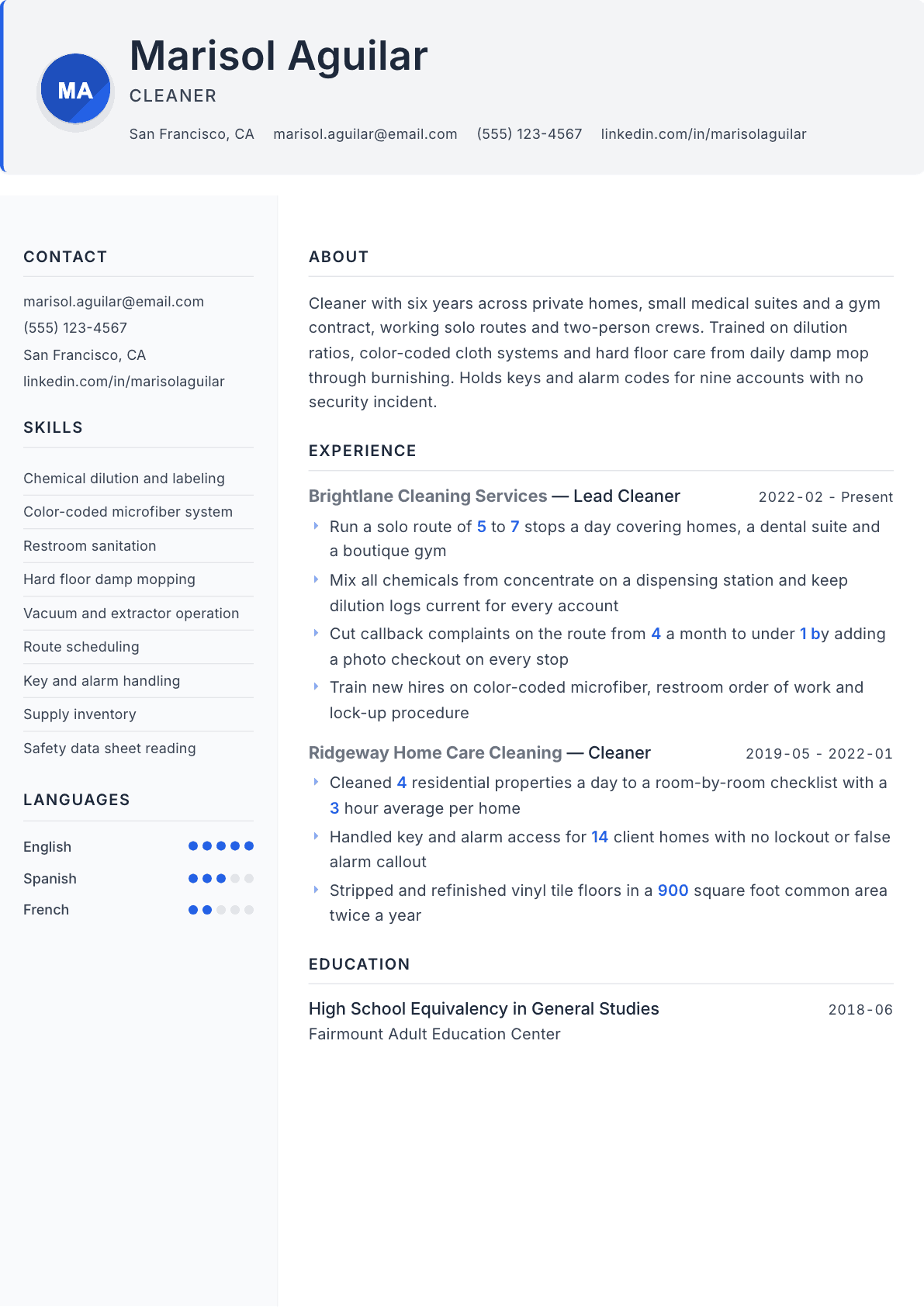
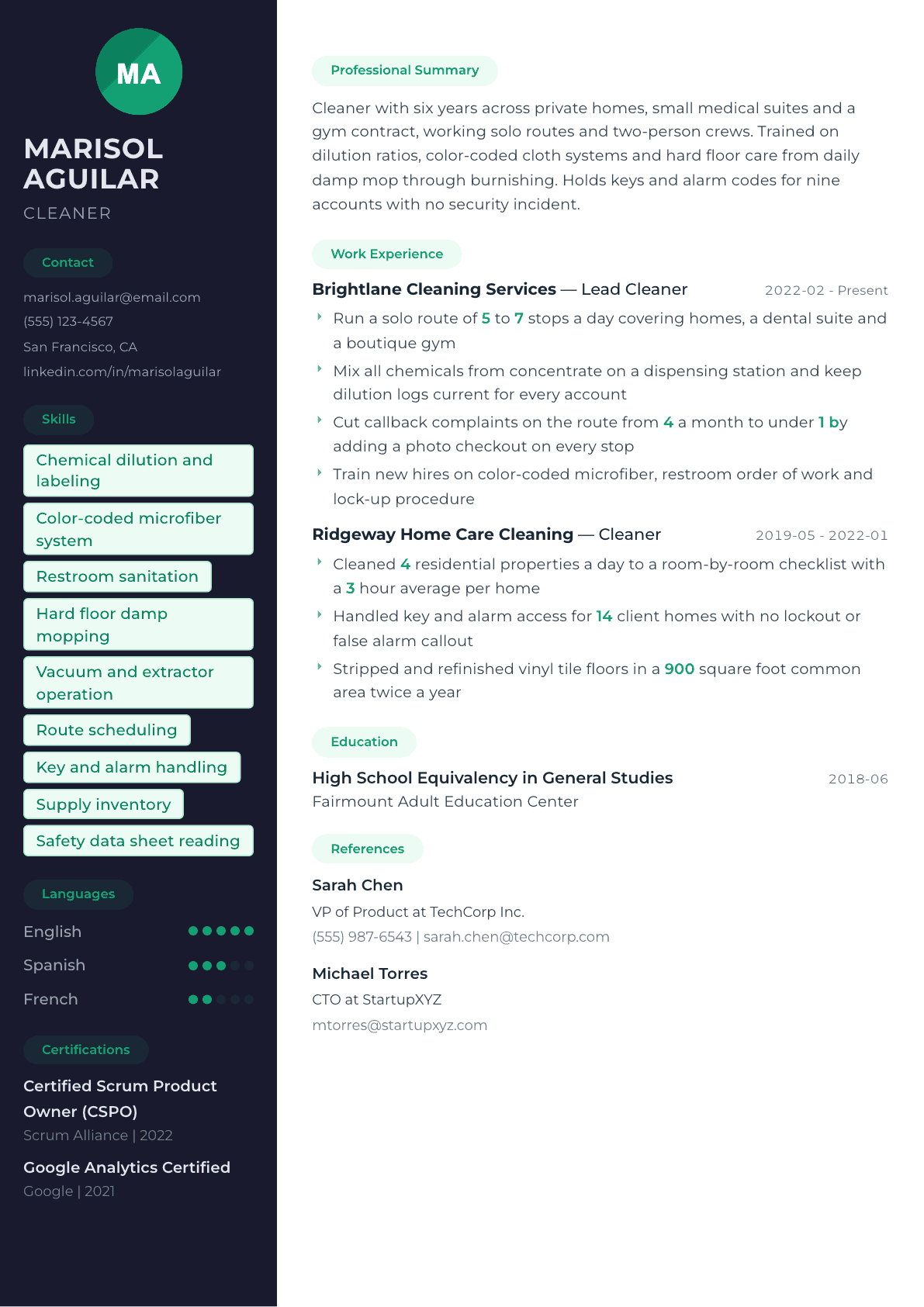
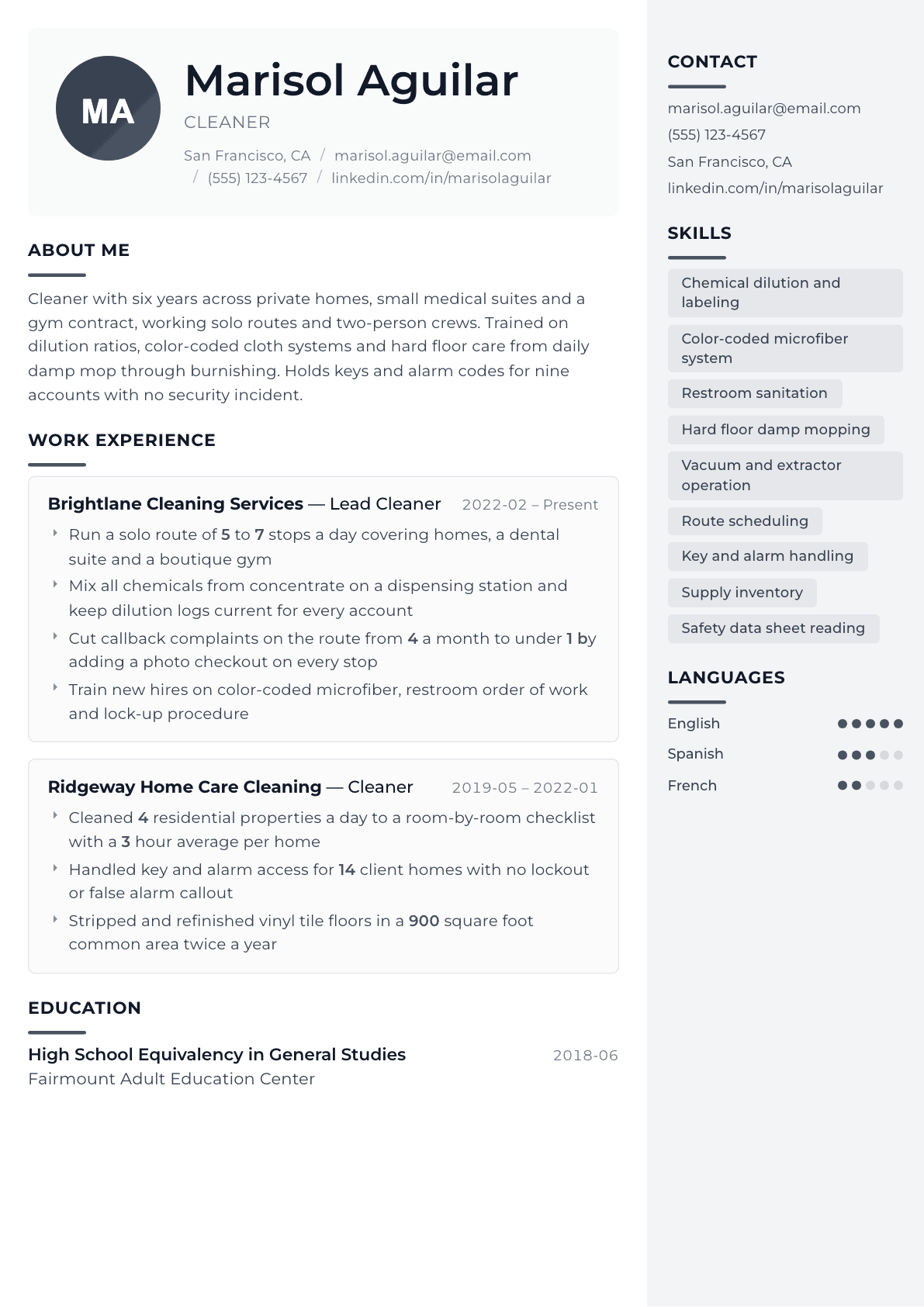
Example Cleaner summary
Cleaner with six years across residential routes, a dental suite and a gym contract, working both solo stops and two-person crews. Mixes every chemical from concentrate, keeps dilution logs current and runs a color-coded cloth system that keeps restroom tools out of kitchens. Holds keys and alarm codes for nine accounts with a clean security record, and trains new hires on order of work.
Skills to list on a Cleaner resume
- Chemical dilution from concentrate
- Safety data sheet compliance
- Color-coded cloth systems
- Restroom deep cleaning
- Hard floor care
- Carpet vacuuming and spotting
- Hot water extraction
- High dusting
- Trash and recycling handling
- Window and glass cleaning
- Route planning
- Key control and alarm codes
- Supply and inventory tracking
- Blood and body fluid cleanup procedure
- Team training
What actually gets this resume read
- Give the size of your route: stops per day, square footage, and whether you work solo or on a crew.
- Name the surfaces you handle, because vinyl tile, sealed concrete and natural stone need different chemicals.
- Say that you mix from concentrate and read safety data sheets, since supervisors screen hard for chemical safety.
- List key holding, alarm codes and lock-up, because trust is the single hardest thing to prove on paper.
- Add any specialty work you can do: extraction, stripping and refinishing, high dusting, post-construction.
- Show reliability with an attendance or callback figure rather than saying you are hardworking and punctual.
- Note the languages you speak and whether you drive, since routes are often assigned on both of those.
How to write a cleaner resume
The person hiring a cleaner is solving two problems at once. She needs someone who can finish a stop inside the time the account was sold for, and she needs someone she can hand a key to. Skill and trust, in that order on the schedule and the reverse order in her head. A resume that only proves one of them stalls.
Most cleaner resumes prove neither. They say hardworking, reliable, attention to detail, and then list duties that every cleaner alive performs. Nothing on the page tells a supervisor how many stops you can carry, whether you mix from concentrate or pour from a jug, or whether you have ever held an alarm code without an incident.
This guide covers the sections a cleaning supervisor reads, what to put in each, three summaries written at different stages of a cleaning career from commercial routes to house cleaner work, before and after bullets you can adapt, and the questions cleaners ask when they rewrite a page that keeps getting ignored. Writing a CV as a cleaner in the UK? The same sections apply, and the format section below covers the few things a UK cleaning manager expects to see differently. Residential cleaner resumes for private homes and home cleaning companies follow the same structure, with keys, alarm codes and repeat clients moved higher on the page.
Cleaning resume sample: a complete entry
This cleaning resume is for a cleaner with three years on commercial routes and some residential work before that. A cleaning supervisor reads for the route, the hours, the equipment and the trust she can place in you, so the summary carries all four.
Summary: Commercial cleaner with three years on evening office and medical routes, covering five stops a night alone. Runs an auto scrubber and a carpet extractor, mixes chemicals from concentrate to the label, and holds keys and alarm codes for every stop. Available evenings and weekends with own transport.
Order for a cleaning resume: header with phone and the area you can travel to, summary, a skills line with machines and chemical training, experience, then any certificate. Residential and commercial work can sit in one resume; give each employer its own line and lead with the work closest to the advert. The experience entry for this sample reads as the bullets below.
- Clean five commercial stops a night alone, including a dental suite and two offices, to a written checklist.
- Strip, scrub and recoat vinyl floors on a set rotation using an auto scrubber and a burnisher.
- Mix disinfectants from concentrate to the label dilution and keep the chemical log and safety data sheets current.
- Hold keys and alarm codes for every stop, and lock up and set the alarm at the end of each visit.
- Report damage or supply needs to the supervisor by text before the end of the shift.
Format: one page, route size high, trust signals visible
One page, reverse chronological, no photo. A cleaning supervisor is often reading on a phone between stops, so the first third of the page has to carry the load: what kind of properties you clean, how many you cover in a day, and whether you drive.
Writing a CV as a cleaner in the UK changes the labels more than the content. Call it a CV, open with a short personal statement instead of a summary, and keep it to one page or two at most. Leave out your photo, date of birth and marital status. Add a line on your right to work in the UK and your DBS check if you have one, because schools, care homes and offices often ask for it before a first shift.
Keep the trades block short and physical. A cleaner is hired on capability and dependability, not on a paragraph about passion for cleanliness. If you have a specialty like carpet extraction or floor refinishing, give it its own line so it is not buried inside a job description.
- Top line under your name: property types cleaned, stops per day, solo or crew, and whether you have a vehicle.
- A short capability block listing surfaces and machines rather than adjectives about your work ethic.
- A trust line: keys held, alarm codes, years of unsupervised access, background check status if you have one.
- Availability written plainly, since early morning, evening and weekend cover decide many cleaning hires.
Summary: what you clean, how much of it, and how safely
Three or four lines. Name the settings you have worked, the daily volume you carry, the chemical training you have, and one dependability fact. A supervisor reading that can already picture you on a route sheet.
Chemical handling belongs here more than most cleaners realize. Saying that you mix from concentrate at a dispensing station and read safety data sheets tells a manager you have been trained somewhere real, and it quietly removes the fear that you will ruin a stone counter or mix two products that should never meet.
Experience: the route, the checklist, the callbacks
Each job should open with the account type and the size of the work: homes per day, square footage, or number of rooms. Then the bullets carry the technical detail. Order of work in a restroom, color-coded cloths so bathroom tools never reach a kitchen, dilution ratios, dwell times on disinfectant, and the machines you run.
Add one bullet with a number that a supervisor tracks. Callbacks or complaints per month is the strongest one available to a cleaner, because it is the metric that decides whether an account renews. Attendance is second. If you have neither recorded, use consistency instead: the length of time you held an account and how many stops it covered.
Cut the bullets that read like a job advert. Dusting, mopping and emptying bins are assumed. What is not assumed is that you can strip and refinish a floor, extract a carpet, or work a medical suite where the disinfectant has to sit wet for a set time before it counts.
Trust, keys and the part nobody writes down
A cleaner is usually alone in someone property. That is the whole risk in the job, and it is the reason a manager will pick a slower cleaner with a spotless record over a fast one with a gap she cannot explain. Put the trust evidence on the page yourself rather than waiting to be asked in an interview you may not get.
Concrete forms of this: the number of keys or fobs you hold, how long you have held them, whether you set alarms, whether you have ever triggered a false callout, and whether you have a current background check. If a client has written you a reference, name the account type and the years rather than pasting the quote.
Residential cleaner resume example, one entry written out: Residential Cleaner, Brightway Home Cleaning, Raleigh, NC, three years. Cleans four to five private homes a day on a recurring biweekly route, holds keys and alarm codes for 22 clients, follows each home's written preference sheet, works around pets and children's schedules, and is requested by name when the route changes.
Cleaner resume skills and the words a cleaning company filters on
Cleaning postings reuse a compact vocabulary: dilution, safety data sheets, cross contamination, high dusting, hard floor care, extraction, terminal clean, touch point disinfection. Use the words from the advert once in your capability block and once in a bullet where you actually did the work, because a line that only appears in a skills list reads as a wish.
The cleaner resume skills that get calls fall into three groups. Technical skills: dilution from concentrate, safety data sheets, restroom order of work, touch point disinfection, floor care and carpet extraction. Trust skills: key and alarm control, working alone in occupied homes or offices, and handling client property. Work habits: arriving on time for early or late shifts, finishing a route checklist and reporting damage or supply gaps the same day. Pick five or six that match the posting and prove each one in a bullet.
Machines are keywords too. Upright and backpack vacuums, a swing machine, an extractor, a wet vacuum, a pressure washer. Naming them by category is enough, and it saves a supervisor from guessing whether she has to train you on the equipment that already sits in her van.
Cleaner resume summary examples
First cleaning job
Reliable worker moving into cleaning after two years in kitchen porter work, already trained on chemical dilution and safe handling. Comfortable on early starts, holds a full driving license and completed a short building services course covering restroom order of work, hard floor care and safety data sheets.
Six years in
Cleaner covering a solo route of five to seven stops a day across private homes, a dental suite and a gym contract. Mixes all chemicals from concentrate, runs a color-coded cloth system and holds keys and alarm codes for nine accounts with no security incident in six years.
Route lead
Lead cleaner responsible for a route of nine accounts and the training of new hires. Reduced monthly complaints on the route from four to under one by introducing a photo checkout at every stop, and covers specialty work including carpet extraction and vinyl tile refinishing without a subcontractor.
Work experience bullets: before and after
Before: Cleaned houses and offices to a high standard.
After: Cleaned a solo route of five to seven stops a day covering private homes, a dental suite and a boutique gym, each to its own written checklist.
Volume and account type let a supervisor place you on a real route instead of guessing at your pace.
Before: Used cleaning chemicals safely.
After: Mixed every product from concentrate at a dispensing station, logged dilution per account and kept safety data sheets in the van for each chemical carried.
It names the system rather than the intention, which is what a manager needs when an inspector asks.
Before: Received good feedback from clients.
After: Cut callback complaints on the route from four a month to under one by adding a photo checkout of every restroom and kitchen before leaving a stop.
A movement between two numbers with the method attached is a result, not a compliment.
Before: Trusted with keys to client properties.
After: Held keys and alarm codes for fourteen client homes across three years with no lockout, no false alarm callout and no access complaint.
Trust becomes checkable once it carries a count, a duration and the absence of a specific failure.
Before: Did floor cleaning.
After: Stripped and refinished vinyl tile in a nine hundred square foot common area twice a year, applying four coats with drying times held between passes.
Refinishing is specialty work, and the coat count and drying discipline prove it was done properly.
Hard skills
- Chemical dilution from concentrate
- Safety data sheet compliance
- Color-coded cloth and mop systems
- Restroom order of work
- Touch point disinfection and dwell times
- Hard floor damp mopping and scrubbing
- Strip and refinish
- Carpet vacuuming, spotting and extraction
- High dusting and vent cleaning
- Window and glass cleaning
- Trash and recycling handling
- Supply inventory and restocking
- Key control and alarm procedure
Soft skills
- Working unsupervised in occupied homes
- Discretion about what you see inside an account
- Time discipline across a fixed route
- Taking a complaint without arguing the point
- Training a new hire on order of work
Certifications worth listing
- CMI Custodial Technician Certification (ISSA Cleaning Management Institute)
- Carpet Cleaning Technician (CCT) (Institute of Inspection, Cleaning and Restoration Certification)
- OSHA 10-Hour General Industry (OSHA Training Institute, U.S. Department of Labor)
Mistakes that cost cleaner candidates the interview
- Filling the page with duties every cleaner performs instead of the route size that shows your capacity.
- Leaving out chemical training, which is the fastest way to look untrained to anyone who has failed an inspection.
- Never mentioning keys, alarms or unsupervised access, so the reader has to raise trust as a question instead of a fact.
- Writing attention to detail three times rather than once showing it with a checkout routine or a complaint figure.
- Hiding specialty work such as extraction or floor refinishing inside a long paragraph where a scanner will miss it.
- Omitting availability and transport, the two practical facts that decide which route you can even be offered.
Cleaner resume questions
What should a cleaning resume include?
On one page: the type of sites you clean, your route size or hours, the machines you run, your chemical training, the trust you hold such as keys and alarm codes, and your availability and transport. Group many short accounts under one employer line, as in the sample entry above.
What skills should I put on a cleaner resume?
Five or six that match the job: chemical dilution and safety data sheets, restroom and kitchen cleaning order, floor care and the machines you run, touch point disinfection, key and alarm control, and reliability on early or late shifts. Prove each one in a bullet. If you have a gap in your work history, show it as a plain date range with one honest line.
Do I need certifications to get hired as a cleaner?
No, most cleaning jobs train on site. A custodial technician certificate or a carpet cleaning credential still helps, because it moves you past entry pay and signals that you already understand dilution, cross contamination and dwell times before your first shift.
How do I write a residential cleaner or house cleaner resume?
Lead with the homes, not the duties: how many homes a day, recurring or move-out cleans, and how long clients have kept you. Put keys, alarm codes, pets and delicate surfaces near the top, because a homeowner hires trust first. Add a background check if you hold one and any product or equipment training.
How do I move from residential cleaning into commercial work?
Lead with square footage rather than number of homes, add any machine you have run beyond a vacuum, and say you can work nights. Commercial accounts run after hours on large floors, so those three facts are what a contract manager screens for first.
Related resume examples
- Building Maintenance Worker Resume example
- Housekeeping Manager Resume example
- Housekeeper Resume example
- Commercial Cleaner Resume example
- Janitor Resume example
- Custodian Resume example