Commercial Cleaner Resume Examples: the lines they read
Write a Commercial Cleaner Resume Built for Contract Accounts
By Mustafa Tarabya, founder of CVBooster · Published · Updated
Commercial cleaner resume example, keywords and writing guide covering square footage, floor machines, night crews and contract scope sheets.
Sample resumes for a commercial cleaner
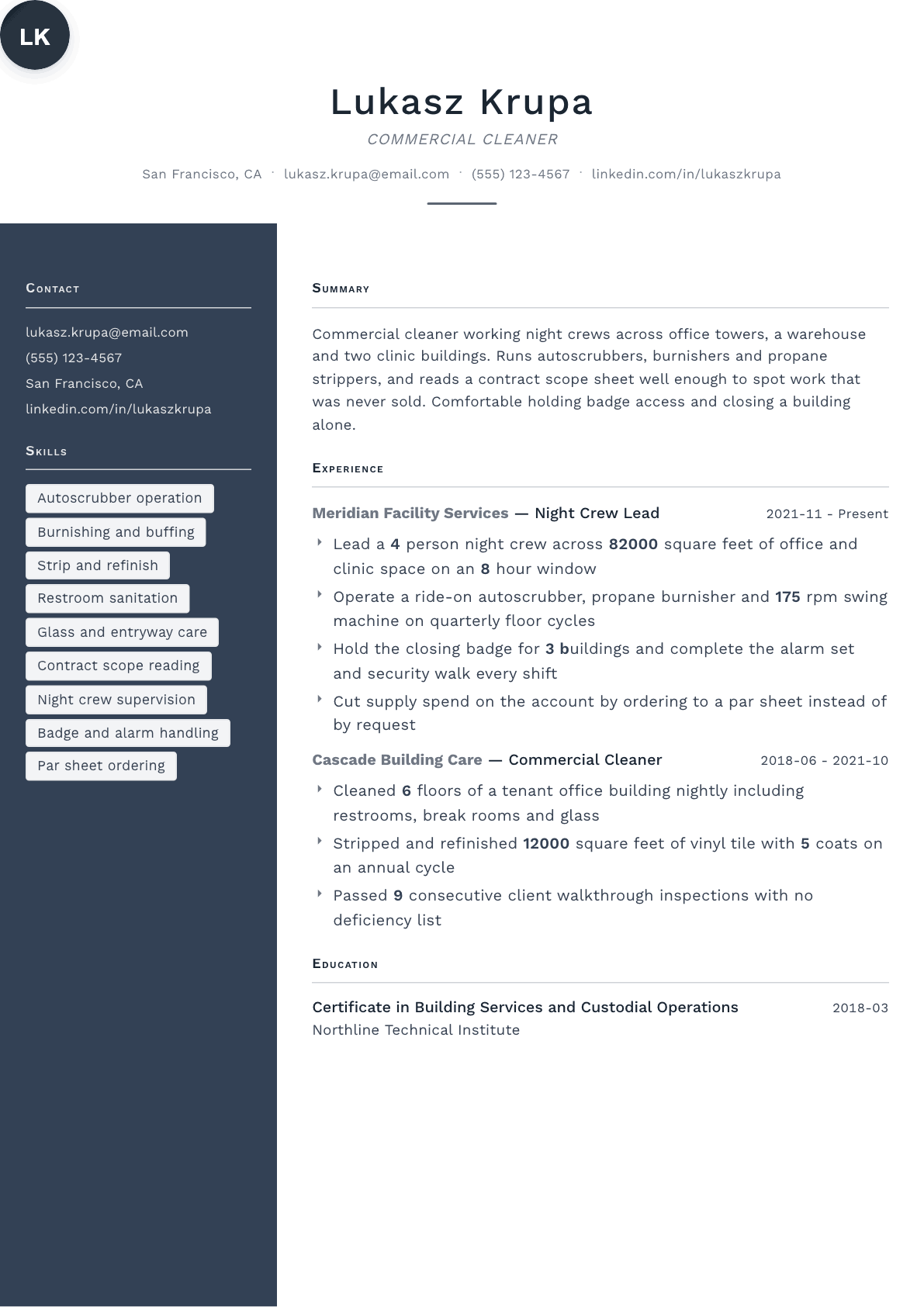
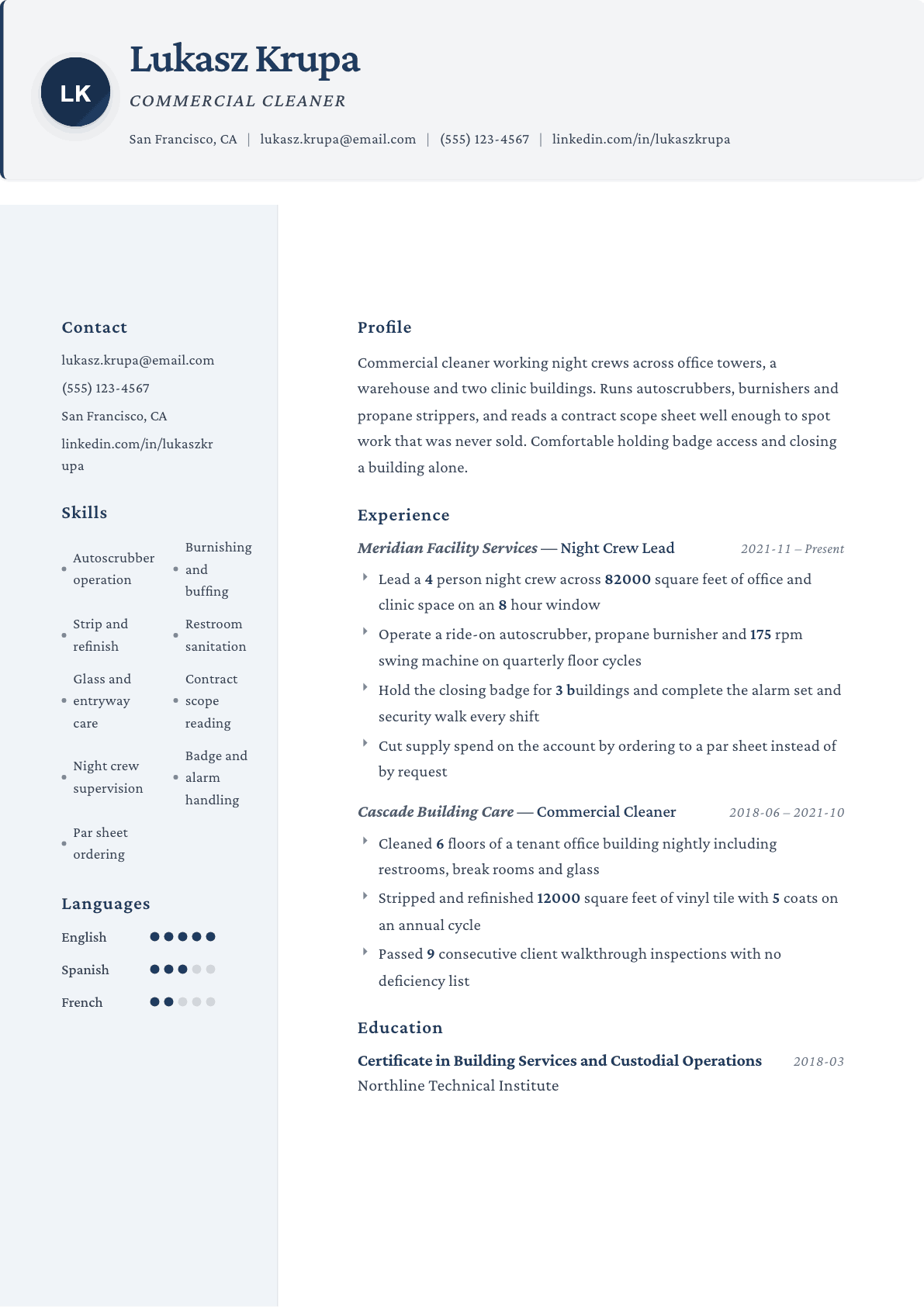
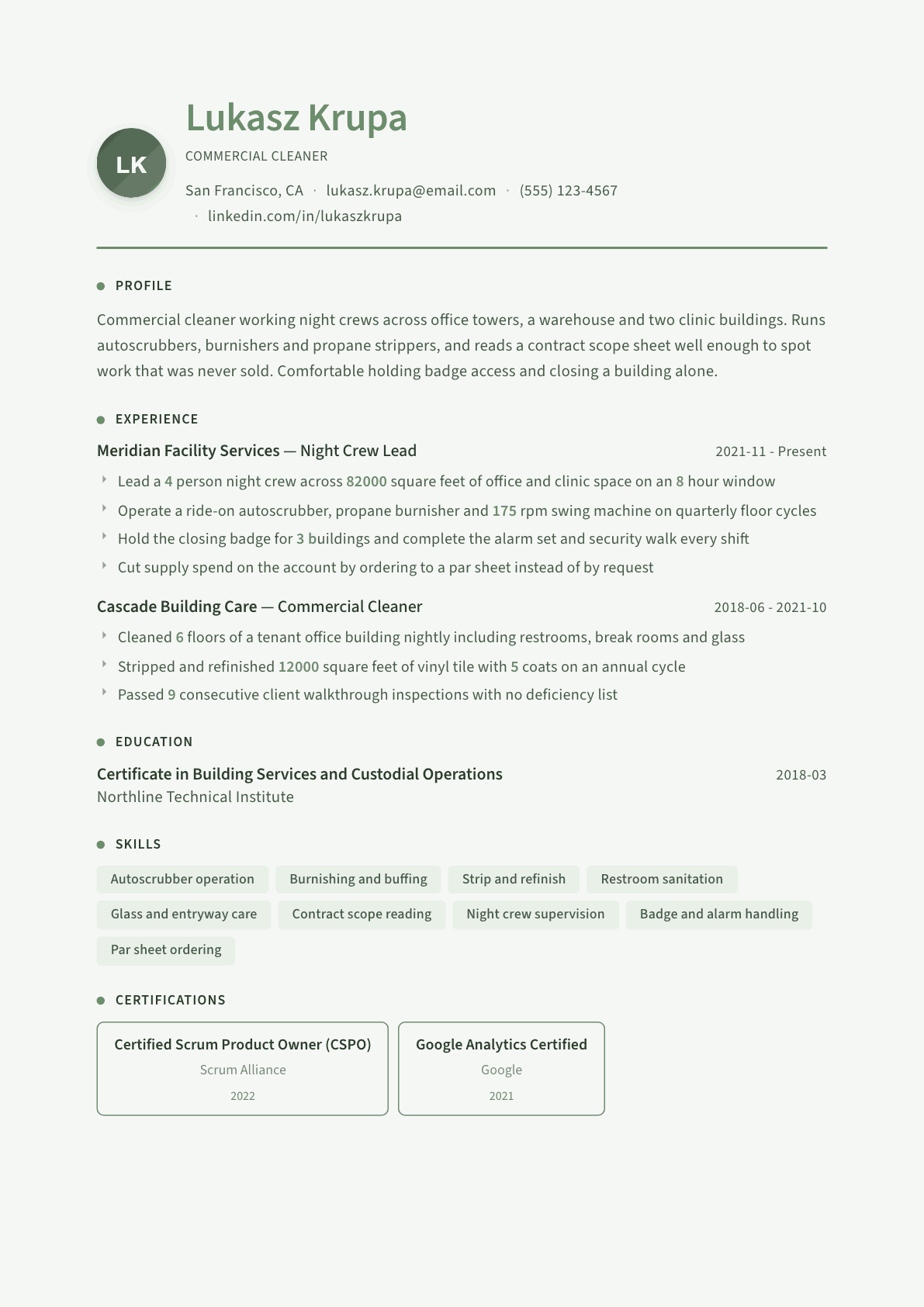
The same commercial cleaner content laid out in three CVBooster templates, so you can see what the finished document looks like before you write a word.
Example Commercial Cleaner summary
Commercial cleaner with seven years on night crews covering office towers, a warehouse and two clinic buildings. Runs ride-on autoscrubbers, propane burnishers and strip and refinish cycles, and leads a four person crew inside an eight hour window. Reads the contract scope sheet closely enough to flag work that was never sold, holds closing badges for three buildings and has passed nine straight client walkthroughs.
Skills to list on a Commercial Cleaner resume
- Ride-on and walk-behind autoscrubbers
- Propane and battery burnishers
- Strip and refinish cycles
- Carpet extraction and bonnet cleaning
- Restroom disinfection
- Entryway matting and glass
- Trash and recycling routes
- Contract scope interpretation
- Night crew leadership
- Badge access and alarm setting
- Par sheet supply ordering
- Bloodborne pathogen procedure
- Wet floor signage and safety
- Client walkthrough preparation
What actually gets this resume read
- Lead with square footage and crew size, because contract managers price a bid on exactly those two numbers.
- Name every floor machine you run, from swing machine and burnisher to ride-on autoscrubber and extractor.
- Say which building types you have cleaned, since clinic, warehouse and office scopes differ sharply.
- Show that you read a scope sheet, because a cleaner who spots unsold work protects the account margin.
- Put badge access, alarm setting and the closing walk on the page, since night work is a security job too.
- Give an inspection or walkthrough result, which is the only quality number a commercial account produces.
How to write a commercial cleaner resume
Commercial cleaning is a contract business. Somebody bid a building at a price built from square footage, frequency and a scope sheet, and the margin on that account survives only if the crew inside it can finish the scope in the hours sold. When an operations manager reads a commercial cleaner resume, she is really asking one question: how much building can this person cover in a shift, and to what standard.
That is why the strongest thing on the page is a number most applicants never write. Square footage. A cleaner who has covered eighty thousand square feet of office and clinic space on an eight hour window has told the reader more in one line than three paragraphs of duties ever will.
This guide covers how to structure the page for a contract reader, what belongs in each section, how to write floor machine work and inspection results, and the questions cleaners ask when they move from homes or a single site into contract work.
Format: square footage first, machines second, security third
One page, reverse chronological. Put the scale of the buildings you have covered in the first block a reader sees, along with whether you worked days or nights and whether you led a crew. Those three facts decide which accounts you can be placed on before anybody reads your bullets.
Give equipment its own section instead of scattering it. Floor machines are capital, and an operations manager who has a ride-on autoscrubber sitting in a building needs to know today whether you can drive it or whether the machine goes unused for a month while you train.
- Scale block: square footage covered, building types, shift window, crew size and whether you led it.
- Equipment block naming each machine class you operate, from swing machine and burnisher to ride-on scrubber.
- Security block: badge or key access, alarm setting, closing walk, and whether you have worked alone overnight.
- Certificate line for any bloodborne pathogen or safety training, which clinic and school accounts ask about.
Summary: buildings, hours, crew and standard
Four lines. Building types, total area, shift length, crew size, and one quality result. If you have led a night crew, say it in the first line, because supervision inside a contract account is a different pay grade and a different conversation.
A quality result in commercial work almost always means a client walkthrough or inspection. Passing consecutive walkthroughs with no deficiency list is the cleanest evidence available in this trade, and it is far more persuasive than describing your standards.
Experience: scope, cycles and what happens after hours
Open each job with the account and its size, then split your bullets between nightly work and periodic cycles. Nightly work is restrooms, trash, glass, entryways, break rooms and vacuuming. Periodic work is the money: strip and refinish, burnishing cycles, carpet extraction, high dusting and window schedules.
Say how the periodic work was scheduled, because that is what separates a cleaner from an operator. Quarterly burnishing, annual strip and refinish with a stated number of coats, extraction twice a year. A manager reading coat counts and cycle intervals knows you have been trained by someone who cared about floor finish.
Then add the after hours reality. Setting the alarm, walking the building, locking a loading dock, dealing with a tenant who is still working at midnight. Contract cleaning is partly a security job and every account manager knows it, even though the advert rarely says so.
Scope sheets, supplies and the margin nobody mentions
A cleaner who can read a scope sheet is worth keeping. Scope creep is where contract accounts lose money: a tenant asks for something that was never sold, the crew does it quietly, and by renewal the account is underwater. If you have flagged unsold work to a supervisor rather than absorbing it, put that on the page in plain language.
Supplies are the other margin. Ordering to a par sheet instead of by request keeps a building stocked without a closet full of product that expires. If you have controlled ordering on an account, say what you ordered against and what happened to the spend.
Skills and the vocabulary contract managers screen for
Postings for contract work recycle a narrow set of terms: janitorial, autoscrubber, burnisher, strip and wax, extraction, touch point disinfection, terminal clean, day porter, night crew, scope of work, walkthrough. Mirror the ones in the advert and skip the ones you cannot back up in a bullet.
Building type is itself a keyword. Clinic, school, warehouse, data center, food plant and tenant office all carry different rules, and a manager filling a clinic contract will search for clinic or medical office before anything else. Name every building type you have actually worked.
Commercial Cleaner resume summary examples
First contract job
Cleaner moving from residential route work into contract cleaning, comfortable on night shifts and trained on chemical dilution and restroom order of work. Has run an upright vacuum, wet vacuum and swing machine, holds a full driving license, and is ready to learn autoscrubber and burnisher operation on the floor.
Seven years in
Commercial cleaner with seven years on night crews across tenant office towers, a warehouse and two clinic buildings. Runs walk-behind and ride-on autoscrubbers, propane burnishers and full strip and refinish cycles, and has passed nine consecutive client walkthroughs on an account with no deficiency list raised.
Night crew lead
Night crew lead covering eighty two thousand square feet of office and clinic space with a four person team inside an eight hour window. Holds closing badges for three buildings, sets alarms and completes the security walk nightly, and moved account supply ordering onto a par sheet to control spend.
Work experience bullets: before and after
Before: Cleaned office buildings at night.
After: Led a four person night crew across eighty two thousand square feet of office and clinic space inside an eight hour cleaning window.
Area, crew size and window are exactly the three inputs a contract is costed on.
Before: Operated floor cleaning machines.
After: Operated a ride-on autoscrubber, propane burnisher and swing machine on quarterly floor cycles, including edge work the machines cannot reach.
Machine classes and the cycle they run on prove operating experience rather than exposure.
Before: Stripped and waxed floors.
After: Stripped and refinished twelve thousand square feet of vinyl tile on an annual cycle, applying five coats with full cure time held between passes.
Area, coat count and cure discipline are what a floor that still looks right in month six requires.
Before: Kept the client happy.
After: Passed nine consecutive client walkthrough inspections with no deficiency list, on an account that had changed contractors twice before.
Walkthrough outcomes are the account quality record, and the account history shows the difficulty.
Before: Locked up the building.
After: Held the closing badge for three buildings, completed the security walk and alarm set every shift, and reported two after hours access issues to the property manager.
It treats closing as the security duty it is, with evidence that you escalate rather than ignore.
Hard skills
- Ride-on and walk-behind autoscrubber operation
- Propane and battery burnishing
- Strip and refinish cycles
- Carpet extraction and bonnet cleaning
- Restroom disinfection and dwell times
- High dusting and vent work
- Entryway matting and glass care
- Trash and recycling routes
- Scope of work interpretation
- Par sheet supply ordering
- Badge access and alarm setting
- Bloodborne pathogen cleanup procedure
- Wet floor signage and site safety
Soft skills
- Running a crew without a supervisor in the building
- Working alone through a full night shift
- Handling a tenant request without agreeing to unsold work
- Pacing a large floor so the window is never missed
- Reporting problems upward the same night they appear
Certifications worth listing
- CMI Custodial Technician Certification (ISSA Cleaning Management Institute)
- CMI Custodial Supervisor Certification (ISSA Cleaning Management Institute)
- OSHA 10-Hour General Industry (OSHA Training Institute, U.S. Department of Labor)
Mistakes that cost commercial cleaner candidates the interview
- Leaving square footage off the page, which forces an operations manager to guess at the only number she prices on.
- Writing that you used floor equipment without naming the machine classes and the cycles you ran them on.
- Skipping building types, so a clinic or school account manager cannot tell whether you know their rules.
- Presenting nightly duties and periodic cycles as one undifferentiated list, which hides the specialty work.
- Ignoring the security half of night work: badges, alarm setting, the closing walk and lone working.
- Claiming a high standard with no walkthrough or inspection outcome anywhere on the page to support it.
Commercial Cleaner resume questions
How do I estimate the square footage I have cleaned?
Ask a supervisor or check the building directory, since most contract accounts publish an area figure. If you cannot confirm it, describe the building instead: six tenant floors, forty offices and eight restrooms. A described building is far better than no scale at all.
Is a commercial cleaner resume different from a janitor resume?
The work overlaps heavily, but a janitor is usually employed by the building and a commercial cleaner by a contractor. Write to the contract reader by leading with area, crew and scope, and to a building employer by leading with your range across minor repairs and setup work.
Do I need floor machine experience to get hired?
Not for a first job, but it changes your pay and the accounts you can be placed on quickly. If you have only used a vacuum and a mop, say so honestly and add that you are ready to train, because managers respect that more than an inflated equipment list.
How should I handle working for several contractors in a few years?
Contract cleaning changes hands often and managers know it. Where an account was rebid and you stayed in the same building under a new contractor, say that plainly, because staying with the building through a contract change is a strong endorsement.
What matters most for clinic and medical office accounts?
Disinfectant dwell times, color-coded tools, sharps awareness, and the discipline to follow a written cleaning order every night. Say you have worked to a documented protocol and completed bloodborne pathogen training, since those accounts are audited far more closely than offices.
Related resume examples
- Building Maintenance Worker Resume example
- Facilities Manager Resume example
- Janitor Resume example
- Cleaner Resume example
- Custodian Resume example
- Facilities Technician Resume example