Janitor Resume Examples: free score, then the gap list
Write a Janitor Resume That Shows Route and Reliability
By Mustafa Tarabya, founder of CVBooster · Published · Updated
Janitor resume example, keyword list and writing guide covering cleaning routes, floor care, chemical safety and building security.
Sample resumes for a janitor
The same janitor content laid out in three CVBooster templates, so you can see what the finished document looks like before you write a word.
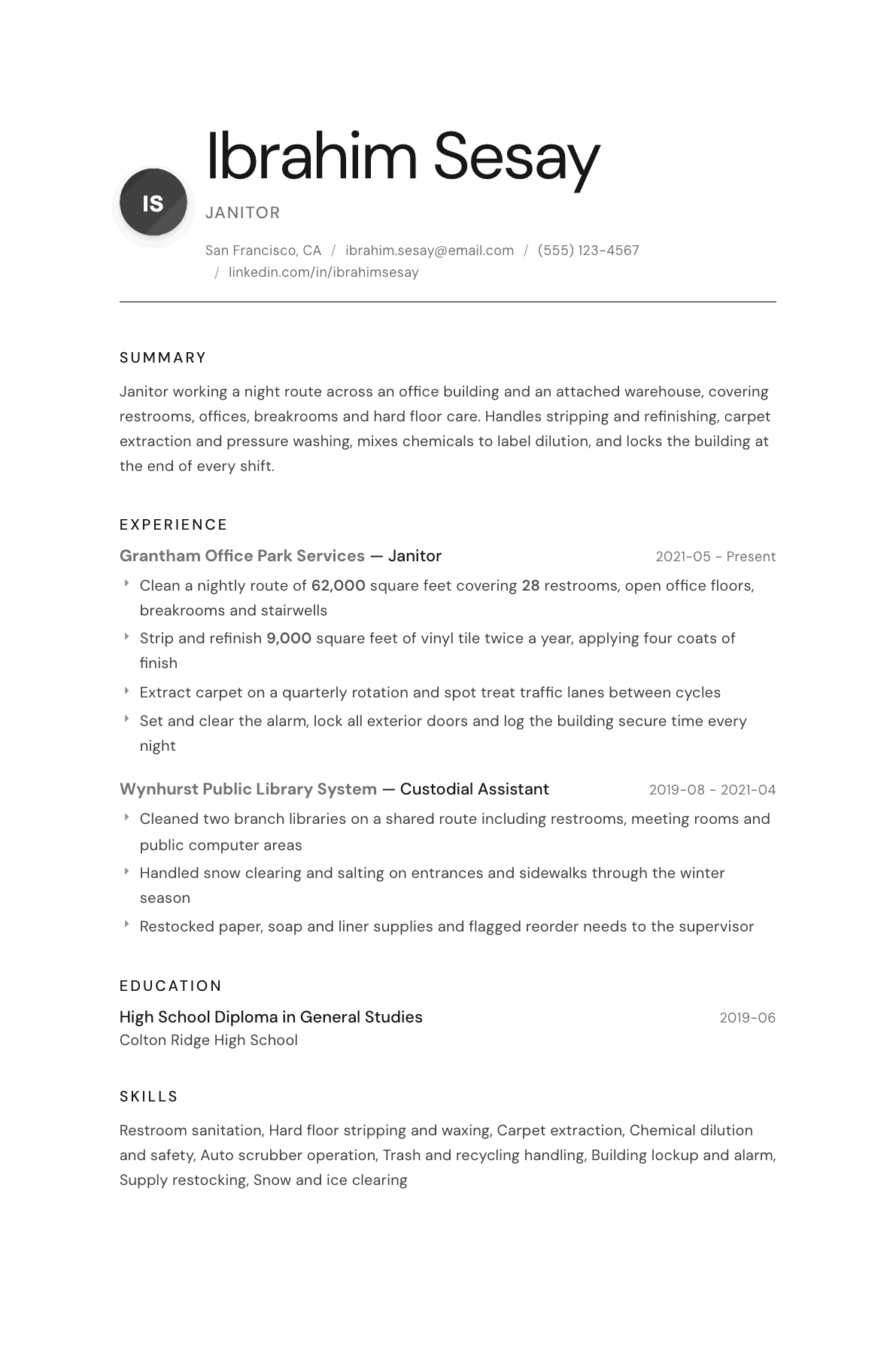
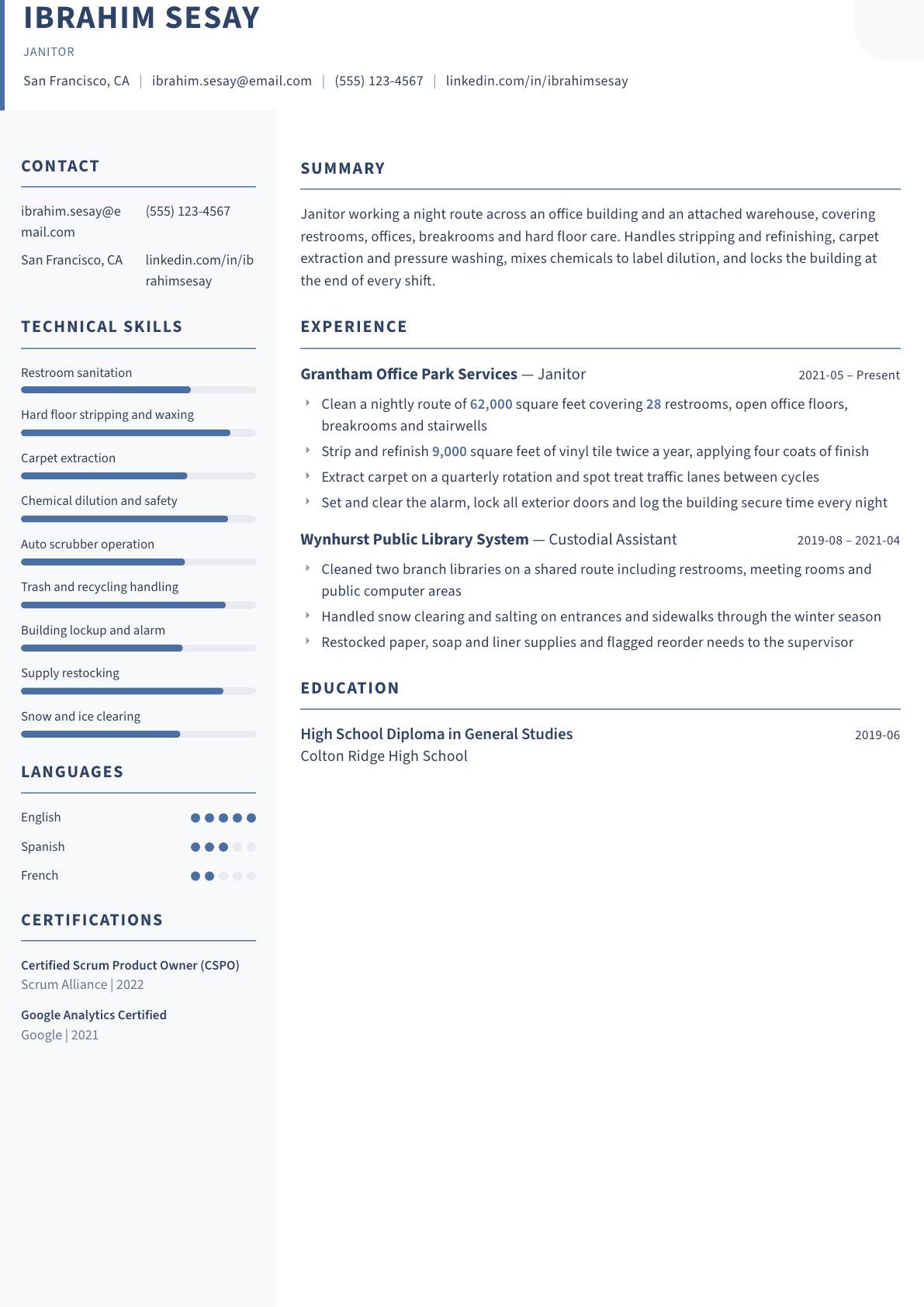
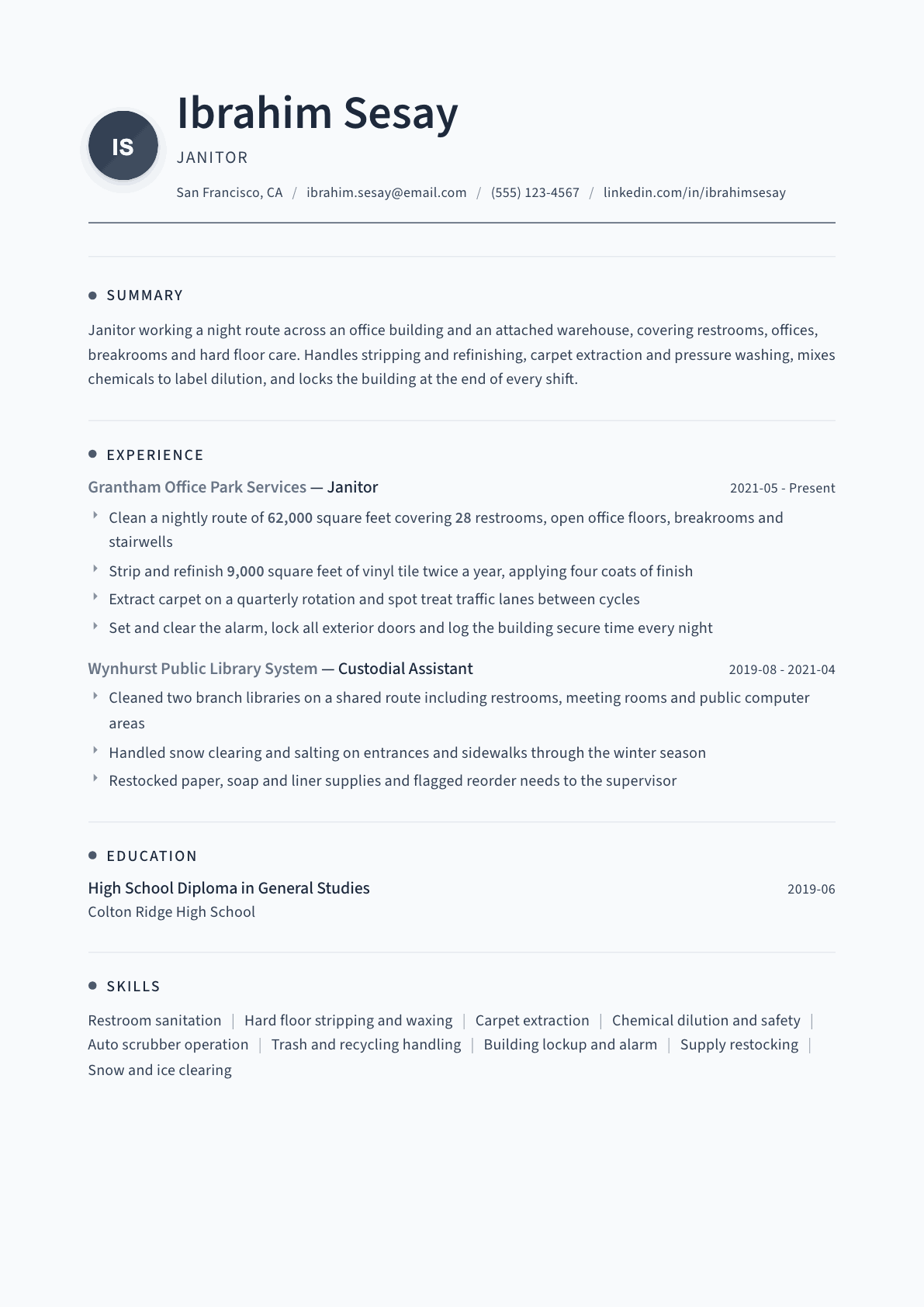
Example Janitor summary
Janitor working a night route across an office building and warehouse, cleaning restrooms, offices, breakrooms and stairwells to a written checklist. Strips and refinishes vinyl tile twice a year, extracts carpet on a quarterly rotation, and runs auto scrubbers and burnishers safely. Mixes chemicals to label dilution, restocks supplies before they run out, and locks the building and sets the alarm at the end of every shift.
Skills to list on a Janitor resume
- Nightly cleaning routes
- Restroom sanitation and disinfection
- Hard floor stripping and refinishing
- Burnishing and buffing
- Carpet extraction and spot treatment
- Auto scrubber and floor machine operation
- Pressure washing entrances
- Chemical dilution and safety data sheets
- Trash, recycling and compactor handling
- Supply inventory and restocking
- Building lockup and alarm systems
- Snow and ice removal
- Minor repairs and light bulb replacement
- Bloodborne pathogen cleanup awareness
What actually gets this resume read
- Give the area you clean per shift and the number of restrooms, because that is how a route is priced.
- Name your floor care work by process: stripping, refinishing, burnishing, carpet extraction, pressure washing.
- List the machines you run, from auto scrubbers and burnishers to extractors and backpack vacuums.
- Show chemical safety with dilution practice and safety data sheet familiarity rather than a vague claim.
- Say whether you open or close the building, set alarms and hold keys, since that is a trust question.
- Include your attendance record or years without a missed shift, which decides many janitorial hires.
How to write a janitor resume
The person hiring a janitor is buying two things: a route that gets finished every night, and a person he can leave alone in an empty building with the keys and the alarm code. Almost every applicant claims to be hardworking and reliable. Almost none of them prove it, which is why a resume that puts numbers on the route and specifics on the floor care work stands out immediately.
Cleaning contractors and in-house facilities managers both price work by area and by task frequency. When your resume says you clean a set square footage with a stated number of restrooms on a nightly route, you are speaking the language the person doing the hiring uses to build a bid. When it says you performed cleaning duties as assigned, you have handed him nothing to compare.
This guide covers the layout a supervisor scans, how to write route and floor care work with real detail, how to present chemical and equipment competence, the trust signals that decide these hires, and the questions janitors ask when they apply for a better route or a lead position.
Format: one page, route scope and equipment stated up front
One page, always. Under your contact line, put the route scope: the type of building, the area covered per shift, the number of restrooms, and the shift you work. That single block gives a supervisor everything he needs for a first sort.
Follow it with an equipment line and a floor care line. The machines you can operate safely and the floor processes you can run are the two things that separate a janitor who can be given the whole building from one who needs supervision, and they are what a supervisor is actually screening for.
- Route line: building type, area per shift, restroom count, and whether you work alone or in a crew.
- Equipment line: auto scrubber, burnisher, extractor, backpack vacuum, pressure washer, floor buffer.
- Floor care line: stripping, refinishing, burnishing, extraction, grout cleaning, entrance matting.
- Trust line: keys held, alarm setting, opening or closing responsibility, background check cleared.
- Availability line: shift worked, weekend coverage, and reliability of transport to the site.
Summary: route, floor care, machines, trust
Three lines with no adjectives. What kind of building you clean and how much of it, which floor care processes you run, which machines you operate, and whether you lock up at the end of the night. A supervisor reads for exactly those four things.
Resist the urge to describe yourself as hardworking or detail oriented. Every competing resume says the same, so the words carry no information. A completed route with a stated area and a stripping and refinishing cycle proves both qualities without claiming either.
Janitor duties for a resume: the route, the periodics, the machines, the close
Head each job with the site type and the route scope, then write bullets around the work. Nightly tasks in order of the route. The periodic work that happens quarterly or twice a year, which is where floor care lives. The machines you run and what you use them on. And the close of the shift: alarm, doors, lights, and the log entry.
Periodic floor care is the most underwritten thing on janitorial resumes. Stripping and refinishing vinyl tile is a real skill with a real sequence, and saying how much area you strip, how many coats of finish you apply, and how often the cycle runs tells a supervisor you have done it rather than watched it.
Written as resume lines, the core janitor duties read like this: Clean a nightly route of offices, two break rooms and eight restrooms, about 40K square feet. Restock paper, soap and liners to par and flag reorders to the supervisor. Strip and refinish vinyl tile in corridors twice a year and burnish monthly. Run an auto scrubber on the lobby and a carpet extractor on office carpet. Empty trash and recycling to the compactor. Lock exterior doors, set the alarm and log the secure time. Each line is a duty with a place, an amount or a machine attached, which is what separates it from a job description.
Add anything that saved the building money or trouble: catching a running toilet, reporting a roof leak the morning after a storm, noticing a propped door. Supervisors hire janitors partly as a set of eyes in an empty building, and evidence of that is rare on a page.
- Nightly route with area, restroom count, and the spaces included.
- Periodic floor care with the cycle frequency, the area treated and the number of finish coats.
- Machines operated and the surfaces you run each one on.
- Supply management: what you restock, how you track it, and how you flag reorders.
- Building close: alarm setting, exterior door checks, and the secure time you log.
Chemicals, safety and the keywords a janitorial posting screens on
Chemical competence is a genuine differentiator. Say that you dilute to the label, use the dispensing system rather than eyeballing, never mix products, and know where the safety data sheets are kept. A supervisor who has dealt with a chemical incident will read that line twice.
Cover the rest of the safety picture briefly and concretely: wet floor signage and traffic control, safe lifting, machine cord handling, sharps and biohazard procedure, and personal protective equipment. If you have completed bloodborne pathogen training, list it, because buildings with public traffic need someone who can handle a cleanup properly.
Adverts for this work repeat a small list: janitorial, custodial, floor care, stripping and waxing, carpet extraction, restroom sanitation, trash removal, auto scrubber, safety data sheets, and building security. Use the same terms in your route and equipment blocks.
Attendance belongs on the page. If you have gone years without a missed shift, or you have covered other routes when a colleague called out, write it. Contractors lose accounts over coverage failures, so a candidate with a demonstrated attendance record is worth more than one with a slightly faster technique.
Janitorial resume sample: entry level custodian
Janitorial resumes samples are most useful when they are complete, so here are two full pages, an entry level custodian and an experienced lead. The people are invented; the order is what to copy. The first is someone with restaurant closing duties and no janitorial title yet.
Profile: Luis Romero, Custodian. One year of closing and deep cleaning in a busy restaurant, comfortable working alone at night, background check cleared, and available for evening and overnight shifts.
- Experience, Closing Crew, Riverside Grill, one year: cleaned the dining room, kitchen floors and four restrooms after close, five nights a week.
- Mopped and degreased the kitchen floor nightly and pulled grease traps on the weekly schedule.
- Took out trash and recycling, broke down boxes and kept the dumpster area clean for health inspections.
- Locked up and set the alarm on manager nights off.
- Skills: wet floor safety, chemical dilution by label, restroom sanitation, trash and recycling.
- Availability: evenings, overnights and weekends; reliable transport.
Janitorial sample resume: experienced janitor and lead
The second of the janitorial sample resume examples is a janitor with six years who now leads a small night crew. Notice the route size, the floor care cycle and the trust line in the first lines.
Profile: Angela Brooks, Lead Janitor. Six years in commercial cleaning, now leading a three person night crew across two office buildings of about 120K square feet. Runs the stripping and refinishing calendar, orders supplies and trains new cleaners on machines and chemicals.
- Current role, Lead Janitor, Summit Building Services, two years: assigns routes for a three person crew, checks every restroom before close, and reports to the account manager.
- Runs the floor care calendar: strips and refinishes vinyl tile twice a year and burnishes monthly in high traffic areas.
- Orders paper, liners and chemicals on par levels, and kept the account inside its supply budget.
- Trains new cleaners on the auto scrubber, burnisher and dispensing system before they work alone.
- Previous role, Janitor, Summit Building Services, four years: nightly route of 60K square feet with 24 restrooms in a medical office building.
- Certifications: OSHA 10 general industry, bloodborne pathogens training.
- Skills: auto scrubber, burnisher, carpet extractor, floor stripping and refinishing, supply ordering, building lockup and alarm.
Janitor resume summary examples
First cleaning job
Reliable worker seeking a first janitorial route, with a year of restaurant closing duties covering deep cleaning, floor mopping, restroom sanitation and trash removal. Comfortable working alone at night, holds a clean driver record, and available for evening and weekend shifts starting immediately.
Three years in
Janitor working a nightly route of 62K square feet across an office building and warehouse, covering 28 restrooms, open floors, breakrooms and stairwells. Strips and refinishes vinyl tile twice a year with four coats of finish, extracts carpet quarterly, and sets the alarm and logs the building secure every night.
Lead janitor
Lead janitor directing a three-person night crew across two buildings, assigning routes, ordering supplies and training new cleaners on machine safety and chemical dilution. Rebuilt the floor care calendar so stripping no longer collided with tenant events, and has not missed a scheduled shift in four years.
Work experience bullets: before and after
Before: Cleaned offices and restrooms every night.
After: Cleaned a nightly route of 62K square feet covering 28 restrooms, open office floors, breakrooms and stairwells, finishing inside the scheduled shift without overtime.
Area, restroom count and finishing on time give a supervisor the numbers he uses to price a route.
Before: Stripped and waxed floors when needed.
After: Stripped and refinished 9K square feet of vinyl tile twice a year, applying four coats of finish and burnishing on a monthly cycle between strips.
Area, frequency and coat count prove hands-on floor care rather than a passing familiarity with the term.
Before: Used cleaning chemicals safely.
After: Diluted every product through the wall dispensing system to label strength, never combined products, and kept the safety data sheet binder current at the janitorial closet.
Specific handling practice is verifiable, where a general claim about safe chemical use is not.
Before: Locked up the building at night.
After: Set the alarm, checked every exterior door and stairwell, and logged the building secure time each night, reporting two propped doors and a broken lock to security the same shift.
The closing routine plus what you caught shows you are the set of eyes the building is paying for.
Before: Kept supplies stocked in the building.
After: Restocked paper, soap and liners on a par level checklist and submitted reorders a week ahead of runout, which ended the emergency supply runs the site had been making monthly.
A stocking method and the problem it solved turn a routine duty into an operational improvement.
Hard skills
- Nightly route completion
- Restroom sanitation and disinfection
- Vinyl tile stripping and refinishing
- Burnishing and buffing
- Carpet extraction and spot treatment
- Auto scrubber and floor machine operation
- Pressure washing entrances and walkways
- Chemical dilution and safety data sheets
- Trash, recycling and compactor handling
- Supply par levels and restocking
- Building lockup and alarm systems
- Snow and ice removal
- Light bulb changes and minor repairs
Soft skills
- Finishing a full route without supervision
- Turning up every scheduled shift
- Noticing damage nobody has reported
- Working quietly around late staff
- Being trusted with keys and alarm codes
Certifications worth listing
- Custodial Technician Certification (ISSA Cleaning Management Institute)
- Bloodborne Pathogens Training (American Red Cross)
- OSHA 10-Hour General Industry (Occupational Safety and Health Administration)
Mistakes that cost janitor candidates the interview
- Calling yourself hardworking and reliable instead of proving it with a route size and an attendance record.
- Leaving out the area you clean per shift, which is the number a contractor uses to price the work.
- Mentioning floor care in one word rather than naming the processes, the cycle and the coats applied.
- Skipping the machines you can operate, which decides whether you get the whole building or half of it.
- Ignoring keys, alarms and building close, when trust is the deciding factor in most of these hires.
- Writing chemical safety as a claim rather than as the dilution and storage practice you actually follow.
Janitor resume questions
Where can I find janitorial resumes samples I can copy?
This page has two complete janitorial resume samples, an entry level custodian and a lead janitor, plus summaries and bullet rewrites for each stage. Copy the order, not the words: route size, floor care, machines, trust and availability, then replace every detail with your own buildings and numbers.
How do I write a janitor resume with no cleaning experience?
Use whatever work involved closing, cleaning or care of a space: restaurant closing duties, warehouse housekeeping, hotel work, or caretaking. Then add your availability, transport, and willingness to work nights, which are the practical things a supervisor needs to know.
What janitor duties should I put on a resume?
The nightly route with its area and restroom count, periodic floor care with the cycle, the machines you run by type, supply restocking, trash and recycling, and building lockup with the alarm. Describe chemicals by dispensing system and dilution practice rather than brand, since every building stocks different products.
Does a janitor resume need a summary section?
Yes, three short lines that state the route size, the floor care you can run, the machines you operate and your shift availability. It saves the supervisor from hunting through bullets and often decides whether the rest of the page gets read.
How do I move from a janitor role to a lead or supervisor position?
Show the parts of the job that scale: training new cleaners, ordering supplies, building the floor care calendar, and covering other routes. Add any experience assigning work or checking quality, since a lead is hired to hold standards across people, not just to clean faster.
Related resume examples
- Custodian Resume example
- Commercial Cleaner Resume example
- Cleaner Resume example
- Building Maintenance Worker Resume example
- Auto Detailer Resume example
- Pool Technician Resume example