Executive Coordinator Resume Examples: read this first
Elevate Leadership with an Executive Coordinator Resume
By Mustafa Tarabya, founder of CVBooster · Published · Updated
Build an executive coordinator resume showcasing your high-level support, board governance, and strategic project management skills.
Sample resumes for a executive coordinator
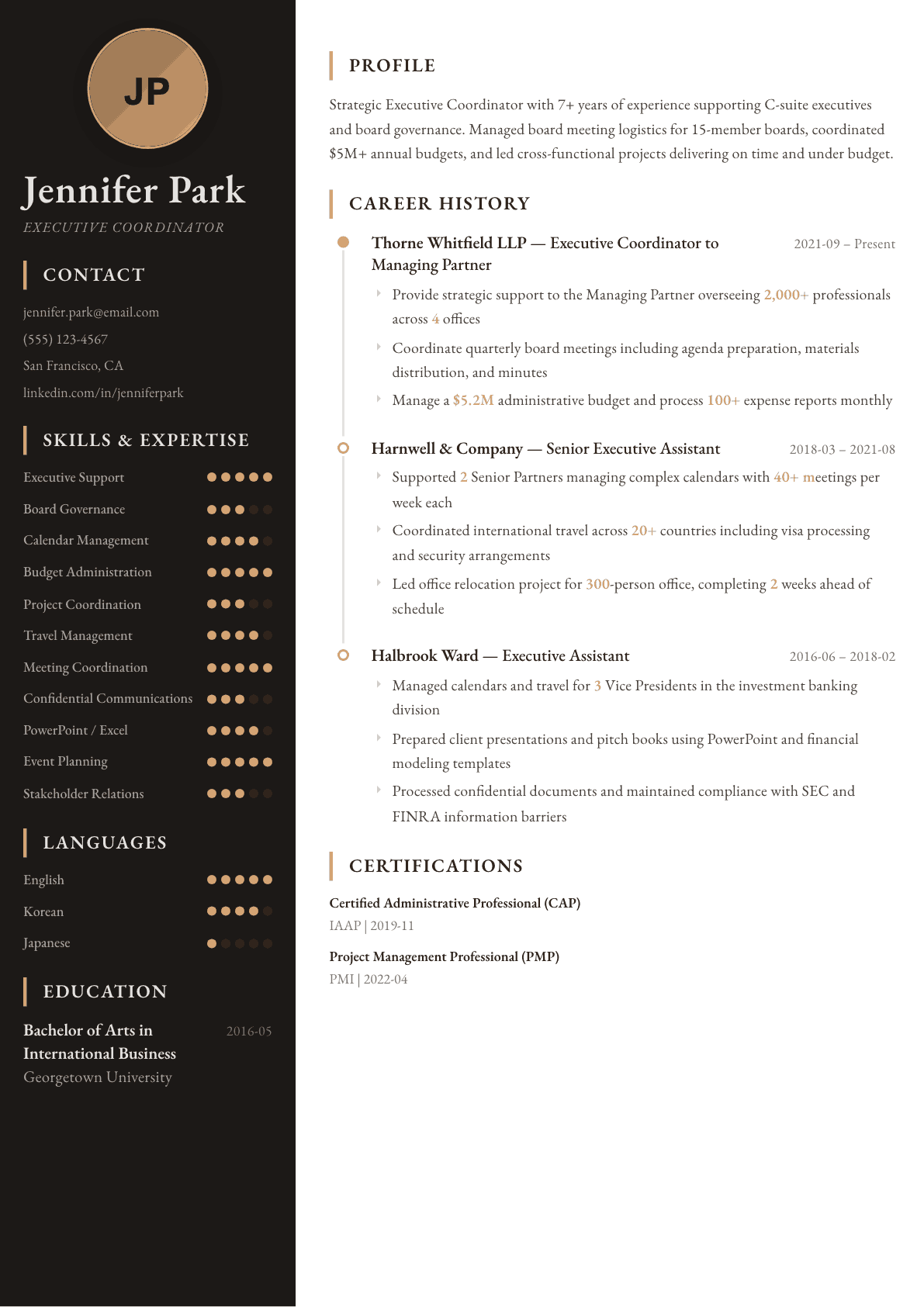
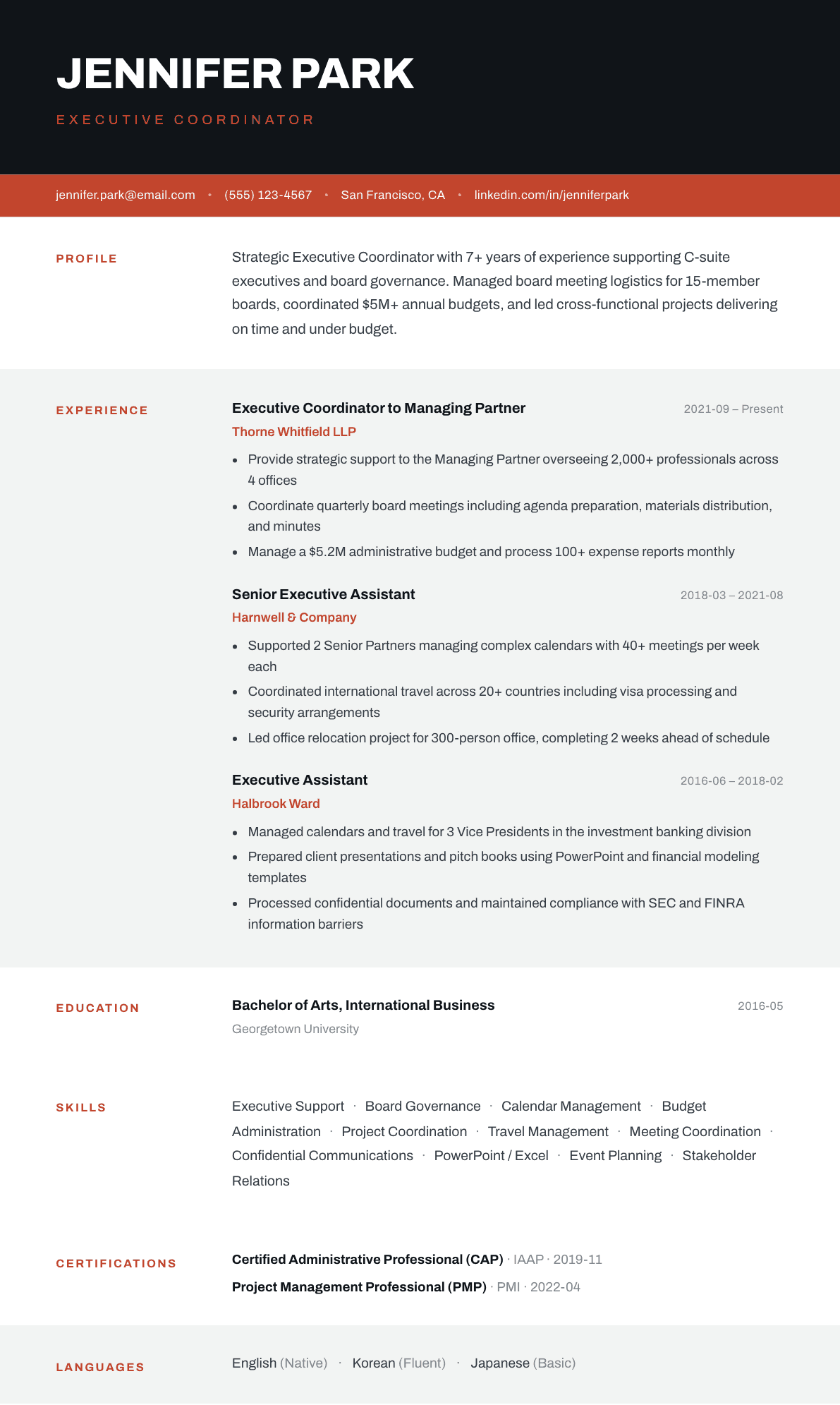
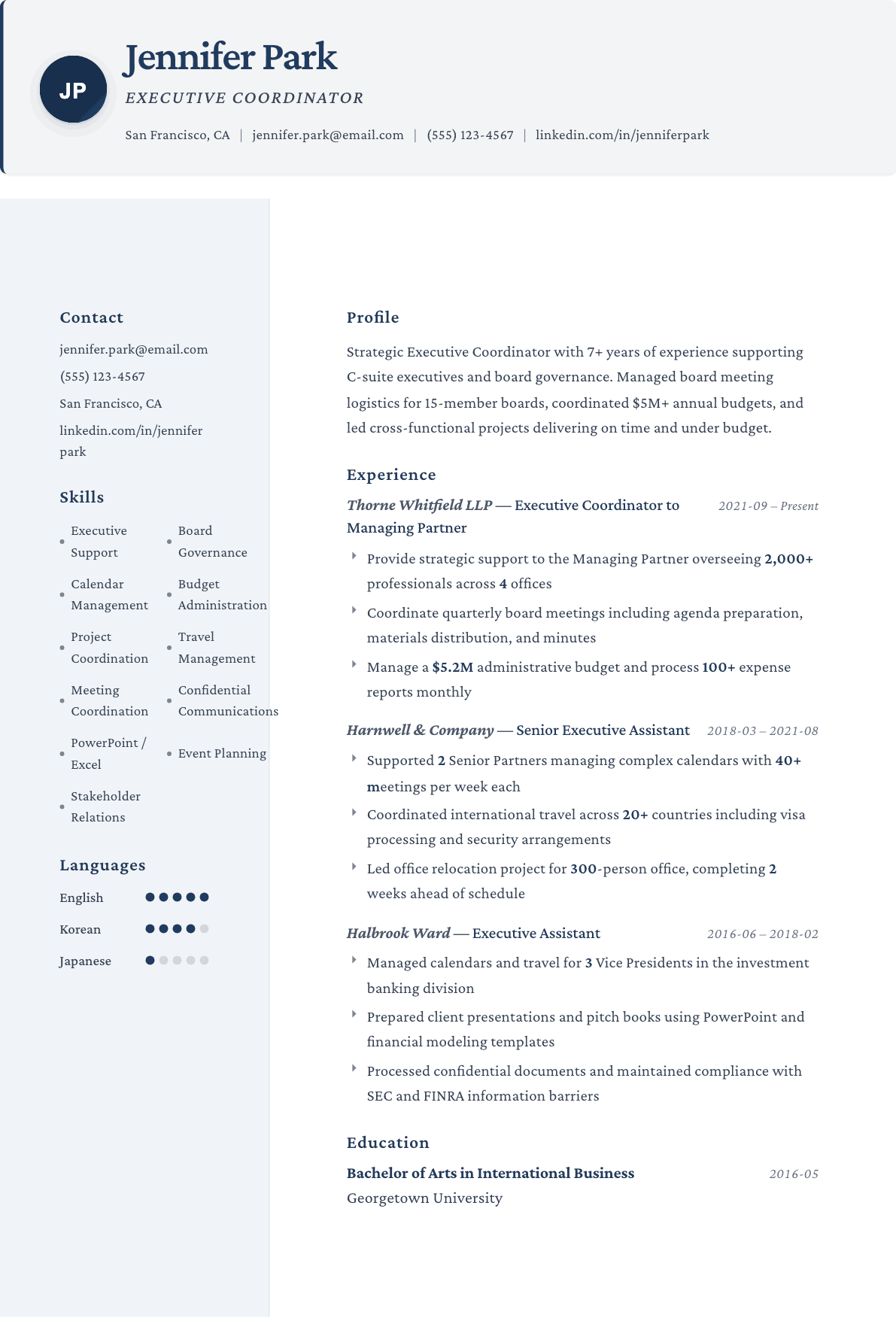
The same executive coordinator content laid out in three CVBooster templates, so you can see what the finished document looks like before you write a word.
Example Executive Coordinator summary
Executive coordinator to a managing partner, 7 years across law and consulting, owning the board calendar, board packs and minutes for a 15-member board. Administers a $5.2M budget, handles international travel across 20 countries, and led an office move for 300 people delivered two weeks early.
Skills to list on a Executive Coordinator resume
- Executive Support
- Board Governance
- Calendar Management
- Budget Administration
- Project Management
- Travel Coordination
- Meeting Facilitation
- Confidential Communications
- PowerPoint / Excel
- Event Planning
- Stakeholder Relations
- Process Improvement
- Vendor Management
- CRM Systems
What actually gets this resume read
- Name the seat you sat next to, whether CEO, CFO, Managing Partner or Board Chair, and the size of the organization behind that seat.
- Spell out the board work: agenda drafting with the chair, board pack assembly and distribution deadlines, minutes, resolutions and committee follow-up.
- State the administrative budget you administered and what you were allowed to approve without a second signature.
- Show the projects that were not calendar work, such as an office relocation, a travel policy rewrite or a new expense system rollout, with the dates and outcome.
- Describe how you protect confidential material, from information barriers on deal files to who is allowed on a document distribution list.
- Give the travel picture in detail: countries per year, visas handled, and how you rebuild an itinerary when a leg is cancelled overnight.
How to write a executive coordinator resume
An executive coordinator resume has to answer a question the title itself leaves open: what did you coordinate. The role sits between senior administrative support and operations, and in practice it means holding the moving parts of a leadership office together, the meeting rhythm, the budget line, the committee calendar, the office logistics, and the projects nobody else owns. A resume that describes only scheduling and travel has described the smaller half.
Hiring managers for this role are usually a chief of staff, an operations director or a department head who has run out of capacity. She is looking for someone who can be given an outcome rather than a task, so the page has to show work you carried from request to completion without supervision, with a deadline and a result attached.
This guide covers how to frame coordination scope, how to write about budgets and governance without overstating authority, three summaries across career stages, before-and-after bullets, and the questions executive coordinators ask when they are trying to move toward operations, chief of staff or program management work.
Format: two pages when scope justifies it
One page for the first few years, two once you are coordinating across several executives, functions or sites. The scope line under each role does the heavy lifting: how many executives or functions you supported, the size of the office or department, the geography, and the categories you owned outright.
Order the sections so coordination sits above administration. A reader for this role wants meeting governance, project tracking, budget administration and event delivery before she reads about calendars, and putting the calendar first quietly recategorizes you as an assistant.
- Header: name, city and state, phone, email, LinkedIn.
- Section order: profile, scope of coordination, experience, systems, education and certifications.
- State whether the role was single-executive support, leadership team support or department-wide.
Profile: breadth, ownership, and one thing you ran end to end
Say who and what you coordinate across, then name one thing you owned completely. A quarterly business review cycle, an office relocation, an onboarding program for new hires, a committee secretariat or an annual planning calendar all read as ownership, and ownership is the whole argument for this title over a support title.
Be careful with the word manage. Coordinating a budget line and approving spend against it are different, and a hiring manager will ask which one you did. Saying tracked, administered or coordinated where that is accurate protects your credibility for the claims where you can say owned.
Experience: governance, projects, budget, and the office
Governance first. The meeting architecture of a leadership office is real work: the annual calendar of leadership meetings, board or committee sittings, the papers deadline before each, the agenda built with the chair, the minutes, and the action log that gets chased between sittings. Describe that cycle with the number of meetings and contributors, and you have described the backbone of the job.
Then projects. Coordinators are handed the initiatives that cross departments and belong to nobody: a policy rollout, an office move, a system migration, an all-hands program, a rebranding of internal materials. For each, give the deliverable, the number of stakeholders, the timeline and the outcome. Use project vocabulary such as milestones, dependencies, status reporting and risk log where it is genuinely what you did.
Budget work needs precision about level. Raising and tracking purchase orders, coding invoices to cost centers, monitoring spend against a departmental budget, preparing variance summaries and managing vendor renewals are all legitimate and all different from holding signing authority. Describe the budget by scope, such as departmental or program level, rather than by figure.
Office and people logistics complete the picture. New hire onboarding schedules, workspace and equipment coordination, supplier contracts, health and safety administration and internal communications are the tasks that make a leadership office function, and they are frequently the reason the role exists.
Show independence, because that is what is being bought
The difference between a coordinator and an assistant, in the reader's mind, is how much instruction the work required. So write bullets that begin with an initiative rather than a request. Identified, designed, established, rebuilt, negotiated and consolidated all imply you saw the problem first. Assisted, supported and helped imply someone else did.
Where you genuinely supported rather than led, say so and describe your specific contribution. A precise supporting role is more credible than an inflated leading one, and hiring managers for this position tend to be excellent at spotting the difference in an interview.
- Lead each bullet with the outcome, then the method.
- Give timelines and stakeholder counts on anything project shaped.
- Separate what you owned from what you contributed to.
Systems, education and the keyword pass
Name the coordination stack, not just the office suite: project tracking in Asana, Monday, Smartsheet or Jira, documentation in SharePoint, Confluence or Notion, finance touchpoints in SAP, Coupa, NetSuite or an expense platform, and any board or committee portal. This list is what distinguishes a coordinator resume from a general administrative one at a glance.
A bachelor degree is common but experience usually decides it. Project or change qualifications are worth more here than in most support roles because they signal the vocabulary you will be expected to use. For keywords, mirror the posting: executive support, governance, committee administration, project coordination, budget tracking, vendor management, stakeholder communication and reporting.
Executive Coordinator resume summary examples
Team coordinator
Team coordinator with two years supporting a department of 45, running the weekly management meeting cycle, tracking actions and raising purchase orders against a departmental budget. Coordinated onboarding logistics for 20 new starters. Seeking an executive coordinator role with broader governance and project scope.
Five years in
Executive coordinator with five years supporting a leadership team of 8 across two sites, owning the annual meeting calendar, committee papers cycle and a departmental budget line. Delivered an office relocation for 120 staff on schedule and rebuilt the onboarding program now used across the division.
Senior coordinator or office lead
Senior executive coordinator with ten years in professional services, currently coordinating across 4 executive functions and 3 offices with 2 junior coordinators reporting in. Runs board and committee secretariat, tracks a program budget with monthly variance reporting, and leads cross-functional projects from scoping to close.
Work experience bullets: before and after
Before: Coordinated meetings for the leadership team.
After: Owned the annual governance calendar of 40 leadership and committee meetings, building agendas with each chair, enforcing a papers deadline five working days ahead and chasing 60 open actions to closure each quarter.
Meeting counts, the papers deadline and the action volume describe a governance cycle rather than room booking.
Before: Helped with department projects.
After: Coordinated an office relocation for 120 staff across 9 teams, managing the fit-out schedule, IT cutover sequence and vendor contracts, and completing the move over a single weekend without lost working days.
Headcount, workstreams and the outcome turn helping into a project you can be interviewed about.
Before: Managed the department budget.
After: Administered a departmental budget line, raising 90 purchase orders a quarter, coding invoices to cost centers and preparing a monthly variance summary that flagged overspend before quarter end.
Naming the actual budget tasks and the variance reporting is accurate without claiming signing authority you did not hold.
Before: Organized onboarding for new employees.
After: Rebuilt the onboarding program for 40 annual starters into a two-week schedule covering equipment, system access, policy sign-off and function introductions, cutting first-week queries to the leadership office by half.
A redesigned program with a measurable reduction shows initiative rather than routine coordination.
Before: Worked with vendors and suppliers.
After: Managed 12 supplier relationships covering catering, facilities and print, renegotiating 3 contracts at renewal and consolidating two overlapping suppliers into one agreement.
Supplier counts and renewal decisions demonstrate commercial contribution instead of general liaison.
Hard skills
- Governance and committee administration
- Agenda, papers and minutes cycles
- Action log tracking and chasing
- Cross-functional project coordination
- Budget tracking and variance reporting
- Purchase orders and invoice coding
- Vendor and contract coordination
- Onboarding program logistics
- Executive reporting and dashboards
- Asana, Monday and Smartsheet
- SharePoint and Confluence documentation
- Event and offsite delivery
Soft skills
- Working without instruction
- Chasing senior people politely
- Prioritizing across competing owners
- Written summary skill
- Handling confidential material
- Steadiness during change
Certifications worth listing
- Certified Administrative Professional (CAP) (International Association of Administrative Professionals)
- Certified Associate in Project Management (CAPM) (Project Management Institute)
- Project Management Professional (PMP) (Project Management Institute)
- Prosci Change Management Certification (Prosci)
- Microsoft Office Specialist: Expert (Microsoft)
Mistakes that cost executive coordinator candidates the interview
- Writing the page as calendar and travel support, which puts you in the assistant pile rather than the coordinator one.
- Claiming to have managed a budget when the accurate word is tracked, which unravels in the first interview.
- Leaving out how many executives, functions or sites you coordinated across.
- Describing projects with no timeline, no stakeholder count and no stated outcome.
- Starting most bullets with assisted or supported, which tells a reader the work always came from someone else.
- Omitting the project and documentation tools, which are the clearest signal that you work at coordinator level.
- Skipping governance work entirely when committee and leadership meeting cycles are the backbone of most of these roles.
Executive Coordinator resume questions
What is the difference between an executive coordinator and an executive assistant?
An executive assistant supports a named principal directly, while a coordinator works across executives, functions and projects. The coordinator page should lead with governance cycles, project delivery and budget administration rather than diary and travel management.
How do I describe budget work without overstating my authority?
Use the verb that matches what you did. Raised purchase orders, coded invoices, tracked spend and prepared variance reports are all accurate and respected. Reserve managed or owned for budgets where you actually approved expenditure.
Can an executive coordinator resume use project management language?
Yes, where it is honest. Milestones, dependencies, stakeholder mapping, status reporting and risk logs are all standard coordinator work, and using that vocabulary correctly is one of the strongest signals of readiness for an operations role.
How do I move from executive coordinator into operations or chief of staff work?
Lead with the initiatives you owned end to end, anything cross-functional, and any reporting the leadership team relied on. Then add the analytical layer, showing where your work changed a decision rather than only supporting one.
How much detail should I give about the executives I coordinate for?
Give levels and functions rather than names: a leadership team of eight covering finance, operations and technology, for example. That establishes the altitude you work at while keeping the discretion any senior office expects from this role.
Related resume examples
- Executive Assistant Resume example
- Office Coordinator Resume example
- Front Office Manager Resume example
- Senior Administrative Assistant Resume example
- Administrative Coordinator Resume example
- Executive Secretary Resume example