Commercial Real Estate Agent Resume Examples: free score
Write a Commercial Real Estate Agent Resume That Shows Deal Flow
By Mustafa Tarabya, founder of CVBooster · Published · Updated
Commercial real estate agent resume example and guide covering tenant representation, leases signed, square footage, comps and pipeline reporting.
Sample resumes for a commercial real estate agent
The same commercial real estate agent content laid out in three CVBooster templates, so you can see what the finished document looks like before you write a word.
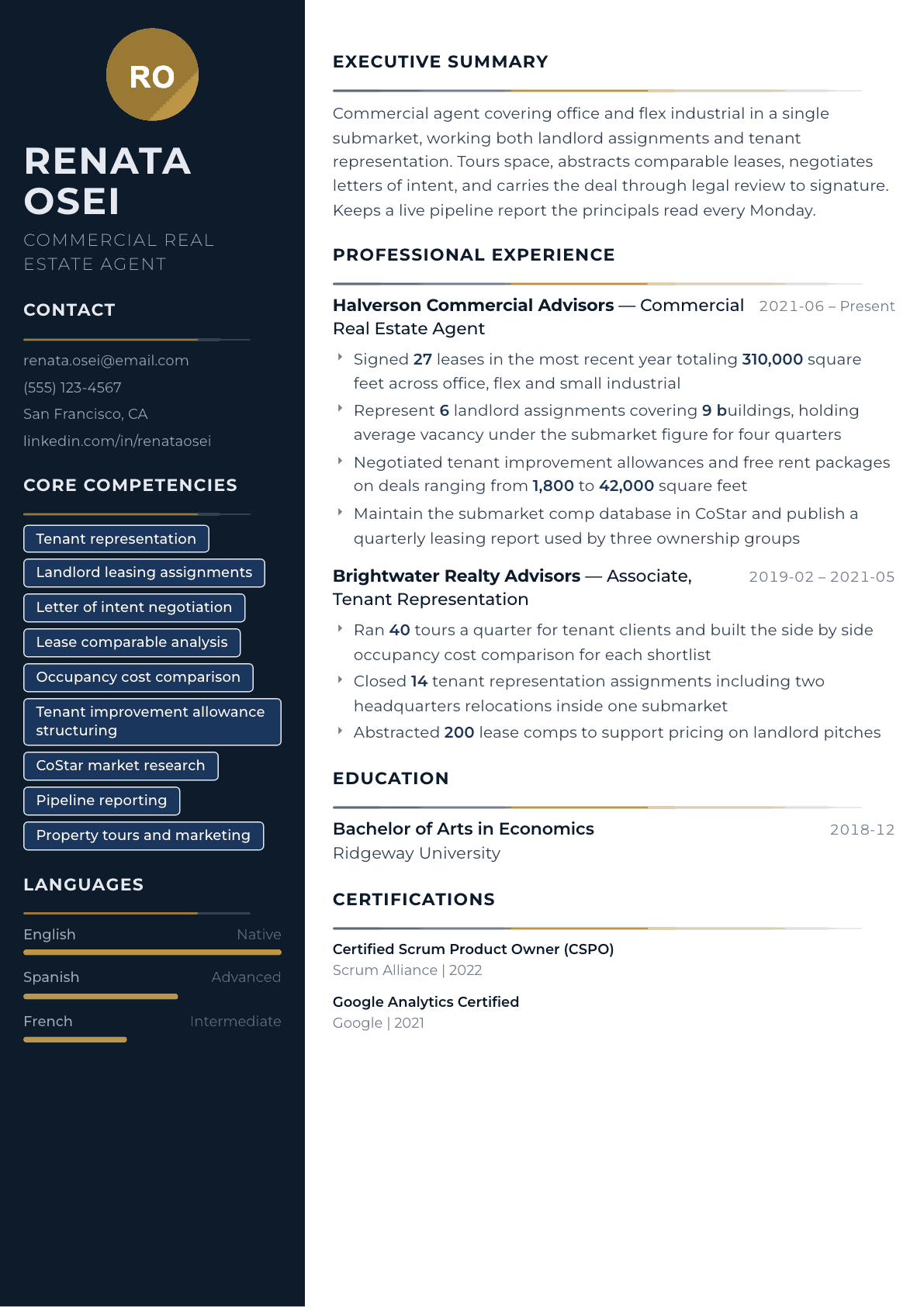
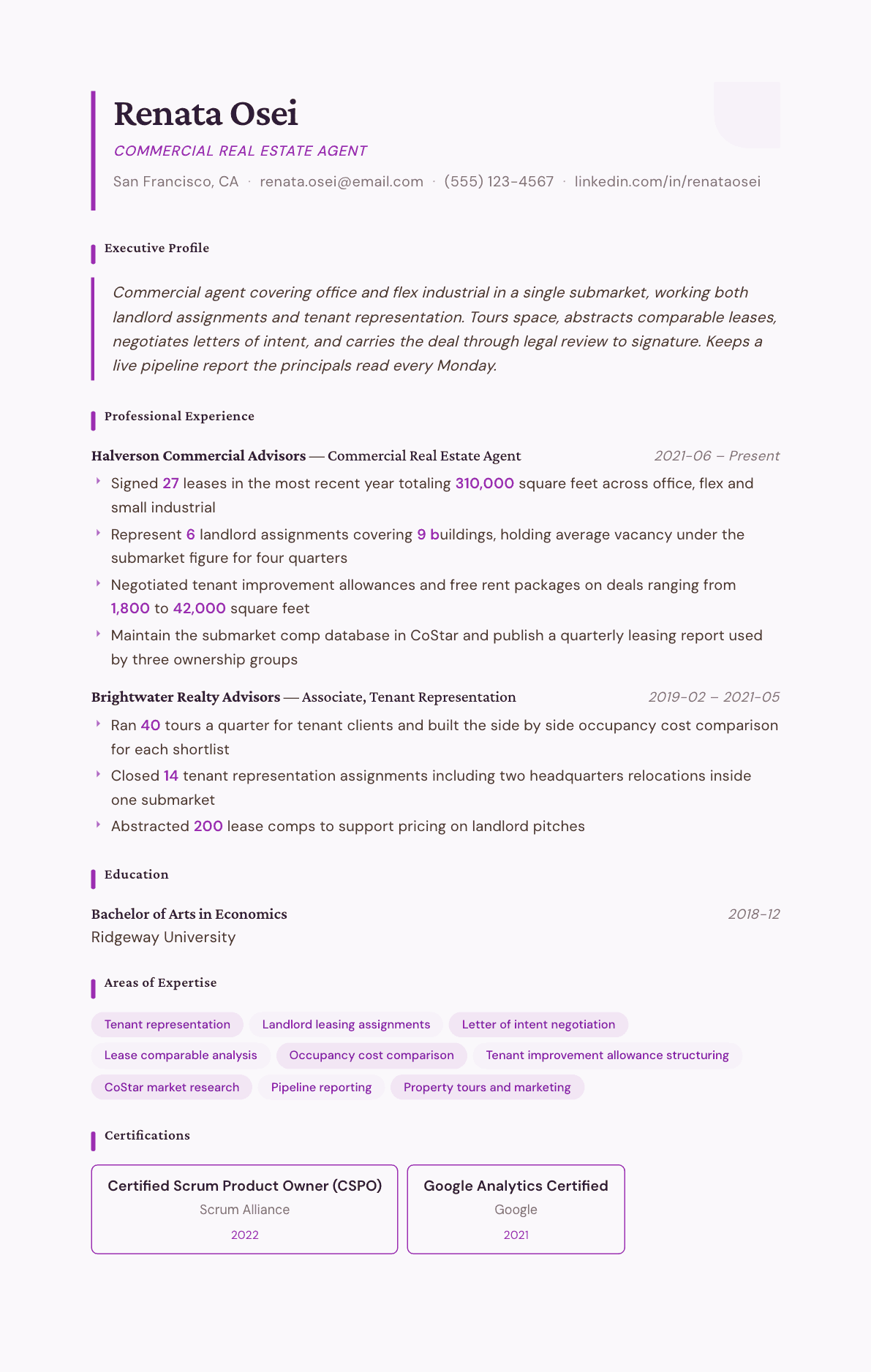
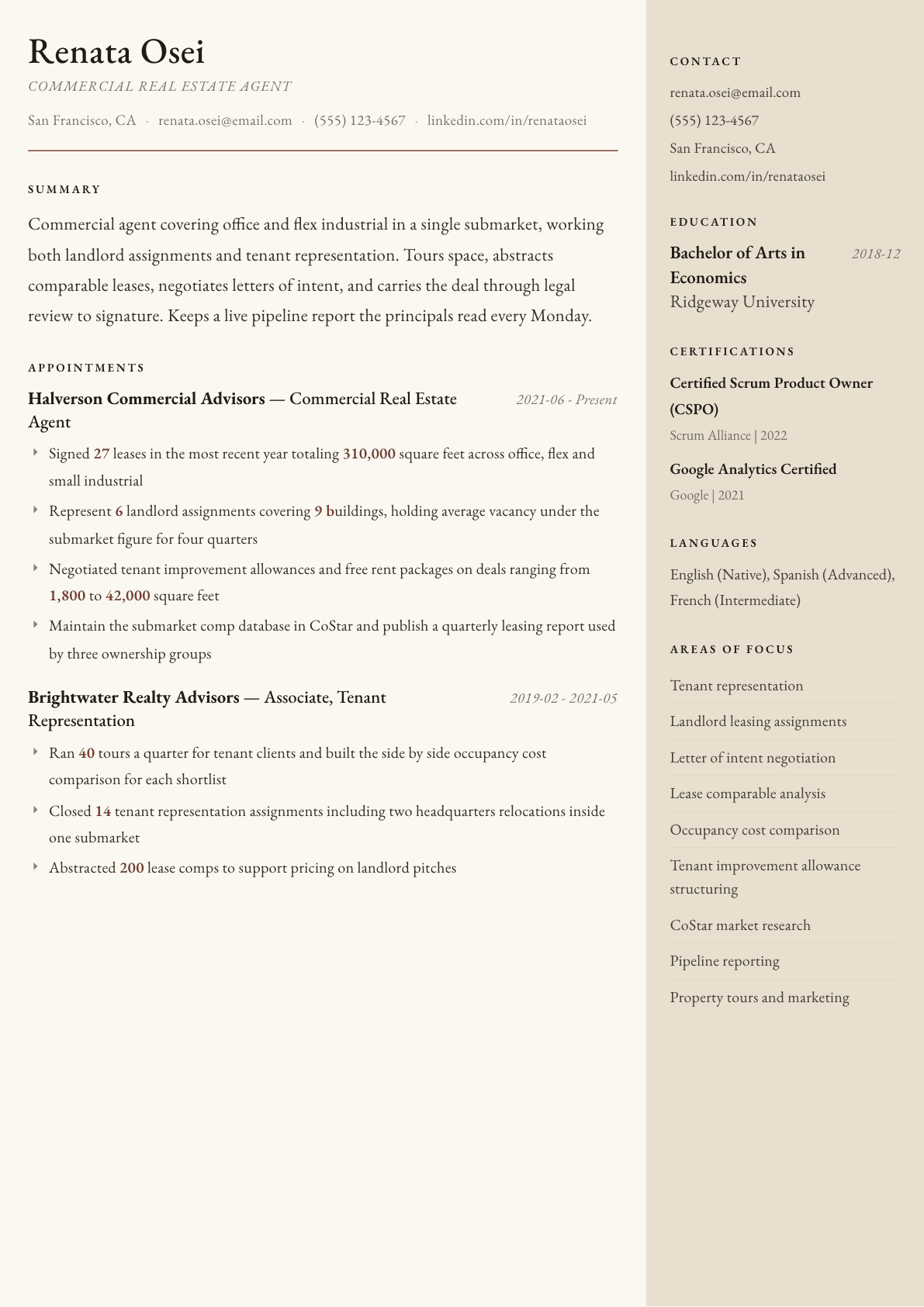
Example Commercial Real Estate Agent summary
Commercial real estate agent covering office and flex industrial in one submarket, with twenty-seven leases signed in the most recent year across more than three hundred thousand square feet. Works both sides of the desk, holding six landlord assignments across nine buildings while running tenant representation searches from tour to signature. Structures allowances and free rent packages, maintains the submarket comp database, and publishes a quarterly leasing report for ownership groups.
Skills to list on a Commercial Real Estate Agent resume
- Tenant representation
- Landlord agency leasing
- Letter of intent drafting
- Lease negotiation and abstracting
- Comparable lease analysis
- Occupancy cost modeling
- Tenant improvement allowance structuring
- Free rent and escalation structuring
- Submarket research
- CoStar and market data platforms
- Property tours and space planning input
- Broker opinion of value
- Pipeline and activity reporting
- Client presentations and pitches
What actually gets this resume read
- Give leases signed and total square footage for each year, because commercial hiring runs on both numbers.
- Separate landlord assignments from tenant representation work, since firms staff those two desks differently.
- Name the product types and the submarket you cover, because commercial credibility is geographic before it is general.
- Show a negotiated term you actually structured, such as free rent, an allowance or an expansion option.
- State the research platform you work in and whether you maintain the comp set yourself.
- Include the pipeline report you produce and who reads it, since ownership groups buy that discipline.
How to write a commercial real estate agent resume
A commercial real estate agent is hired for a desk, not for a general talent. The managing director filling it already knows which product type and which submarket the seat covers, and she is reading your page to find out whether your deal flow, your comp knowledge and your client relationships belong to that same square on the map. Broad claims about commercial expertise work against you here.
The second thing she is reading for is which side of the table you have worked. Landlord agency leasing and tenant representation demand different instincts, different reporting and different clients, and many agents have done both unevenly. Splitting them out on the page is more honest and more persuasive than a single blended deal count.
This guide covers presenting leases signed and square footage credibly, writing negotiated terms rather than outcomes, showing comp and research discipline, and turning a pipeline report into evidence. Three summaries, before and after bullets, and the questions agents ask when they move between product types or from residential practice.
Format: coverage line, deal table, then assignments and clients
One page for most agents, two once you have a decade of assignments. Open with a coverage line: product types, submarket or corridor, and whether you work landlord side, tenant side or both. That sentence lets a managing director decide in seconds whether to keep reading, which is a service to you as much as to her.
Follow it with a small deal table by year: leases signed, total square footage, and sales if you do investment work. Keep dollar volume optional and secondary, because square footage and deal count survive comparison between markets while volume mostly reports rent levels in your city.
- Coverage line for a commercial agent: product types, submarket, and landlord agency against tenant representation.
- Deal table by year: leases signed, square footage, sales transactions and average deal size in square feet.
- Assignment list: landlord clients by building count and square footage under assignment, without naming confidential owners.
- Research block naming the data platforms, the comp set you maintain and any market report you publish.
Summary: product, submarket, both sides of the desk, one deal fact
Three lines carrying product type, geography, sides worked and one number. An agent covering office and flex industrial in a defined submarket, with a specific lease count and square footage last year, has described a real desk. An agent presenting themselves as a results driven commercial professional has described nothing a director can staff against.
If you are moving from residential to commercial, name the crossover and be realistic about it. Prospecting discipline, tour management and contract familiarity transfer. Lease economics, recovery structures and occupancy cost analysis do not, so show whatever training or transaction exposure you have in those areas instead of implying the gap does not exist.
Deals: leases signed, square footage, and the terms you structured
Give lease count and square footage together for each year, then the deal size range so a reader can tell whether your book is many small suites or a few large blocks. Both profiles are valuable, but they are different jobs, and a director staffing large block office leasing will not want an agent whose average deal is a small suite unless you address it directly.
Then write the terms. Tenant improvement allowances structured, free rent periods negotiated, escalation language, renewal and expansion options, early termination rights, and how you traded one against another to close. Commercial leasing is a negotiation over a term sheet, and an agent who can name the levers they pulled sounds like someone who has sat in the room while a lease was papered.
For tenant representation work, show the search process: requirement definition, the tour set, the side by side occupancy cost comparison, and the letter of intent process across multiple landlords. The comparison model is the deliverable clients remember, so say that you build it.
Landlord assignments, vacancy and the reporting owners buy
Landlord work is judged on vacancy and velocity. Give the buildings under assignment, the square footage, and how vacancy moved against the submarket while you held them. If you inherited a difficult asset, say what the vacancy was when you took it, because the starting point is the whole story on a troubled building.
Then describe the reporting. Ownership groups pay for visibility as much as for deals: a leasing activity report, a pipeline by prospect and stage, tour counts, and a quarterly market summary with the comps behind your pricing recommendation. An agent who produces that consistently is easier to keep than one who only appears when a lease is ready.
Research, comps and the vocabulary of the postings
Comp knowledge is the currency of a commercial desk. Say which platforms you work in, whether you maintain the submarket comp set yourself, and how many lease comps you have abstracted. An agent who can quote effective rent net of concessions across a corridor wins listings from agents who quote asking rents.
The vocabulary in postings is narrow and worth matching exactly: tenant representation, landlord agency, letter of intent, broker opinion of value, effective rent, occupancy cost, tenant improvement allowance, expansion option, absorption, and the product terms your market uses for flex, shallow bay and creative office. Place each where the work is shown rather than in an isolated keyword list.
Commercial Real Estate Agent resume summary examples
Associate, first two years
Commercial associate on a tenant representation team, running 40 tours a quarter and building the side by side occupancy cost comparison for every shortlist. Closed 14 assignments including two headquarters relocations, and abstracted 200 lease comps supporting the team's landlord pitches in 2023.
Producing agent
Commercial agent covering office and flex industrial in one submarket, with 27 leases signed last year across 310K square feet. Holds 6 landlord assignments over 9 buildings while running tenant searches from tour to signature, and structures allowance and free rent packages on deals from 1,800 to 42K square feet.
Senior agent with a team
Senior agent leading two associates and an analyst across industrial and flex product in three submarkets. Holds 14 landlord assignments, publishes the quarterly leasing report three ownership groups price from, and has kept assignment vacancy below the submarket average for eight consecutive quarters.
Work experience bullets: before and after
Before: Completed numerous commercial lease transactions.
After: Signed 27 leases in 2024 totaling 310K square feet across office, flex and small industrial product, with deal sizes ranging from 1,800 to 42K square feet.
Count, square footage and the deal size range let a director see the exact shape of your book.
Before: Represented landlords in leasing their buildings.
After: Held 6 landlord assignments covering 9 buildings, taking one inherited asset from 31% vacancy to 8% in five quarters through a repositioned suite mix and a revised concession package.
A starting vacancy, an ending vacancy and the strategy behind the move make the assignment result readable.
Before: Negotiated favorable lease terms for clients.
After: Negotiated tenant improvement allowances and free rent packages against annual escalation and term length, and secured expansion options on four deals where the tenant expected growth within the first term.
Naming the levers traded shows how a commercial negotiation actually works instead of asserting a good result.
Before: Toured spaces with prospective tenants.
After: Ran 40 tours a quarter for tenant clients and produced a side by side occupancy cost comparison for every shortlist, covering base rent, escalations, recoveries and amortized improvement cost.
Tour volume plus the analytical deliverable separates a tour guide from a tenant representative.
Before: Stayed current on market conditions.
After: Maintained the submarket lease comp database in CoStar and published a quarterly leasing report that three ownership groups use when setting asking rents and concession packages.
Owning the comp set and having owners price from your report proves market credibility rather than claiming it.
Hard skills
- Tenant representation and requirement definition
- Landlord agency leasing
- Letter of intent drafting and negotiation
- Lease abstraction and comparable analysis
- Occupancy cost modeling
- Tenant improvement allowance structuring
- Concession and escalation negotiation
- Broker opinion of value
- Submarket research and comp set maintenance
- Property tours and space fit assessment
- Pipeline and leasing activity reporting
- Investment sales support and offering materials
Soft skills
- Prospecting a corridor building by building without a warm introduction
- Telling an owner their asking rent is not supported by the comps
- Managing a tenant's internal committee through a long decision
- Holding a deal together through legal review on both sides
- Keeping a landlord relationship intact after a lease falls apart
Certifications worth listing
- Certified Commercial Investment Member (CCIM) (CCIM Institute)
- SIOR Designation (Society of Industrial and Office Realtors)
- Real Property Administrator (RPA) (BOMI International)
Mistakes that cost commercial real estate agent candidates the interview
- Presenting a single blended deal count when landlord agency and tenant representation are staffed as separate desks.
- Giving dollar volume without square footage, which tells a reader about your market's rents rather than your production.
- Claiming broad commercial coverage instead of naming the product types and submarket you genuinely know.
- Describing negotiations by outcome rather than by the allowance, free rent and escalation terms you actually traded.
- Skipping the comp work, when quoting effective rent net of concessions is what wins listings from other agents.
- Omitting the reporting you produce for ownership, which is a large part of why owners renew an assignment.
Commercial Real Estate Agent resume questions
How do I move from residential to commercial real estate?
Lead with prospecting discipline, tour management and contract familiarity, then address the gap directly by showing training or exposure in lease economics, recovery structures and occupancy cost. Directors expect the gap and respect a candidate who names it.
Can I name my landlord clients on the page?
Describe assignments by building count, square footage, product type and submarket rather than by owner name, unless the relationship is public. Confidentiality is watched closely in this business, and a discreet description costs you nothing with a knowledgeable reader.
What if my deals are small compared to the role I want?
Show volume and velocity instead of size, then point at the transferable complexity: multi party negotiations, difficult landlords, build out coordination. Many large deals are simpler than a set of small ones done well, and a director understands that.
How much market data should I put on my resume?
Enough to prove you own a comp set rather than borrow one. Name the platform, the number of comps you maintain or abstract, and any market report you publish. Detailed market commentary belongs in the interview and the pitch, not on the page.
Should I include investment sales work on a leasing resume?
Include it in a separate line if it is real, since valuation instinct helps a leasing agent argue rent. Keep it clearly secondary when you are applying for a leasing desk, because a director will worry that your attention drifts toward sales commissions.
Related resume examples
- Real Estate Agent Resume example
- Leasing Consultant Resume example
- Real Estate Broker Resume example
- Commercial Property Manager Resume example
- Home Inspector Resume example
- Acquisitions Analyst Resume example