Total Rewards Manager Resume Examples: read this first
Write a Total Rewards Manager Resume That Reads as Strategy, Not Administration
By Mustafa Tarabya, founder of CVBooster · Published · Updated
Build a total rewards manager resume with a worked example, the pay and equity detail executives ask about, ATS keywords and a section-by-section guide.
Sample resumes for a total rewards manager
The same total rewards manager content laid out in three CVBooster templates, so you can see what the finished document looks like before you write a word.
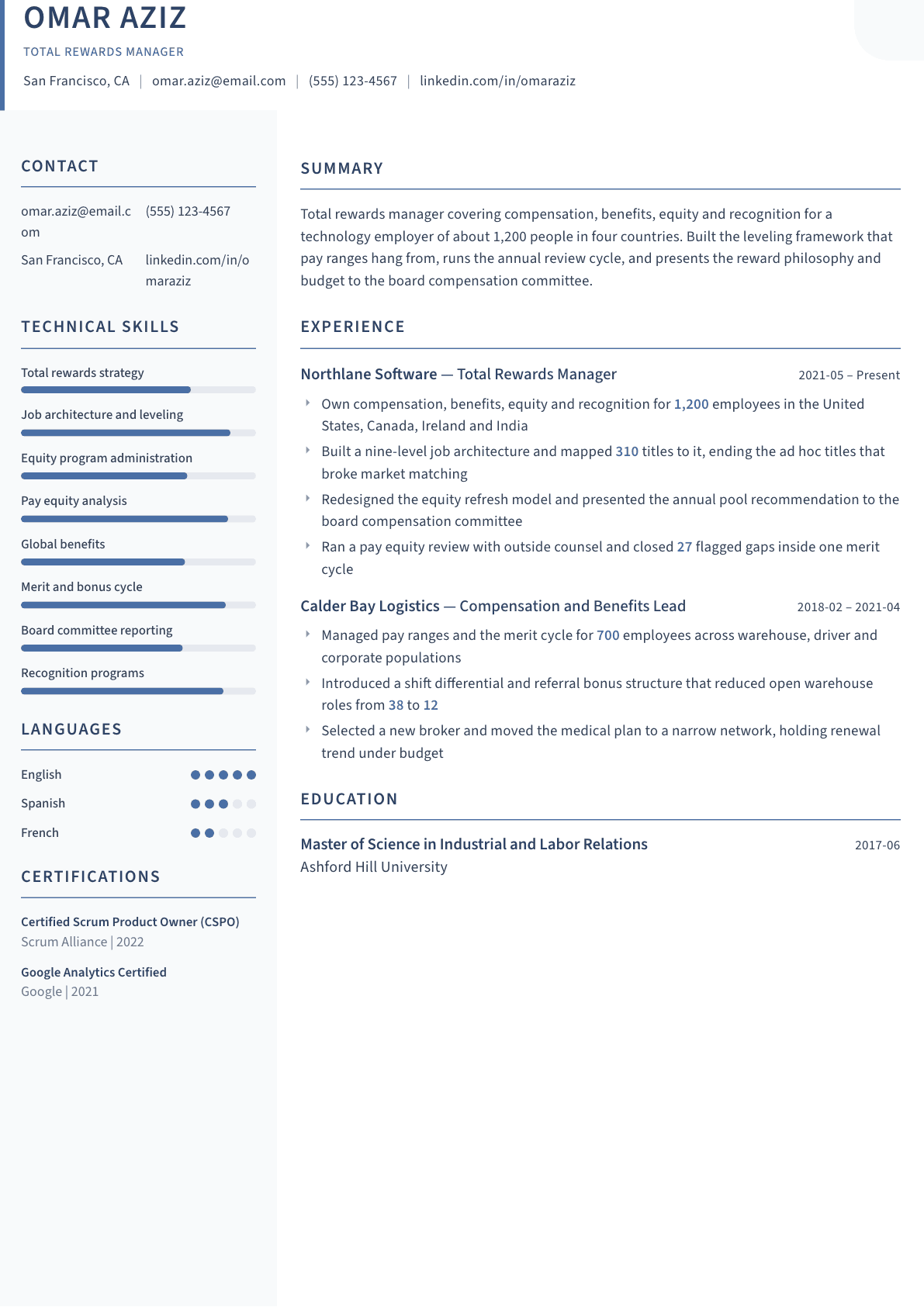
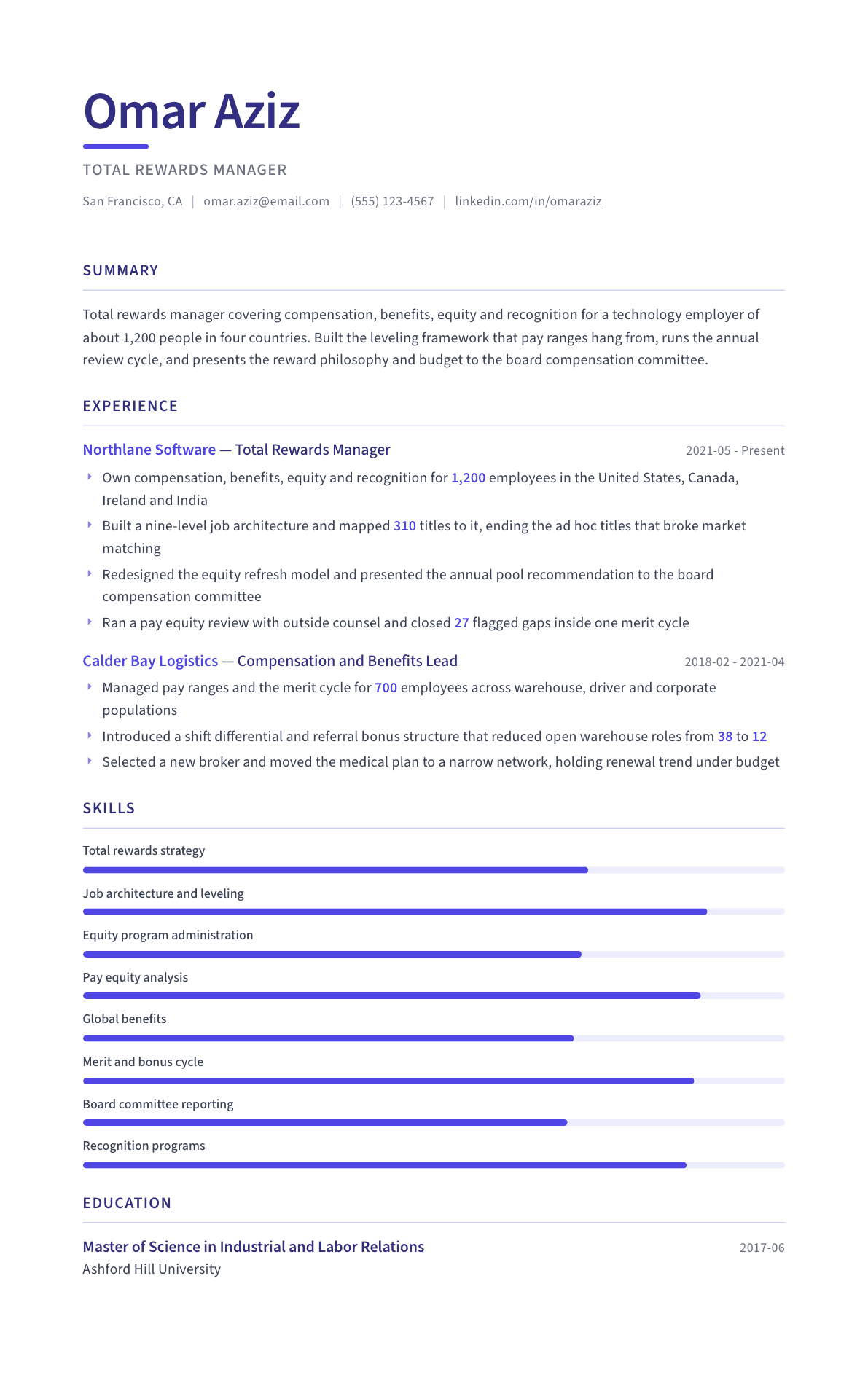
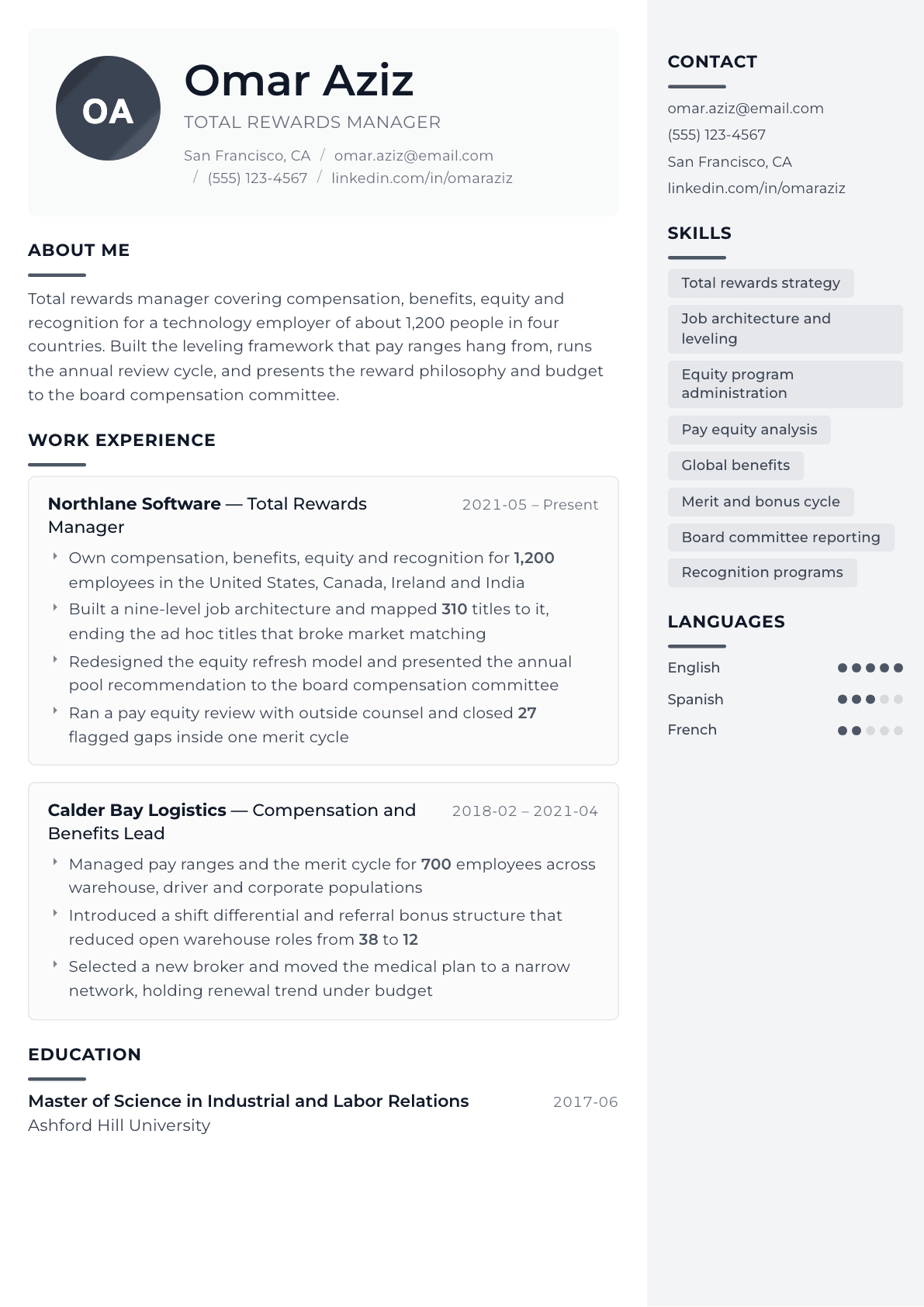
Example Total Rewards Manager summary
Total rewards manager covering pay, benefits, equity and recognition for a technology employer with people in four countries. Built a nine-level job architecture, mapped three hundred titles onto it, and rebuilt the equity refresh model presented to the board compensation committee. Led a pay equity review with outside counsel and closed every flagged gap within one merit cycle.
Skills to list on a Total Rewards Manager resume
- Total rewards strategy
- Job architecture and leveling
- Salary range design
- Market benchmarking
- Merit and bonus planning
- Equity compensation
- Pay equity analysis
- Pay transparency compliance
- Global benefits governance
- Workday Advanced Compensation
- Recognition program design
- Executive compensation support
- Compensation committee reporting
- Financial modeling
What actually gets this resume read
- Frame the scope in one line: headcount, countries, and which of pay, benefits, equity and recognition you actually owned.
- Show the leveling or job architecture work, because that is what separates a rewards manager from a senior analyst.
- Name the equity vehicles you administered, such as restricted stock units or options, and the platform they lived in.
- Give the audience for your recommendations: an executive team, a board compensation committee or a works council.
- Include pay equity and pay transparency work, naming the jurisdictions whose posting rules you had to meet.
- Keep administration bullets short and put design, modeling and governance bullets first in every job.
How to write a total rewards manager resume
Total rewards is the title an employer uses when they want one person to hold pay, benefits, equity and recognition together and explain the whole package to an executive team. The resume has to read that way. A reader who finishes your page should be able to state your reward philosophy, the population it covered, and the decision you got approved last year.
The most common failure is a resume that is really a compensation resume with benefits tacked on. If equity, recognition and the governance work are missing, a hiring manager reads it as one discipline and slots you a level lower than you applied.
Below is the structure this role wants, three summaries at different stages, before-and-after bullets covering pay, equity and governance, the credentials that matter in rewards, and the questions candidates ask when they write it.
Format: two pages, scope line first, design work ahead of administration
Use two pages and spend the first half of page one on your current role. Under each employer write a scope line covering headcount, countries, the components you owned and the governance body you presented to. Then order the bullets by altitude: framework and design first, cycle execution second, administration last.
Keep the layout conservative. The audience includes a chief people officer and often a finance partner, and the resume is a small sample of how you present numbers to that room.
- Header: name, credentials such as CCP, GRP or SHRM-SCP, city and state, phone, email.
- Order: summary, experience, education, certifications, systems.
- Name the survey sources, the compensation module and the equity platform in a single technical line.
Summary: philosophy, components, population, and one approved decision
Say what you owned across the four components, over how many people and how many countries, and then name one thing an executive body approved on your recommendation. That approval is the clearest available proof that you operate at rewards level rather than analyst level.
Avoid the phrase competitive and equitable rewards strategy unless you follow it with the mechanism. A reader wants to know whether your philosophy meant paying at market median with a wide bonus range, or paying below median with generous equity, and how you defended that choice.
Architecture: the work that separates rewards from compensation
Job architecture is the backbone of the discipline, so give it real space. Number of levels, career tracks separated between individual contributor and manager, how many titles you mapped, what you did with the ones that did not fit, and how the framework connected to ranges, promotion criteria and mobility.
Write the maintenance too. A framework built once and abandoned is a project; a framework with an intake process for new jobs, an annual review and a governance rule for exceptions is a system. Employers hire rewards managers for the second one.
Equity, benefits and recognition: prove you carry all three
For equity, name the vehicles you administered, the grant cadence, the refresh model you designed, the pool recommendation you built and the platform where grants were tracked. If you supported the board compensation committee, say what materials you prepared and how far ahead of the meeting they went out.
For benefits, cover governance rather than transactions: plan strategy across countries, harmonization after an acquisition, broker and consultant selection, and renewal outcomes. For recognition, give the program design and the behavior it changed, since a recognition platform launch on its own says nothing about whether anyone used it.
Compliance, transparency and the keywords a screen wants
Pay transparency rules differ by jurisdiction, so name the states or countries whose posting and reporting rules you had to satisfy and what you changed to meet them: published ranges on requisitions, manager talking points, or a reporting file for a regulator. Add pay equity method, cadence and remediation approach.
The keyword set for this role is specific: total rewards strategy, job architecture, leveling, market benchmarking, merit planning, short-term and long-term incentives, equity refresh, pay equity, pay transparency, global benefits governance, compensation committee. Work them into bullets rather than a block.
Total Rewards Manager resume summary examples
Moving up from analyst
Compensation analyst with four years of benchmarking and merit cycle support, now leading the leveling refresh for a 700-person business. Built the market pricing library, modeled three range scenarios for the executive team, and coordinated the benefits renewal with the broker. Working toward the CCP.
Owning all four components
Total rewards manager covering pay, benefits, equity and recognition for 1,200 employees in four countries. Built a nine-level job architecture, mapped 310 titles to it, and presented the annual equity pool recommendation to the board compensation committee. Closed 27 flagged pay gaps inside one merit cycle.
Global rewards lead
Total rewards leader for a 6,000-person group across nine countries, with two analysts reporting in. Harmonized rewards after two acquisitions, set the global leveling standard, and rebuilt the long-term incentive design approved by the compensation committee. Owns pay transparency readiness across the jurisdictions in scope.
Work experience bullets: before and after
Before: Developed the company total rewards strategy.
After: Set the rewards philosophy for 1,200 employees in four countries: market median base, above-market equity for engineering, and a bonus range approved by the executive team.
A philosophy only means something when the resume states the actual positioning choices behind it.
Before: Created a job leveling framework.
After: Built a nine-level architecture with separate individual contributor and manager tracks, mapped 310 titles onto it, and added an intake process so new jobs are leveled before the offer goes out.
The maintenance mechanism turns a one-time project into an operating system a reader can trust.
Before: Managed the equity program.
After: Redesigned the annual equity refresh model around performance and level, built the pool recommendation, and presented the dilution scenarios to the board compensation committee.
Naming the model, the deliverable and the audience proves ownership at governance level.
Before: Worked on pay equity.
After: Ran a pay equity review with outside counsel across 1,200 employees, reviewed 27 flagged cases with the business, and completed remediation within the following merit cycle.
Scope, method and closure make the claim defensible without exposing confidential findings.
Before: Handled benefits for international employees.
After: Consolidated benefits governance across four countries onto a single broker of record, aligned leave and pension provisions to local minimums, and set a common renewal calendar.
Global benefits work is credible when the resume names the structure, not just the geography.
Hard skills
- Total rewards strategy
- Job architecture and leveling
- Salary range design
- Market benchmarking
- Merit and incentive planning
- Equity program design
- Pay equity analysis
- Pay transparency compliance
- Global benefits governance
- Compensation committee reporting
- Workday Advanced Compensation
- Financial modeling in Excel
Soft skills
- Executive presence
- Influence without authority
- Judgment on exceptions
- Cross-border collaboration
- Clear data storytelling
- Discretion
Certifications worth listing
- Certified Compensation Professional (CCP) (WorldatWork)
- Global Remuneration Professional (GRP) (WorldatWork)
- Certified Benefits Professional (CBP) (WorldatWork)
- Certified Executive Compensation Professional (CECP) (WorldatWork)
- SHRM Senior Certified Professional (SHRM-SCP) (Society for Human Resource Management)
Mistakes that cost total rewards manager candidates the interview
- Submitting a compensation resume under a rewards title, with no equity, recognition or governance evidence anywhere.
- Describing a leveling project without saying how many titles were mapped or what happened to the outliers.
- Naming an executive audience without saying what you recommended and whether it was approved.
- Treating global scope as a country list, when the reader wants to know what you standardized and what stayed local.
- Filling the page with cycle administration, which reads as analyst work when the title promises design.
- Claiming a pay transparency approach with no jurisdiction named and no change to postings or manager guidance.
Total Rewards Manager resume questions
What makes a total rewards resume different from a compensation resume?
Breadth plus governance. A compensation resume can win on pricing and cycle execution alone. A rewards resume must show equity or benefits design, a framework you built, and a decision an executive body approved on your recommendation.
How do I show equity experience if my company is private?
Describe the vehicle and the mechanics: option grants with a valuation refresh, restricted stock units with a defined vesting schedule, or a phantom plan. Name the grant approval path, the platform where grants were tracked, and the education you gave employees who had never held equity.
Which credential helps most for total rewards roles?
The CCP is the common baseline in pay-heavy roles, the GRP suits multi-country scope, and the CBP covers the benefits side. Pick the one matching the job you want next, and list completed courses while you are still working toward the full designation.
How much benefits detail belongs on a rewards resume?
Enough to prove you can hold the renewal and the plan strategy, not the full administrative record. Two or three bullets covering funding approach, broker or consultant management, renewal outcome and any harmonization work will carry the section.
Should I include recognition and wellbeing programs?
Yes, briefly, and only with an outcome. Say what the program rewarded, how participation changed after your redesign, and what it cost relative to budget. A launch date on its own reads as activity rather than a rewards decision.
Related resume examples
- Compensation Analyst Resume example
- Chief People Officer Resume example
- Compensation and Benefits Manager Resume example
- HR Director Resume example
- Benefits Specialist Resume example
- HR Analyst Resume example