HR Analyst Resume Examples: free ATS score and gap list
Build an HR Analyst Resume Around Data People Actually Use
By Mustafa Tarabya, founder of CVBooster · Published · Updated
An HR analyst resume example with reporting and analytics bullets, the people data keywords hiring teams screen for, and a full writing guide.
Sample resumes for a hr analyst
The same hr analyst content laid out in three CVBooster templates, so you can see what the finished document looks like before you write a word.
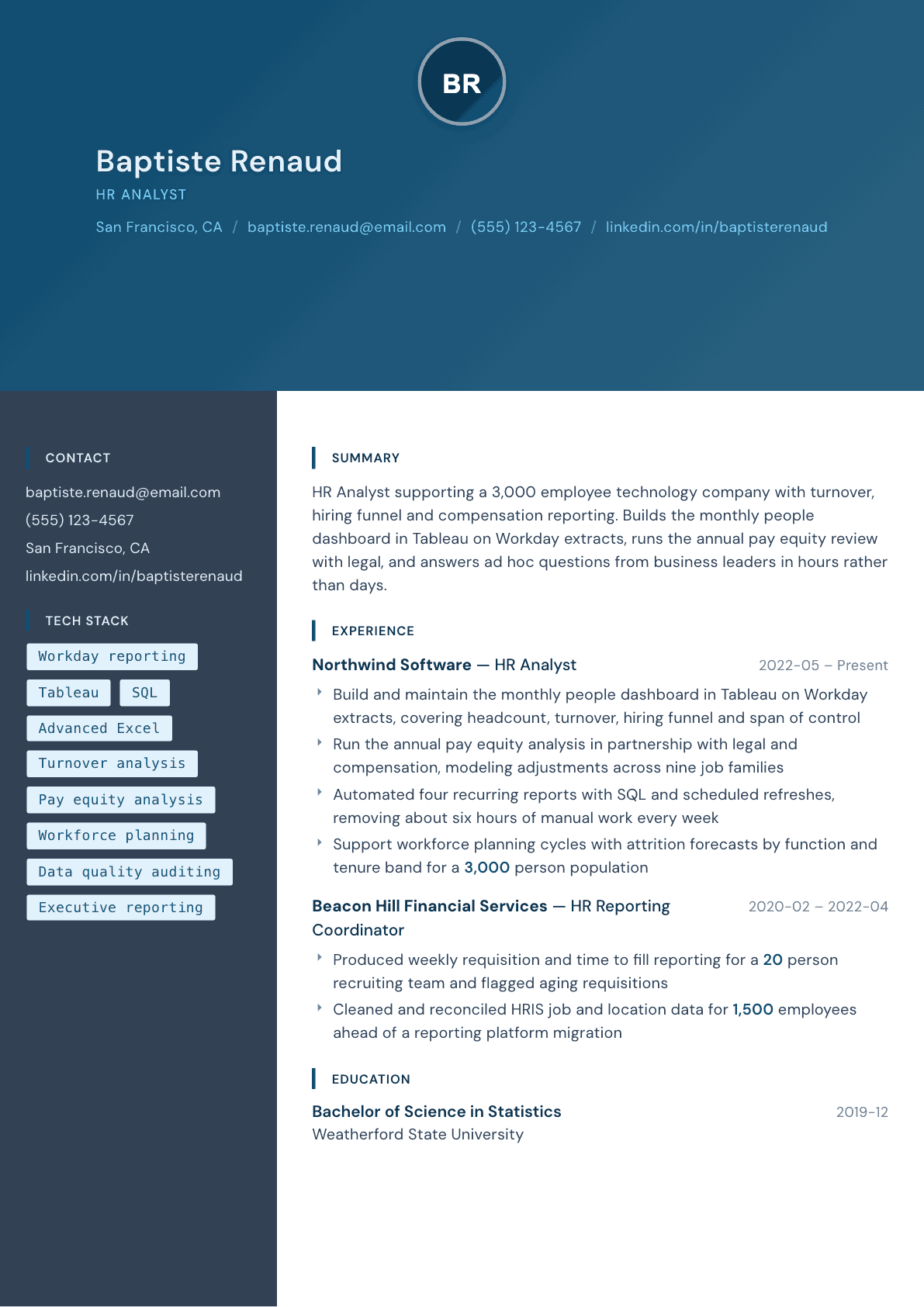
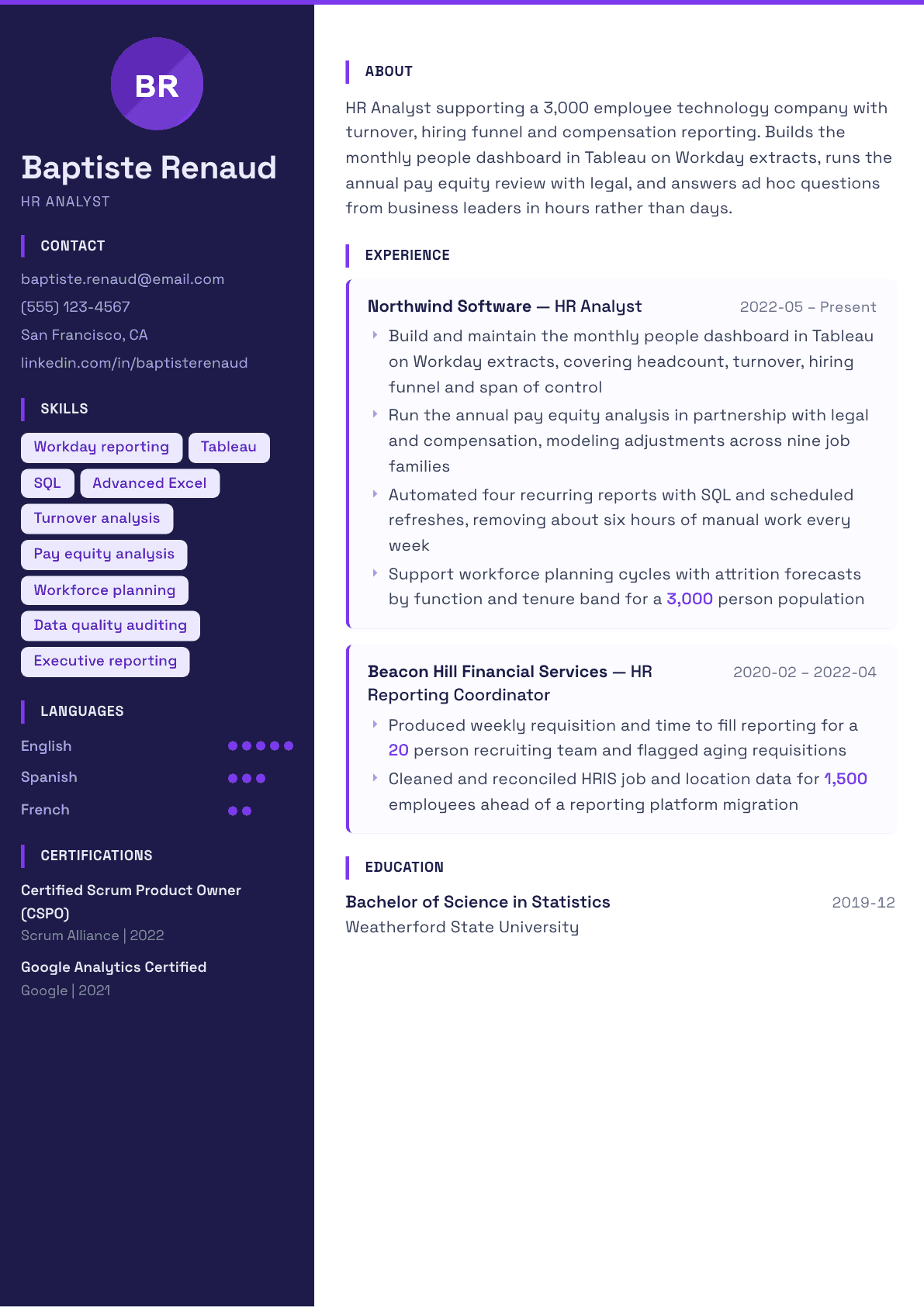
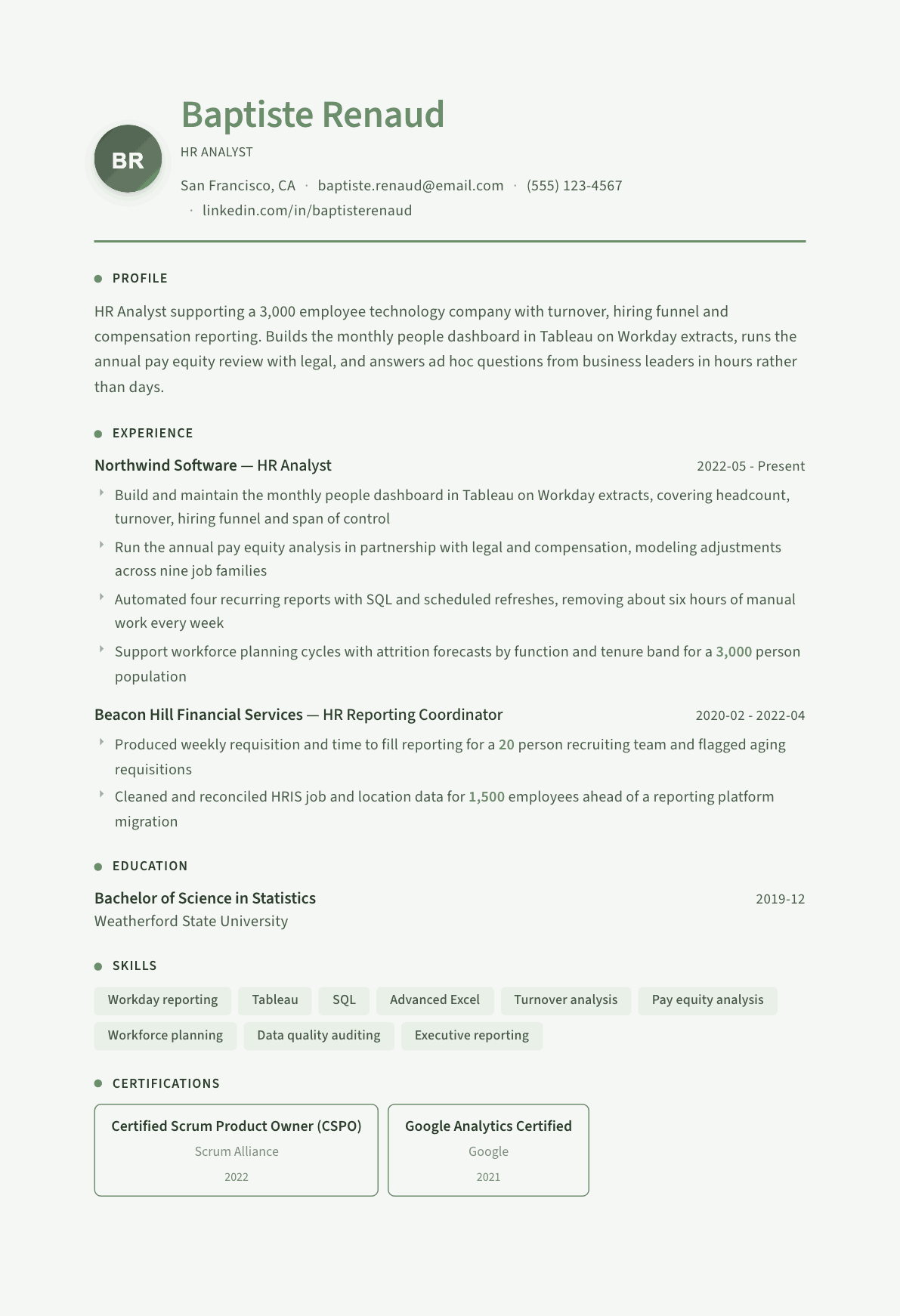
Example HR Analyst summary
HR Analyst with five years turning Workday data into reporting that leaders act on for a 3,000 employee technology company. Owns the monthly people dashboard in Tableau, runs the annual pay equity review with legal and compensation, and automated four recurring reports with SQL. Supports workforce planning with attrition forecasts by function and tenure. Seeking a people analytics role with modeling and governance ownership.
Skills to list on a HR Analyst resume
- People analytics
- Workday report writer
- Tableau
- Power BI
- SQL
- Advanced Excel and Power Query
- Turnover and retention analysis
- Hiring funnel metrics
- Compensation analysis
- Pay equity review support
- Workforce planning and forecasting
- Data quality auditing
- Survey analysis
- Dashboard design
- Executive reporting
- HR data governance
What actually gets this resume read
- Lead with the population you report on and the systems your data comes from, because credibility starts with the source.
- Name your tools precisely: Workday report writer, Tableau, Power BI, SQL, Excel with Power Query. Vague data skills get skipped.
- Describe an analysis by the decision it changed, not by the chart you made, since analysts are hired for influence.
- Show automation in saved hours or removed manual steps, which is the clearest proof of analyst value to a lean team.
- Include data governance work such as definition alignment, since disagreement about what turnover means kills more dashboards than bad code.
- Keep statistical claims modest and accurate, and be ready to explain any model you list on the resume in an interview.
How to write a hr analyst resume
An HR analyst resume has an unusual double burden. It has to convince an HR leader that you understand how people data behaves, including how messy a job history table gets after two reorganizations, and it has to convince a technically minded reviewer that you can actually build the thing. Candidates usually satisfy one audience and lose the other.
The tell is in how the achievements are written. Weak analyst resumes describe artifacts: built a dashboard, created reports, maintained metrics. Strong ones describe decisions: the workforce plan that changed, the requisitions that got reprioritized, the pay adjustments that were funded, the definition dispute that stopped two departments reporting different turnover from the same source.
This guide covers how to present your data sources and tools honestly, how to write analysis bullets around the decision rather than the chart, what governance work to include, and three summaries covering a reporting coordinator, a working analyst and someone moving into people analytics ownership.
Format: sources and tools in the top third
One page until you have around six years, then two. Place a compact technical block high on the page listing your data sources and your tools separately: the HRIS you extract from, the reporting layer you build in, the query and spreadsheet skills you use. Analyst screening is largely a tools match, so make that match findable in a few seconds.
Then keep the rest of the page in prose bullets rather than a second skills grid. Two competing lists of technologies makes a reader assume neither is deep, and the space is better spent on the analyses you have delivered.
- Sources: Workday, UKG, SuccessFactors, an applicant tracking system, a survey platform, payroll extracts.
- Tools: SQL, Tableau, Power BI, Excel with Power Query, Python if you genuinely use it at work.
- Sections: summary, technical block, professional experience, education, certifications.
Summary: population, sources, and what leaders do with your output
Name the workforce population you report on, the systems the data comes from, and the recurring products you own. Credibility for an analyst starts with the source, because anyone who has worked with people data knows that the effort is in reconciling it rather than in charting it.
Close the summary with impact framed as use rather than delivery. Reporting that leaders act on, forecasts that feed the workforce plan, an analysis that supported a funded pay adjustment. That framing tells the reader you are hired for influence, which is what separates an analyst from a report generator.
Experience: write the decision, not the deliverable
For each significant analysis, write the question, the method in a clause, and the decision that followed. A turnover analysis that identified a first year attrition spike in one job family and led to a revised onboarding schedule is a complete story. A bullet reading analyzed turnover data is not a story at all.
Include the volume and cadence of your recurring work, because reliability is part of the job. The monthly people pack and its delivery date, the weekly requisition report and its audience, the quarterly workforce planning inputs. Then show what you automated and roughly how much manual work that removed each week.
Compensation and pay equity work deserves careful handling. Say that you supported the analysis alongside compensation and legal partners, describe the modeling at a high level such as adjustments across job families, and leave out any figure or finding that would be inappropriate to share outside the company.
Data quality and governance: the unglamorous differentiator
Every experienced analyst has spent months on definitions. What counts as a termination, whether contingent workers are in headcount, how transfers affect turnover, when a requisition is considered open. Say that you led or contributed to that alignment work, because it is the thing a hiring manager most needs and most rarely sees on a resume.
Data quality auditing belongs here too: reconciling job and location hierarchies, catching effective dating errors, validating a population before a reporting migration. Describe an audit you ran and what it caught. It shows the discipline that keeps your dashboards from quietly becoming wrong.
Communication: the half that gets analysts promoted
Analysts who advance are the ones who can explain a result to an operations leader in two sentences. Show it by naming your audience and the format: a monthly pack presented to department heads, a workforce planning session you facilitated, a one page summary that accompanied a board level metric.
Keep the statistical claims proportionate to what you actually did. Describing a regression you did not run, or calling a simple comparison a predictive model, will not survive a technical interview, and honest description of solid work is more persuasive than inflated method language.
HR Analyst resume summary examples
From reporting coordinator
HR reporting coordinator moving into an analyst role after two years producing weekly requisition and time to fill reporting for a twenty person recruiting team. Cleaned and reconciled HRIS job and location data ahead of a platform migration. Strong Excel skills and working knowledge of SQL.
Four years in people analytics
HR Analyst supporting a three thousand employee technology company with headcount, turnover, hiring funnel and compensation reporting. Owns the monthly people dashboard built in Tableau on Workday extracts, automated four recurring reports with SQL, and supports the annual pay equity review with compensation and legal.
Senior people analytics
Senior people analytics professional with eight years across financial services and technology. Builds attrition forecasts by function and tenure that feed the annual workforce plan, owns metric definitions across the HR function, and partners with finance on headcount reconciliation each quarter.
Work experience bullets: before and after
Before: Created HR dashboards and reports for management.
After: Built and maintain the monthly people dashboard in Tableau on Workday extracts, covering headcount, turnover, hiring funnel and span of control for eight business units.
The tool, the source, the metrics and the audience make the dashboard a defined product rather than a task.
Before: Analyzed turnover data for the organization.
After: Identified a first year attrition concentration in one job family through tenure band analysis, which led to a revised onboarding schedule and a change to the interview panel.
The finding and the two decisions that followed show analysis that changed something.
Before: Automated some reporting processes.
After: Automated four recurring reports with SQL and scheduled refreshes, removing about six hours of manual preparation every week from the HR operations team.
A count, a method and recovered hours give automation a value the reader can compare.
Before: Assisted with compensation analysis.
After: Supported the annual pay equity review with compensation and legal partners, modeling adjustment scenarios across nine job families and preparing the summary for the leadership review.
Naming the partners, the scope and the deliverable shows real involvement without disclosing sensitive detail.
Before: Worked to improve HR data quality.
After: Led the alignment of turnover and headcount definitions across HR and finance, ending a recurring dispute where two teams reported different numbers from the same source.
Governance framed as a resolved conflict demonstrates influence, which pure data cleanup language hides.
Hard skills
- People analytics
- Workday report writer
- Tableau
- Power BI
- SQL
- Advanced Excel and Power Query
- Turnover and retention analysis
- Hiring funnel metrics
- Compensation analysis support
- Workforce planning and forecasting
- Data quality auditing
- Metric definition governance
Soft skills
- Explaining a result plainly
- Curiosity about the underlying process
- Skepticism about a clean number
- Confidentiality with pay data
- Working across HR and finance
- Prioritizing ad hoc requests
Certifications worth listing
- Tableau Desktop Specialist (Tableau)
- Microsoft Certified: Power BI Data Analyst Associate (Microsoft)
- SHRM Certified Professional (SHRM-CP) (Society for Human Resource Management)
- Certified Compensation Professional (CCP) (WorldatWork)
Mistakes that cost hr analyst candidates the interview
- Listing tools with no analysis attached, which reads as a technology inventory rather than an analyst record.
- Describing dashboards as achievements when the achievement is the decision the dashboard produced.
- Skipping the data sources, so a reader cannot tell whether you extracted the data or received it in a file.
- Ignoring definition and governance work, the part of the job that most distinguishes experienced analysts.
- Overstating statistical method, a claim that collapses in the first technical conversation about your model.
- Including a specific pay equity finding or compensation figure that should never leave the employer.
HR Analyst resume questions
Do I need SQL to be an HR analyst?
Not for every role, but it widens the field considerably. Many teams run on the HRIS report writer and advanced spreadsheets, while roles that touch multiple sources or build a reporting layer usually expect query skills and some experience with a visualization tool.
How do I move from HR coordinator to HR analyst?
Take the reporting work nobody wants, learn the report writer in your HRIS properly, rebuild a manual recurring report as an automated one, and start describing your output by the decision it supported rather than by the file you delivered.
What metrics should appear on an HR analyst resume?
The ones your leaders actually reviewed: headcount, voluntary and involuntary turnover, time to fill, offer acceptance, internal fill rate, span of control and absence. Name the ones you owned rather than listing every metric that exists in the field.
Is people analytics a different job from HR analyst?
The titles overlap heavily. People analytics roles usually lean further toward modeling, survey science and research design, while HR analyst roles carry more recurring reporting and operational support. Read the posting for method language before deciding which to mirror.
How much compensation detail can I include?
Describe the process and your role, such as supporting a pay equity review or building benchmarking files, without any actual figures, findings or job level pay ranges. Employers screen for discretion here, and an overly specific bullet works against you.
Related resume examples
- HRIS Analyst Resume example
- Compensation Analyst Resume example
- HR Data Analyst Resume example
- Workforce Planning Analyst Resume example
- Total Rewards Manager Resume example
- HR Administrator Resume example