Concrete Finisher Resume Examples: the lines they read
Build a Concrete Finisher Resume Superintendents Trust
By Mustafa Tarabya, founder of CVBooster · Published · Updated
A concrete finisher resume sample with placement, flatwork and finish keywords, and a guide to writing bullets that show slab quality and pace.
Sample resumes for a concrete finisher
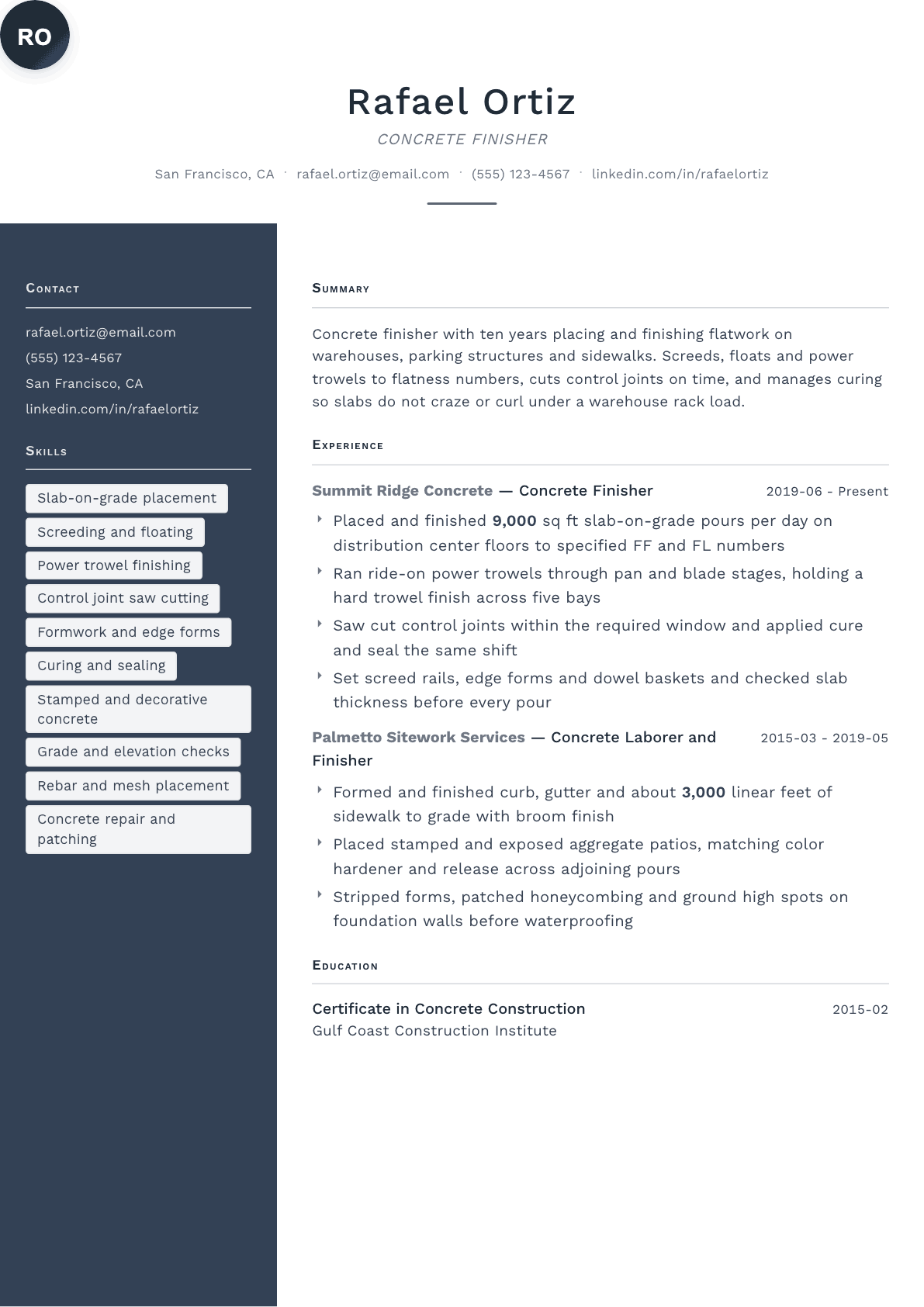
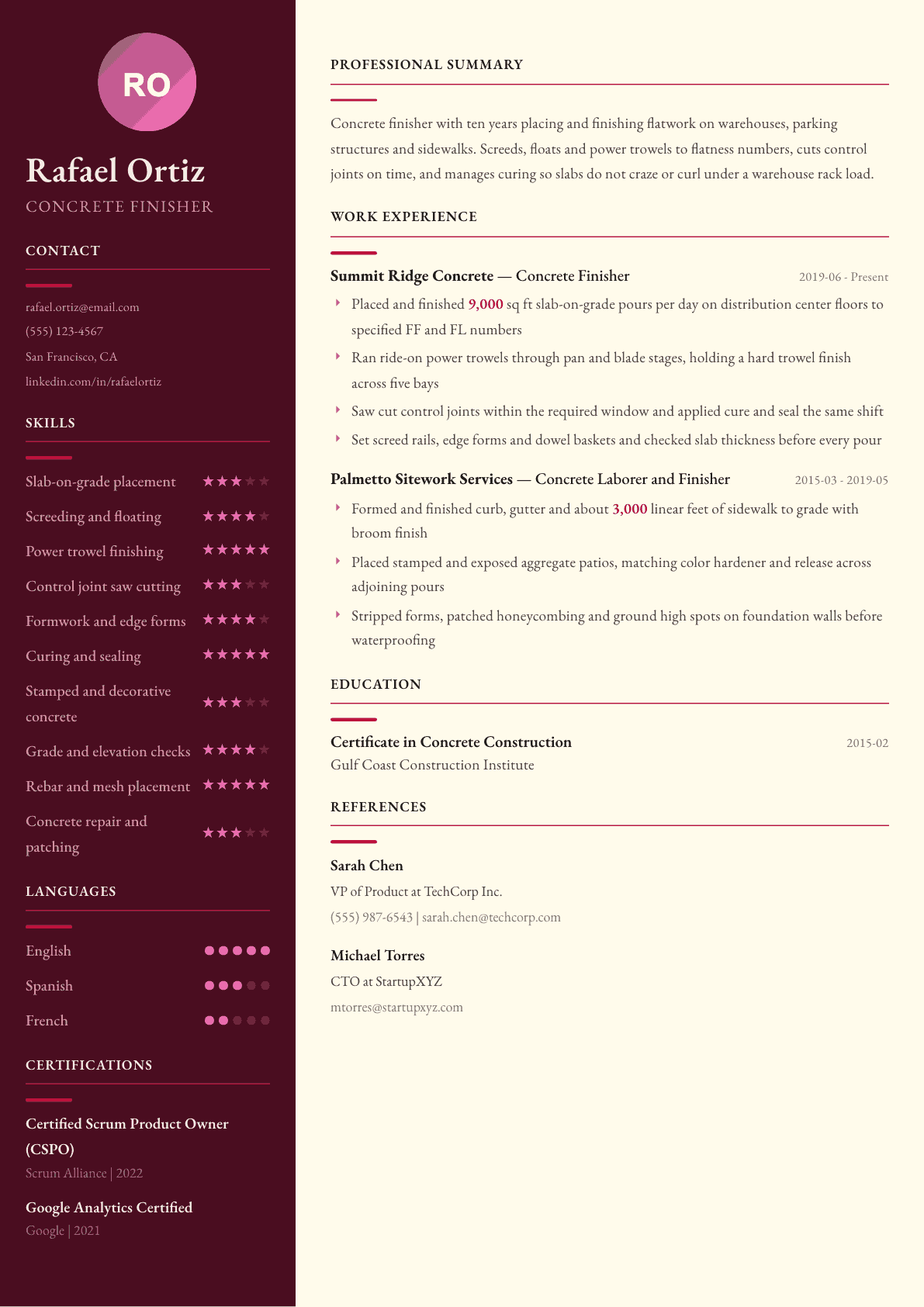
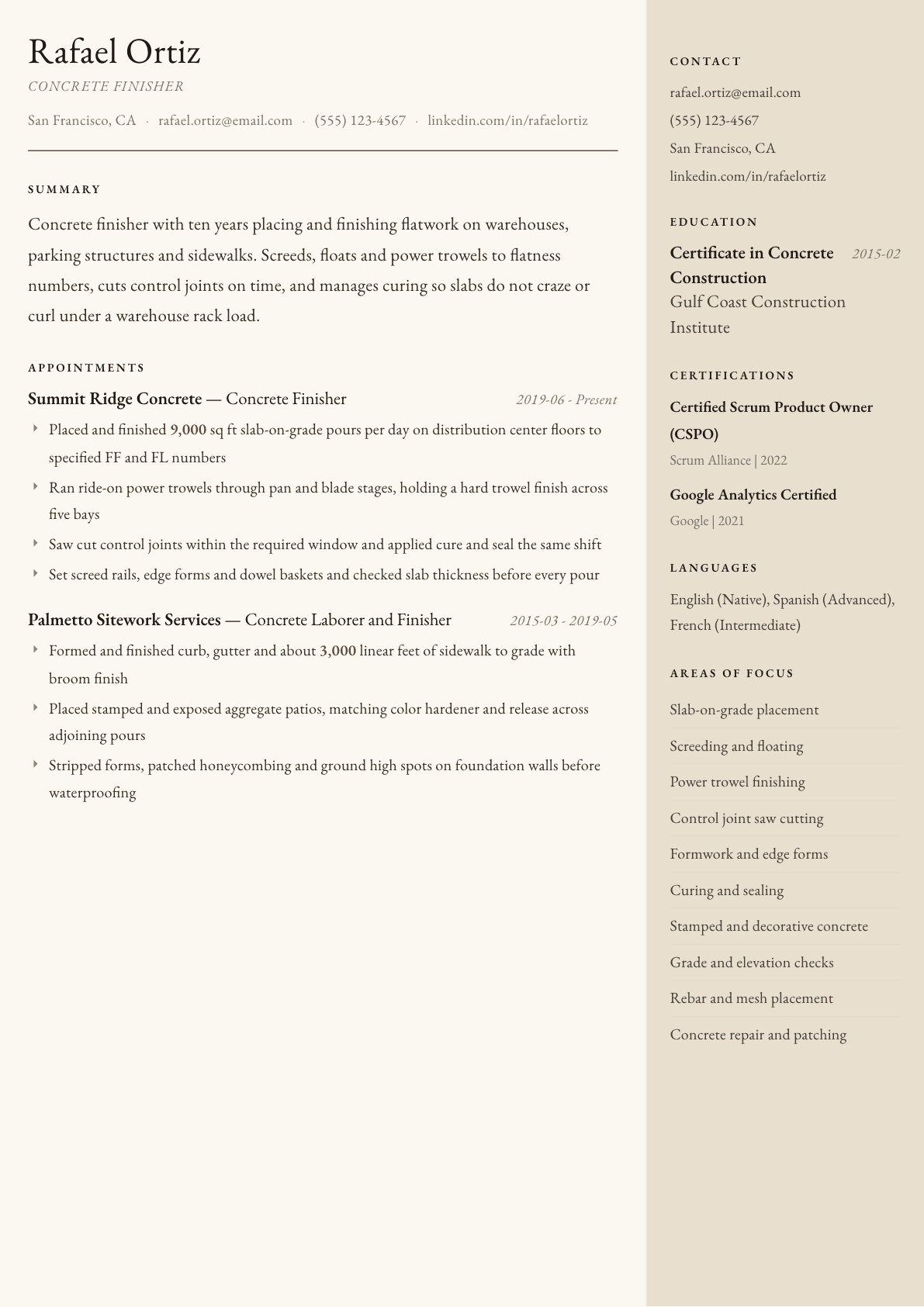
The same concrete finisher content laid out in three CVBooster templates, so you can see what the finished document looks like before you write a word.
Example Concrete Finisher summary
Concrete finisher with ten years on warehouse slabs, parking decks and sitework flatwork. Sets forms and screed rails, places to grade, and finishes with ride-on trowels to the flatness and levelness numbers the specification calls for. Cuts joints inside the window, applies cure and seal the same day, and repairs defects before the next trade arrives.
Skills to list on a Concrete Finisher resume
- Concrete placement
- Screeding
- Bull floating and edging
- Power trowel operation
- Hard trowel finish
- Broom and exposed aggregate finish
- Stamped concrete
- Control and construction joints
- Formwork setting
- Rebar and wire mesh
- Curing compounds
- Grade checking and laser level
- Slab repair and grinding
- Cold and hot weather placement
- Site safety practices
What actually gets this resume read
- Give the square footage you place and finish in a day, since that number sets the crew size an estimator budgets.
- Name the finishes you deliver: broom, hard trowel, exposed aggregate, stamped, salt and polished surfaces.
- Mention flatness and levelness specifications, because warehouse and parking slabs are accepted or rejected on them.
- Show that you understand timing, from initial set to bull float, saw cut window and curing method.
- Separate flatwork from vertical work, as forming walls and columns is bid and staffed differently from slabs.
- List the equipment you run, from ride-on trowels and laser screeds to walk-behind saws and vibratory screeds.
How to write a concrete finisher resume
Concrete gives you one chance. The truck arrives, the clock starts, and every decision from screed height to the moment you cut joints is locked in by the time the sun goes down. A superintendent hiring a concrete finisher is trying to work out whether you have the judgment to read a slab as it sets, and whether you have the stamina to hold that judgment through a nine-thousand-square-foot pour.
That is why the strongest resumes in this trade are built on placement volume, finish type and timing. How much you place and finish in a day, which finishes you deliver, and how you handle the window between bull float and hard trowel say more than any list of duties.
This guide walks through the sections in the order a concrete contractor reads them, gives summaries for a laborer moving into finishing, a working finisher and a lead, rewrites five common bullets, and answers the questions finishers ask when they write.
Format: one page, flatwork and vertical kept separate
Single page, reverse-chronological, plain text layout. Under each employer, separate flatwork from vertical and structural work, because forming walls, columns and elevated decks is bid and staffed differently from placing and finishing slabs. A reader who has to guess which one you did will assume the easier answer.
Put your city, travel radius, whether you have your own hand tools, and your driving endorsements near the top. Concrete crews start before dawn and often travel, so those lines matter more here than in most trades.
- Header: name, trade, city and state, phone, email, travel radius, tool ownership.
- Order: summary, work history split by flatwork and vertical, finishes and equipment, safety training.
- Newer finishers list the training program and the finishers they worked under first.
Summary: volume, finish and the slab type
Lead with the daily volume you place and finish, then the slab types. A distribution center floor built to flatness and levelness numbers, a parking deck with a broom finish and slope to drains, a residential driveway and a stamped patio are four different jobs with four different acceptance standards.
Add the finishes you deliver and the equipment you operate. A finisher who runs a ride-on trowel through pan and blade stages is a different hire from one who has only worked walk-behind machines, and that distinction belongs in the opening lines rather than buried in a skills list.
Experience: yardage, timing and acceptance
Give square footage or cubic yardage per pour and per day, with the building type attached. Then describe the sequence: setting screed rails and edge forms, checking slab thickness and reinforcement before the truck arrives, placing and striking off, bull floating, waiting on the set, floating and troweling, cutting joints inside the window, and applying cure.
Name the acceptance criteria where they existed. Floor flatness and levelness targets on warehouse slabs, slope to drain on decks and sidewalks, surface tolerance under a straightedge on architectural work. A finisher who mentions how the slab was measured after he left has been on jobs where somebody measured, and that is what a commercial contractor wants.
Weather work is worth its own bullet. Hot weather placements with evaporation retarder and cold weather work with blankets and heaters show a range of conditions and, more importantly, that you understand why the slab behaves differently in each.
- Square footage or yardage per pour, plus how many pours in a week.
- The finish delivered and the equipment used to get there.
- Joint cutting timing and the cure or seal applied afterward.
- Formwork, screed rails, dowel baskets, rebar and mesh you set before the pour.
Decorative and repair work, when you have it
Stamped concrete, exposed aggregate, integral color, color hardener, salt finish and polishing are a separate market that pays differently, and a contractor who does that work hires on it directly. If you have it, describe the patterns, the release method and how you kept color consistent across adjoining pours, because color mismatch is the complaint that generates the most callbacks.
Repair work also deserves a line. Grinding high spots, patching honeycombing, epoxy injection on cracks, joint filling and slab replacement in occupied buildings all show a finisher who can be sent to problems rather than only to fresh pours.
Keywords a concrete contractor searches for
Match the posting language: concrete finisher, cement finisher, slab on grade, elevated deck, screed and strike off, bull float, ride-on power trowel, hard trowel finish, broom finish, exposed aggregate, stamped concrete, control joint saw cutting, cure and seal, dowel baskets, laser screed, floor flatness. Use them where they are true and skip the ones that are not.
Concrete Finisher resume summary examples
Concrete laborer moving into finishing
Concrete laborer with two years setting forms, placing rebar and helping on flatwork pours. Screeds, bull floats and edges under a lead finisher, cuts control joints, strips forms and patches walls. Holds an OSHA 10 card and is training toward running a walk-behind trowel.
Working finisher, seven years
Concrete finisher with seven years on warehouse slabs, sidewalks and curb work, placing and finishing about nine thousand square feet a day. Runs ride-on trowels through pan and blade stages, cuts joints inside the window, and delivers broom, hard trowel and exposed aggregate finishes.
Finishing foreman
Concrete finishing foreman with fourteen years leading crews of eight on distribution centers and parking structures. Plans pour sequence and joint layout, hits specified flatness and levelness numbers, coordinates pump and truck timing, and handles decorative and repair scopes for the company.
Work experience bullets: before and after
Before: Poured and finished concrete slabs.
After: Placed and finished about nine thousand square feet of slab on grade per day on distribution center floors, holding the specified flatness and levelness numbers.
Daily area plus an acceptance standard tells an estimator both your pace and the grade of slab you can be trusted with.
Before: Used a power trowel on the floor.
After: Ran ride-on power trowels through pan and blade stages across five bays, timing each pass to the set so the surface burnished without blistering.
Describing the stages and the timing shows the judgment behind the machine, which is the part that cannot be taught quickly.
Before: Cut joints in the concrete.
After: Saw cut control joints to the specified depth inside the required window on every pour, then applied cure and seal the same shift to limit curling.
Joint timing and curing are where slabs crack or curl, so naming the window and the follow-up proves you know why it matters.
Before: Did decorative concrete for homeowners.
After: Placed stamped and exposed aggregate patios, matching color hardener and release across adjoining pours so the finished surface read as one placement.
Color consistency is the actual difficulty in decorative work, and naming it separates real experience from a single weekend job.
Before: Prepared the site before pouring.
After: Set screed rails, edge forms and dowel baskets, then checked slab thickness and mesh placement against the drawings before the first truck arrived.
Pre-pour checks are where a finisher prevents problems, and listing them shows you think past the day of the pour.
Hard skills
- Slab on grade placement and finishing
- Screeding and strike off
- Bull floating and edging
- Ride-on and walk-behind power trowels
- Hard trowel and burnished finishes
- Broom and exposed aggregate finishes
- Stamped and colored concrete
- Control and construction joint layout
- Saw cutting and joint filling
- Formwork, screed rails and dowel baskets
- Rebar and welded wire mesh placement
- Curing compounds and sealers
- Grade checking with laser level
- Concrete repair, grinding and patching
Soft skills
- Reading a slab as it sets
- Stamina on long pours
- Crew timing and communication
- Early start reliability
- Coordination with pump and truck drivers
Certifications worth listing
- ACI Concrete Flatwork Finisher and Technician (American Concrete Institute)
- ACI Concrete Field Testing Technician Grade I (American Concrete Institute)
- OSHA 10-Hour Construction (OSHA Outreach Training Program)
Mistakes that cost concrete finisher candidates the interview
- Giving no volume figure, which leaves an estimator unable to work out how many finishers a pour of yours would need.
- Mixing flatwork and formwork into one description, when contractors staff and price those scopes separately.
- Never mentioning joint timing or curing, the two decisions that most often show up later as cracks and curling.
- Skipping the equipment list, so a reader cannot tell whether you have run a ride-on trowel or only a walk-behind.
- Listing decorative concrete without describing color control, which is the part that actually goes wrong.
- Omitting hot and cold weather placements, even though they prove you understand how the mix behaves in real conditions.
Concrete Finisher resume questions
What numbers belong on a concrete finisher resume?
Square footage or yardage placed and finished per day, the number of pours per week on your biggest project, and any acceptance standard the slab was measured against. Those three figures let a contractor size you against their own crews immediately.
Do certifications matter for a concrete finisher?
A recognized flatwork finisher credential and a field testing certification both help on commercial work, because specified projects often require certified personnel on site. On residential flatwork they matter less, but they still make a resume verifiable.
How do I write about decorative concrete experience?
Describe the finishes by name, the patterns and tools you used, and the method you followed to keep color consistent between pours. Decorative work is judged entirely on appearance, so the detail that shows control of color and texture is what a client-facing contractor wants.
Should I mention working in cold or hot weather?
Yes, because both change the set time and the finishing window dramatically. Saying you have used blankets and heaters in winter or evaporation retarder in summer tells a foreman you can be scheduled year round without supervision on the mix.
I mostly do sidewalks and driveways. How do I get commercial work?
Lead with grade control, forming, joint layout and finish quality, since those transfer directly. Then add any larger continuous pour you have worked, list your equipment experience honestly, and get a safety card so site access is not the reason you are passed over.
Related resume examples
- Masonry Worker Resume example
- Construction Manager Resume example
- Bricklayer Resume example
- Ironworker Resume example
- General Laborer Resume example
- Carpenter Apprentice Resume example