Ironworker Resume Examples: free ATS score and gap list
Write an Ironworker Resume That Shows Steel and Safety
By Mustafa Tarabya, founder of CVBooster · Published · Updated
An ironworker resume sample with structural connecting, rebar and rigging keywords, plus a guide to writing bullets a steel foreman respects.
Sample resumes for a ironworker
The same ironworker content laid out in three CVBooster templates, so you can see what the finished document looks like before you write a word.
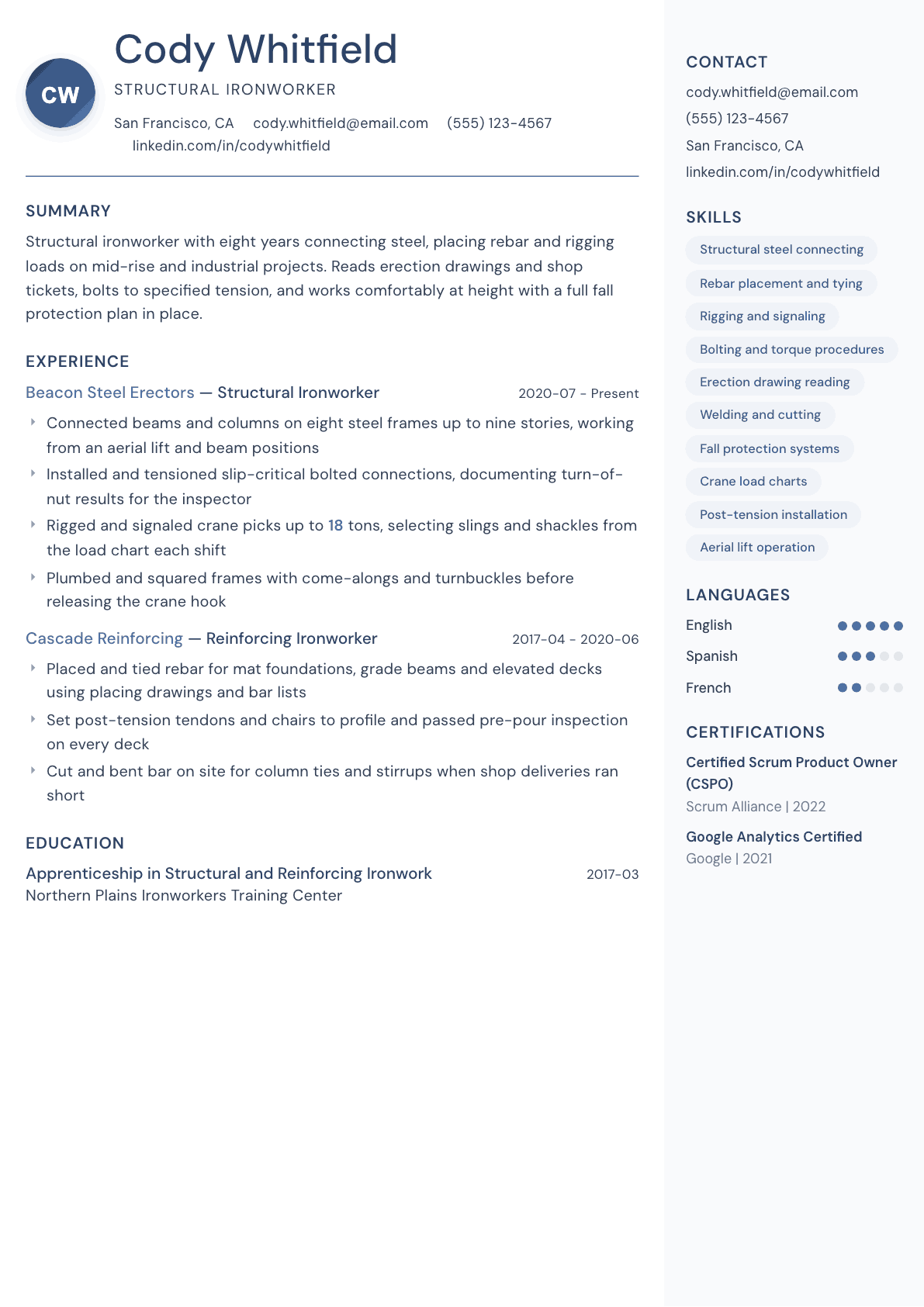
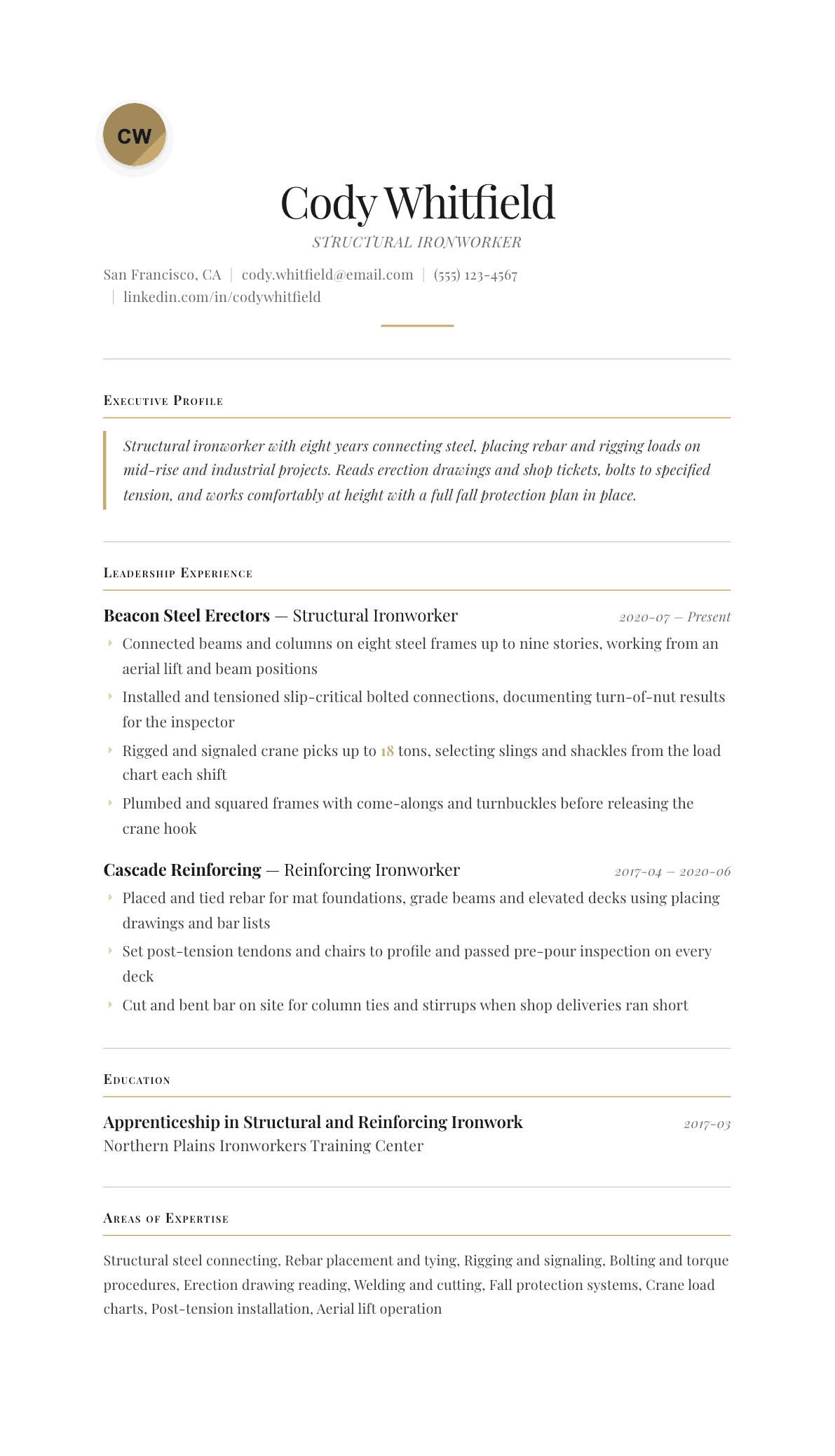
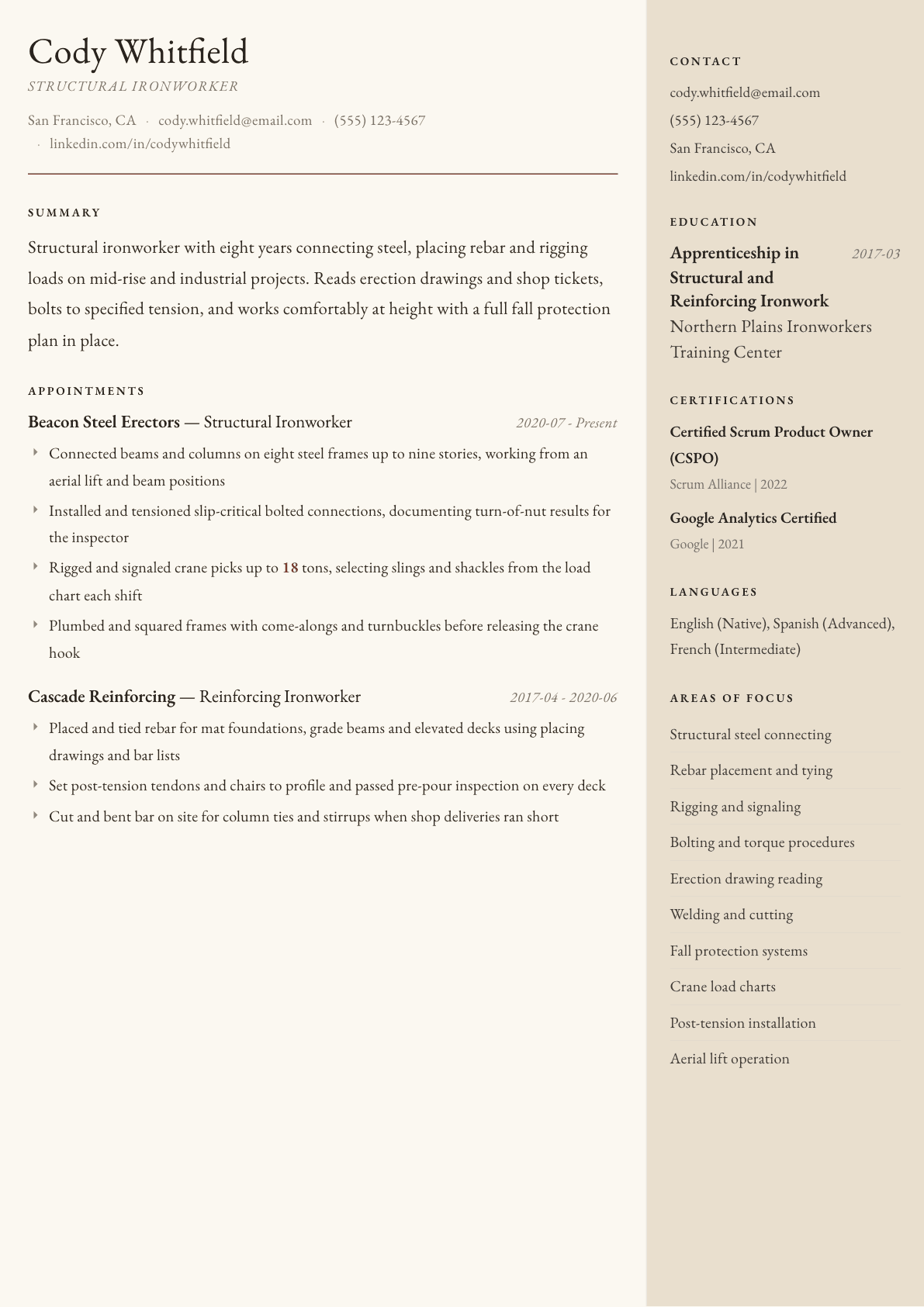
Example Ironworker summary
Structural ironworker with eight years connecting steel and placing reinforcing on mid-rise and industrial projects. Works from erection drawings and placing drawings, torques slip-critical connections for inspection, rigs and signals crane picks, and plumbs frames before the hook releases. Trained in fall protection and comfortable at height across an entire winter schedule.
Skills to list on a Ironworker resume
- Structural steel erection
- Beam and column connecting
- Rebar placement and tying
- Post-tension tendon installation
- Rigging and load calculation
- Crane hand signals
- Bolted connection torque
- Field welding
- Oxy-fuel cutting
- Erection and placing drawings
- Fall protection and tie-off
- Aerial lift operation
- Plumbing and squaring frames
- Decking and shear stud work
- Job hazard analysis
What actually gets this resume read
- Say whether your time is structural, reinforcing, ornamental or rigging, because those are staffed as separate skills.
- Name the connection work you do, from turn-of-nut bolting to field welding, and who inspected it.
- Give building heights, tonnage or bar weight so a foreman can picture the scale of steel you have handled.
- List your rigging and signal training, since crane-side qualifications decide who works next to the pick.
- Show your fall protection habits directly, because a safety record is the first thing an erector screens for.
- Include the drawings you work from: erection plans, shop tickets, placing drawings and bar lists.
How to write a ironworker resume
Steel erectors hire on trust before they hire on skill. The foreman reading your resume is deciding whether he would put you on a beam next to his own crew, and everything he learns about your judgment comes from how you describe rigging, connections and working at height.
The first job of the page is to say which branch of the trade you belong to. Structural connecting, reinforcing, ornamental and rigging are related but distinct, and a company staffing a steel frame does not want to guess whether your years were spent tying rebar in a mat foundation.
This guide sets out the sections in the order an erector reads them, gives summaries for an apprentice, a journey-level ironworker and a foreman, rewrites five of the bullets that show up in almost every ironworker resume, and answers the questions the trade actually asks.
Format: one page, branch of the trade stated up front
Reverse-chronological, one page, no columns or graphics. Directly under your name, state whether you are a structural, reinforcing, ornamental or rigging ironworker, and name any combination you genuinely hold. That single line filters your resume into the right pile before anyone reads a bullet.
Add your local and union status if you have one, your travel availability, and whether you own tools, a bolt bag and harness. Ironworkers travel for work more than most trades, so a clear line about where you will go saves a phone call.
- Header: name, branch of ironwork, city and state, phone, email, local, travel availability.
- Order: summary, certifications and cards, work history with projects, skills, apprenticeship.
- Apprentices list hours completed and the training center above the work history.
Summary: the steel you have handled and how high
Say the building types and the scale. Nine-story steel frames, industrial platforms and pipe racks, mat foundations and elevated decks, bridge work, or precast erection each give a foreman a picture. Add tonnage or pick weight if you know it, because that is how a rigging conversation starts.
Then name what you do with your hands: connecting, bolting up, plumbing and squaring, decking and stud welding, tying rebar, setting post-tension tendons, welding in the field. Ironworkers who name their tasks get slotted onto a crew faster than ones who say experienced in all aspects of ironwork.
Experience: connections, rigging and inspection
For each employer, give the projects, your position on the crew, and bullets built on specifics. On structural work that means the frame height, the number of floors, the connection type and how the bolts were verified. Slip-critical connections tensioned by turn-of-nut or with direct tension indicators, documented for an inspector, is a sentence with weight behind it.
On reinforcing work, name the elements: mat foundations, grade beams, columns and ties, shear walls, elevated decks, and post-tension tendon profiles. Add the drawings you worked from, since placing drawings and bar lists are a real literacy that not every ironworker has.
Rigging belongs in its own bullet wherever you did it. The pick weights, the slings and shackles you chose, whether you used a load chart, and whether you gave hand signals or worked on radio. A foreman reads that as evidence you will not put a load over somebody.
- Frame height, floors and tonnage on structural jobs.
- Connection type and the verification method used, plus who inspected it.
- Rigging: pick weights, hardware selection, signaling method.
- Fall protection setup: anchor points, retractables, static lines, and net or deck sequencing.
Welding, cards and equipment
If you weld in the field, say which processes and which positions, and whether you have tested to a procedure. A welding qualification carried by an ironworker widens the work he can be sent to, so it should appear near the top rather than in a list at the bottom.
List the equipment you operate: aerial lifts, telehandlers, welders, torches, impact wrenches and tensioning equipment, come-alongs and turnbuckles. Add every card you hold with the issuing body, because on most steel jobs the card determines who is allowed near the crane at all.
Keywords a steel erector searches for
Postings in this trade repeat a short list: structural ironworker, connector, bolt up, slip-critical connection, turn-of-nut, erection drawings, plumbing and squaring, metal decking, shear studs, rebar tying, placing drawings, post-tension, rigging, hand signals, load chart, fall protection, aerial lift. Use the ones that describe you and leave the rest alone.
Ironworker resume summary examples
Apprentice ironworker
Ironworker apprentice with 2,800 hours across reinforcing and structural work. Ties rebar to placing drawings, tends connectors, rigs light picks under a qualified signalman, and handles decking and stud layout. Holds a fall protection card and is testing toward a field welding qualification.
Journey-level connector
Structural ironworker with eight years connecting steel on frames up to nine stories, bolting slip-critical connections and documenting turn-of-nut results for inspection. Rigs and signals picks to 18 tons from load charts, plumbs frames with come-alongs, and welds field connections in flat and horizontal positions.
Erection foreman
Ironworking foreman with seventeen years leading raising gangs on mid-rise and industrial steel. Plans erection sequence with the crane operator, writes the daily fall protection plan, manages bolt-up and inspection documentation, and has run reinforcing crews on mat foundations and post-tension decks.
Work experience bullets: before and after
Before: Connected steel beams and columns.
After: Connected beams and columns on eight steel frames up to nine stories, working from aerial lifts and beam positions with a full tie-off plan on every pick.
Frame count, height and the access method give a foreman a picture of the work, and the tie-off line answers his first safety question.
Before: Tightened bolts on connections.
After: Installed and tensioned slip-critical bolted connections by turn-of-nut, marking and documenting results so the third-party inspector could verify each joint.
Naming the tensioning method and the documentation shows you have worked under inspection rather than just spun a wrench.
Before: Helped with crane picks.
After: Rigged and signaled crane picks up to 18 tons, selecting slings, shackles and spreader bars against the load chart and confirming the pick plan before each lift.
Hardware selection and the load chart reference tell an erector you rig deliberately instead of reaching for whatever is on the ground.
Before: Tied rebar on foundations.
After: Placed and tied rebar for mat foundations, grade beams and elevated decks from placing drawings and bar lists, passing pre-pour inspection on every deck.
Working from placing drawings and passing inspection turns a routine task into evidence of drawing literacy and accuracy.
Before: Made sure the building was straight.
After: Plumbed and squared frames with come-alongs and turnbuckles against survey control, holding tolerance before the crane hook was released.
The tools and the reference point show a technical process rather than an eyeball judgment a foreman would have to check.
Hard skills
- Structural steel connecting
- Bolt-up and turn-of-nut tensioning
- Erection drawing interpretation
- Rebar placement and tying
- Placing drawings and bar lists
- Post-tension tendon installation
- Rigging and hardware selection
- Crane load charts and hand signals
- Field welding and oxy-fuel cutting
- Metal decking and shear stud installation
- Plumbing and squaring frames
- Fall protection systems and anchor points
- Aerial lift and telehandler operation
- Job hazard analysis
Soft skills
- Situational awareness at height
- Clear signaling and communication
- Calm under load
- Crew discipline
- Following an erection sequence exactly
Certifications worth listing
- Rigger Level I (National Commission for the Certification of Crane Operators)
- Signalperson Certification (National Commission for the Certification of Crane Operators)
- Certified Welder (American Welding Society)
- OSHA 30-Hour Construction (OSHA Outreach Training Program)
Mistakes that cost ironworker candidates the interview
- Not saying which branch of ironwork you come from, which forces an erector to guess and often to guess wrong.
- Writing about rigging without pick weights, hardware or a load chart, so nothing on the page proves the judgment behind it.
- Treating fall protection as a slogan rather than describing anchors, retractables and the sequence you actually worked to.
- Leaving welding qualifications at the bottom of the page when they widen the work a company can send you to.
- Skipping inspection details on bolted connections, when documented tensioning is exactly what a structural job runs on.
- Listing tonnage or building heights with no project attached, which reads as a number pulled from memory rather than a job.
Ironworker resume questions
Should I list structural and reinforcing work separately?
Yes. They are staffed as different crews and often by different companies, so a reader needs to see at a glance how many years you have in each. Combining them hides the depth of whichever one you are actually strongest in.
How important are rigging and signaling certifications?
On most steel jobs the card decides who is allowed to rig and signal, which decides who works next to the crane all day. Holding them makes you useful from the first shift instead of waiting for someone else to be available.
What does an ironworker put on a resume with only apprenticeship hours?
Lead with the hours completed, the training center and the specific tasks you have performed unsupervised. Then list the projects you were dispatched to and the foremen you worked under, because early in this trade references carry more weight than any single skill.
How do I show a good safety record without sounding hollow?
Describe practice rather than attitude. Name the anchor systems you used, the sequence you followed for decking and netting, and any period you worked without a recordable incident on a named project. Specifics read as habit, slogans read as filler.
Does field welding experience belong on an ironworker resume?
Absolutely, if you have tested to a procedure. Name the processes and positions you are qualified in and the issuing body, because an ironworker who can weld field connections saves the erector from bringing in a separate trade.
Related resume examples
- Welder Resume example
- Crane Operator Resume example
- Scaffolder Resume example
- Concrete Finisher Resume example
- Millwright Resume example
- Glazier Resume example