General Laborer Resume Examples: the lines they read
Write a General Laborer Resume That Works Across Sites and Warehouses
By Mustafa Tarabya, founder of CVBooster · Published · Updated
Sample resume for general labor with examples for construction, warehouse and grounds work: lifting, equipment, safety cards and reliability.
Sample resumes for a general laborer
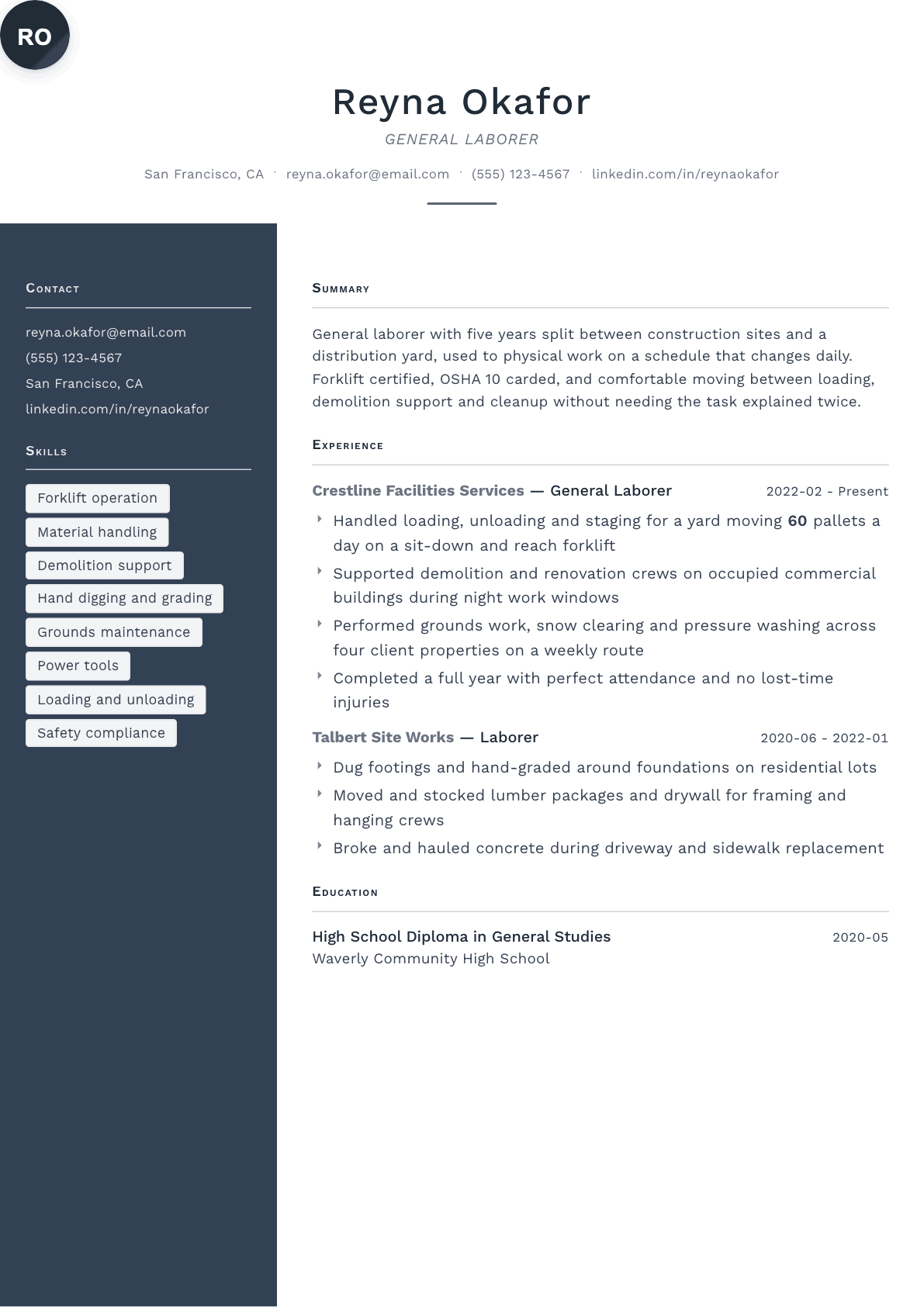
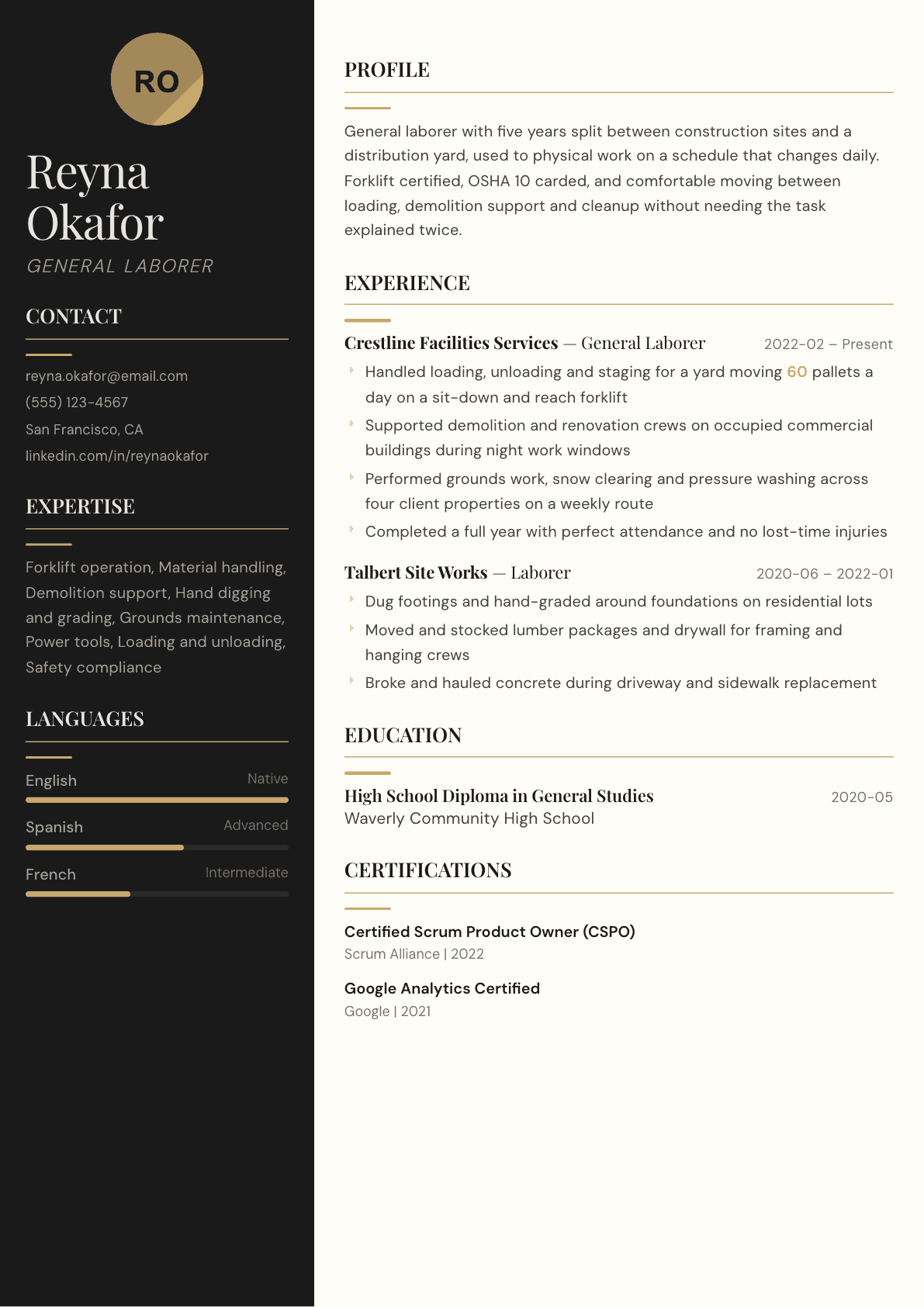
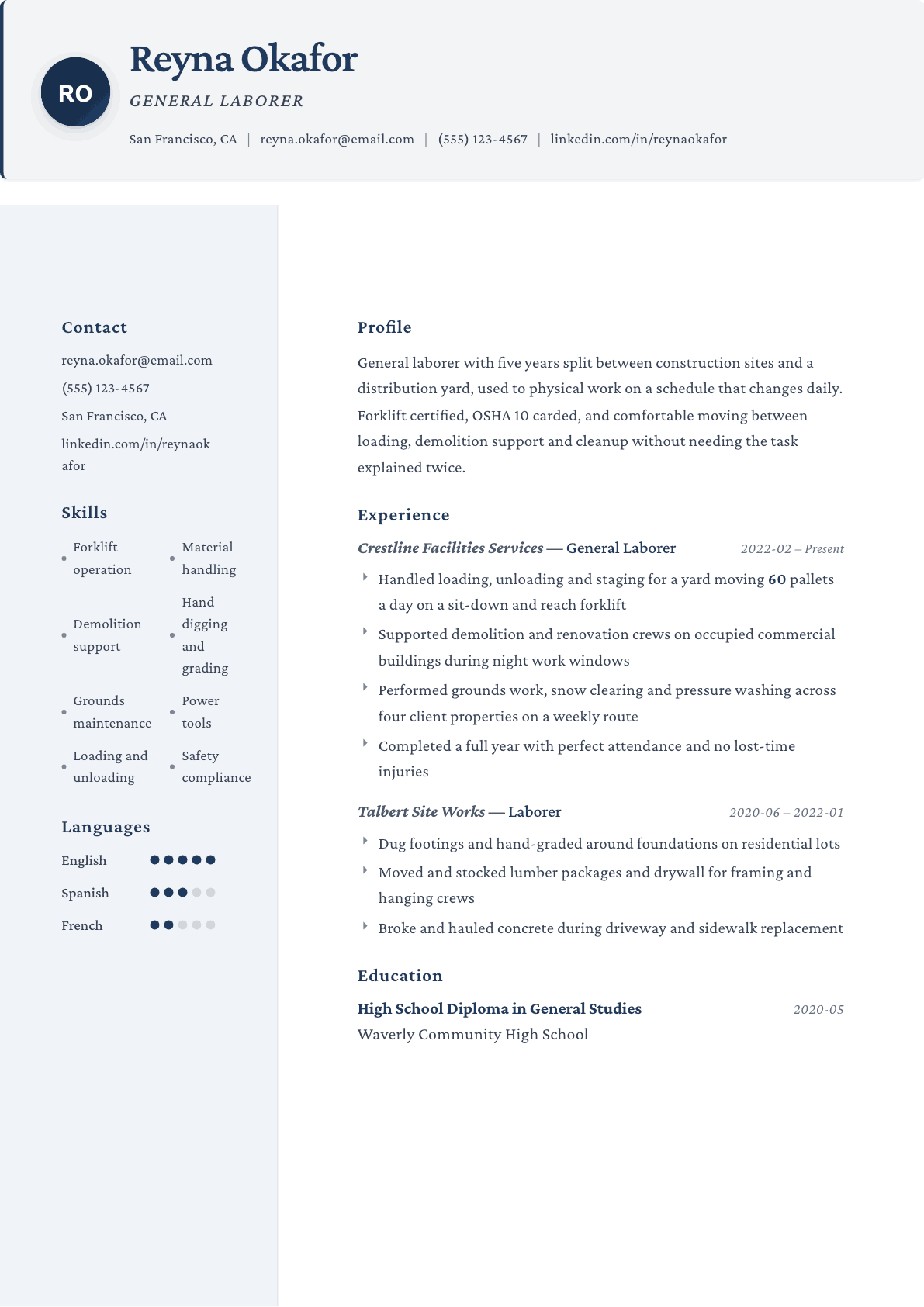
The same general laborer content laid out in three CVBooster templates, so you can see what the finished document looks like before you write a word.
Example General Laborer summary
General laborer with five years across construction sites and a distribution yard, forklift certified and OSHA 10 carded. Moves 60 pallets a day on a reach truck, supports demolition crews on night work in occupied buildings, and closed a full year with perfect attendance and no lost-time injuries. Available for day, night or weekend shifts.
Skills to list on a General Laborer resume
- Material handling
- Loading and unloading
- Forklift operation
- Pallet jack operation
- Demolition support
- Hand digging and grading
- Debris removal
- Grounds maintenance
- Hand and power tools
- Pressure washing
- Inventory staging
- Safety compliance
- Physical stamina
What actually gets this resume read
- Say up front how much you can lift and carry regularly, because postings screen on that requirement first.
- List forklift, pallet jack and small equipment certifications, and note whether they are current.
- Cover both settings if you have them: construction sites and warehouse or yard work read to different employers.
- Give attendance and injury record a line of their own, since dependability is what the hire is really about.
- Name shift availability, including nights, weekends and on-call, because staffing decisions turn on it.
- Avoid one long paragraph. Use short bullets that a supervisor can read in under a minute.
How to write a general laborer resume
General laborer postings come from three very different places: construction sites, warehouses and yards, and facilities or grounds teams. The same title covers all three, so the resume has to tell the reader within a few lines which environments you have worked in and which machines you can run. A page that stays vague gets passed over by all three.
These roles are usually filled quickly and often as temporary work that converts to permanent. The hiring coordinator is checking whether you meet the physical requirement in the posting, whether your certifications are current, and whether your shift availability fits their gap. Everything else is secondary.
This guide covers how to lay the page out for a fast read, a sample resume for general labor with examples by setting, how to write lifting and equipment claims that a supervisor can verify, how to present a mixed work history without it looking scattered, and the questions laborers ask when they want a temporary placement to turn into a permanent one.
Format: a facts block, then the work
Start with a block of hard facts: certifications with current status, driver license class, shift availability, and the physical requirements you meet, stated the way postings state them. Coordinators screen against a checklist, and matching the checklist in the first inch of the page moves you to the top of the pile.
Keep the page to one side, plain text, no columns. Many of these applications are uploaded through a portal that strips formatting, and a design-heavy file often arrives scrambled.
- Facts block: certifications, license class, availability, lifting capacity, transportation.
- Environments line: construction sites, warehouse and yard, facilities and grounds.
- Equipment line: forklift class, pallet jack, compactor, saw, pressure washer and hand tools.
Say what you lift, carry and operate
Postings are explicit about physical demands, so answer them directly. State the weight you lift and carry regularly, whether you can stand a full shift, and whether you are comfortable working at height or in cold storage. Copy the posting's own units rather than inventing your own phrasing.
Then name equipment precisely. Sit-down and reach forklift are different machines with different evaluations behind them. Pallet jack, order picker, scissor lift, plate compactor, mixer and pressure washer all belong on the page if you have run them, along with whether your evaluation is current.
Make a mixed history read as range, not drift
Laborers often carry short jobs across several industries, and that history looks unstable if it is left as a plain list. Group it instead. A short line naming the environments you have worked in, followed by entries with the type of site or facility, turns a scattered record into a candidate who can be dropped anywhere.
Where jobs were seasonal or agency placements, label them. Seasonal, temporary and contract are ordinary words in this field and they explain a date range instantly. An unlabeled three-month job makes a coordinator wonder; a labeled one does not.
Reliability and safety are the whole interview
Attendance, injury record and following instruction are what supervisors screen for, in that order. Put an attendance line in your most recent job, and if you have finished a stretch with no lost-time injuries, say how long. These are the two facts that get a temporary placement converted.
Add the safety practices you follow rather than a statement that safety matters to you: pre-shift equipment checks, lockout awareness, correct lifting technique, and reporting damaged pallets or unsafe loads instead of working around them.
Keywords across the three settings
Screening systems in this field search on material handling, loading and unloading, forklift certified, pallet jack, order picking, demolition, debris removal, grounds maintenance, inventory staging and safety compliance. Include the ones that are true for every setting you are targeting.
If you are aiming at one setting in particular, adjust the top of the page toward it. A yard supervisor and a site foreman both hire general laborers, but the first reads for forklift and pick rates while the second reads for tools, weather and site cleanup.
Sample resume for general labor (general labourer resume sample)
This sample resume for general labor is written for a laborer with three years across construction cleanup and warehouse work, applying to a staffing agency that places on both. The facts block comes first, then the summary, then two jobs written as evidence.
Summary: General laborer with three years on commercial construction sites and in a distribution warehouse. Certified on sit down and stand up forklifts, OSHA 10 card holder, comfortable with the lifting requirement in most postings, and available for first or second shift with my own transport.
Examples of general labor resumes differ mostly in the experience bullets. Keep the same order and swap the evidence for the setting the posting names.
Whether you spell it general labourer or general laborer, employers want the same page: what you can lift and operate, where you have worked, and proof you show up. Here is a complete general labourer resume sample for someone with experience across construction sites and warehouses. The person and employers are invented.
Profile: Tyrone Davis, General Laborer. Four years of labor work across construction cleanup, warehouse loading and landscaping. Can lift and carry seventy pounds, OSHA 10 certified, forklift certified, own work boots and transport, and available for early starts and overtime.
- Facts block: forklift certification and its expiry, OSHA 10 card, valid driver license, steel toe boots and your own PPE, shift availability and reliable transport.
- Construction site: cleanup and debris removal, staging material for the trades, setting barricades and signage, and running a jackhammer, plate compactor or concrete mixer.
- Warehouse and yard: picking and packing against a daily rate, loading and unloading trailers, cycle counts, RF scanner work, pallet jack and forklift.
- Facilities and grounds: mowing and trimming, snow removal, moving furniture for event setups, and simple repairs logged in a work order system.
- Close each job with one line on reliability, such as a full season without a missed shift, but only if it is true.
- Current role, General Laborer, Keystone Construction, two years: site cleanup, material handling and helping carpenters and concrete crews on commercial jobs.
- Unload and stage lumber, drywall and block from delivery trucks, and keep walkways and stairways clear for daily safety walks.
- Mix and carry concrete and mortar, set up and take down scaffolding with the crew, and run hand and power tools.
- Previous role, Warehouse Associate through a staffing agency, two years: loaded trailers, picked orders with RF scanners and drove a sit down forklift.
- Kept a perfect attendance record for one full year on the agency assignment and was offered a direct hire position.
- Skills: material handling, power tools, forklift, pallet jack, concrete mixing, basic carpentry, site cleanup, landscaping equipment.
- Certifications: OSHA 10 Construction, forklift operator certification, first aid and CPR.
General Laborer resume summary examples
New to the work
General laborer available for immediate start on day, night or weekend shifts. Comfortable lifting 50 pounds repeatedly through a full shift, with a season of grounds work and moving experience behind me. Own transportation, steel-toe boots and basic hand tools, and I take instruction the first time.
A few years in
General laborer with five years across construction sites and a distribution yard, forklift certified and OSHA 10 carded. Moves 60 pallets a day on a reach truck, supports demolition crews during night work in occupied buildings, and closed a full year with perfect attendance and no lost-time injuries.
Lead laborer
Lead laborer with ten years in facilities and site work, directing a two to four person crew on daily assignments. Certified on sit-down and reach forklift, runs grounds and snow routes across four client properties, and trains new hires on equipment checks and safe lifting.
Work experience bullets: before and after
Before: Loaded and unloaded trucks.
After: Handled loading, unloading and staging for a yard moving 60 pallets a day on sit-down and reach forklifts.
Daily volume and the exact machines let a supervisor judge your pace without an interview.
Before: Helped with demolition projects.
After: Supported demolition and renovation crews in occupied commercial buildings during night work windows, protecting finished areas each shift.
The setting and the shift type show you can work under the constraints that make those jobs hard to staff.
Before: Maintained the grounds at client sites.
After: Ran grounds work, snow clearing and pressure washing across four client properties on a fixed weekly route.
A route with a property count reads as an owned assignment rather than occasional help.
Before: Good attendance and safety record.
After: Completed a full year with perfect attendance and no lost-time injuries while working rotating day and night shifts.
A stated period and shift pattern make the claim checkable, which is the point of putting it on the page.
Before: Dug and prepared areas for construction.
After: Dug footings and hand-graded around foundations on residential lots, then broke and hauled concrete during driveway replacement.
Two named scopes with the tools implied beat one sentence that could describe almost any outdoor job.
Hard skills
- Material handling
- Loading and unloading
- Forklift operation
- Pallet jack and order picker
- Demolition support
- Hand digging and grading
- Debris removal
- Grounds maintenance and snow clearing
- Pressure washing
- Hand and power tools
- Inventory staging and counts
- Safety compliance and equipment checks
Soft skills
- Dependability across shifts
- Following instruction precisely
- Stamina through a full shift
- Flexibility between sites
- Teamwork with rotating crews
- Speaking up about unsafe loads
Certifications worth listing
- Powered Industrial Truck Operator Training (OSHA Outreach Training Program)
- OSHA 10-Hour General Industry (OSHA Outreach Training Program)
- OSHA 10-Hour Construction (OSHA Outreach Training Program)
- Adult First Aid and CPR (American Red Cross)
Mistakes that cost general laborer candidates the interview
- Leaving lifting capacity and shift availability off the page when both are screening questions.
- Writing forklift without saying which type or whether the evaluation is current.
- Presenting short jobs as a bare list instead of labeling them seasonal, temporary or contract.
- Using one file for warehouse and construction applications without changing the top of the page.
- Describing duties with no volumes, routes or property counts to give them scale.
- Adding a long personal statement that pushes the certifications below the first screen of the page.
General Laborer resume questions
Is a general labourer resume different from a general laborer resume?
Only in spelling. Labourer is the British and Canadian spelling and laborer is the American one. Use the spelling from the job posting you are answering, so your resume matches what the employer typed. Everything else, from the lifting and equipment line to the reliability proof, stays the same.
What is the difference between a general laborer and a construction laborer resume?
A construction file leads with site cards, scopes and tools. A general laborer file has to serve warehouses and facilities too, so it leads with certifications, lifting capacity, equipment and availability, then shows the environments you have worked in.
Should I put my lifting capacity on the resume?
Yes, because postings state a requirement and screeners check for it. Give a weight you can genuinely handle repeatedly through a shift, use the posting's own units, and pair it with whether you can stand or walk for the full shift.
How do I get a temporary laborer job to become permanent?
Make the resume show the traits that drive conversion decisions: attendance, safety record and range of equipment. Once on site, ask the supervisor what the permanent role requires, then add the certification or machine that closes the gap.
How far back should a general laborer resume go?
About ten years is plenty. Keep the recent roles detailed, compress older ones into single lines with dates and job type, and drop anything that no longer supports the kind of work you are applying for now.
Related resume examples
- Construction Laborer Resume example
- Construction Worker Resume example
- Carpenter Resume example
- Warehouse Supervisor Resume example
- Demolition Worker Resume example
- Groundskeeper Resume example