Bricklayer Resume Examples: free ATS score and gap list
Write a Bricklayer Resume That Shows Real Wall Production
By Mustafa Tarabya, founder of CVBooster · Published · Updated
A bricklayer resume sample with masonry bond, mortar type and production keywords, plus a guide to writing bullets a masonry foreman believes.
Sample resumes for a bricklayer
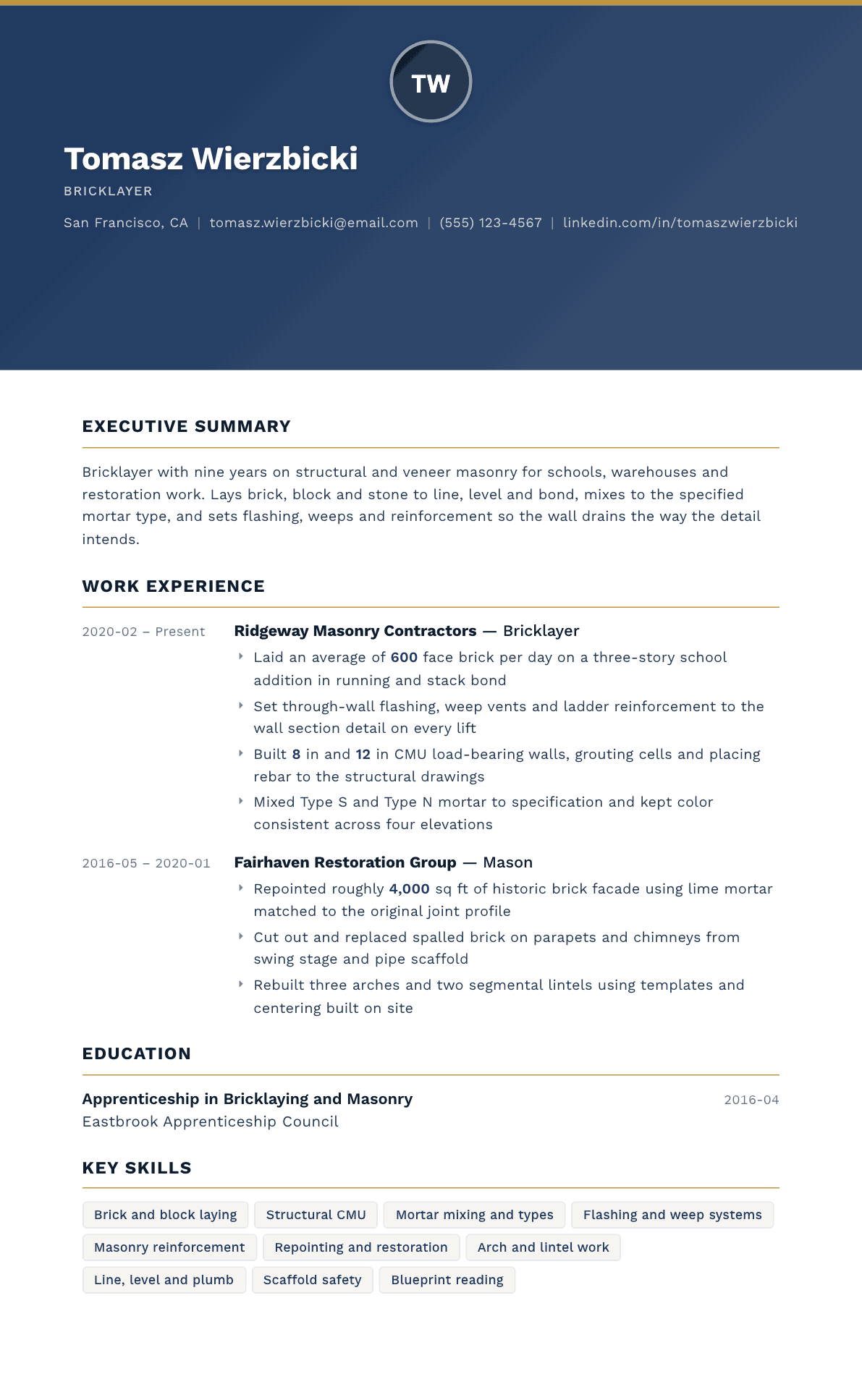
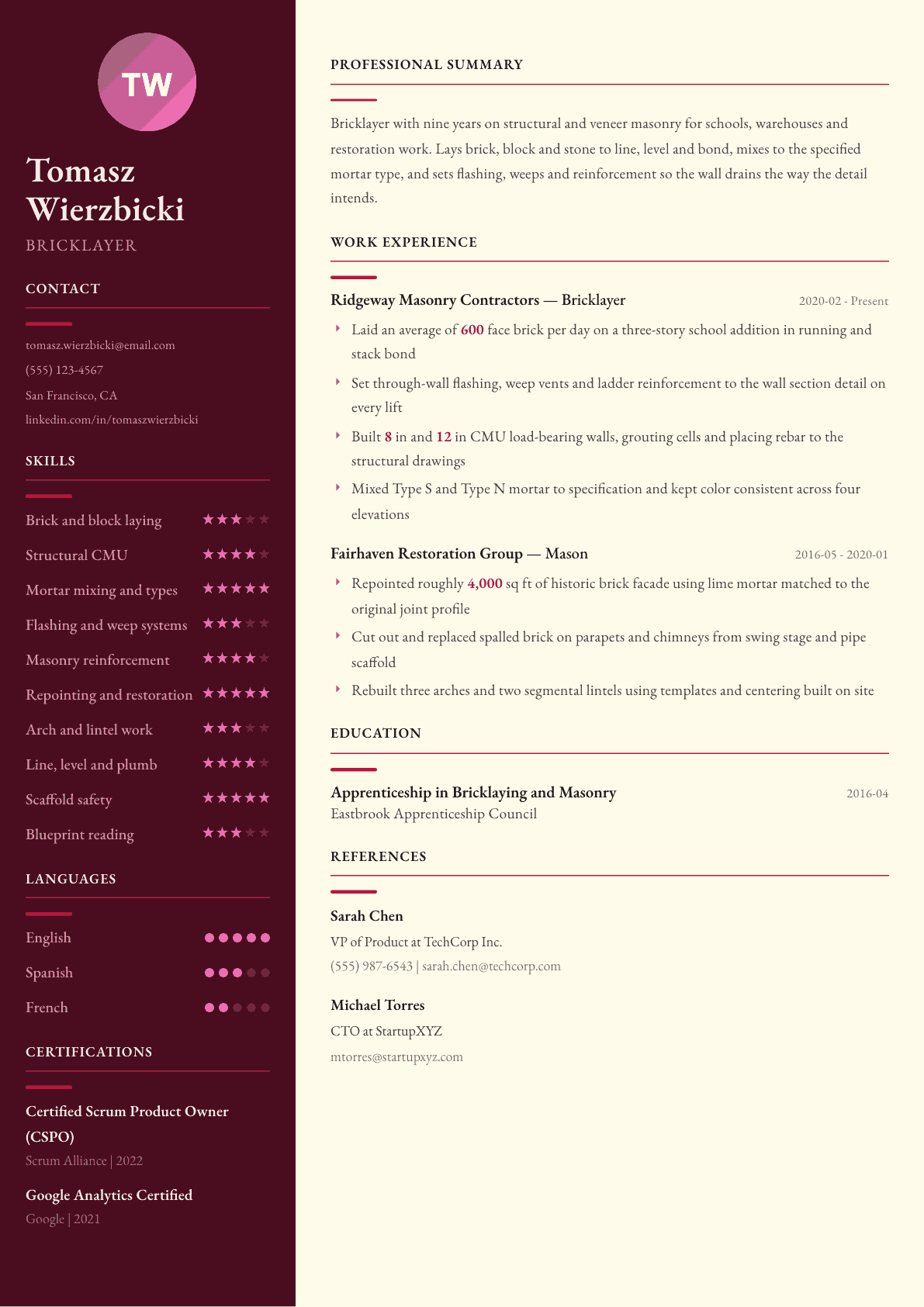
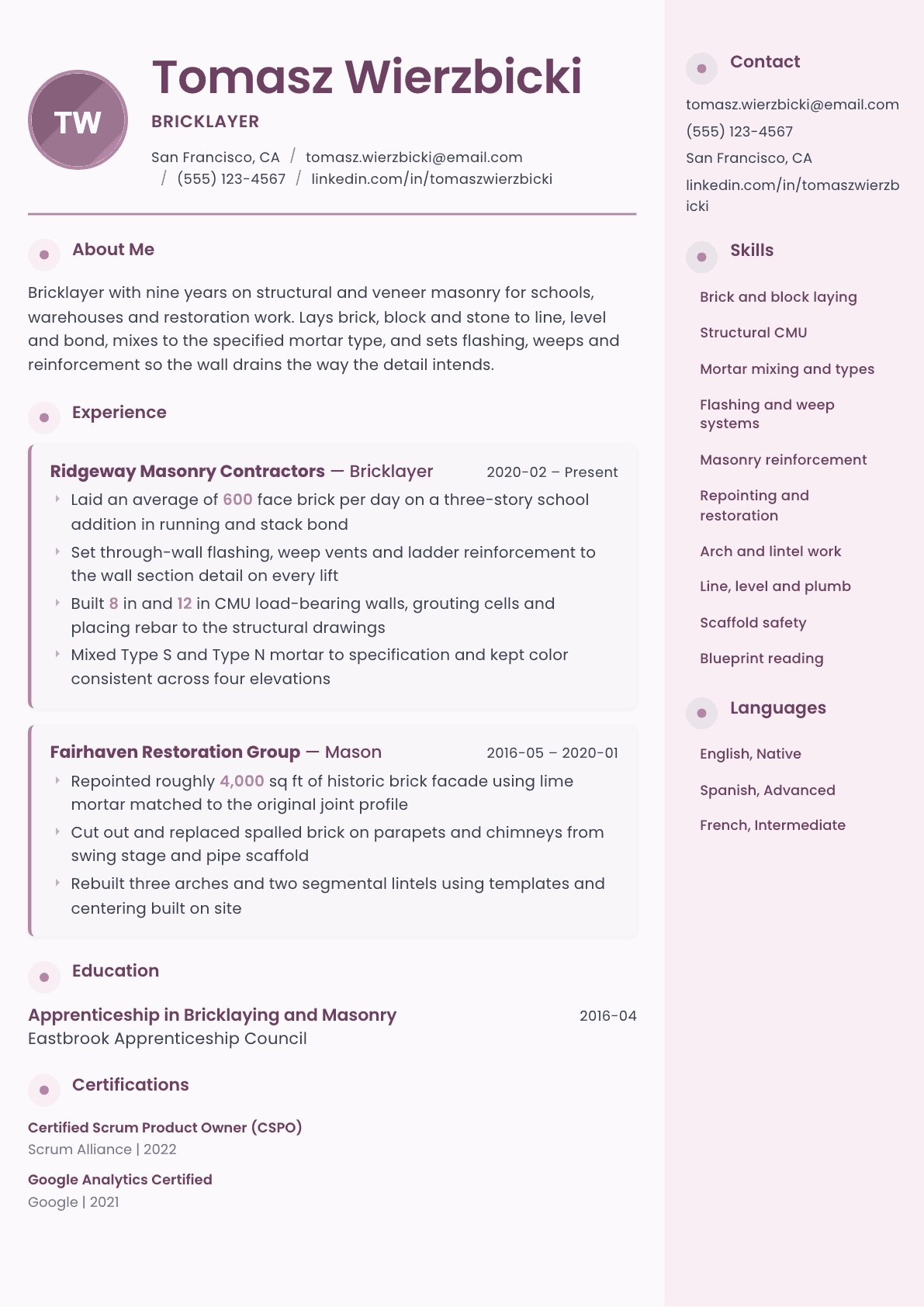
The same bricklayer content laid out in three CVBooster templates, so you can see what the finished document looks like before you write a word.
Example Bricklayer summary
Bricklayer with nine years laying face brick, structural block and stone on schools, warehouses and historic restoration. Holds production while keeping joints tight to line and level, sets flashing, weeps and reinforcement to the wall section, and matches mortar type and color across elevations. Comfortable working from swing stage and pipe scaffold in all seasons.
Skills to list on a Bricklayer resume
- Brick laying
- Concrete block laying
- Structural masonry
- Brick veneer
- Mortar types and mixing
- Through-wall flashing
- Weep and cavity drainage
- Masonry reinforcement and grout
- Repointing
- Historic restoration
- Arch and lintel construction
- Stone setting
- Scaffold and swing stage work
- Blueprint and wall sections
- Layout and story pole
- Cold weather masonry
What actually gets this resume read
- Give a daily brick or block count, because production rate is the first number a masonry foreman looks for.
- Name the bond patterns you lay: running, stack, Flemish, English and soldier courses on openings.
- Specify mortar types by letter, and say when you have matched lime mortar on historic restoration work.
- Describe the moisture details you install, since flashing, weeps and cavity drainage decide whether a wall leaks.
- Separate structural CMU work from veneer, as grouting, rebar placement and inspections apply only to the first.
- List the access you work from: swing stage, mast climber, pipe scaffold or hydraulic scaffold towers.
How to write a bricklayer resume
Masonry is one of the few trades where a foreman can look at a wall and know within a minute who built it. That is why a bricklayer resume gets read for two facts above everything else: how much wall you put up in a day, and whether the joints, the bond and the moisture details hold when someone checks them.
The second fact is the one most applicants leave out. Flashing, weeps, ties, reinforcement and cavity drainage are what keep water out of a building, and a masonry contractor who has paid for a leaking wall reads a resume looking for a bricklayer who installs those details without being told twice.
This guide covers the layout of the resume, what to write in each section, three summaries covering an apprentice, a journey-level bricklayer and a foreman, five rewritten bullets, and the questions masons ask when they are putting the page together.
Format: one page, employers with projects underneath
Use a plain one-page reverse-chronological layout. Under each masonry contractor, name the projects by type: school addition, warehouse shell, mid-rise veneer, historic facade restoration, retaining walls and site masonry. Building type tells a foreman what tolerances and inspections you have worked under better than any adjective can.
Add your union status if you have one, your local, your travel radius and whether you have your own hand tools. Masonry crews move between sites and states, and those practical lines are often what determines who gets the first call on a Sunday night.
- Header: name, trade, city and state, phone, email, union local if applicable, travel radius.
- Order: summary, work history with projects, masonry skills, safety training, apprenticeship.
- Apprentices list the hours completed and the classroom program above the work history.
Summary: production, materials and the kind of wall
Open with the number a foreman wants. A daily face brick count, or a block count, tied to the kind of wall you were laying. Then the materials: face brick, structural block, cast stone, thin veneer, natural stone, and whether you have done historic restoration with lime mortar.
Finish with the class of work. Structural CMU with grouted cells and rebar is inspected work with a submittal package behind it. Veneer over sheathing is a different scope with a different pace. Say which one you have spent most of your time on, and mention if you can do both.
Experience: counts, bond and the details behind the wall
Every job needs a production figure and a wall description. Six hundred face brick a day on running bond is a fact a foreman can price. Laying brick for a school is not. Add the height, the number of elevations, and whether you worked from ground, pipe scaffold, swing stage or a mast climber, because access changes the pace as much as the material does.
Then the details. Through-wall flashing and end dams, weep vents, ladder or truss reinforcement, veneer anchors at the correct spacing, control joints and expansion joints, grouted cells with rebar to the structural drawings, and cleaning method at the end. Each of these is a line item on an inspection report, and each proves you build walls that survive weather.
Cut the bullets that describe the trade in general. Mixed mortar, laid brick and block, and used a trowel and level belong to every bricklayer and tell a reader nothing about you.
- Daily unit count with the bond pattern and the material.
- Wall height, elevations and the access equipment you worked from.
- The moisture and reinforcement details you installed, and who inspected them.
- Mortar type by letter, plus color matching or lime mortar work if you have done it.
Restoration and specialty work deserve their own space
Repointing, brick replacement, arch rebuilding, chimney and parapet work, and stone repair are a separate market with its own clients, and a contractor who does that work will hire on it alone. If you have it, give it a short block of its own with the buildings, the mortar analysis or matching you followed, and the joint profiles you tooled.
Say how you cut out old joints, since grinder damage to brick edges is the complaint conservators raise most. Hand chiseling, controlled grinding depth and the way you handled soft historic brick are the details that mark a restoration mason rather than a production one.
Keywords a masonry contractor searches for
Mirror the language of the postings: bricklayer, mason, face brick, structural CMU, grouted cells, veneer anchors, through-wall flashing, weep vents, ladder reinforcement, Type S mortar, lime mortar, repointing, running bond, soldier course, control joints, story pole, swing stage, mast climber. Each one used once, in a sentence where it is genuinely true.
Bricklayer resume summary examples
Second-year apprentice
Masonry apprentice with 3,000 hours toward a bricklayer certification, mixing and tending on commercial block and veneer work. Lays block on straight runs under a journey mason, sets scaffold, cuts on a masonry saw, and reads elevations and story poles on site.
Journey-level bricklayer
Bricklayer with eight years on schools, warehouses and mid-rise veneer, averaging 600 face brick a day in running bond. Lays structural block with grouted cells and rebar, installs flashing, weeps and ladder reinforcement, and works from pipe scaffold and mast climbers.
Masonry foreman
Masonry foreman with sixteen years leading crews of ten on commercial and restoration projects. Runs layout from story poles, sets daily production targets, orders material against takeoffs, and has rebuilt arches, parapets and historic facades using matched lime mortar and tooled joint profiles.
Work experience bullets: before and after
Before: Laid brick and block on commercial buildings.
After: Laid an average of 600 face brick per day in running and stack bond on a three-story school addition, keeping joints to line across four elevations.
A daily count with the bond and building height turns an unmeasurable claim into a production rate a foreman can staff around.
Before: Installed flashing and other materials in the wall.
After: Set through-wall flashing with end dams, weep vents at the specified spacing and ladder reinforcement on every lift, following the wall section detail.
These are the details that decide whether a wall leaks, so naming them specifically answers the contractor question behind the resume.
Before: Did repointing on old buildings.
After: Repointed roughly four thousand square feet of historic facade using lime mortar matched to the original, cutting joints by hand to protect soft brick edges.
Restoration is a separate market, and describing the mortar match and cutting method shows you belong in it.
Before: Built block walls with rebar in them.
After: Built 8 in and 12 in load-bearing CMU walls, placing rebar and grouting cells to the structural drawings and passing special inspection at each pour.
Structural masonry is inspected work, so naming the wall thickness, the reinforcement and the inspection proves it was really that scope.
Before: Worked high up on scaffolding.
After: Worked from swing stage and pipe scaffold up to six stories, tying off at all times and staging material so the crew never reached over the guardrail.
Describing how you worked safely at height is far more convincing to a foreman than saying you are safety conscious.
Hard skills
- Face brick laying to line and level
- Structural CMU and grouted cells
- Brick and stone veneer
- Mortar types and mixing
- Through-wall flashing and end dams
- Weep vents and cavity drainage
- Ladder and truss reinforcement
- Veneer anchors and ties
- Repointing and joint tooling
- Arch, lintel and parapet construction
- Story pole and elevation layout
- Masonry saw cutting
- Swing stage and mast climber work
- Cold and hot weather masonry protection
Soft skills
- Consistency over a long wall
- Crew pacing and material staging
- Reading details before starting
- Working through weather
- Mentoring apprentices
Certifications worth listing
- OSHA 30-Hour Construction (OSHA Outreach Training Program)
- OSHA 10-Hour Construction (OSHA Outreach Training Program)
- Scaffold Competent Person Training (Scaffold and Access Industry Association)
Mistakes that cost bricklayer candidates the interview
- Leaving out a daily production figure, which is the first number a masonry foreman looks for and the easiest one to give.
- Describing only the brick and never the details behind it, so nothing on the page proves you build walls that stay dry.
- Treating structural block and veneer as the same experience, when the inspections and submittals are entirely different.
- Skipping the access equipment you have worked from, even though height and staging change pace more than material does.
- Writing generic safety claims instead of describing tie-off, guardrails and material staging at height.
- Burying restoration experience inside a general work history when it is a market that hires on that alone.
- Listing every short job separately so a steady run with one masonry contractor reads as instability.
Bricklayer resume questions
How many bricks a day should I claim on my resume?
Claim the honest average you held over a full project, not your best day. Foremen compare that number against their own crews and will test it in the first week, so an inflated figure costs more than a modest one ever would.
Should a bricklayer resume mention union membership?
Yes if you are in the trade under a local, because it tells a contractor immediately which work you can be dispatched to and under which agreement. If you work open shop, say that plainly instead, along with your travel radius and tool ownership.
How do I show restoration experience alongside production masonry?
Give restoration its own short block with the buildings, the mortar you matched and the joint profiles you tooled. Keeping it separate stops a production contractor from skimming past it and lets a restoration firm find it in seconds.
What if I have laid mostly block and not much brick?
Say so directly and lead with structural masonry: wall thickness, reinforcement, grouting and the inspections you passed. Block work on inspected structural walls is valuable experience, and pretending otherwise only sets up a mismatch on your first day.
Do I need to list safety training as a bricklayer?
It helps, because most commercial sites require a card before badge-in and scaffold work carries its own competent person requirement. Listing the training you hold with the issuing body removes an administrative reason for a contractor to move on.
Related resume examples
- Masonry Worker Resume example
- Construction Manager Resume example
- Concrete Finisher Resume example
- Tile Setter Resume example
- Scaffolder Resume example
- Construction Foreman Resume example