Conference Coordinator Resume Examples: read this first
Write a Conference Coordinator Resume That Reads Like a Run Sheet
By Mustafa Tarabya, founder of CVBooster · Published · Updated
Conference coordinator resume example with session counts, room setup detail and registration tools, plus the keywords venues screen for and a guide.
Sample resumes for a conference coordinator
The same conference coordinator content laid out in three CVBooster templates, so you can see what the finished document looks like before you write a word.
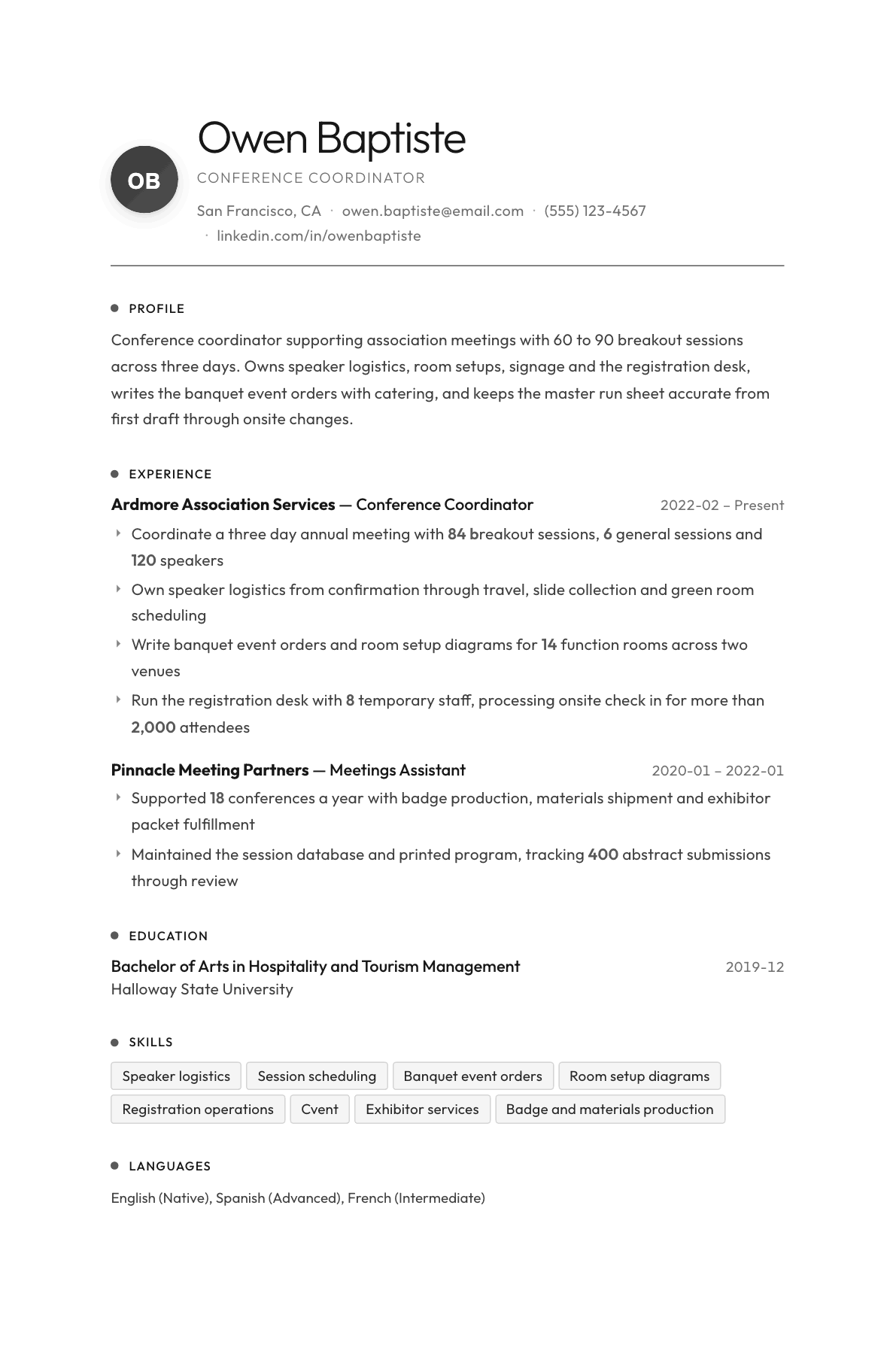
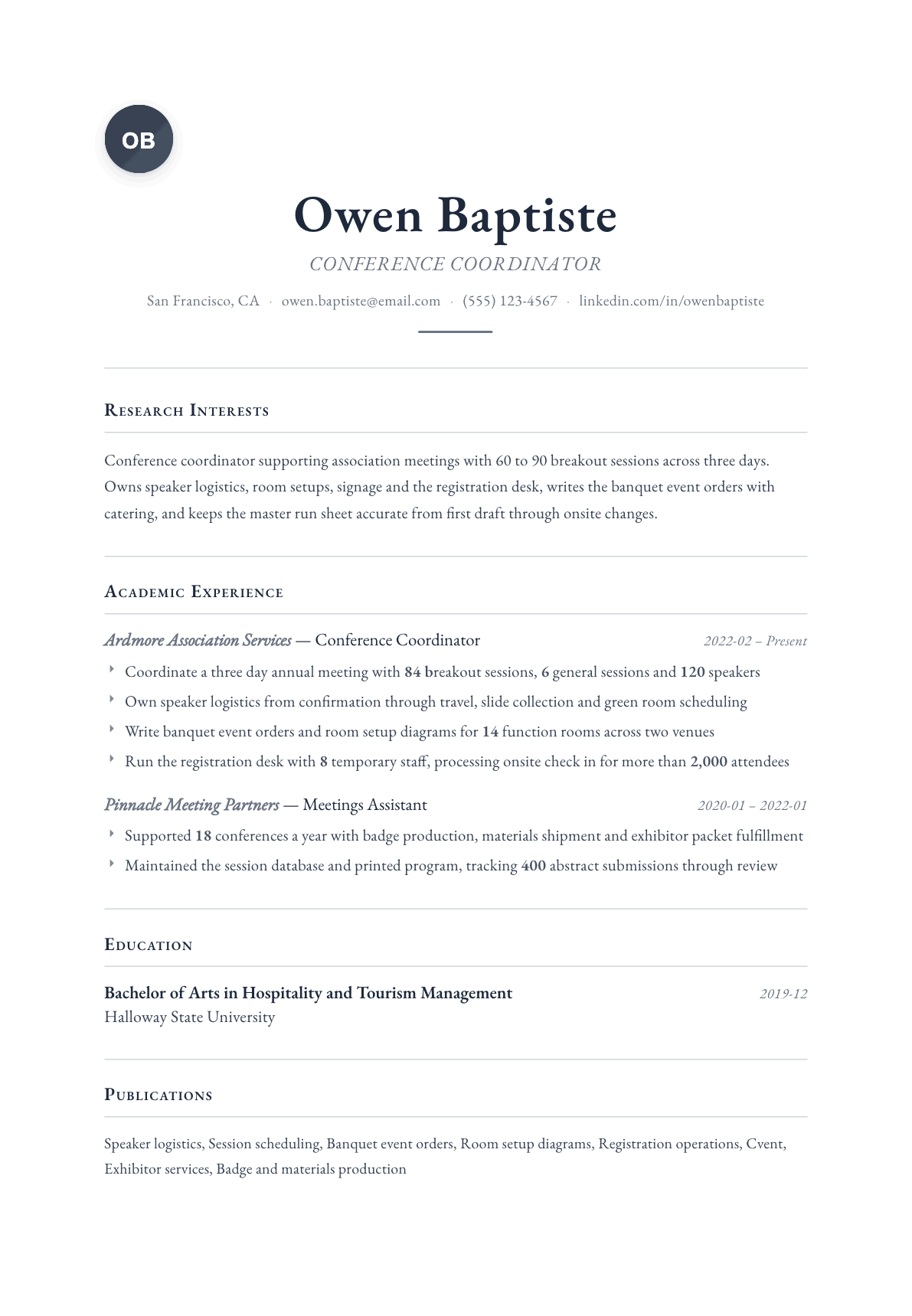
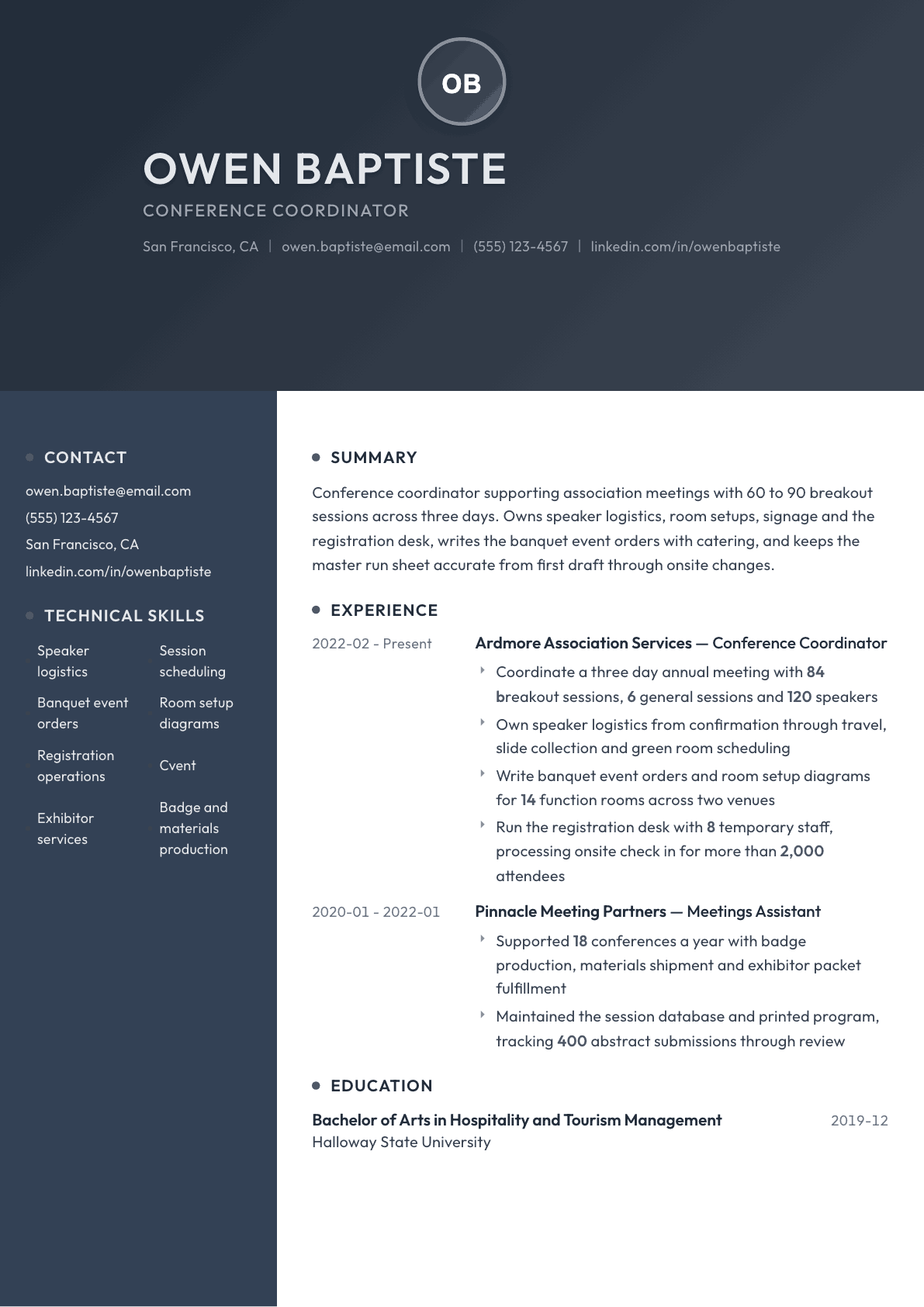
Example Conference Coordinator summary
Conference coordinator with five years supporting association annual meetings of more than eighty sessions across multiple venues. Owns speaker logistics, room setup diagrams, banquet event orders and the registration desk, and keeps the run sheet accurate through onsite changes. Comfortable leading temporary registration crews and working with exhibitors on move in. Seeking a meetings manager role with a national association.
Skills to list on a Conference Coordinator resume
- Session and agenda scheduling
- Speaker logistics
- Abstract and submission tracking
- Banquet event orders
- Room setup diagrams
- Registration operations
- Badge and materials production
- Exhibitor and sponsor services
- Audiovisual requirements
- Cvent
- Housing and room blocks
- Onsite run sheet management
- Vendor coordination
- Post meeting reporting
What actually gets this resume read
- Quantify the meeting: session count, speaker count, function rooms and attendees, because that is the scope test.
- Show speaker logistics in detail, from confirmation and travel through slide collection and green room timing.
- Name the registration and abstract systems you work in, such as Cvent, Eventbrite or an association database.
- Prove you can write a banquet event order and a room setup diagram, since venues live off both documents.
- Include exhibitor and sponsor service work: booth assignments, packets, freight deadlines and move in windows.
- Describe how you keep the run sheet current onsite when rooms, speakers and timings change during the day.
How to write a conference coordinator resume
A conference coordinator resume is checked against a program book. The person hiring is looking at a meeting with dozens of concurrent sessions, hundreds of speakers, a room block, an exhibit hall and a registration desk, and asking whether you can hold the details that hold it together.
That means the resume has to be countable. Sessions, speakers, function rooms, exhibitors, attendees and the number of meetings you support a year. Vague language about assisting with conferences reads as someone who has stood near a meeting rather than run part of one.
This guide walks through the sections a meetings department reads, three summaries from an assistant through a senior coordinator, before and after bullets, and the questions coordinators ask when they apply to a larger association or a venue side role.
Format: put the meeting profile up front
One page until you have run several large annual meetings. Under each employer, give the meeting profile: attendees, concurrent session count, speakers, function rooms and how many venues were involved. That block does the screening, and everything after it is supporting detail.
Reverse chronological, plain layout, no columns. Meetings departments and venue sales teams often run applications through recruiting software that mangles multi column templates, and this is not the role in which to make a design statement.
- Meeting profile: attendees, sessions, speakers, function rooms, venues, exhibit hall size.
- Meeting types: association annual meeting, scientific congress, corporate summit, training conference.
- Which pieces you owned: speakers, registration, exhibitors, housing, catering, audiovisual.
- Whether you worked in house, for a management company, or on the venue side.
Speaker and program logistics
Speaker management is the core of the job and the part most resumes underwrite. Describe the whole chain: invitation and confirmation, contracts or agreements, travel and accommodation, presentation collection with a cut off, speaker ready room scheduling, session moderator briefings and the reimbursement paperwork afterward.
If you handled abstracts, say so and give the volume. Submission windows, reviewer assignment, scoring, acceptance notices and building the accepted set into a grid of concurrent sessions is a distinct competence that scientific and medical meetings hire for specifically.
The venue documents: orders, diagrams and the run sheet
Prove you can write a banquet event order and a room setup diagram. Those two documents translate a program into a building: seating style, capacity, staging, head tables, audiovisual, catering timing, refresh breaks and turnover between sessions. A coordinator who writes them cleanly saves a venue a day of corrections.
The run sheet is the third document and the one that lives during the meeting. Say how you keep it current when a speaker cancels, a room floods or a session moves, and how the change reaches the audiovisual crew, the venue and the signage in the right order.
- Banquet event orders written and revised with the venue catering office.
- Room setup diagrams with capacities, staging and audiovisual noted.
- Turnover plans between concurrent sessions in the same room.
- Onsite change control: who is told, in what order, and how signage follows.
Registration, housing and exhibitors
Registration is a system and a desk. Name the platform you built categories and pricing rules in, then describe the desk: badge production, staffing counts, lanes, throughput and how you handled the opening morning rush with temporary staff you had never met before that week.
Housing and exhibitors sit alongside. Room blocks, cut off dates, attrition tracking and rooming lists on one side. Booth assignment, exhibitor kits, freight deadlines, move in windows and sponsor deliverables on the other. Coordinators who have touched both are noticeably more employable.
Skills and the vocabulary meetings departments search for
Postings repeat a defined set of terms: banquet event order, room block, attrition, run sheet, speaker ready room, concurrent sessions, exhibitor services, badge production, audiovisual requirements, post meeting report. Use the ones you have worked with and drop the rest, because interviewers in this field test vocabulary quickly.
Close the resume with reporting. Session attendance, registration by category, housing pickup against the block, exhibitor renewals and a survey summary are what a meetings director carries into next year planning, and a coordinator who produces them gets promoted.
Conference Coordinator resume summary examples
Meetings assistant
Meetings assistant supporting eighteen conferences a year with badge production, materials and exhibitor packet fulfillment, and maintaining the session database and printed program. Tracked four hundred abstract submissions through review last cycle, and is ready for a conference coordinator role on a large annual meeting.
Coordinator
Conference coordinator on a three day association annual meeting with eighty four breakout sessions, six general sessions and one hundred and twenty speakers. Owns speaker logistics, banquet event orders and room diagrams for fourteen function rooms, and runs a registration desk staffed by eight temporary workers.
Senior coordinator
Senior conference coordinator managing the full program cycle for a scientific congress across two venues, including abstract review, concurrent session grids and speaker travel. Owns the housing block and attrition tracking, briefs the audiovisual crew each morning, and produces the post meeting report for the board.
Work experience bullets: before and after
Before: Helped organize the annual conference.
After: Coordinated a three day annual meeting with eighty four breakout sessions, six general sessions and one hundred and twenty speakers across two venues.
Session and speaker counts are the scale test for this role, and a general claim skips it entirely.
Before: Communicated with speakers.
After: Ran speaker logistics end to end: confirmations, travel and accommodation, slide collection against a cut off, and speaker ready room scheduling for every session.
The chain shows ownership of a process rather than a mailbox someone else set up.
Before: Worked with the venue on setup.
After: Wrote banquet event orders and room setup diagrams for fourteen function rooms, including capacities, staging, audiovisual and turnover between concurrent sessions.
Naming both documents proves you can translate a program into a building without supervision.
Before: Ran the registration desk.
After: Opened the registration desk with eight temporary staff across three lanes, checking in more than two thousand attendees with pre printed badges.
Staffing, lanes and volume describe a desk a meetings director can compare against her own.
Before: Kept everything on track during the event.
After: Maintained the master run sheet onsite through speaker cancellations and two room changes, pushing each update to audiovisual, the venue and signage the same hour.
Change control is the real onsite skill, and describing the path of an update makes it verifiable.
Hard skills
- Session and agenda scheduling
- Speaker logistics and travel
- Abstract submission and review tracking
- Banquet event orders
- Room setup diagrams and capacities
- Registration configuration and onsite check in
- Badge and materials production
- Housing blocks and attrition tracking
- Exhibitor and sponsor services
- Audiovisual requirements gathering
- Onsite run sheet management
- Post meeting reporting
Soft skills
- Detail retention across a long build
- Speaker diplomacy
- Composure at the registration desk
- Clear briefing of temporary staff
- Written precision in venue documents
Certifications worth listing
- Certified Meeting Professional (CMP) (Events Industry Council)
- Digital Event Strategist (DES) (Professional Convention Management Association)
- Certified Government Meeting Professional (CGMP) (Society of Government Meeting Professionals)
Mistakes that cost conference coordinator candidates the interview
- Describing conferences without session, speaker or attendee counts, which removes every scale signal from the page.
- Treating speaker management as correspondence rather than a chain with travel, slides and a ready room attached.
- Never mentioning banquet event orders or setup diagrams, the two documents venues judge a coordinator by.
- Omitting housing and attrition work, which is where associations carry real contractual risk.
- Leaving out onsite change control, so the reader assumes you have only worked the build and not the meeting.
- Ending the work history at the closing session with no post meeting reporting to show.
Conference Coordinator resume questions
What separates a conference coordinator from an event coordinator?
Program depth. A conference coordinator manages concurrent sessions, speakers, abstracts, housing blocks and exhibitors over a multi day agenda, where general event work often centers on a single room and one running order.
How do I show abstract management experience?
Give the submission volume, the review structure and what you built from the accepted set. Tracking several hundred submissions through reviewer assignment and scoring, then constructing the session grid, is the detail scientific meetings hire against.
Do I need to know a specific registration platform?
Knowing one well transfers to the next, so name the platform and say what you configured: categories, pricing rules, questions, badge fields and reports. Configuration experience is what a meetings director is actually testing for.
How much detail should I give about the venue relationship?
Enough to show you can work the catering office directly. Name the documents you wrote, how revisions were handled, and how you resolved a setup that arrived wrong on the morning of a session with attendees already arriving.
Is the CMP credential useful for a coordinator?
Yes, particularly inside associations and government meeting work, because it standardizes the vocabulary and signals a career commitment. Pair it with a meeting you can describe session by session, since the credential alone persuades nobody.
Related resume examples
- Event Planner Resume example
- Banquet Manager Resume example
- Event Manager Resume example
- Guest Services Manager Resume example
- Event Coordinator Resume example
- Catering Sales Manager Resume example