Event Planner Resume Examples: free ATS score and gap list
Event Planner Resume: Event Organizer Resume Sample and Examples
By Mustafa Tarabya, founder of CVBooster · Published · Updated
Event planner and event organizer resume sample by level, with one example written out in full and the budgets, vendors and attendance numbers to show.
Sample resumes for a event planner
The same event planner content laid out in three CVBooster templates, so you can see what the finished document looks like before you write a word.
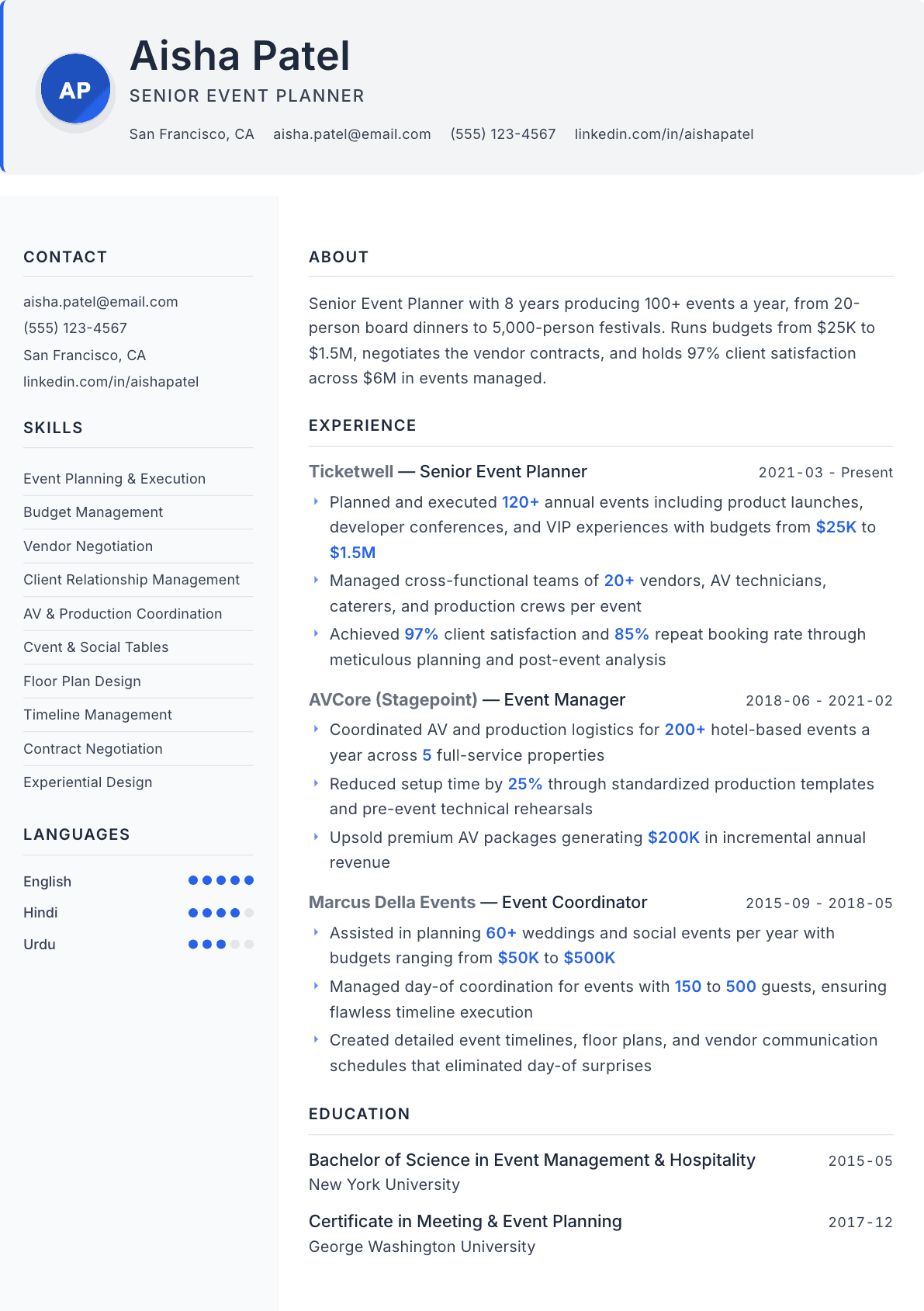
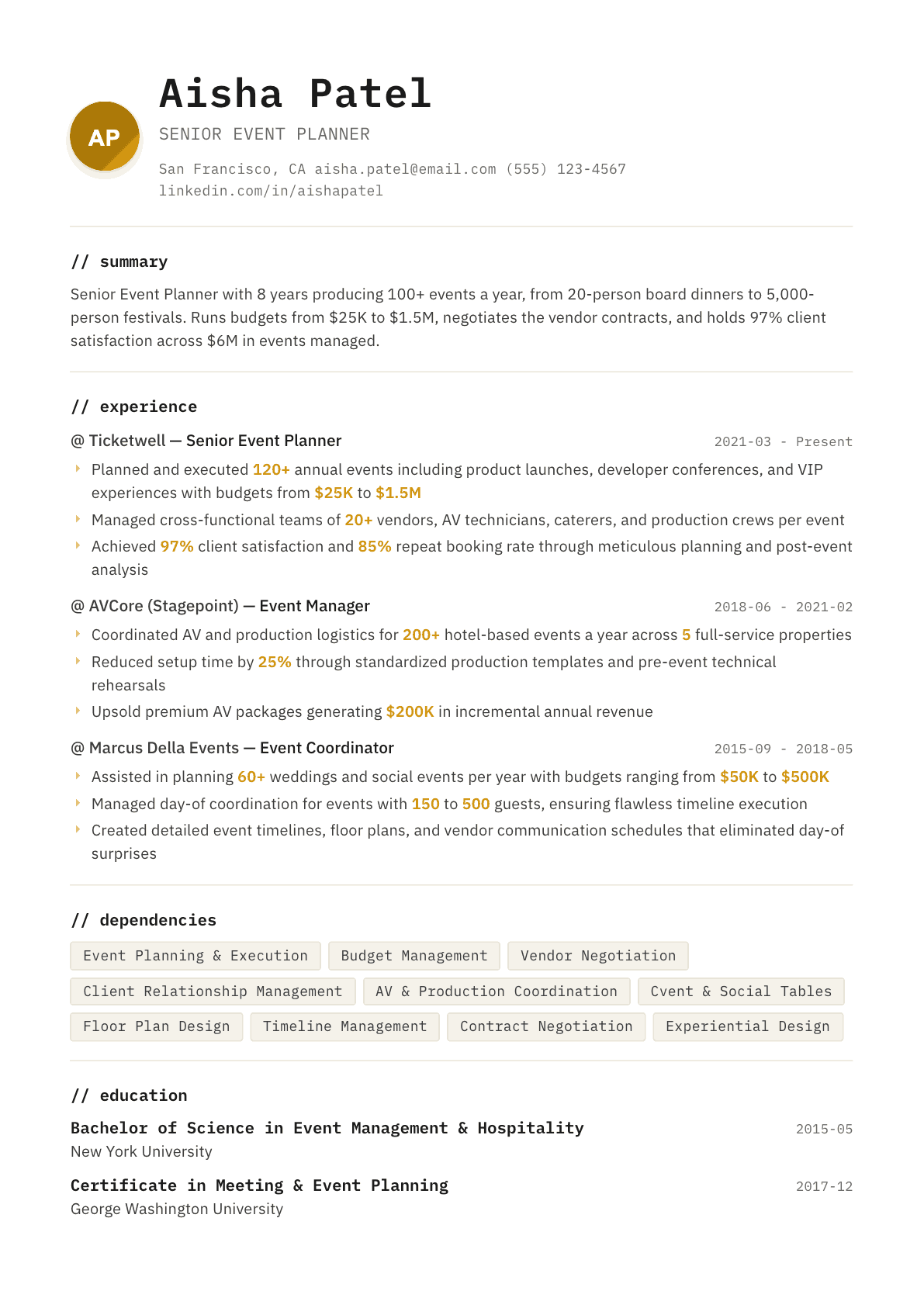
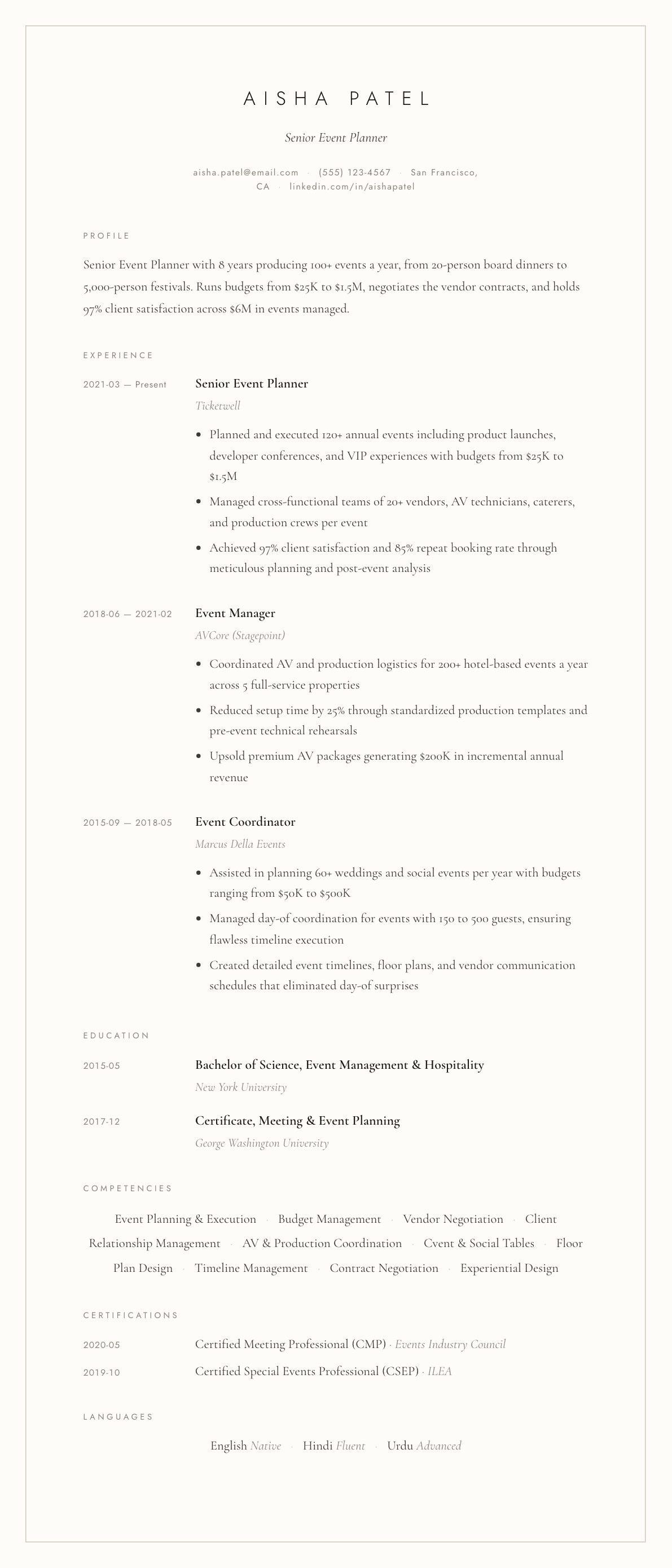
Example Event Planner summary
Senior Event Planner producing 120 events a year on budgets up to $1.5M, from product launches to multi-day conferences. Holds 97% client satisfaction and an 85% repeat booking rate. CMP and CSEP certified, strong on vendor negotiation and AV production.
Skills to list on a Event Planner resume
- Event Planning & Execution
- Budget Management
- Vendor Negotiation
- Client Management
- AV & Production
- Cvent
- Social Tables
- Floor Plan Design
- Timeline Management
- Contract Negotiation
- Experiential Design
- Hybrid & Virtual Events
- Sponsorship Management
- Risk Management
- Post-Event Analytics
What actually gets this resume read
- Quantify event portfolio: number of events per year, budget ranges, guest counts, and client satisfaction rates.
- Showcase diverse event types (corporate, social, nonprofit, hybrid/virtual) to demonstrate versatility.
- Highlight vendor management scope with the number of vendors coordinated and negotiation savings achieved.
- Include event technology proficiency (Cvent, Social Tables, Bizzabo, Whova) for ATS optimization.
- Demonstrate creative vision with specific examples of themed events, experiential elements, or brand activations.
- Mention repeat client rates and referral metrics as evidence of exceptional service.
How to write a event planner resume
An event planner resume is read by an agency producer, an in-house marketing or events director, or a client-side hiring manager, and all three are scanning for the same three things: the size of the events you have owned, the budgets you have controlled, and whether anything you produced actually happened on the day it was supposed to. Event work is judged on delivery, so a resume built on adjectives instead of scale reads as junior no matter how many years it covers.
The title spans several businesses. Corporate and conference planning, association meetings, brand experiential and product launches, social and wedding planning, and nonprofit fundraising events all use it, and each has a different budget structure, a different sales cycle and a different definition of success. Registration numbers matter to a conference planner, attendee dwell time matters to an experiential producer, and net funds raised matters to a gala planner.
This guide covers how to build the document for someone who hires producers, with example summaries for an event coordinator, a working planner and a senior planner or producer, before and after bullets that swap vague coordination language for hard delivery detail, and the questions planners ask when they change sectors or go from in-house to agency.
Format: one page early, two once you have a portfolio of events
Reverse chronological with a short profile line under each employer: organization type, the kind of events produced, the annual event count, the budget range you controlled, and the largest attendance you have delivered. Those five facts let a producer place you within one read.
Add a selected events section once you have produced work worth naming. Give each event the format, the attendance, the budget band, your role and the outcome. Agencies pull from that block when they staff a pitch, which makes it the most practically useful section on the page.
- Header: name, city and state, phone, email, CMP or other credential.
- Order: summary, experience, selected events, systems, certifications, education.
- Say whether each event was in person, virtual or hybrid, since production skills differ sharply.
Summary: event type, attendance range, budget scale and role
Three or four lines. Name the sector, the event types, the attendance range from your smallest to your largest, the budget band you managed, and whether you led or supported. A reader is matching you to a program, so the difference between producing intimate executive dinners and producing a multi-day conference for thousands has to be visible immediately.
Add a specialty when you have one. Speaker and content management, exhibitor and sponsorship operations, registration and attendee data, production and staging, international logistics with travel and visas, or accessibility and inclusive design each differentiate a candidate in a field where everyone claims organization.
Experience: budget, timeline, vendors and the day itself
Budget first. Total budget managed, the number of line items or cost centers, how close you landed to the number, and any savings you found through negotiation or scope change. Event budgets overrun quietly, and a planner who reports variance against budget is signaling a discipline most candidates never mention.
Then the production. The critical path and how far ahead you built it. Venue sourcing and contract negotiation including attrition, force majeure and food and beverage minimums. Vendor management by count and category: catering, audio visual, staging, decor, transport, security, talent. The run of show and how detailed it was. Load-in and load-out schedules. Rehearsals and technical checks.
Then the attendee side. Registration numbers against target, website and communications, badge and check-in flow and its throughput, session attendance, mobile app adoption, and post-event survey results. Finally, the measurable outcome the client cared about: leads captured, funds raised, press coverage, renewal or rebooking. Ending your bullets at the event ends them one step before the part that matters.
Systems and the operational spine
Name the platforms. Cvent, Eventbrite, Bizzabo, Hopin, Tripleseat, Social Tables, Asana, Monday and Smartsheet all appear on postings, and each names a different part of the job: registration, ticketing, virtual delivery, venue and catering, diagramming and project management. A planner who lists the exact stack is far easier to slot into a team.
Show the documents you produce, because they are the real deliverable between kickoff and doors. Production schedule, run of show, vendor matrix, budget tracker, floor plan and rooming list. Naming them signals you have run events rather than attended them.
- Give the registration platform and the largest registration you have managed on it.
- Include contracting detail: attrition clauses, minimums, cancellation terms, insurance certificates.
- Note virtual and hybrid production experience by platform and concurrent attendee count.
Credentials and the professional bodies that matter
The Certified Meeting Professional designation from the Events Industry Council is the most recognized credential in the field and carries an experience requirement, so it belongs after your name and in its own line. The Digital Event Strategist credential from the same council reads well for virtual and hybrid work.
Beyond credentials, membership and volunteer leadership in a professional association is worth a line, as is any speaking you have done on event operations. Both signal a planner who stays current on contracting, safety and technology rather than repeating the same event annually.
Event planning resume example: one complete page
An event planning resume is read for three numbers before anything else: how many events a year, how many people at each, and how much of the budget you controlled. The event planning resume example below is a mid level corporate planner, written out as the top half of the page. A wedding or social planner keeps the same order and swaps corporate clients for couples and venues.
Profile: Tessa Morgan, Event Planner. Six years planning corporate events of 50 to 1,200 attendees, currently 40 events a year for a professional services firm. Owns the budget, vendor contracts and run of show for every event, and has delivered three multi day conferences with hotel room blocks over 600 room nights.
If the posting says event organizer rather than planner, use the sample below unchanged except for the headline. Organizer is the more common word in community, sports and festival work, and the hiring manager types the word from her own advert when she searches applications. Keep the title you actually held in the job heading and put the posting title in the summary line.
- Current role, Event Planner, Ashgrove Advisory Group, four years.
- Plans 40 events a year, from client dinners of 50 to an annual conference of 1,200, and owns each budget from first quote to final reconciliation.
- Negotiated hotel room blocks and food and beverage minimums for three conferences, keeping attrition penalties at zero for two years running.
- Manages 30 regular vendors, including AV, catering, transport and print, with contracts and certificates of insurance on file before booking.
- Writes the run of show and briefs on site staff of up to 25, and runs the event day from the production desk.
- Previous role, Events Coordinator, Bellmont Hotel, two years: coordinated 150 weddings and meetings a year with banquet event orders.
- Skills: Cvent, Eventbrite, Social Tables, Excel budgets, contract negotiation, run of show, vendor management. Certification: CMP in progress.
Event Planner resume summary examples
Event coordinator
Event coordinator with 2 years supporting 60 corporate and social events a year, building run of show documents, managing registration in Cvent for groups up to 500, and running day-of vendor check-in. Produced floor plans and timelines that kept load-in on schedule across a busy season.
Event planner
Event planner producing 120 events a year from executive dinners to a 2,000-attendee user conference, owning budgets from small internal programs to major launches. Manages 20 vendors per event, holds delivery to the approved budget, and maintains an 85% client rebooking rate.
Senior producer
Senior event producer with 8 years across agency and in-house work, leading conferences, product launches and 5,000-person festivals. Owns venue contracting, production partners and the full critical path, manages a team of three coordinators, and reports post-event results against the client objective.
Work experience bullets: before and after
Before: Planned and executed corporate events.
After: Produced 120 events a year including product launches, a developer conference and executive dinners, with attendance from 20 to 2,000 and budgets spanning internal programs through flagship launches.
Event count, formats and the attendance range give a producer your real range instead of a job description.
Before: Managed event budgets.
After: Owned budgets across 30 cost centers per flagship event, tracked variance weekly in a live budget sheet, and closed the season within the approved number on every program.
Variance tracking and closing on budget is the single most persuasive claim an event planner can make.
Before: Coordinated with vendors and suppliers.
After: Managed 20 vendors per event across catering, audio visual, staging, decor and transport, running one master production schedule and a load-in sequence that held to the venue dock window.
The vendor count and the load-in constraint show you controlled the operation rather than forwarding emails.
Before: Handled event registration and attendee communication.
After: Ran registration in Cvent for a 2,000-attendee conference, hitting the registration target three weeks early and moving 1,800 badge check-ins through in under 40 minutes on day one.
Registration against target plus check-in throughput are the two numbers a conference owner remembers.
Before: Received positive feedback from clients.
After: Closed the year with an 85% rebooking rate across recurring corporate clients, driven by a post-event report that compared delivery against the objectives agreed at kickoff.
Rebooking is the outcome, and naming the report explains the mechanism that produced it.
Hard skills
- Event budget management and variance tracking
- Venue sourcing and contract negotiation
- Run of show and production scheduling
- Vendor and supplier management
- Registration platforms including Cvent
- Virtual and hybrid event production
- Audio visual and staging coordination
- Floor plans and diagramming
- Sponsorship and exhibitor operations
- Speaker and content management
- Attendee data and post-event reporting
- Risk, insurance and safety planning
Soft skills
- Calm on show day
- Client expectation management
- Negotiation with venues and vendors
- Attention to sequencing
- Team direction under pressure
- Written clarity in production documents
Certifications worth listing
- Certified Meeting Professional (CMP) (Events Industry Council)
- Digital Event Strategist (DES) (Professional Convention Management Association)
- Certified Special Events Professional (CSEP) (International Live Events Association)
- Certified Government Meeting Professional (CGMP) (Society of Government Meeting Professionals)
Mistakes that cost event planner candidates the interview
- Describing events without attendance, budget band or your actual role, which makes every line unreadable.
- Never reporting budget variance, when landing on the number is the core competence of the job.
- Ending bullets at the event instead of the outcome the client paid for, such as leads, funds raised or rebooking.
- Listing project management software without naming the registration platform, which is the field-specific tool.
- Writing one resume for corporate conferences and social weddings when the two sectors hire on different evidence.
- Leaving virtual and hybrid production off the page entirely, which now reads as a gap rather than a preference.
Event Planner resume questions
What is the difference between an event planner and an event coordinator resume?
A coordinator supports execution: documents, vendor check-in, day-of logistics. A planner owns the budget, the contracts and the outcome. If you are applying up, lead with any budget you controlled and any venue contract you negotiated, since those are the ownership markers.
How do I show event budgets without disclosing client figures?
Use bands rather than exact numbers, describe the number of cost centers you managed, and report variance against the approved budget as a percentage. Hiring managers care that you held the line, not what a former client spent on staging.
What should an event organizer resume sample show?
The events you ran with format, attendance and budget band, the vendors and venues you managed, the registration or ticketing platform you used and one measurable result per event. Put the posting title, event organizer, in your headline and summary. A Certified Meeting Professional credential belongs near the top if you hold it.
How do I move from in-house events to an agency?
Agencies staff against pitches, so give them a selected events block they can lift: format, attendance, budget band, your role and outcome. Add multi-client capacity by showing how many concurrent programs you ran, since that is the difference an agency worries about.
What should an event planning resume example include?
Events per year, attendance range, the largest budget you controlled, the vendors you managed and the platforms you used, such as Cvent or Social Tables. Add one result that is not about feelings, such as zero attrition penalties or a conference delivered under budget, and keep it to one page until you have a portfolio.
Related resume examples
- Catering Manager Resume example
- Hotel General Manager Resume example
- Banquet Manager Resume example
- Wedding Planner Resume example
- Event Manager Resume example
- Catering Sales Manager Resume example