Event Coordinator Resume Examples: the lines they read
Plan an Event Coordinator Resume That Gets You Hired
By Mustafa Tarabya, founder of CVBooster · Published · Updated
Create an organized event coordinator resume with event logistics expertise, budget management, and attendee satisfaction metrics that event companies seek.
Sample resumes for a event coordinator
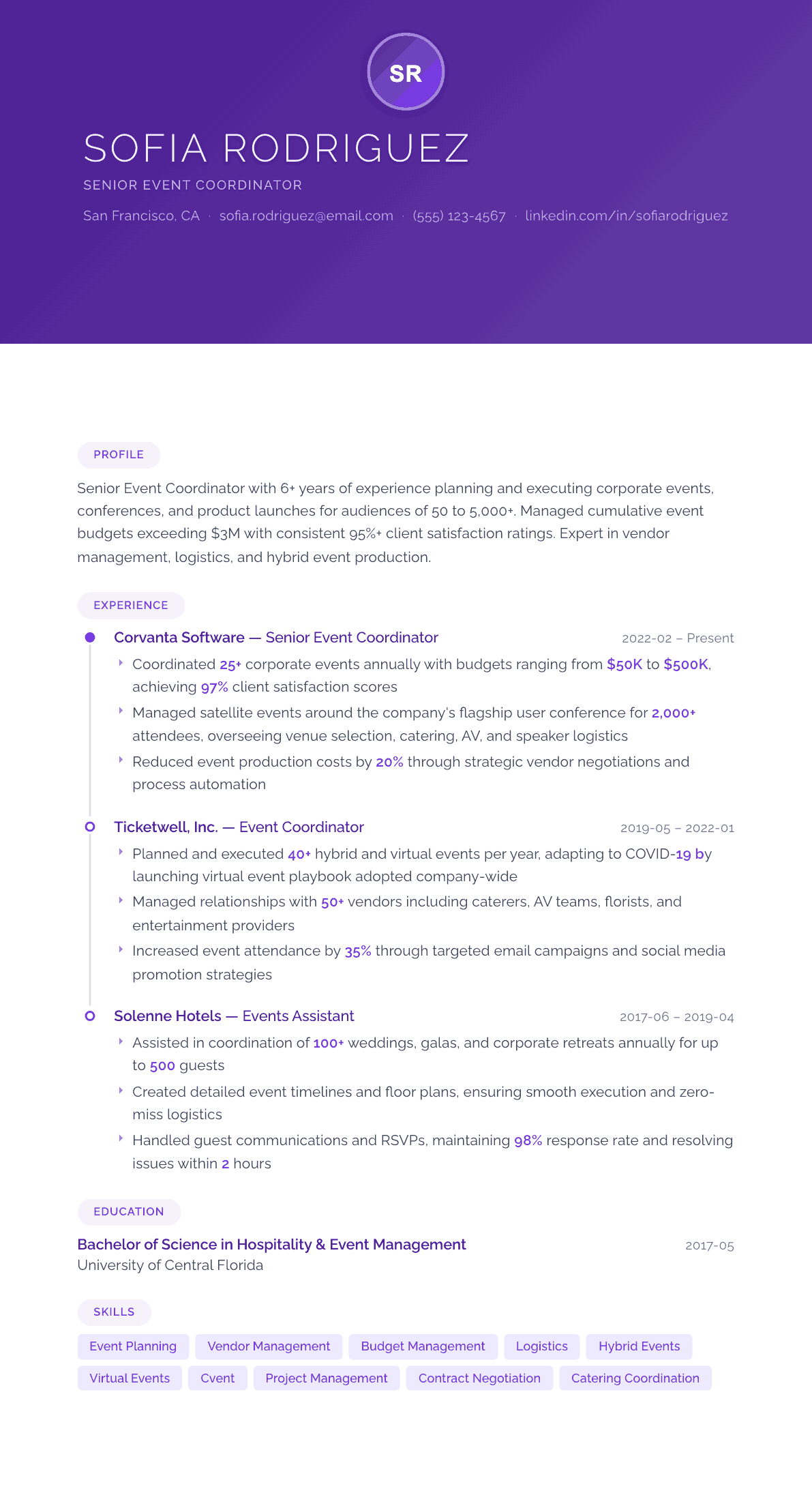
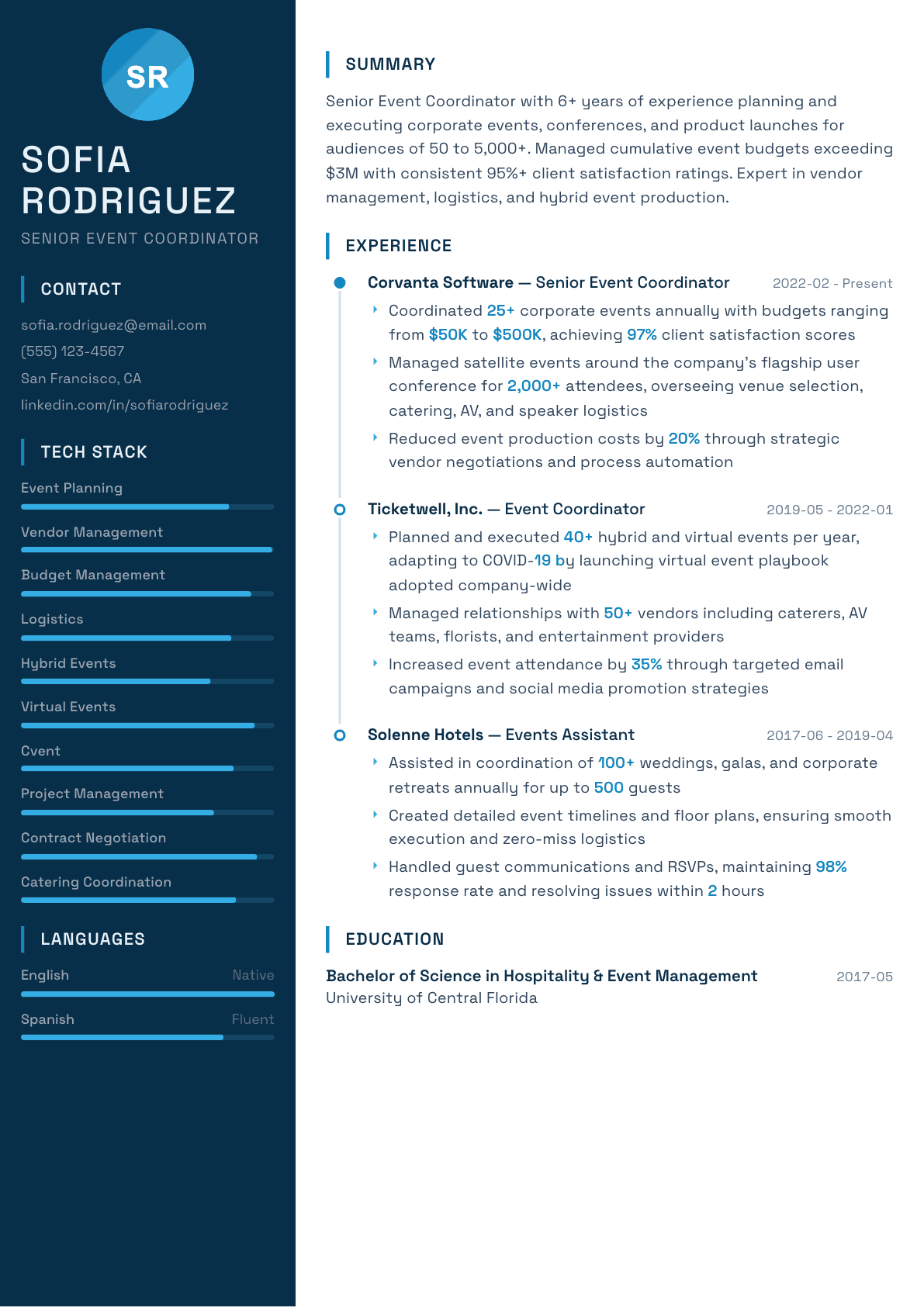
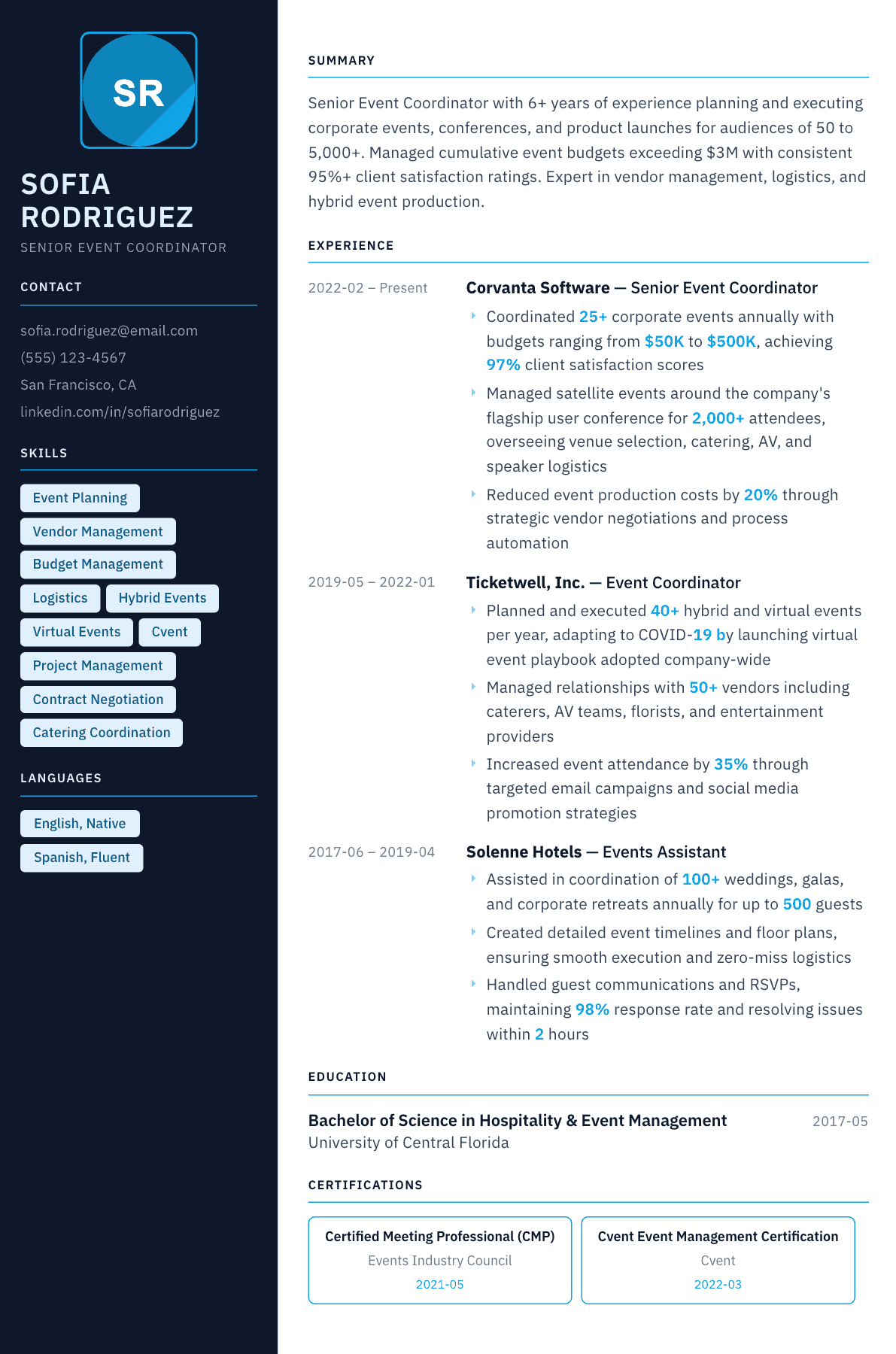
The same event coordinator content laid out in three CVBooster templates, so you can see what the finished document looks like before you write a word.
Example Event Coordinator summary
Event Coordinator with 6 years running 25+ corporate events a year on budgets up to $500K, for audiences from 50 to 5,000. Holds 97% client satisfaction and cut production costs 20% through vendor negotiation. Certified Meeting Professional, strong on hybrid production and vendor logistics.
Skills to list on a Event Coordinator resume
- Event Planning
- Event Coordination
- Vendor Management
- Budget Management
- Logistics
- Hybrid Events
- Virtual Events
- Cvent
- Eventbrite
- Contract Negotiation
- Catering
- AV Production
- Sponsorship Management
- Project Management
What actually gets this resume read
- Quantify your events: number of events per year, audience sizes, budgets managed, and satisfaction scores.
- Highlight vendor management experience and cost savings achieved through negotiation.
- Showcase hybrid and virtual event expertise as these formats continue to be in high demand.
- Include specific event management tools: Cvent, Eventbrite, Bizzabo, Hopin, Whova.
- Demonstrate crisis management and problem-solving skills with specific examples.
How to write a event coordinator resume
Event coordinator applications are screened for evidence that nothing fell apart on your watch. The person hiring has been on a show floor when a keynote laptop died, a caterer arrived two hours late, or a hotel room block sold out a week before an event. They are reading your resume for proof that you have run the timeline, held the vendors to it, and made the call when a plan stopped working at nine in the evening with four hundred guests arriving the next morning.
The second thing they screen for is the type of event, because the skills only partly transfer. Corporate conferences turn on registration data, room blocks, session logistics and sponsor deliverables. Trade shows turn on booth build, freight and union labor rules. Weddings and social events turn on client relationships and vendor negotiation. Internal and field marketing events turn on pipeline and follow-up. Name the types you have run, or the reader will assume the smallest one.
This guide covers how to structure an event resume around the portfolio of events themselves, which numbers matter, three summaries from a first coordinator role through a senior producer, before-and-after bullets, and the questions coordinators ask when the work is invisible if it went well.
Format: one page with an event profile block
One page for most coordinators, two once you are producing large programs. Under the summary, add an event profile: the event types you run, the number of events per year, the attendance range, the budget band you have held, and the registration and event platforms you work in. Hiring managers use that block to place you instantly.
Then consider a short selected events list. Four or five entries, each with the event name or type, the attendance, the format (in person, virtual, hybrid), your role, and one line on the outcome or the complication you handled. This is the closest thing the profession has to a portfolio and most applicants leave it out.
- Header: name, title, city, phone, email, and willingness to travel if that is true.
- Event profile: types, annual volume, attendance range, budget band, platforms.
- Sections in this order: summary, event profile, selected events, experience, skills, certifications, education.
Summary: the events you run, the scale, and what you own end to end
Three lines naming the event types, the annual volume, the largest attendance you have handled, and the parts of the process you own without supervision: sourcing and contracting, budget, run of show, vendor management, on-site direction, post-event reporting. Detail oriented is the phrase every candidate in this pile uses; ownership language is what separates them.
If you have run virtual and hybrid formats, say so with the platform, because production skill in a streamed environment is a separate competence from room logistics and many teams still need both.
Experience: the timeline, the vendors, the budget and the save
Write bullets that follow the real arc of an event. Sourcing and site selection, contract terms you negotiated including attrition and cancellation clauses, the production timeline you built and held, the run of show and cue-to-cue, load in and load out, and the post-event reconciliation. That sequence tells a manager you have owned events rather than assisted on them.
Vendors are the core of the job. Name the categories you manage: venue, catering, audio visual, staging, decor, transport, security, printing, freight, staffing agencies, interpreters. Then show a negotiation with a result, since cost control is one of the few parts of the role with a clean number attached.
Include one bullet on a save. Something went wrong and you fixed it: a speaker cancellation covered within an hour, a power failure managed with the venue engineer, a registration system outage handled with a paper backup at the door. This is the most memorable bullet on an event resume and almost nobody includes one.
Numbers that make an event resume credible
Attendance and budget are the baseline. Add the operational figures that show control: registration to attendance conversion, on-site check-in time, the share of the budget you came in under, sponsor deliverables fulfilled, session satisfaction scores from the post-event survey, and repeat attendance or renewal for a recurring event.
For events tied to marketing, add the downstream result the business cared about: meetings booked at a booth, qualified leads captured and handed to sales within an agreed window, or pipeline attributed to the event. State the source of the number, since event attribution is contested in most companies.
- Scale: attendees, sessions, exhibitors, room nights, staff and volunteers you directed.
- Money: total budget, largest single contract, savings from renegotiation, final variance to budget.
- Experience quality: satisfaction score, net promoter result, complaint volume, repeat attendance.
- Business result: leads captured, meetings held, sponsor renewals, revenue from ticketing.
Tools, certifications and the keywords postings use
Name the registration and event management platforms you have configured rather than just used: Cvent, Eventbrite, Bizzabo, Swoogo, Whova, Splash. Add the streaming or virtual platform, the project tool your timeline lives in, the badge and check-in system, and the diagramming tool you use for floor plans.
Postings repeat a fixed vocabulary: event planning, logistics, vendor management, contract negotiation, budget management, run of show, registration, sponsorship fulfillment, hybrid events, site selection, room block. Use the ones that match your work in the profile block and again inside a bullet where they are demonstrated.
Event Coordinator resume summary examples
First coordinator role
Event coordinator supporting twelve corporate events a year with attendance up to 300, owning registration setup, vendor scheduling and on-site check-in. Built the current check-in process that cut average wait at the door to under two minutes, and manages catering and audio visual bookings independently.
Six years in
Event coordinator with six years running conferences and field marketing events, 25 a year with budgets up to a quarter of a million and attendance to 1,200. Owns site selection, contracting and run of show, negotiated a venue package that came in 18% under budget, and produces hybrid formats in Cvent.
Senior producer
Senior event producer leading a flagship annual conference of 3,500 attendees plus a regional roadshow across six cities. Directs a team of three coordinators and a staffing agency, manages sponsor fulfillment for 40 partners, and holds a repeat attendance rate above half year over year.
Work experience bullets: before and after
Before: Planned and executed corporate events.
After: Planned and produced 25 corporate events a year ranging from executive dinners of 30 to a conference of 1,200, owning site selection, contracting, run of show and on-site direction.
Volume, the range of formats and the parts you owned show the level far better than the word executed.
Before: Managed vendors and negotiated contracts.
After: Managed venue, catering, audio visual and staging vendors across a quarter of a million in annual spend, and renegotiated the audio visual contract with attrition terms that cut the line item by 18%.
Naming the vendor categories, the spend and a specific renegotiated clause proves commercial control.
Before: Handled event registration and attendee communications.
After: Configured registration in Cvent with four ticket types and session capacity limits, ran the pre-event message sequence, and lifted registration to attendance from 62% to 78%.
Platform configuration and a conversion figure turn an administrative line into evidence of a system you built.
Before: Solved problems on-site during events.
After: Covered a keynote cancellation three hours before the session by moving a panel forward, rebriefing two speakers and reprinting the agenda, with no change to the published end time.
A specific save with the actions and the outcome is the most convincing bullet an event resume can carry.
Before: Worked with sales on event follow-up.
After: Set the lead capture standard at trade show booths, handed scanned contacts to sales within 24 hours with session and interest tags, and tracked 60 booked meetings from a single show.
A handoff time and a measured business result connect event logistics to the outcome a marketing leader funds.
Hard skills
- Event planning and production
- Site selection and sourcing
- Contract negotiation
- Budget management and reconciliation
- Run of show and cue sheets
- Vendor and supplier management
- Registration platform configuration
- Cvent
- Eventbrite
- Hybrid and virtual production
- Audio visual and staging coordination
- Sponsorship fulfillment
- Room blocks and travel logistics
- Post-event reporting and surveys
Soft skills
- Composure on site
- Vendor relationship building
- Clear direction to temporary staff
- Anticipating failure points
- Hospitality instinct
- Negotiating without damaging the relationship
Certifications worth listing
- Certified Meeting Professional (CMP) (Events Industry Council)
- Certified Special Events Professional (CSEP) (International Live Events Association)
- Digital Event Strategist (DES) (Professional Convention Management Association)
- Cvent Event Management Certification (Cvent)
Mistakes that cost event coordinator candidates the interview
- Describing events with adjectives such as successful and flawless instead of attendance, budget and format.
- Leaving out the budget band, which is the fastest way for a manager to judge the scale you have handled.
- Listing duties from the planning phase only, so the reader cannot tell whether you have directed anything on site.
- Skipping the save, which is the single most persuasive story an event professional can put on the page.
- Naming platforms you have logged into rather than the ones you configured, which fails the first practical question.
- Ignoring post-event work, since reconciliation, surveys and reporting are what turn a coordinator into a producer.
- Claiming hybrid experience when you attended a streamed event rather than produced one.
Event Coordinator resume questions
What should an event coordinator resume include besides job duties?
A short selected events list. Give four or five events with the type, attendance, format, your role and one line about the result or complication. It functions as a portfolio and gives an interviewer something concrete to ask about.
How do I quantify events if I never owned the budget?
Use the numbers you did control: attendees checked in, vendors coordinated, sessions scheduled, staff or volunteers directed, registration conversion, and check-in wait time. Those show operational scale without claiming financial authority you did not have.
Is the CMP worth it for an event coordinator?
It carries real weight in corporate and association meetings and appears as a preference in many postings. It requires documented experience and an exam, so it usually makes sense once you have several years of event work rather than at the very start.
How do I show virtual and hybrid event experience?
Name the streaming or event platform, say what you produced rather than attended, and describe the production elements: speaker rehearsals, run of show for a live stream, moderation of chat and questions, and how you handled the in-room and remote audiences at once.
Should I list weddings and social events on a corporate event resume?
Yes, when you translate them. Client management, vendor negotiation, timeline discipline and on-site direction all transfer. Present them with guest counts, budgets and vendor categories in the same format as your corporate work rather than as a separate softer section.
Related resume examples
- Campaign Manager Resume example
- PR Specialist Resume example
- Community Manager Resume example
- Event Planner Resume example
- Catering Manager Resume example
- Event Manager Resume example