Event Manager Resume Examples: free ATS score and gap list
Write an Event Manager Resume That Shows Budget and Scale
By Mustafa Tarabya, founder of CVBooster · Published · Updated
Event management resume sample with a complete entry, attendee counts, budget scope and vendor detail, plus the keywords venues search for.
Sample resumes for a event manager
The same event manager content laid out in three CVBooster templates, so you can see what the finished document looks like before you write a word.
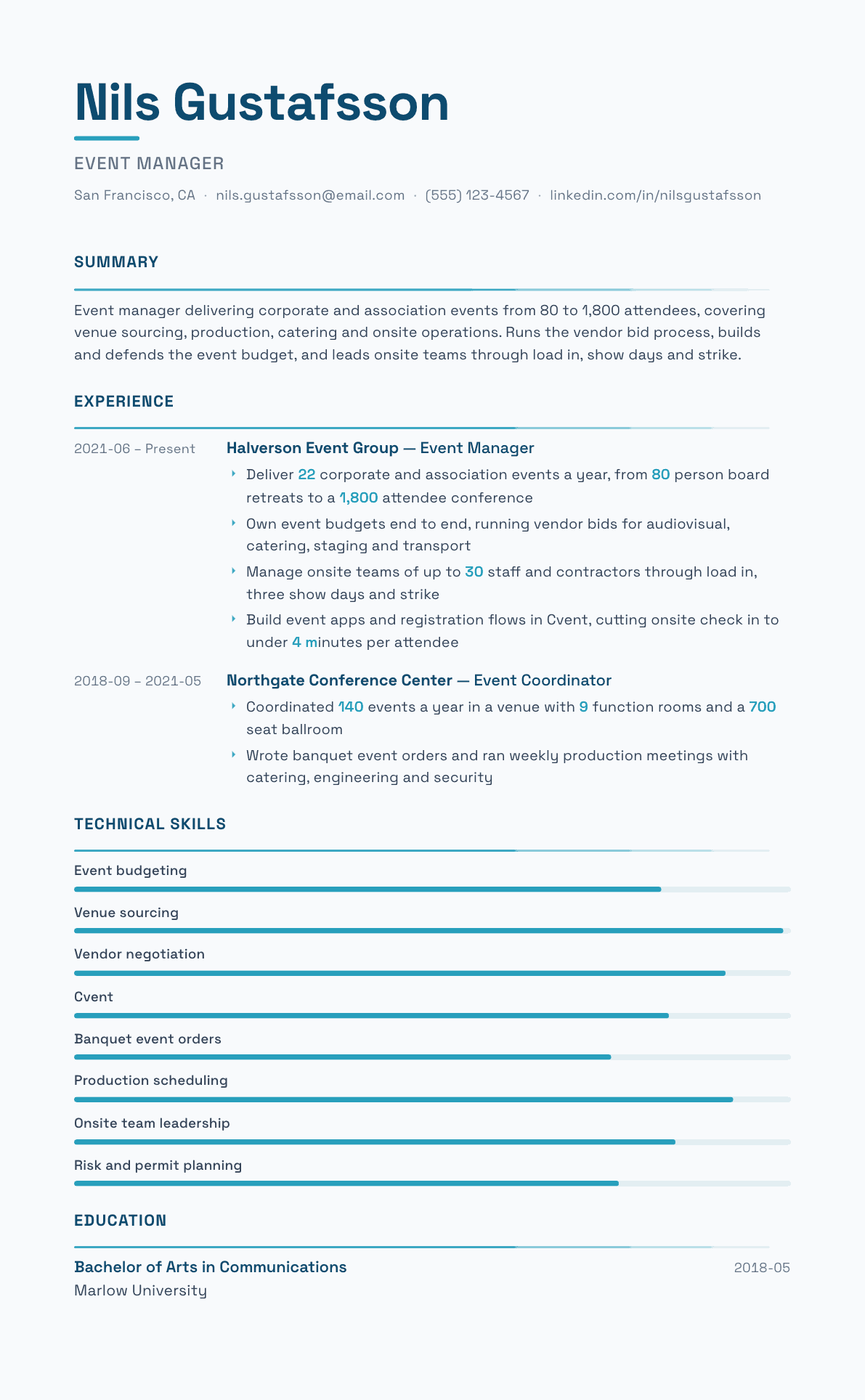
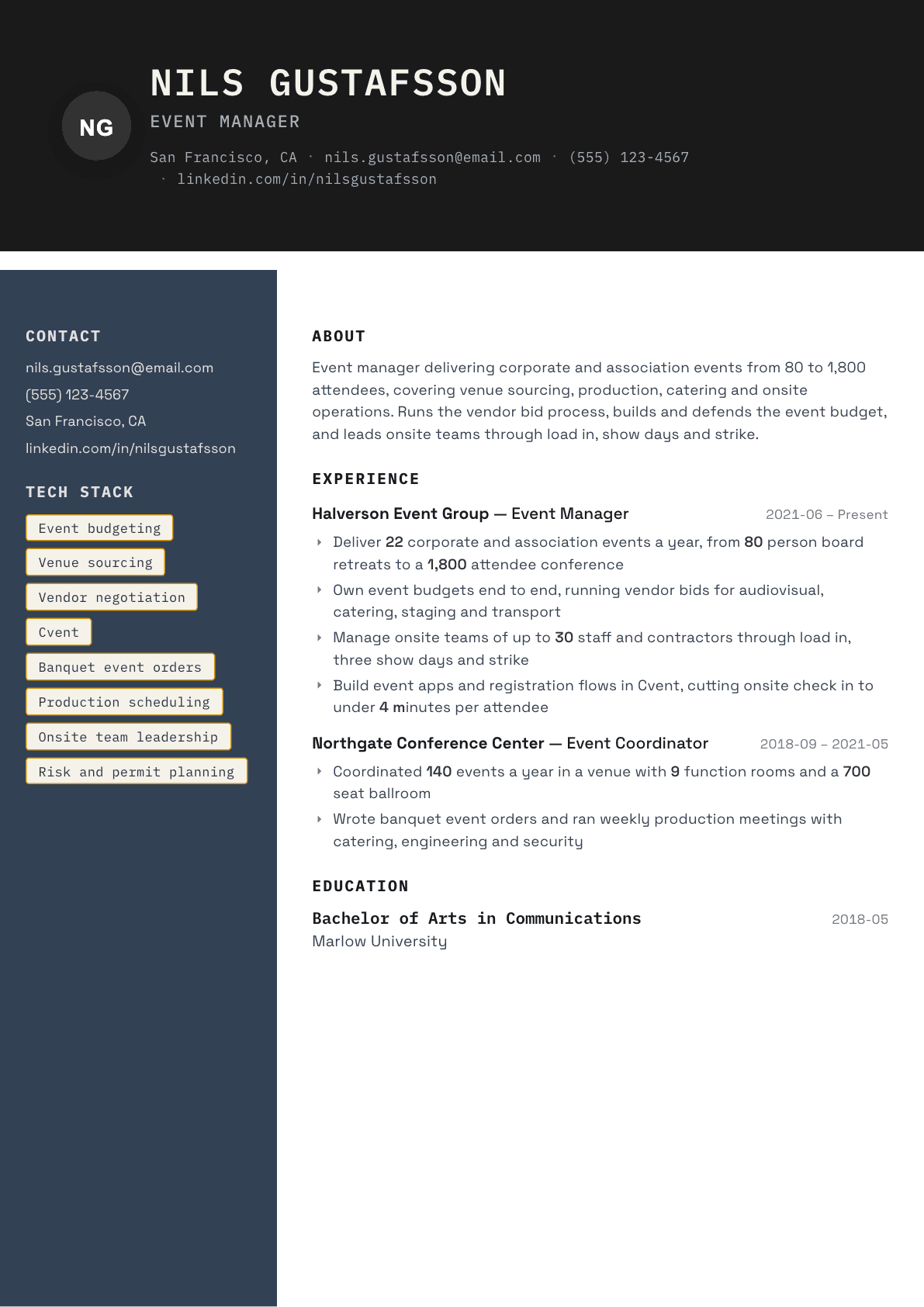
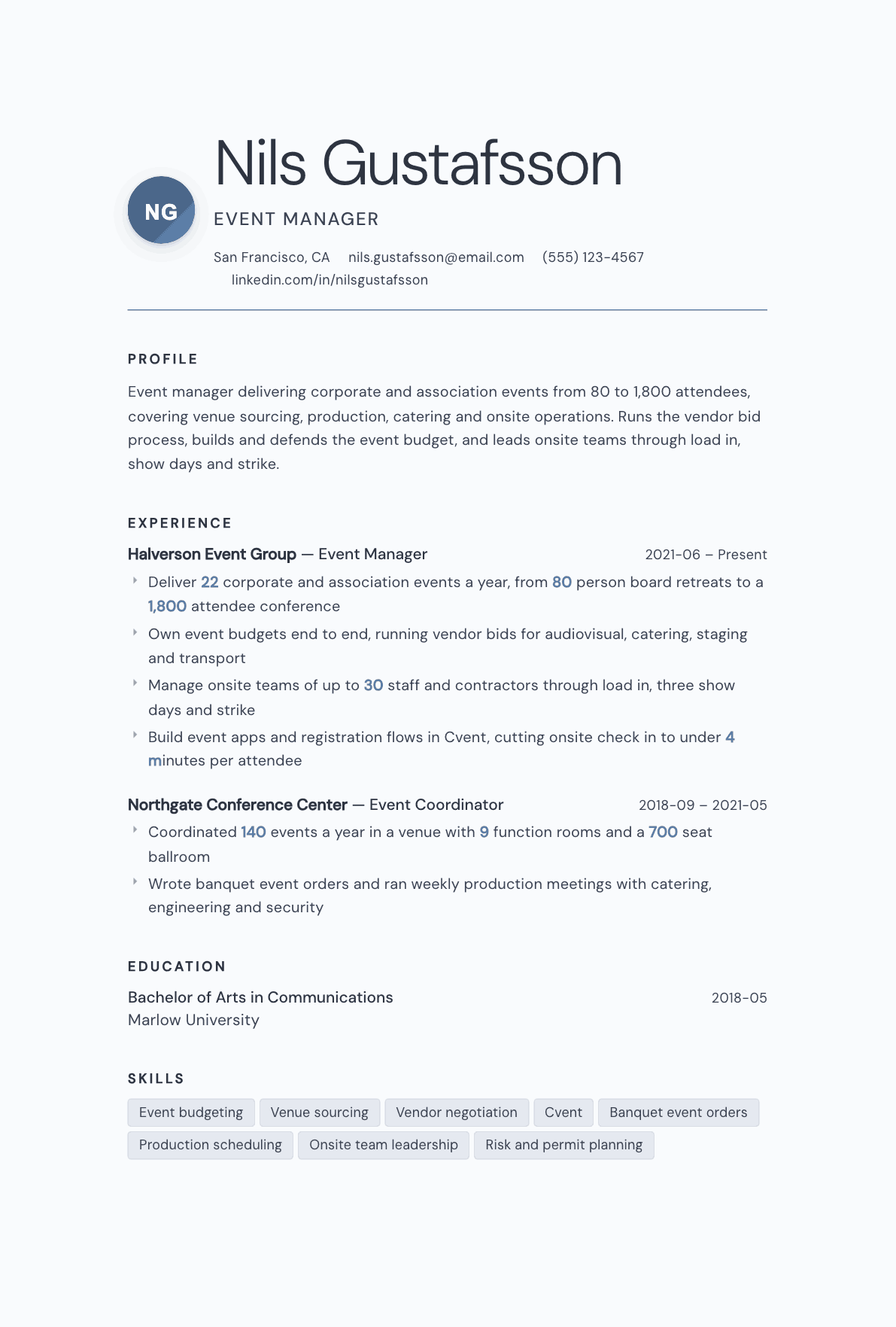
Example Event Manager summary
Event manager with seven years delivering corporate and association programs from 80 person retreats to conferences of nearly two thousand attendees. Owns budgets and vendor bids, builds registration in Cvent, and leads onsite crews through load in, show days and strike. Seeking a senior event role with an association that runs a national annual meeting.
Skills to list on a Event Manager resume
- Event budgeting and reconciliation
- Venue sourcing and site visits
- Vendor negotiation
- Run of show production
- Banquet event orders
- Audiovisual coordination
- Registration and check in
- Cvent
- Social Tables
- Onsite team leadership
- Permits and insurance certificates
- Sponsor fulfillment
- Catering and menu planning
- Post event reporting
- Contract review
What actually gets this resume read
- Anchor every job in attendee counts and event types, because a venue director reads scale before anything else.
- Say what you owned on the budget: building it, bidding it, approving invoices, or reconciling it after the event.
- Name the platforms you run registration and sourcing in, such as Cvent, Delphi, Social Tables or Eventbrite.
- Show the operations side with load in, run of show, staffing counts and strike, not only the planning phase.
- Include risk work: permits, insurance certificates, crowd plans and the safety briefing you ran with venue staff.
- Give one recovery example, since every hiring manager wants to hear how you handled a vendor failing on show day.
How to write a event manager resume
Event manager is one of the few job titles that means five different jobs. Agency side production, venue side operations, in house corporate programs, association meetings and festival work all use it. The first thing a resume has to do is tell the reader which one you have been doing, because the skills only partly overlap.
After that, the read is about scale and money. Attendee counts, number of events a year, budget ownership, vendor bids and the size of the onsite team you led. A hiring manager is trying to work out whether you can be handed her largest program without supervision.
This guide covers how to structure the resume, three summaries from a coordinator stepping up to a program lead, rewritten bullets from real event work, and the questions event managers ask when they cross between agency, venue and in house roles.
Event management resume sample: a complete entry
This event management resume sample is for an event manager on the agency side with six years of corporate conferences and incentive trips. A hiring manager reads for which side of the table you sit on, the size of the events, the budget you control and how many you run a year, so the summary carries all four.
Summary: Event manager at a corporate events agency, running around twenty conferences, launches and incentive trips a year for audiences of one hundred to two thousand. Owns the budget, venue and vendor contracts, the run of show and the onsite team. CMP certified, with registration and app platforms including Cvent.
Order for an event management resume: header, summary, a skills line with platforms and contract work, experience with one line of scale per employer, certifications, then education. The experience entry for this sample reads as the bullets below.
- Plan and run around twenty corporate events a year, from a forty person board retreat to a two thousand delegate sales conference.
- Own each event budget from first estimate to final reconciliation, and report variance to the client within two weeks of close.
- Source and contract venues, hotels, caterers and production companies, negotiating attrition and cancellation terms.
- Write the run of show and lead an onsite team of up to fifteen staff and temps on show days.
- Build registration and the event app in Cvent, and report attendance and survey results to the client after each event.
Format: name the side of the table first
Under each employer, state whether you sat agency side, venue side or client side, and what kind of events they were. A venue event manager runs other people programs inside one building. An agency event manager runs one client program across many buildings. Both are valuable and neither is a substitute for the other.
Keep it to two pages at most, reverse chronological, with a portfolio line of your largest events rather than a photograph or a graphic timeline. Application software handles plain layouts better, and the portfolio line does the visual work anyway.
- Employer type: agency, venue, association, corporate in house, festival or nonprofit.
- Event types: conference, incentive, product launch, gala, board meeting, trade show, festival.
- Signature events with attendee count, format and how many years you ran them.
- Team scope: staff managed onsite, contractors coordinated, direct reports year round.
Scale: attendees, events per year and budget ownership
Attendee count is the fastest scale signal, so give a range across your portfolio rather than a single number. Then say how many events you deliver in a year, since twenty two events a year and two events a year are entirely different operating rhythms even at similar attendee counts.
Be specific about budget ownership without inventing a total. Say whether you built the budget, ran the vendor bids, approved invoices, tracked variance during the build, or reconciled after the event. Those are four separable responsibilities and hiring managers ask about each one.
Production: run of show, vendors and the build
Write about the documents that carry an event: the run of show, the production schedule, the vendor scope of work, the floor plan and the staffing grid. A manager who names them is describing a discipline. A manager who says coordinated all aspects of the event is describing an aspiration.
Cover the build itself. Load in windows, rigging and power requirements, audiovisual coordination, catering timing, security and crowd flow, rehearsals, show calling and strike. Include the moment something failed and what you did, because vendor failure on show day is the question every interviewer asks.
Attendee experience and technology
Registration is where attendees form their first opinion, so describe the platform you built in, the data you collected, the check in method and how long the queue actually took. Badge printing, mobile apps, session scanning and lead capture for sponsors all sit in this same layer.
Add the reporting that closes the loop: attendance by session, sponsor deliverables fulfilled, survey results, and the post event debrief you led with vendors and the client. Managers who report after an event get trusted with the next one.
- Registration platform and what you configured inside it.
- Check in method and the actual throughput at the door.
- Sponsor and exhibitor deliverables tracked to fulfillment.
- Post event report contents and who received it.
Risk, contracts and the words a hiring manager scans for
Risk work is a differentiator because so few resumes carry it. Venue contracts and attrition clauses, force majeure language, insurance certificates from vendors, permits, crowd management plans, accessibility provision and the safety briefing you ran with venue staff all belong on the page.
The vocabulary in postings is consistent: event budget, venue sourcing, vendor negotiation, run of show, banquet event order, registration, audiovisual, load in, strike, sponsor fulfillment, post event reporting. Use the ones you own and let the bullets prove them.
Event Manager resume summary examples
Coordinator stepping up
Event coordinator at a conference center with nine function rooms, supporting around 140 events a year and writing banquet event orders with catering and engineering. Runs weekly production meetings and owns smaller programs end to end, and is ready for an event manager role at an agency or association.
Four years managing
Event manager delivering twenty two corporate and association programs a year, from eighty person board retreats to conferences approaching two thousand attendees. Owns budgets and vendor bids, builds registration and check in flows, and leads onsite crews of up to thirty through load in, show days and strike.
Program lead
Senior event manager owning a national program portfolio with a five city roadshow and one flagship annual meeting. Runs venue sourcing and contract negotiation including attrition terms, manages three coordinators year round, and presents post event performance to the executive sponsor each cycle.
Work experience bullets: before and after
Before: Planned and executed corporate events.
After: Delivered twenty two corporate and association events a year, ranging from eighty person board retreats to a conference of nearly two thousand attendees.
A portfolio range plus annual frequency shows both scale and operating rhythm in a single line.
Before: Managed event budgets.
After: Built event budgets line by line, ran competitive bids for audiovisual, catering, staging and transport, and reconciled final costs against plan after each program.
Separating build, bid and reconcile proves ownership of the whole financial cycle rather than a spreadsheet.
Before: Worked with vendors on site.
After: Led onsite teams of up to thirty staff and contractors through load in, three show days and strike, calling the run of show from the production desk.
Show calling and headcount are the two facts that distinguish an operator from a planner.
Before: Handled event registration.
After: Configured registration and the event app in Cvent, then cut onsite check in to under four minutes per attendee using pre printed badges and three scanning lanes.
The platform, the method and the throughput make an operational improvement that another venue could copy.
Before: Solved problems when things went wrong.
After: Replaced a staging vendor who failed twelve hours before doors, resourcing the set locally and opening the general session on time.
One concrete failure and recovery answers the interview question every hiring manager plans to ask.
Hard skills
- Event budgeting and reconciliation
- Venue sourcing and site inspections
- Vendor bids and negotiation
- Run of show and production scheduling
- Banquet event orders
- Audiovisual and staging coordination
- Registration and onsite check in
- Cvent
- Floor plans and capacity planning
- Permits and insurance certificates
- Sponsor and exhibitor fulfillment
- Post event reporting
Soft skills
- Show day composure
- Vendor negotiation
- Client and sponsor communication
- Onsite team leadership
- Decisive problem solving under time pressure
Certifications worth listing
- Certified Meeting Professional (CMP) (Events Industry Council)
- Certified Special Events Professional (CSEP) (International Live Events Association)
- Certified Government Meeting Professional (CGMP) (Society of Government Meeting Professionals)
Mistakes that cost event manager candidates the interview
- Never saying whether you worked agency side, venue side or in house, which leaves the reader guessing at your actual job.
- Giving event types with no attendee counts, so nothing on the page establishes scale.
- Claiming budget management without specifying whether you built, bid, approved or reconciled it.
- Describing planning only and omitting load in, show calling and strike, which reads as a desk role.
- Leaving out risk and contract work, one of the few areas where an experienced manager can visibly separate.
- Filling the page with adjectives about creativity instead of the production documents you actually own.
Event Manager resume questions
How do I move from venue side to agency side event work?
Lead with the transferable operations: banquet event orders, floor plans, audiovisual coordination and vendor management. Then show any program you owned end to end, since agencies worry that venue managers have only ever executed someone else design.
What budget details are safe to include?
Describe ownership and process rather than totals you cannot verify publicly. Which lines you built, how bids were run, how variance was tracked during the build and how you reconciled afterward gives a hiring manager everything useful.
Is a CMP worth it for an event manager?
It carries real weight with associations, government meeting buyers and larger corporate teams, and it standardizes vocabulary across the field. It does not replace a portfolio, so pursue it alongside programs you can describe in detail.
Should I list every event I have worked on?
No. Choose the signature ones and give each a scale, a format and your specific role. A long undifferentiated list makes it impossible to see which events you led and which you supported as one of many hands.
What should an event management resume include?
A summary that says which side you work on, agency, venue or in house, the number and size of events per year, the budget you own, the contracts you negotiate, your platforms such as Cvent, and certifications such as the CMP. The sample entry above shows all of these in one summary and five bullets.
Related resume examples
- Event Planner Resume example
- Banquet Manager Resume example
- Conference Coordinator Resume example
- Catering Sales Manager Resume example
- Catering Manager Resume example
- Event Coordinator Resume example