Construction Estimator Resume Examples: read this first
Build a Construction Estimator Resume That Proves Your Bid Accuracy
By Mustafa Tarabya, founder of CVBooster · Published · Updated
A construction estimator resume example with takeoff and bid tips, the software and CSI division keywords preconstruction leads search, and a writing guide.
Sample resumes for a construction estimator
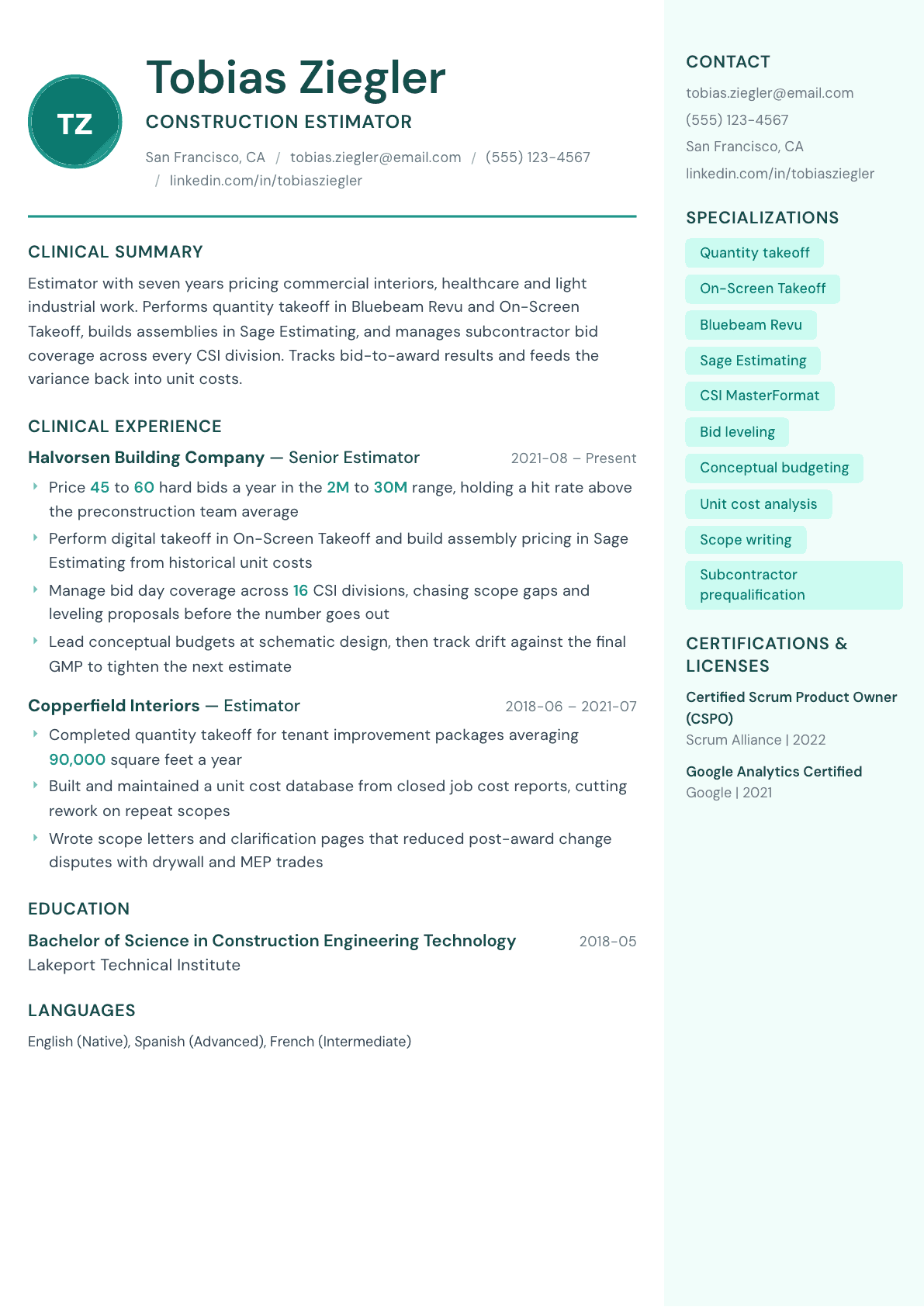
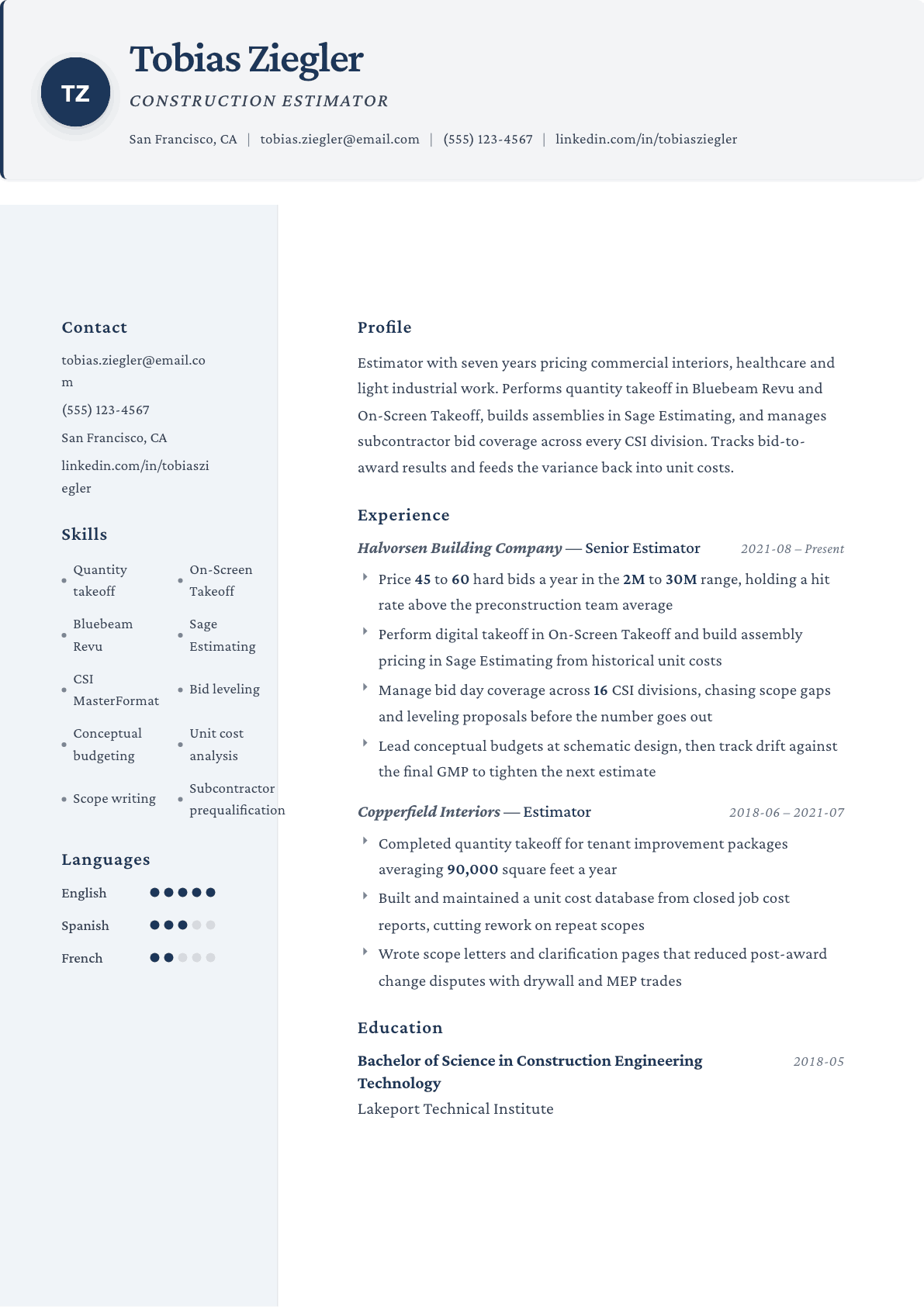
The same construction estimator content laid out in three CVBooster templates, so you can see what the finished document looks like before you write a word.

Example Construction Estimator summary
Construction estimator with seven years pricing commercial interiors, healthcare and light industrial projects from schematic budgets through hard bid. Runs digital takeoff in On-Screen Takeoff and Bluebeam Revu, builds assemblies in Sage Estimating, and levels subcontractor proposals across all sixteen CSI divisions on bid day. Maintains a unit cost database rebuilt from closed job cost reports so the next number is sharper than the last one.
Skills to list on a Construction Estimator resume
- Quantity takeoff
- On-Screen Takeoff
- Bluebeam Revu
- Sage Estimating
- HeavyBid
- ProEst
- CSI MasterFormat
- Bid leveling and scope review
- Conceptual and parametric budgeting
- Unit cost database maintenance
- Value engineering
- Subcontractor prequalification
- GMP development
- Self-perform labor pricing
- Historical cost analysis
What actually gets this resume read
- State your annual bid volume and the dollar range of the jobs you price, because an estimator is measured by the size of the numbers.
- Separate hard bid work from negotiated and design-build work, since the estimating process and the risk are completely different.
- Name the takeoff and estimating software by product: On-Screen Takeoff, Bluebeam Revu, Sage Estimating, HeavyBid, ProEst.
- Show that you close the loop by comparing awarded estimates to final job cost, which is what separates a pricer from an estimator.
- List the CSI divisions and building types you have priced, because a healthcare estimator and a highway estimator are not interchangeable.
- Mention scope letters, clarifications and exclusions, since disciplined scope writing is what keeps a low bid from becoming a loss.
How to write a construction estimator resume
Estimating is one of the few construction roles where the quality of your work is provable after the fact. Every number you put on a bid form is eventually compared to what the job actually cost. A preconstruction director reading your resume is looking for signs that you know this and that you have closed the loop, rather than someone who produces a spreadsheet and never sees the job cost report again.
The other thing that reader is checking is fit. An estimator who prices tenant improvement drywall packages and an estimator who prices earthwork and underground utilities use different software, different unit bases and different risk assumptions. The resume has to say which one you are in the first two lines, and it has to say it in the vocabulary the trade uses.
This guide covers how to structure the page, what belongs in a bid history, which numbers make an estimator credible, and how to write bullets that show pricing judgment instead of spreadsheet activity.
Format: employment first, bid history close behind
Reverse-chronological employment, then a short bid history or representative projects block. The bid history is where an estimator wins the read: project type, contract value, delivery method, and whether the bid was won and self-performed or subcontracted.
Keep the layout single column and text-based. Estimating departments often route resumes through the same applicant tracking system the rest of the company uses, and a two column template with icons tends to come out of the parser scrambled.
- Header: name, city and state, phone, email, credential letters if you hold them.
- Order: summary, representative projects or bid history, experience, software, education, certifications.
- Group projects by building type so a healthcare posting can see healthcare work immediately.
Summary: sectors, annual bid volume, method
Name the building types and civil work you price, the annual volume in dollars or number of bids, and whether the work is hard bid, negotiated, design-build or a mix. Add the estimating method you use, whether that is detailed quantity takeoff from drawings, assembly pricing from a unit cost database, or parametric budgeting at concept stage.
Three lines is enough. A preconstruction lead reading twenty resumes will decide from this block whether the rest of the page is worth the time.
Experience: takeoff, bid day, and the loop back to job cost
Split each job into the three things estimators actually do. First, quantity takeoff and pricing: what you measure, from what drawing quality, in which software, and how the unit costs are built. Second, bid day management: subcontractor coverage by division, leveling proposals, chasing scope gaps and assembling the final number under a deadline that does not move. Third, the feedback loop: comparing awarded estimates to final job cost and adjusting the database.
The third piece is the one most resumes leave out, and it is the one that separates a takeoff technician from an estimator. A single bullet describing how you rebuilt unit costs from closed job cost reports carries more weight than five bullets about software proficiency.
Also write about scope discipline. Clarification pages, exclusions and scope letters are what stop a winning bid from becoming a losing job, and a preconstruction manager will recognize immediately whether you understand that.
- Volume: bids per year, dollar range, hit rate if you can state it accurately.
- Coverage: divisions you self-price versus divisions you rely on trade proposals for.
- Accuracy: variance between estimate and final cost, and what you changed because of it.
Software and cost data: name every product
Estimating is software specific to a degree few construction roles are. List what you actually operate: On-Screen Takeoff and Quick Bid, Bluebeam Revu, Sage Estimating, ProEst, HeavyBid for heavy civil, Assemble or a model-based takeoff tool if you price from BIM.
Name your cost data sources too. Whether you work from an in-house historical database, published unit cost data or supplier quotes changes how a hiring manager reads your accuracy claims. Include CSI MasterFormat and UniFormat literacy, because those are the languages a bid is organized in.
Keywords the preconstruction team screens on
Recurring phrases in estimator postings include quantity takeoff, bid leveling, scope review, conceptual estimate, schematic budget, guaranteed maximum price, value engineering, subcontractor prequalification, self-perform pricing and general conditions. Use each once in a place where it is true. General conditions estimating in particular is worth a bullet of its own, because many candidates have never built that sheet and the ones who have are worth more.
Construction Estimator resume summary examples
Junior estimator
Construction engineering graduate with two years performing quantity takeoff on commercial interior packages. Measures drywall, ceilings and finishes in On-Screen Takeoff, assembles subcontractor bid comparisons, and supports bid day coverage. Comfortable reading structural and architectural sets and flagging scope gaps before the proposal deadline.
Seven years in
Estimator with seven years pricing commercial interiors and light industrial work between 2M and 30M. Runs takeoff in On-Screen Takeoff, builds assemblies in Sage Estimating, and manages bid day coverage across all sixteen divisions. Maintains a unit cost database rebuilt from closed job cost reports each quarter.
Chief estimator
Chief estimator leading a preconstruction team of four on healthcare and higher education work. Owns conceptual budgets at schematic design, guaranteed maximum price development, and the go or no-go recommendation. Tracks estimate to final cost variance by division and adjusts the historical database from every completed job.
Work experience bullets: before and after
Before: Performed takeoffs and prepared estimates for construction projects.
After: Priced 52 hard bids a year between 2M and 30M, performing takeoff in On-Screen Takeoff and building assembly pricing in Sage Estimating from in-house unit costs.
Bid count, dollar range and named software make the volume and the method verifiable.
Before: Reviewed subcontractor bids.
After: Leveled subcontractor proposals across 16 divisions on bid day, identifying scope gaps in fire protection and controls before the number went to the owner.
Leveling across named divisions with a specific catch shows the judgment that bid day actually requires.
Before: Worked with the project team after award.
After: Compared awarded estimates to final job cost on every completed project and updated unit costs by division, reducing estimate variance on repeat concrete scopes.
The feedback loop is what makes an estimator improve, and most resumes never mention it.
Before: Helped with value engineering.
After: Produced value engineering logs with 30 priced alternates on a design-build medical clinic, bringing the budget back under the owner target without cutting program area.
A count of priced alternates and the outcome turns a buzzword into a documented deliverable.
Before: Wrote scope letters for bids.
After: Wrote scope letters and clarification pages for each trade package, which cut post-award scope disputes with drywall and mechanical subcontractors to near zero.
Linking the document to the dispute outcome shows why scope discipline matters commercially.
Hard skills
- Quantity takeoff
- On-Screen Takeoff and Quick Bid
- Bluebeam Revu
- Sage Estimating
- HeavyBid
- CSI MasterFormat and UniFormat
- Bid leveling and scope review
- Conceptual and parametric budgeting
- Unit cost database maintenance
- General conditions estimating
- Guaranteed maximum price development
- Value engineering logs
- Self-perform labor and equipment pricing
Soft skills
- Working to a fixed bid deadline
- Trade partner communication
- Attention to scope detail
- Commercial judgment
- Cross-checking under time pressure
Certifications worth listing
- Certified Professional Estimator (CPE) (American Society of Professional Estimators)
- Certified Estimating Professional (CEP) (AACE International)
- Certified Cost Professional (CCP) (AACE International)
- OSHA 30-Hour Construction (OSHA Outreach Training Program)
Mistakes that cost construction estimator candidates the interview
- Listing software without any indication of the dollar volume or the number of bids you priced with it.
- Hiding the building types you price, which makes a healthcare or industrial employer assume you have never touched their work.
- Claiming a hit rate you cannot support, because a preconstruction director will ask for the arithmetic in the interview.
- Treating takeoff as the whole job and never mentioning bid day coverage, leveling or scope letters.
- Skipping the comparison between estimate and final cost, which is the single strongest signal of a maturing estimator.
- Using the same resume for a general contractor and a specialty trade contractor, whose pricing bases have almost nothing in common.
Construction Estimator resume questions
Should a construction estimator resume include a bid history?
Yes, a short one. Six to ten representative projects with type, value, delivery method and outcome tell a preconstruction lead more than any list of duties, and it gives the interview somewhere concrete to start.
Is it safe to publish my hit rate?
Only if you can define it and defend it. State the basis, such as bids submitted against projects awarded within a stated period, and avoid the number entirely if your employer counted it differently or if you inherited bids mid-cycle.
What software should I list first?
Whatever the posting names first. Match their stack in your skills block, then list the rest. An employer running Sage Estimating and On-Screen Takeoff will short-list the candidate whose page contains both products before anyone else.
How do I move from a trade estimator role to a general contractor?
Lead with the divisions you price deeply, then show breadth: bid day coverage across trades, scope leveling and general conditions work. General contractors hire trade estimators regularly, but they need proof you can assemble a whole building number.
Do I need a degree to work as a construction estimator?
Many employers accept trade experience plus demonstrated takeoff and pricing ability, particularly at specialty contractors. A construction management or engineering technology degree helps at larger general contractors, and the professional estimating certifications carry real weight either way.
Related resume examples
- Construction Manager Resume example
- Carpenter Resume example
- Construction Project Manager Resume example
- General Contractor Resume example
- Construction Superintendent Resume example
- Construction Safety Manager Resume example