Construction Safety Manager Resume Examples: free score
A Construction Safety Manager Resume Built on Program Ownership
By Mustafa Tarabya, founder of CVBooster · Published · Updated
A construction safety manager resume sample, program and audit writing tips, the regulatory keywords contractors screen for, and a full guide.
Sample resumes for a construction safety manager
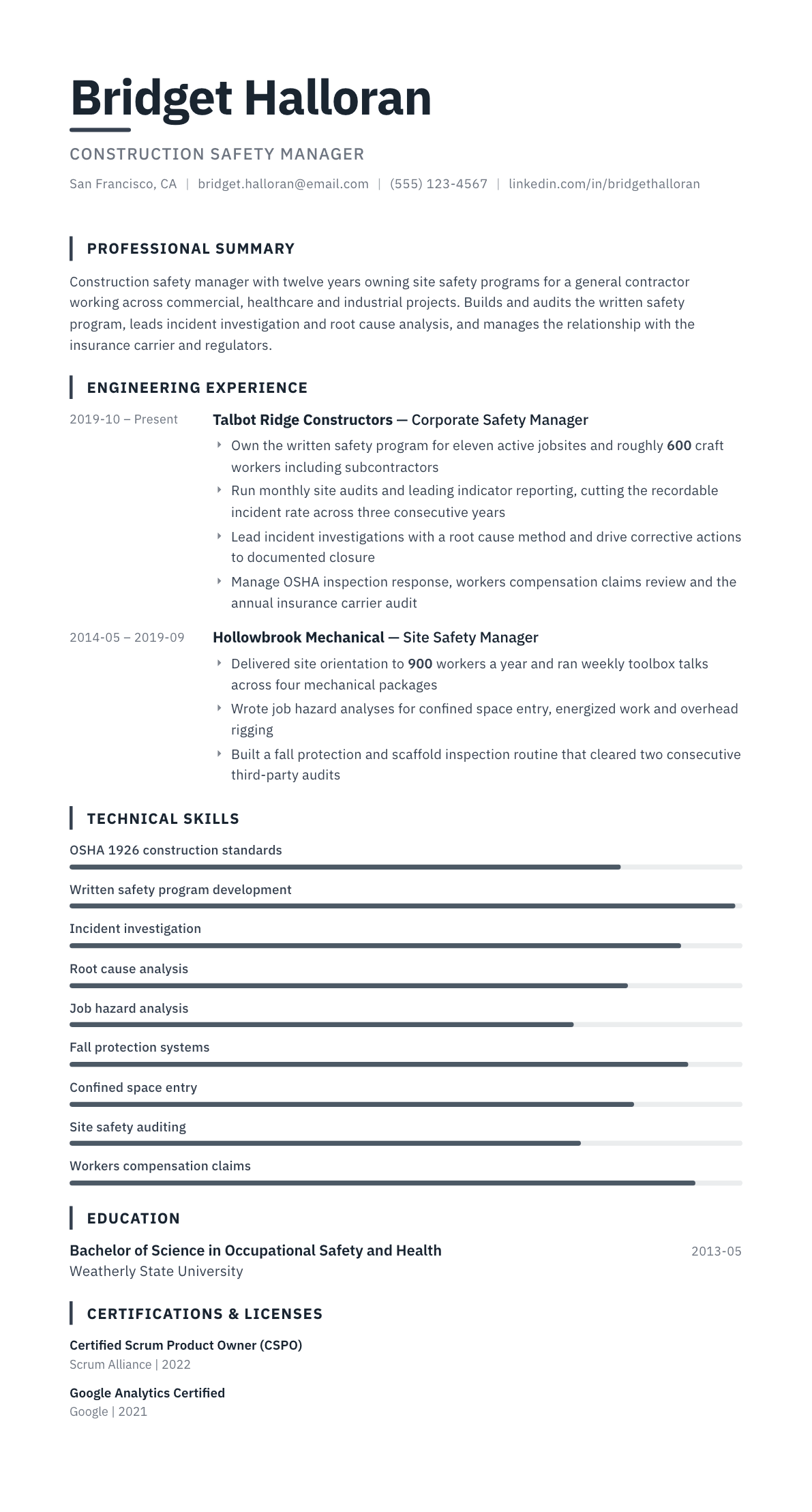
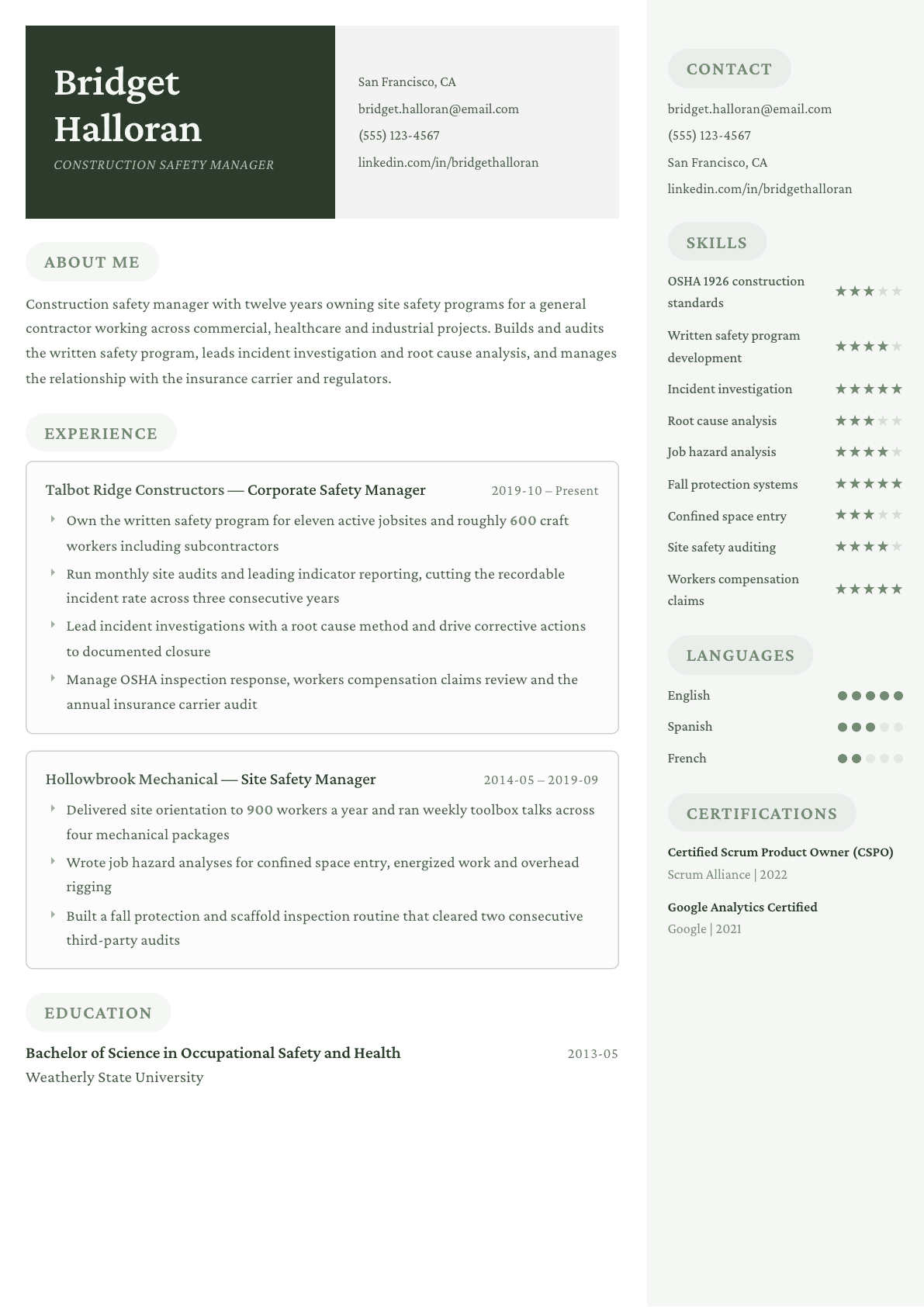
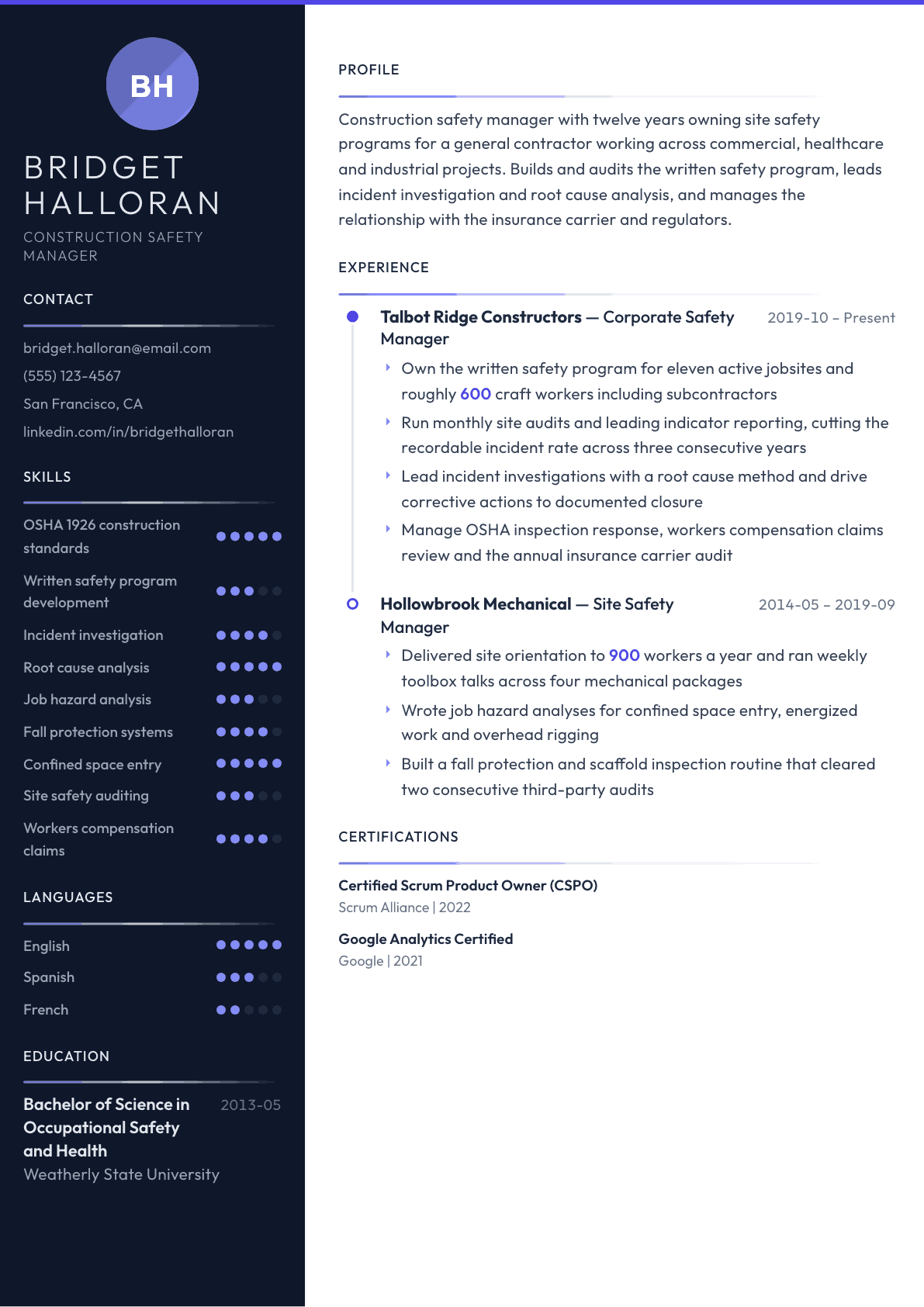
The same construction safety manager content laid out in three CVBooster templates, so you can see what the finished document looks like before you write a word.
Example Construction Safety Manager summary
Construction safety manager with twelve years owning the written safety program for a general contractor across commercial, healthcare and industrial work. Audits eleven active jobsites, leads incident investigation to documented root cause, and manages regulator response, carrier audits and workers compensation review. Builds high hazard programs for fall protection, confined space and excavation, and holds subcontractors to the same standard as self-perform crews.
Skills to list on a Construction Safety Manager resume
- OSHA 1926 construction standards
- Written safety program development
- Site safety audits
- Incident investigation
- Root cause analysis
- Job hazard analysis
- Fall protection systems
- Confined space entry program
- Excavation and trenching safety
- Crane and rigging safety
- Subcontractor prequalification
- Workers compensation claims management
- Leading indicator reporting
- Emergency action planning
- Safety orientation and training delivery
What actually gets this resume read
- Show program ownership rather than attendance: who wrote the safety manual, who audits it, and who answers when a regulator arrives.
- Put your recordable incident rate and experience modification rate trend on the page, because those numbers decide bid prequalification.
- Name the high hazard programs you personally manage: fall protection, confined space, excavation, energized work, crane and rigging.
- Balance lagging indicators with leading ones, near miss reporting and audit closure rates, since mature contractors ask for both.
- List the certifications with the issuing board, because CHST and CSP are the two credentials most construction postings name outright.
- Describe how you hold subcontractors to the program, since most site exposure on a general contractor job sits with the trades.
How to write a construction safety manager resume
A construction safety manager is hired to carry risk that the company cannot afford to leave with anyone else. The person reading your resume, usually a vice president of operations or a risk manager, is asking whether you can hold a program together across multiple jobsites, answer a regulator without the company losing ground, and keep the insurance numbers in a range that lets the firm bid the work it wants.
That makes this one of the few construction resumes where numbers from outside the schedule matter most. Recordable incident rate, experience modification rate, audit closure rates and near miss reporting volume are the currency. A resume that lists safety duties without any of these reads as a coordinator applying for a manager job.
This guide sets out how to show program ownership rather than participation, how to present incident data honestly, which high hazard programs to name, and how to write about regulator and carrier relationships in a way that does not sound defensive.
Format: credentials up top, program scope right behind
Put your safety credentials directly under the summary with the certifying board, then a scope line stating how many active jobsites, how many workers including subcontractor crews, and which markets. Scope is the fastest way for a risk manager to place you.
Then reverse-chronological experience. Two pages is normal at manager level, and the second page should be carrying incident data, audit programs and training delivery rather than filler.
- Header: name, city and state, phone, email, board certification letters.
- Order: summary, certifications, scope of program, experience, training delivered, education.
- Note whether you sit corporately across projects or are assigned to a single large site.
Summary: markets, span of control, and the trend line
Name the markets you cover, the number of active sites and workers under your program, and the direction your incident numbers moved while you owned them. A trend is more honest and more persuasive than a single flattering figure.
If you carry a board certification, put the letters in this block. Many construction safety postings state the credential as a requirement, and an automated screen will look for the exact term.
Experience: own the program, do not attend it
The first cluster is the written program. Who authored the safety manual, who revises it when a standard changes, and who audits compliance against it. Say which high hazard programs you personally wrote: fall protection, confined space entry, excavation and trenching, energized electrical work, crane and rigging, silica and respirable dust, hot work.
The second is measurement. Site audit frequency and scoring, leading indicator reporting, near miss volume, corrective action closure rate and the incident rate trend. Pair a lagging number with a leading one so the reader sees a functioning system rather than luck.
The third is response. Incident investigation with a named root cause method, regulator inspection handling, workers compensation claim review with the carrier, and return to work coordination. The fourth is the subcontractor interface, since on a general contractor project most of the exposure sits with trade partners who do not work for you.
- Program: the documents you own and the standards behind them.
- Measurement: audit cadence, closure rates and the incident trend across a stated period.
- Response: investigations led, regulator visits handled, claims reviewed with the carrier.
Training and culture: show delivery, not intent
Safety managers spend a large part of the week teaching. Say what you deliver, how often and to how many people: site orientation, competent person training for scaffolds and excavations, rigging and signal person qualification, first aid and CPR, and supervisor coaching on pre-task planning.
If you are an authorized outreach trainer, say so and name the training institute path, because that lets a company deliver its own thirty hour courses instead of buying them. Also describe how you get field supervisors to run the daily safety conversation themselves, which is what a mature program actually looks like.
Keywords in construction safety manager postings
Expect written safety program, job hazard analysis, incident investigation, root cause analysis, recordable incident rate, experience modification rate, leading indicators, competent person, fall protection, confined space, excavation, crane and rigging, subcontractor prequalification and regulatory inspection response. Use each where it is true, and keep the abbreviation and the full phrase together the first time so both survive an automated screen.
Construction Safety Manager resume summary examples
Site safety manager, first program role
Occupational safety graduate with three years as site safety manager on a hotel build with ninety workers. Delivered orientation and weekly toolbox talks, wrote job hazard analyses for fall protection and rigging, and closed audit findings within a week. Holds the construction health and safety technician credential.
Eight years in
Construction safety manager covering six active commercial jobsites and roughly three hundred craft workers including trade partners. Owns the written program, runs monthly audits with leading indicator reporting, and leads investigations to documented root cause. Recordable rate fell in each of the last three years under this program.
Corporate safety director
Corporate safety leader for a general contractor with eleven active projects and six hundred workers across commercial, healthcare and industrial markets. Owns the safety manual, the prequalification standard for trade partners, regulator response and the annual carrier audit. Board certified safety professional supervising three regional managers.
Work experience bullets: before and after
Before: Managed safety on construction sites.
After: Owned the written safety program across eleven active jobsites and roughly 600 craft workers including trade partner crews, auditing each site monthly against the manual.
Site count, headcount and an audit cadence turn a title into a measurable span of control.
Before: Investigated accidents.
After: Led incident investigations using a structured root cause method, drove corrective actions to documented closure, and briefed operations leadership on the systemic finding from each case.
A named method plus closure and reporting shows an investigation system rather than an incident file.
Before: Reduced injuries at the company.
After: Cut the recordable incident rate in each of three consecutive years while near miss reporting rose, indicating that the drop came from reporting culture rather than under-recording.
Pairing a lagging improvement with a leading indicator is how a credible safety professional presents data.
Before: Handled OSHA inspections.
After: Managed regulator inspection response across four site visits, produced the requested records the same day, and closed each item without contested citations.
Volume, response speed and outcome show competence in the moment that costs companies the most.
Before: Trained workers on safety.
After: Delivered site orientation to about 900 workers a year and ran competent person training for scaffolding and excavation so each crew had qualified coverage on every shift.
Training numbers plus the coverage purpose show why the delivery mattered operationally.
Hard skills
- Written safety program development
- Construction safety standards and regulatory compliance
- Site safety auditing and scoring
- Incident investigation and root cause analysis
- Job hazard analysis
- Fall protection program management
- Confined space entry and permit systems
- Excavation and trenching safety
- Crane, rigging and signal person qualification
- Silica and respirable dust control
- Workers compensation claims and return to work
- Trade partner prequalification
- Leading and lagging indicator reporting
Soft skills
- Influence without direct authority
- Stopping work and holding the line
- Executive reporting
- Coaching field supervisors
- Composure during an incident
Certifications worth listing
- Certified Safety Professional (CSP) (Board of Certified Safety Professionals)
- Associate Safety Professional (ASP) (Board of Certified Safety Professionals)
- Construction Health and Safety Technician (CHST) (Board of Certified Safety Professionals)
- Safety Trained Supervisor Construction (STSC) (Board of Certified Safety Professionals)
- Authorized Construction Outreach Trainer (OSHA Training Institute Education Center)
Mistakes that cost construction safety manager candidates the interview
- Listing safety duties with no incident data, which reads as a coordinator resume submitted for a manager role.
- Quoting a company-wide rate you had no influence over, a claim that collapses in the first interview question.
- Naming only lagging numbers, since experienced risk managers ask immediately what your leading indicators were.
- Skipping the trade partner interface, where most of the exposure on a general contractor project actually sits.
- Writing about regulator visits defensively, when the hiring question is simply whether you handle them calmly.
- Omitting board certification letters that the posting names outright, which stops the resume at the automated screen.
Construction Safety Manager resume questions
Which safety certification carries the most weight in construction?
The certified safety professional credential is the senior benchmark, and the construction health and safety technician credential is the one most site-level postings name. Both come from the Board of Certified Safety Professionals, so list the board with the letters.
Should I put my incident rate on the resume?
Yes, if it is yours and you can explain the calculation. Give a trend across a stated period rather than a single year, and pair it with reporting volume so the reader can see the improvement was not achieved by discouraging reports.
How do I write about a serious incident on my watch?
Do not hide it and do not lead with it. If it comes up, describe the investigation, the root cause and the program change that followed. Employers hire safety managers who have learned something, not ones who claim a spotless record.
Do I need field construction experience to be a construction safety manager?
It helps enormously. Superintendents listen to people who understand sequencing and can suggest a workable control rather than a stop. If you came from a classroom path, show the hours you spend in the field and the trade knowledge you built.
What is the difference between a safety manager and a safety director resume?
Span and authorship. A manager runs the program on assigned projects, a director owns the corporate standard, the budget, prequalification rules and the carrier relationship, and supervises other safety staff. Make the reporting line and the staff you managed explicit.
Related resume examples
- Construction Manager Resume example
- Crane Operator Resume example
- Health and Safety Officer Resume example
- Safety Coordinator Resume example
- Construction Superintendent Resume example
- Site Supervisor Resume example