Construction Foreman Resume Examples: what gets the call
Write a Construction Foreman Resume That Shows Crew Leadership
By Mustafa Tarabya, founder of CVBooster · Published · Updated
Construction foreman resume example with crew size, production rates, layout and safety bullets, and a guide to writing for lead trade roles.
Sample resumes for a construction foreman
The same construction foreman content laid out in three CVBooster templates, so you can see what the finished document looks like before you write a word.
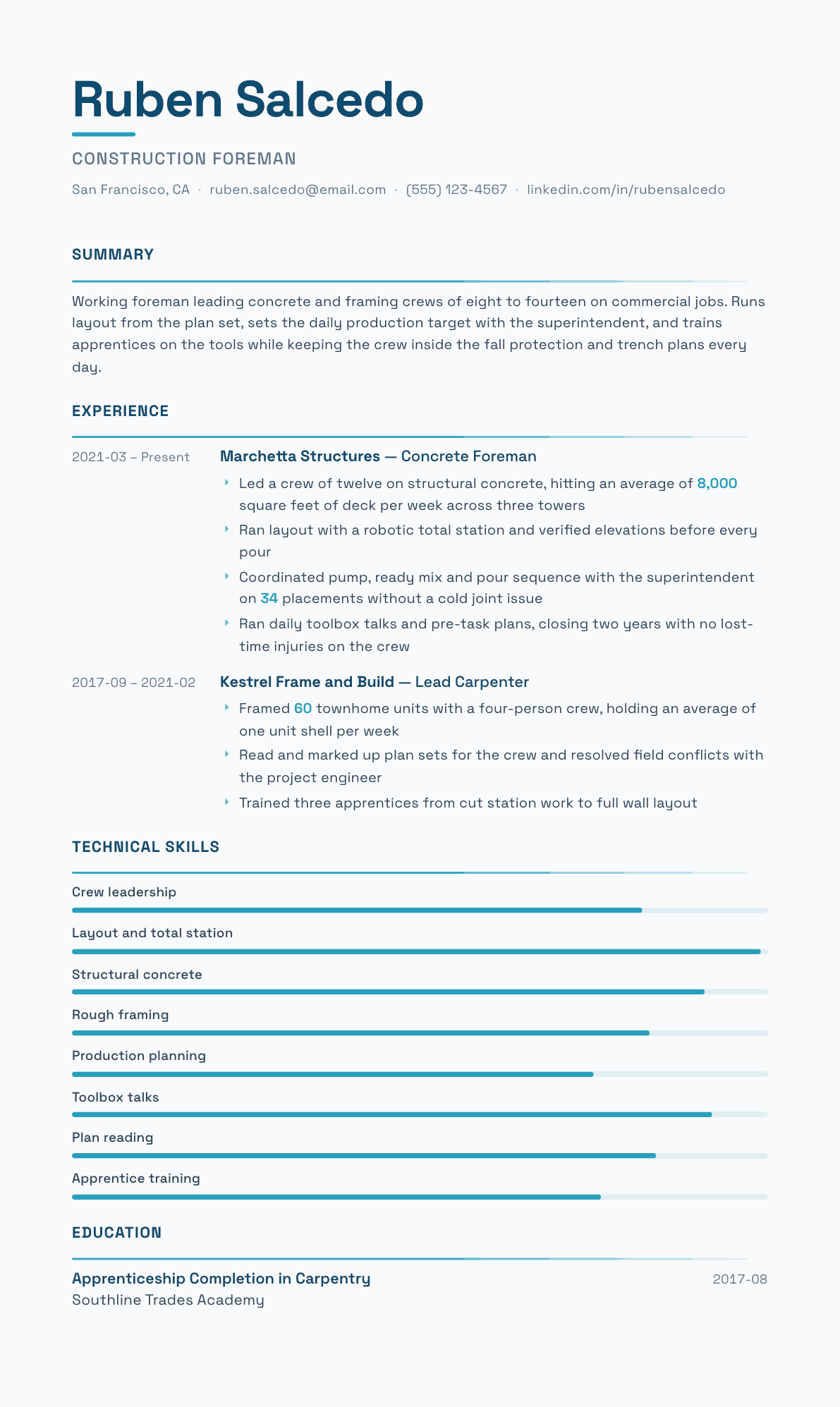
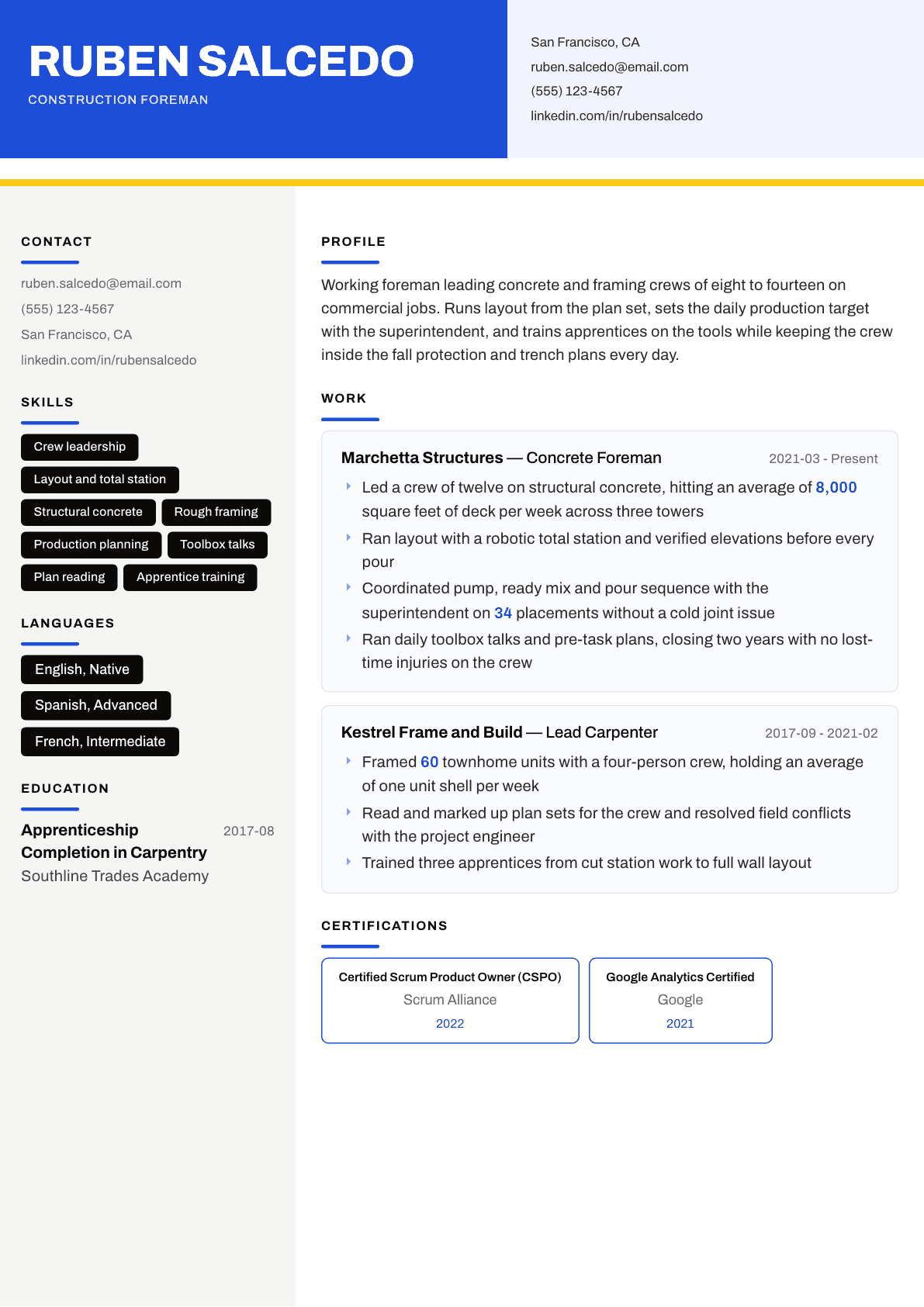
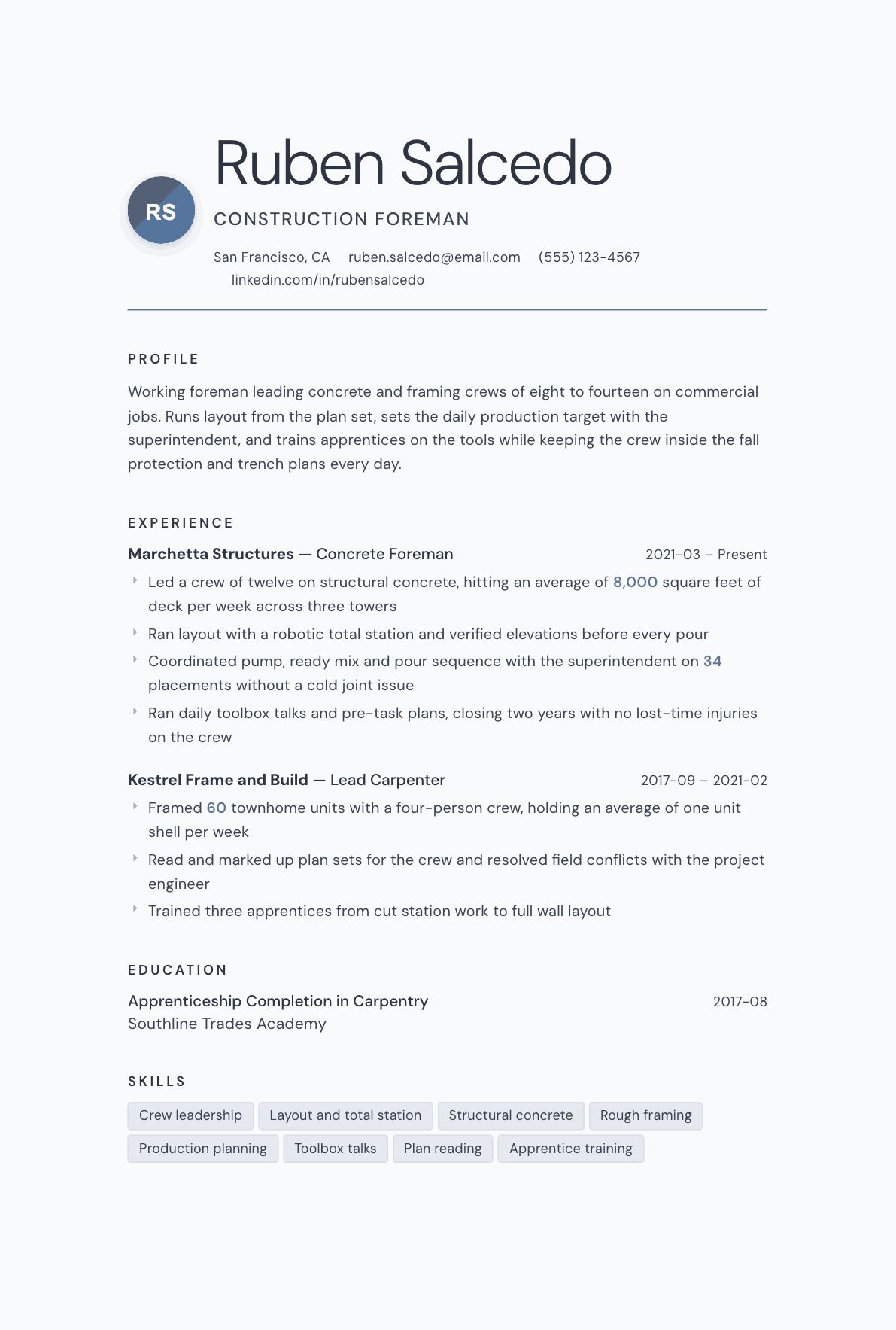
Example Construction Foreman summary
Working foreman with eight years leading concrete and framing crews of up to fourteen on commercial jobs. Holds an average of 8,000 square feet of deck per week, runs layout with a robotic total station, and coordinates pump and ready mix schedules with the superintendent. Closed two years with no lost-time injuries on the crew. Looking for a foreman seat with a self-perform contractor.
Skills to list on a Construction Foreman resume
- Crew supervision
- Structural concrete
- Formwork
- Rough framing
- Layout and elevations
- Robotic total station
- Blueprint reading
- Production planning
- Manpower and material planning
- Toolbox talks
- Fall protection
- Trench and excavation safety
- Quality control
- Apprentice training
What actually gets this resume read
- State crew size and trade in the first line of every job, because that is what defines a foreman role.
- Give a production rate: square feet of deck per week, units framed, linear feet installed or pours completed.
- Show the planning side of the job, including manpower calls, material orders and the daily target you set.
- Name the layout tools you use, whether that is a robotic total station, laser level or transit.
- Include the safety routine you personally run and how long your crew has gone without a lost-time injury.
- List apprentices trained and any who advanced, since developing hands is a large part of the seat.
How to write a construction foreman resume
The foreman seat is where the craft and the schedule meet. A superintendent hiring a foreman wants to know the trade you lead, how many hands you have run, and what your crew produces in a week. Those three facts decide whether your resume gets read past the first job, because a foreman is bought by production, not by titles.
It is a working leadership job, and the resume has to show both halves. The craft half is layout, tooling, sequencing and quality. The leadership half is manpower calls, material ordering, toolbox talks, training apprentices and answering for what the crew did between two inspections. A page that shows only one half reads as either a lead hand or an office person.
This guide covers how to present crew size and trade, how to write a production rate a superintendent will believe, how to describe planning and safety as things you personally run, and the questions foremen ask when they move contractors or step toward a superintendent role.
Format: trade and crew size in the first line of every job
Under each employer, name your trade and the size of the crew you led. Concrete foreman over twelve hands is a specific job. Foreman is not. Add the project type and duration so the reader knows whether the crew was steady or built for a single phase.
One page works up to about ten years. Beyond that, add a short project line list underneath the recent jobs rather than expanding the bullets, and keep the layout plain enough to print from a trailer.
- Job header: trade, crew size, project type, dates.
- Order: summary, credentials, experience with production numbers, skills and tools, training.
- Say whether the work was self-perform for a general contractor or under a subcontract.
Production rates: the number that gets you hired
Give the rate your crew held, in the units your trade uses. Square feet of deck per week, units framed, linear feet of pipe set, cubic yards placed per pour, panels erected per day. A superintendent converts that rate into a schedule immediately, which is why it is the most valuable line on the page.
Pair the rate with the crew size, because a rate without manpower is meaningless. Twelve hands holding eight thousand square feet of deck a week is a claim a reader can test against their own history, and testable claims are the ones that survive an interview.
If your work does not have a clean rate, use duration instead: floors per cycle, units per week, or the number of pours completed in a season without a rework issue.
Layout, quality and the craft half
Name your layout method and instrument: robotic total station, laser level, transit, or hand layout from the plan set. Then describe the checks you run before work is covered, such as verifying elevations before a pour, checking wall layout against the dimension string, or confirming embed and sleeve locations against the drawings.
Quality shows best as rework avoided. A season of pours with no cold joint issue, a building with no wall out of tolerance at drywall, or a punch list that came back nearly empty all say more about your craft than any adjective.
The planning half: manpower, material and the day plan
Foremen who last are the ones who plan the next day before they leave. Write that work: setting the daily target with the superintendent, calling manpower for the coming week, ordering material against the look-ahead, staging tools and equipment, and confirming access and crane or pump time before the crew arrives.
Add coordination with other trades. Holding a slab for an electrician's conduit, sequencing around a mechanical rough-in, or resolving a field conflict with the project engineer are the moments where a foreman either protects the schedule or costs a week.
Safety, training and keywords
You own the safety of the crew, so describe what you personally run: daily toolbox talks, pre-task planning with each hand, fall protection setup and inspection, trench and excavation checks, equipment inspections before use, and stopping work when conditions change. Then give the incident-free duration for your crew specifically.
Training belongs here too. Count the apprentices you have taken from a cut station to full layout and any who advanced to journeyman, because developing hands is a standing shortage in every trade. Recruiters search on foreman, crew leader, layout, formwork, self-perform, toolbox talks, production rate, fall protection and quality control, so use the terms your trade actually uses.
Construction Foreman resume summary examples
New foreman
Lead carpenter stepping into a foreman seat, running a four-person crew on residential and light commercial framing. Framed 60 townhome units at roughly one shell per week, reads and marks up plan sets for the crew, and has trained three apprentices from cut station work to full wall layout.
Running a crew
Working foreman with eight years leading concrete and framing crews of up to fourteen on commercial jobs. Holds an average of 8,000 square feet of deck per week, runs layout with a robotic total station, and coordinates pump and ready mix schedules with the superintendent on every placement.
General foreman
General foreman with sixteen years in structural concrete, currently overseeing three crews and a total of 38 hands across two towers. Owns manpower planning and material ordering for the self-perform scope, and has closed four consecutive projects with no lost-time injuries.
Work experience bullets: before and after
Before: Supervised a crew on the job site.
After: Led a crew of twelve on structural concrete, holding an average of 8,000 square feet of deck per week across three towers.
Crew size plus a production rate lets a superintendent convert your experience straight into schedule terms.
Before: Did layout for the crew.
After: Ran layout with a robotic total station and verified elevations against the drawings before every pour.
The instrument and the verification step show craft ownership rather than a general responsibility.
Before: Coordinated with other trades and the superintendent.
After: Coordinated pump, ready mix and pour sequence with the superintendent on 34 placements with no cold joint issue.
A count and a quality outcome prove the coordination worked instead of merely happening.
Before: Held safety meetings.
After: Ran daily toolbox talks and pre-task plans with each hand, closing two years with no lost-time injuries on the crew.
Tying the routine to a crew-specific record makes the safety claim yours rather than the company's.
Before: Trained new workers.
After: Trained three apprentices from cut station work through full wall layout, with two advancing to journeyman classification.
Naming the progression and the outcome shows you build hands, which every contractor is short of.
Hard skills
- Crew supervision and manpower planning
- Structural concrete and formwork
- Rough framing and blocking
- Layout and elevation control
- Robotic total station and laser level
- Blueprint and shop drawing reading
- Production planning and daily targets
- Material ordering and staging
- Toolbox talks and pre-task planning
- Fall protection and trench safety
- Quality control and tolerance checks
- Apprentice training
Soft skills
- Setting pace without burning the crew
- Direct feedback on the tools
- Reading a drawing conflict early
- Coordinating with other trades
- Keeping composure at a pour
- Developing new hands
Certifications worth listing
- OSHA 30-Hour Construction (OSHA Outreach Training Program)
- Excavation Competent Person (OSHA-authorized training provider)
- Core Curriculum: Introductory Craft Skills (NCCER)
- Certified Concrete Flatwork Finisher (American Concrete Institute)
- Adult First Aid and CPR (American Heart Association)
Mistakes that cost construction foreman candidates the interview
- Writing foreman without naming the trade or the number of hands you led.
- Leaving out a production rate, which is the number a superintendent converts into schedule.
- Describing only the craft and never the manpower, material and planning half of the seat.
- Attributing the company safety record to yourself instead of your own crew record.
- Skipping layout instruments and quality checks, which are what separate a foreman from a lead hand.
- Listing apprentices trained with no progression, so the training reads as informal help.
Construction Foreman resume questions
What production numbers should a construction foreman put on a resume?
Use your trade's own unit: square feet of deck per week, units framed, linear feet installed, or pours completed. Always pair the rate with crew size and project type, because a rate without manpower cannot be judged by anyone.
How do I show leadership if I still work with the tools?
Write both halves plainly. Working foreman is a recognized title, so state it, then show the planning you own: daily targets, manpower calls, material orders, toolbox talks and training. The tools do not weaken the leadership claim, they support it.
How do I move from foreman to superintendent?
Add the parts of the superintendent job you already touch: look-ahead input, coordinating other trades, inspection scheduling and quality documentation. Then name the software and the safety training the office expects, since that is usually the visible gap.
Should a foreman resume list every project?
No. Detail the three or four most relevant projects with crew size and production, then put the rest in a compact list with type, size and dates. A long undifferentiated project history hides the jobs you most want read.
Does union or non-union experience belong on the resume?
Yes, list your local and classification if you are union, because it answers questions about dispatch, scale and training in one line. If you have worked both, say so, since contractors that run mixed operations screen specifically for that flexibility.
Related resume examples
- Construction Manager Resume example
- Carpenter Resume example
- Construction Superintendent Resume example
- Construction Safety Manager Resume example
- Site Supervisor Resume example
- Construction Worker Resume example