Site Supervisor Resume Examples: the lines they read
Write a Site Supervisor Resume That Shows Crew Control and Quality
By Mustafa Tarabya, founder of CVBooster · Published · Updated
A site supervisor resume example with crew, sequencing and safety tips, the jobsite keywords contractors search for, and a full writing guide.
Sample resumes for a site supervisor
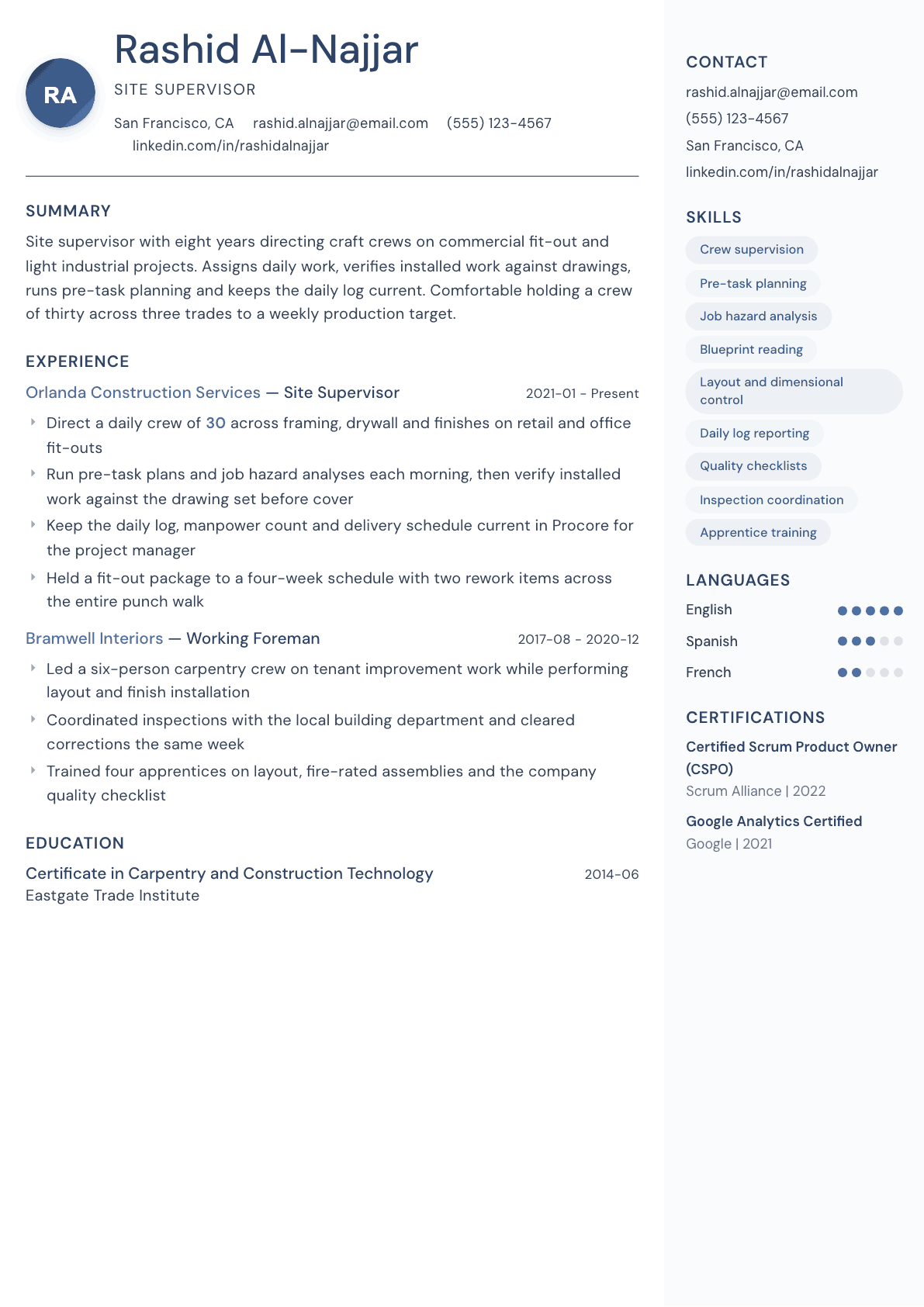
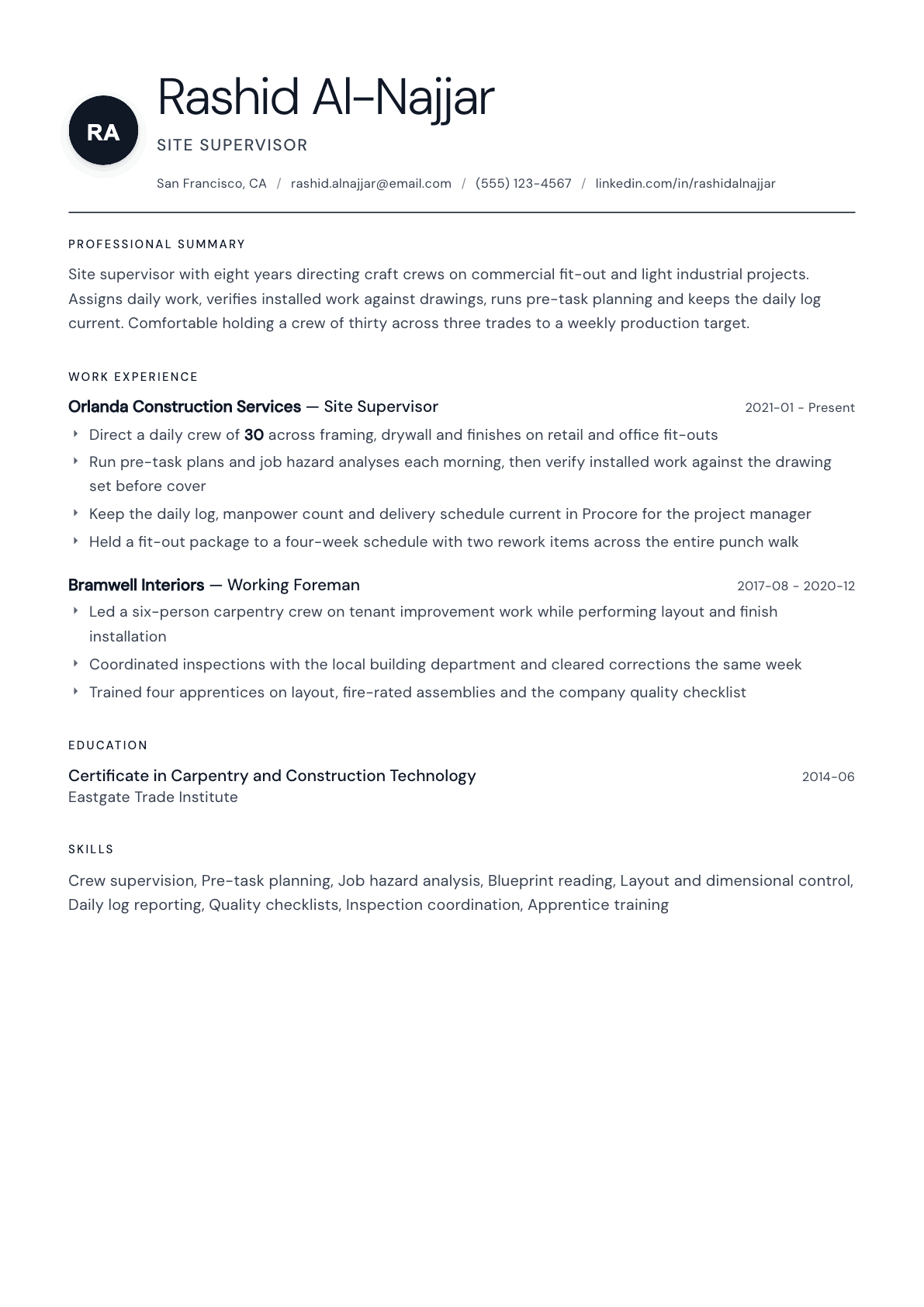
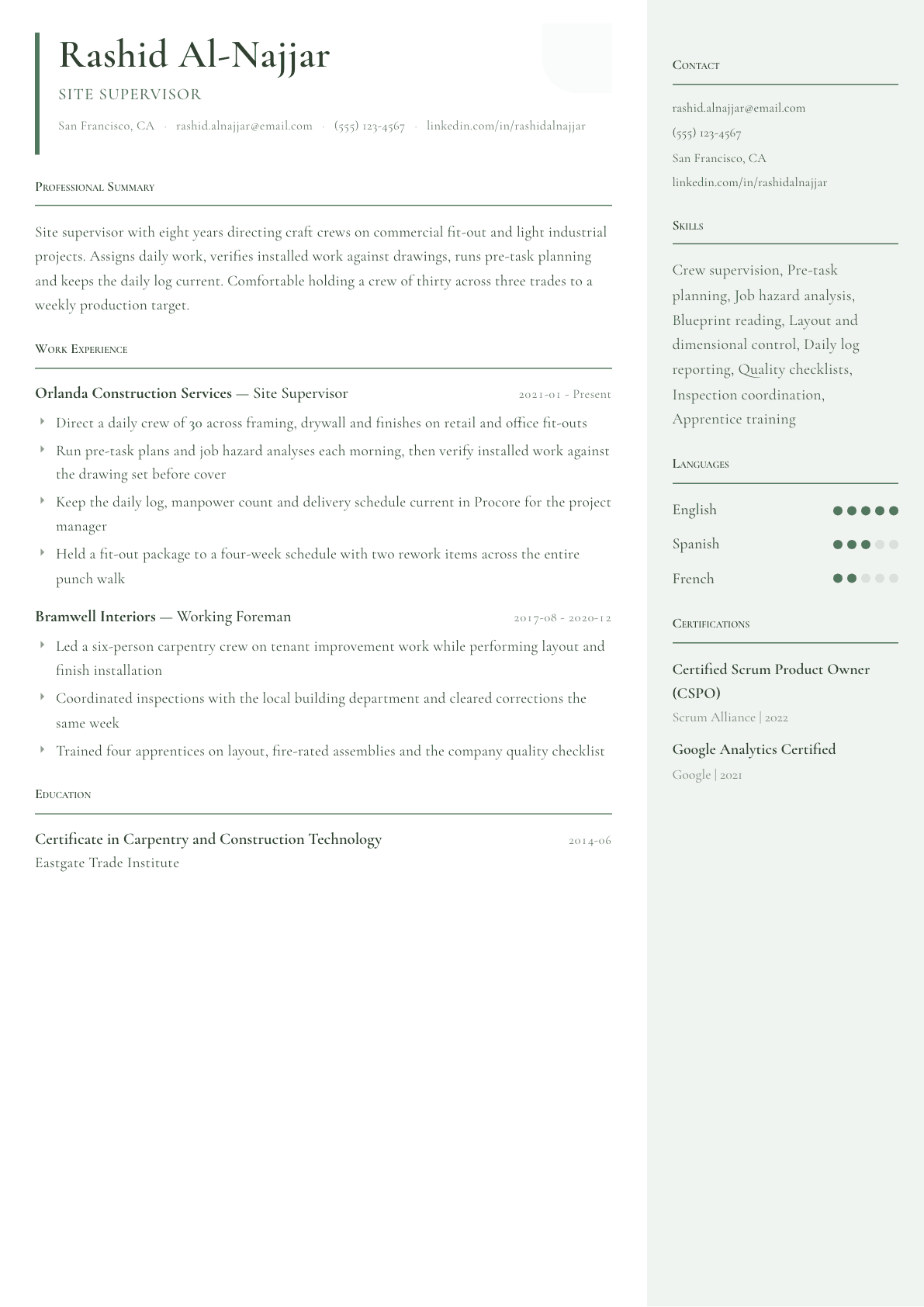
The same site supervisor content laid out in three CVBooster templates, so you can see what the finished document looks like before you write a word.
Example Site Supervisor summary
Site supervisor with eight years directing craft crews on commercial fit-out and light industrial work. Runs daily assignments for up to thirty workers across framing, drywall and finish trades, opens each shift with a pre-task plan and job hazard analysis, and verifies installed work against the drawing set before anything is covered. Keeps daily logs and manpower counts current so the project manager never has to chase the field.
Skills to list on a Site Supervisor resume
- Crew supervision
- Daily work assignment
- Pre-task planning
- Job hazard analysis
- Blueprint and shop drawing reading
- Layout and dimensional control
- Quality control checklists
- Daily logs and manpower reporting
- Inspection coordination
- Rework and punch resolution
- Toolbox talks
- Apprentice mentoring
- Material staging
- Scaffold and fall protection oversight
What actually gets this resume read
- Say how many people you supervise daily and across which trades, because crew size is the number a superintendent compares first.
- Show that you plan work before it starts: pre-task plans, job hazard analyses and morning assignments belong on the page.
- Prove you read drawings by naming what you verify, layout, dimensional control, fire-rated assemblies, before work gets covered.
- Include production evidence such as square footage completed per week, because a supervisor is hired to hold a rate.
- Mention how you handle inspection corrections and rework, since the cost of a supervisor who misses those is measured in weeks.
- Keep your own trade credentials visible, because most contractors want a supervisor who came up through the tools.
How to write a site supervisor resume
A site supervisor is hired to hold a crew to a rate and a standard. The superintendent reading your resume wants to know how many people you direct each morning, which trades they belong to, what you check before work gets covered, and whether the last job came off the punch walk clean. Those four answers decide the interview, and none of them are helped by an opening line about being a hardworking team player.
Most site supervisors came up through a trade, and that is an asset rather than something to disguise. A supervisor who can still read a layout, spot a fire-rated assembly built wrong and price a small change on the spot is more useful than one who only fills out the log. Show the tools you came up with and then show what you added on top.
This guide walks through crew scope, pre-task planning, quality verification, daily reporting and the production evidence that convinces a superintendent you will not need supervising yourself.
Format: keep it field-shaped and easy to scan
One page is fine early on, two once you have supervised several projects. Reverse-chronological, plain layout, and a projects line under each employer with type, size and duration. Put trade licenses and safety cards near the top, because those are hard gates on many sites.
Avoid columns and graphics. Contractors run resumes through the same parsers everyone else does, and a supervisor resume that loses its dates in a two column layout gets read as a gap.
- Header: name, city and state, phone, email, trade license and safety training.
- Order: summary, experience with crew size, projects, certifications, education or apprenticeship.
- Include union affiliation, travel range or per diem history when relevant to the employer.
Summary: crew size, trades, sector
State the daily crew size you direct, the trades involved, and the sector: commercial fit-out, light industrial, residential, civil. Add your own trade background and any safety supervision credential in the same block.
A supervisor who says he leads thirty workers across framing, drywall and finishes on retail and office fit-outs has told a superintendent almost everything needed to decide whether to keep reading.
Experience: assignment, verification and production
The first bullets are about directing work. Morning assignments, manpower allocation between areas, material staging, and how you adjust when a trade in front of you slips. Say how many people and across which crews, since that number is the primary comparison a superintendent makes.
The second cluster is verification. Layout and dimensional control, drawing checks before cover, fire-rated assembly detail, anchor and fastener patterns, and the company quality checklist. A supervisor who names what he checks before drywall goes up sounds like someone who has actually eaten a rework bill.
The third is production and reporting. Square footage completed per week, floors turned over, units finished, plus the daily log, manpower count and photos that keep the project manager current. Add inspection coordination and how quickly you clear corrections, because that is where schedules quietly bleed.
- Crew: headcount, trades, and whether you are working with tools or supervising only.
- Quality: what you verify, at what stage, and against which document.
- Production: a weekly or monthly rate you held, and the rework or punch result.
Safety: pre-task planning belongs in the bullets
A site supervisor owns the daily hazard conversation whether or not there is a safety professional on site. Write about the pre-task plan and job hazard analysis you run each morning, the fall protection and scaffold checks you perform, and how you stop work when a condition changes.
Also cover training you deliver. Toolbox talks, new hire orientation on your area, and apprentice coaching are real supervisory duties and they show a hiring manager that your crews get better instead of just staying busy.
Keywords superintendents and recruiters look for
Postings repeat crew supervision, daily work assignment, pre-task planning, job hazard analysis, blueprint reading, layout, quality control checklist, daily log, manpower reporting, inspection coordination, punch list and toolbox talk. Put each into a bullet where you can back it with a number or a named process, and keep the trade vocabulary of the sector you are targeting, because the words a fit-out contractor uses are not the words a heavy civil contractor uses.
Site Supervisor resume summary examples
Working foreman stepping up
Journeyman carpenter and working foreman with six years leading a crew of six on tenant improvement projects. Performs layout, installs fire-rated assemblies and finish work, coordinates inspections with the building department, and trains apprentices on the company quality checklist. OSHA 30 trained.
Eight years supervising
Site supervisor directing a daily crew of thirty across framing, drywall and finish trades on retail and office fit-outs. Runs pre-task plans each morning, verifies installed work against the drawing set before cover, and keeps daily logs and manpower counts current in Procore for the project manager.
Lead supervisor
Lead site supervisor with fourteen years on commercial and light industrial work, running two crews and reporting directly to the superintendent. Holds a supervisory safety credential, mentors two junior supervisors, and has closed the last four packages with fewer than ten punch items each.
Work experience bullets: before and after
Before: Supervised workers on the jobsite.
After: Directed a daily crew of thirty across framing, drywall and finish trades, assigning work by area each morning and rebalancing manpower when the mechanical rough fell behind.
Crew size, named trades and a real adjustment show supervision instead of presence.
Before: Made sure the work was done right.
After: Verified layout, fastener patterns and fire-rated assembly details against the drawing set before cover, using the company quality checklist at each area sign-off.
Naming what is checked, when and against which document is what a superintendent actually trusts.
Before: Held safety meetings.
After: Ran a pre-task plan and job hazard analysis with every crew each morning and delivered weekly toolbox talks covering fall protection, ladders and silica control.
Specific hazards and a daily rhythm prove a working safety habit rather than a checkbox.
Before: Kept the project moving.
After: Held a fit-out package to a four-week schedule by staging materials a floor ahead and turning over areas as they finished rather than waiting for the whole level.
The method behind the result is what a hiring manager can evaluate, and it shows planning ability.
Before: Worked with inspectors.
After: Coordinated framing and rough-in inspections with the building department and cleared every correction within the same week to keep drywall on schedule.
Turnaround on corrections is the field detail that decides whether a schedule holds.
Hard skills
- Crew supervision and daily assignment
- Pre-task planning and job hazard analysis
- Blueprint and shop drawing reading
- Layout and dimensional control
- Quality control checklists
- Daily logs and manpower reporting
- Material staging and delivery coordination
- Fall protection and scaffold inspection
- Inspection coordination
- Punch list and rework resolution
- Toolbox talk delivery
- Apprentice training
Soft skills
- Direct crew communication
- Holding a standard without losing the crew
- Problem solving at the wall
- Reliability and time keeping
- Coaching newer workers
Certifications worth listing
- OSHA 30-Hour Construction (OSHA Outreach Training Program)
- Safety Trained Supervisor Construction (STSC) (Board of Certified Safety Professionals)
- First Aid, CPR and AED (American Red Cross)
- Competent Person Training for Scaffolding and Fall Protection (National Center for Construction Education and Research)
Mistakes that cost site supervisor candidates the interview
- Never stating crew size, which leaves a superintendent unable to compare you against the next candidate.
- Hiding the trade you came from, when field credibility with a crew is a large part of why supervisors get hired.
- Writing about responsibility for quality without naming a single check you perform before work is covered.
- Leaving out production rates, so there is no evidence you can hold a crew to a weekly target.
- Mentioning safety once at the end rather than showing the daily pre-task routine that a site actually runs on.
- Copying an office project manager resume, which makes it unclear whether you were in the field at all.
Site Supervisor resume questions
What is the difference between a site supervisor and a foreman?
A foreman usually leads one trade crew and often works with tools. A supervisor typically directs multiple crews or trades and spends the day on assignment, verification and reporting. State which you did, and say if you still worked with tools.
How do I show production on a site supervisor resume?
Use a rate the trade recognizes: square footage of drywall hung per week, units turned over per month, linear feet of pipe set, or floors completed. Pair it with the punch or rework outcome so the number reads as quality work, not speed.
Do I need to list every project I supervised?
No. Choose the projects closest to the posting by sector and size, describe them properly with duration and crew, and summarize the rest in one line. Detail on five relevant jobs beats bare names for twenty.
Should I include my trade license and apprenticeship?
Yes, near the top. Many contractors specifically want a supervisor who came through an apprenticeship, and a current trade license also matters for insurance and for what you are permitted to sign off in the field.
How do I get a supervisor role without prior supervisory title?
Describe the leadership you already do: running a crew as a working foreman, training apprentices, laying out work for others and coordinating with other trades. Add a supervisory safety credential, which is the cheapest signal that you are ready.
Related resume examples
- Carpenter Resume example
- Construction Manager Resume example
- Construction Foreman Resume example
- Site Manager Resume example
- Construction Superintendent Resume example
- Safety Coordinator Resume example