Construction Laborer Resume Examples: what gets the call
Create a Construction Laborer Resume Foremen Actually Call Back
By Mustafa Tarabya, founder of CVBooster · Published · Updated
Construction laborer resume example with safety cards, equipment and site-work bullets, and a guide to getting called for the next crew.
Sample resumes for a construction laborer
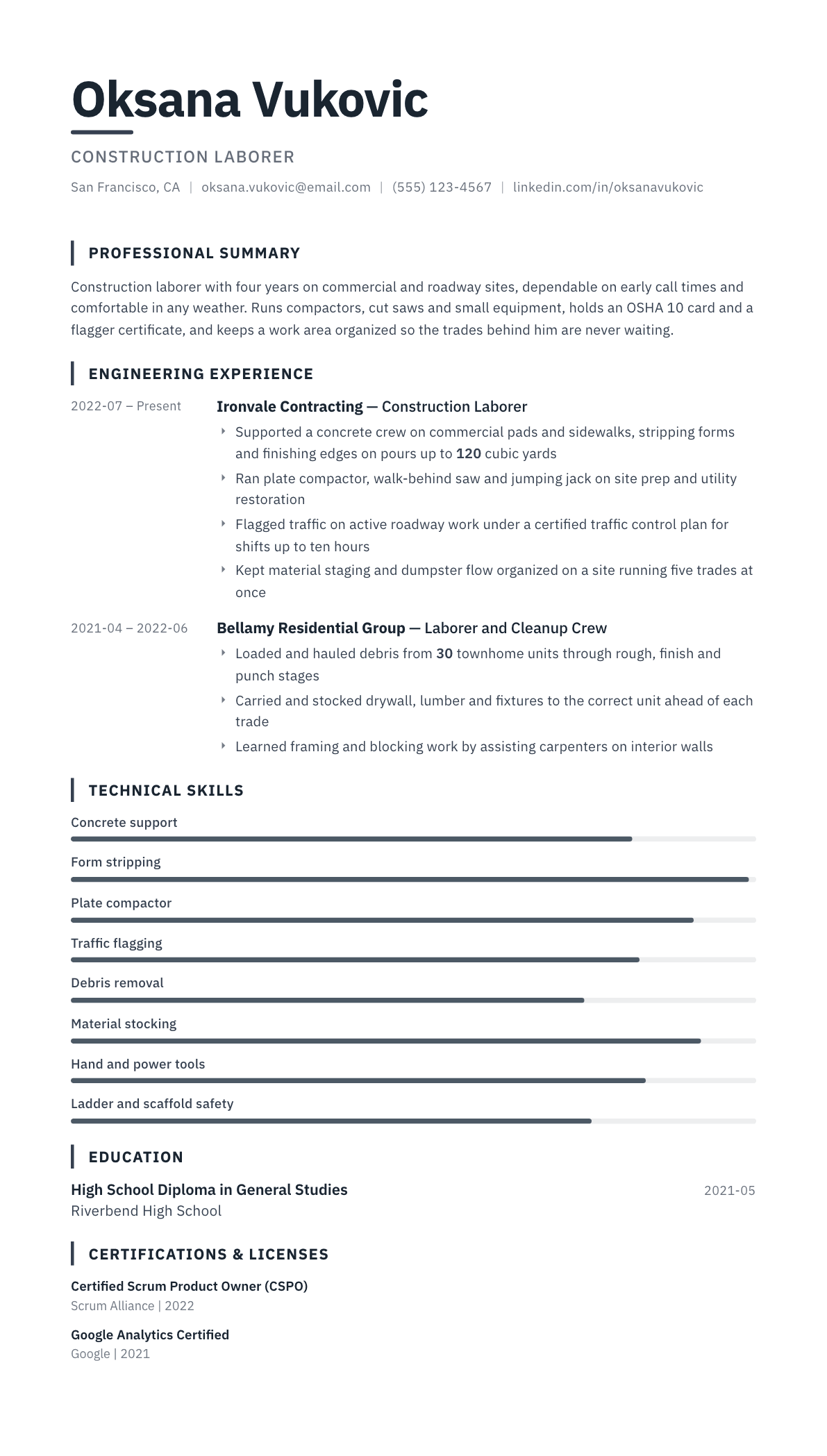
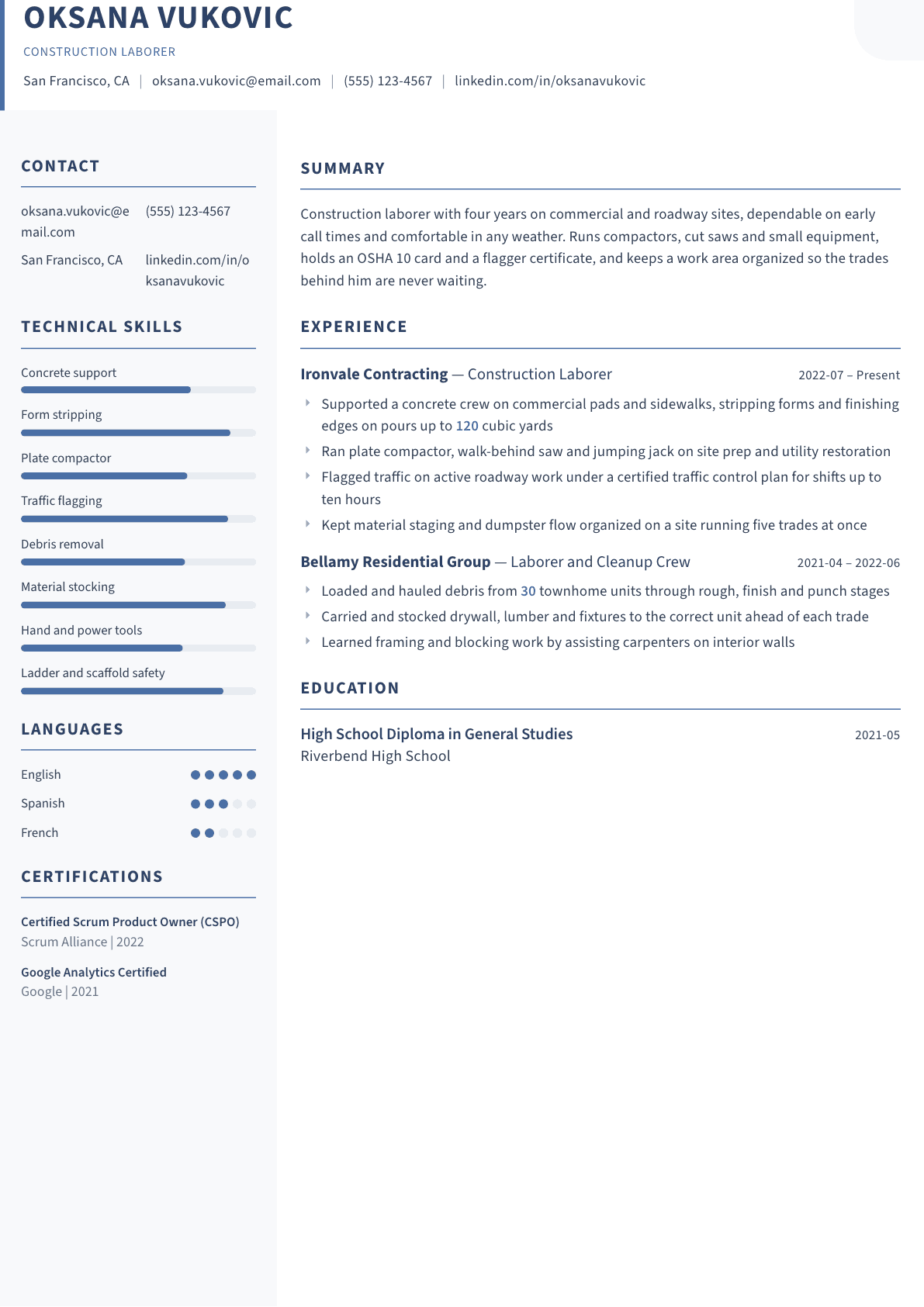
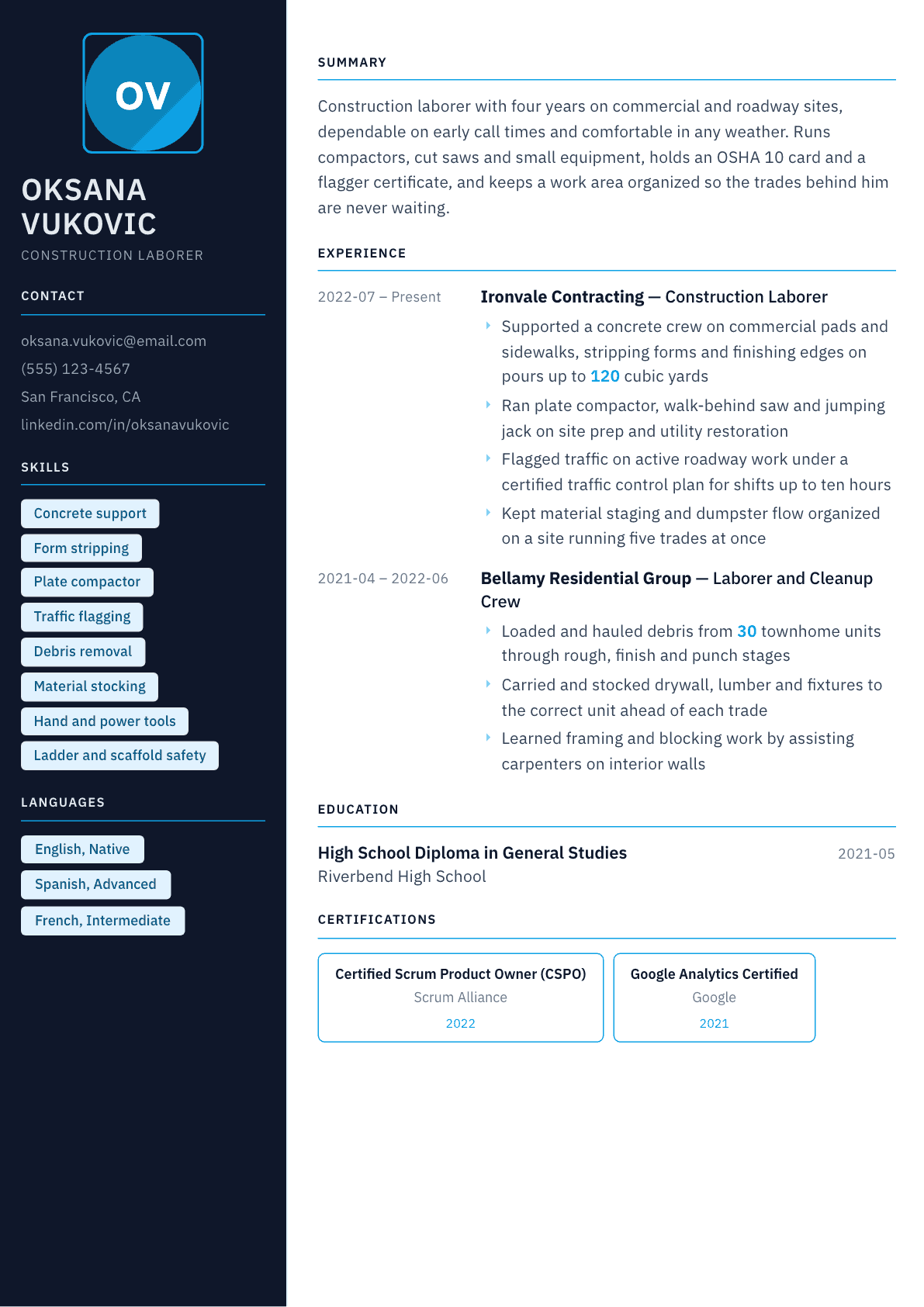
The same construction laborer content laid out in three CVBooster templates, so you can see what the finished document looks like before you write a word.
Example Construction Laborer summary
Construction laborer with four years on commercial and roadway sites, OSHA 10 carded and flagger certified. Supports concrete crews through pours up to 120 cubic yards, runs compactors and walk-behind saws, and keeps staging and debris flow clear on sites with five trades working at once. Reliable on early call times and available for full-time crew work.
Skills to list on a Construction Laborer resume
- General site labor
- Concrete support and form stripping
- Trenching and backfill
- Demolition and debris removal
- Material handling and stocking
- Plate compactor operation
- Concrete saw operation
- Traffic flagging
- Scaffold and ladder safety
- Fall protection
- Hand and power tools
- Site housekeeping
- Measuring and marking
What actually gets this resume read
- Lead with your safety cards, because a foreman needs to know today whether you can be on site tomorrow.
- Say what kind of sites you have worked: commercial, residential, roadway, utility or industrial.
- List every piece of equipment you can run, even small equipment like compactors, saws and mixers.
- Show reliability with dates that have no unexplained gaps and one line about attendance or early call times.
- Add a driver license class and whether you have your own transportation and basic hand tools.
- Keep it to one page in plain type, since these resumes are often read on a phone in a job trailer.
How to write a construction laborer resume
Hiring a construction laborer is a low-drama decision made under time pressure. A foreman is short two hands for a pour on Thursday and wants to know whether you can badge onto the site, keep up for ten hours, and come back Friday. The resume that answers those questions in the top third of the page gets the call.
That means the credentials, the availability and the sector come first, and the personal qualities come last or not at all. Hardworking and motivated appear on every laborer resume ever printed, so they carry no information. A flagger certificate, a compactor you can run and a year with no missed days carry a great deal.
This guide covers the layout that works for entry and early-career site work, how to write the tasks so they sound like the job rather than a chore list, how to handle agency placements and gaps, and the questions laborers ask when they want the next step toward a trade.
Format: cards, availability and license before work history
Open with a compact block of facts a foreman needs immediately: safety training, flagger certificate, first aid, driver license class, reliable transportation, and whether you own boots, hard hat, vest and basic hand tools. This block is the reason a laborer resume gets read at all.
Follow with availability. Say whether you can take night shifts, weekend work and out-of-town jobs with per diem. Crews are built around who can be there, and volunteering that information puts you in front of applicants the office has to chase.
- Facts block: training cards, license class, transportation, personal protective equipment and tools.
- Availability line: shift types, weekends, travel, and how soon you can start.
- Sector line: commercial, residential, roadway, utility or industrial sites you have worked.
Write the work as trade support, not chores
Laborers keep production moving, and the resume should read that way. Supporting a concrete crew means stripping forms, wetting the pour, running the buggy and finishing edges. Supporting a framing crew means stocking lumber to the right unit before the crew gets there. Naming which trade you supported tells a foreman where you already know the rhythm.
Give scale where you have it: cubic yards on a pour, units stocked, cartons or bundles moved, linear feet of trench, hours flagging on an active roadway. These numbers are ordinary to you and rare on a laborer resume, which is exactly why they work.
Include the site discipline you kept: staging by trade, dumpster and debris flow, keeping walkways clear, and protecting finished work. Superintendents notice laborers who understand that housekeeping is schedule protection.
Equipment and the skills that move you up
List the small equipment you can run: plate compactor, jumping jack, walk-behind saw, mixer, generator, pressure washer, jackhammer and pipe laser if you have used one. On many crews these are what separate a laborer who gets kept from one who gets released at the end of a phase.
Then flag the direction you are heading. If you have been picking up framing, blocking, form setting or pipe work by assisting a journeyman, write it as learning under a specific trade. Contractors would rather hire a laborer who is on a path than one who intends to stay a helper indefinitely.
Reliability, agencies and gaps
Attendance is the top complaint contractors have about labor, so make yours visible. A line stating a full year with no missed days, or two years with one contractor, does more than any adjective on the page.
If you have worked through a labor hall or staffing office, list the agency as the employer and name the sites and general contractors beneath it. That keeps the timeline continuous while still showing the range of work. For weather layoffs, write seasonal layoff and the months, and the gap stops being a question.
Keywords a labor office will search
Construction staffing systems match on card and task language: OSHA 10, flagger certified, concrete crew, form stripping, demolition, debris removal, material handling, plate compactor, trenching, fall protection and site cleanup. Use the terms you truly hold, spelled the way the industry spells them.
Keep the file plain and text-based so the office can copy details out of it. A photograph of a handwritten page, which is still common, cannot be searched at all and often never leaves the recruiter's phone.
Construction Laborer resume summary examples
Starting out
Laborer seeking full-time site work, OSHA 10 carded with first aid training and my own boots, hard hat and hand tools. Two summers of demolition and cleanup on residential remodels, comfortable with jackhammer and debris hauling. Available for day or night shifts and early call times, with reliable transportation.
Three to five years
Construction laborer with four years on commercial and roadway sites, OSHA 10 carded and flagger certified. Supports concrete crews through pours up to 120 cubic yards, runs compactors and walk-behind saws, and keeps staging and debris flow clear on sites running five trades at once.
Senior laborer
Senior laborer with nine years in commercial construction, often first on site and last off. Runs small equipment, sets up shoring and edge protection, and directs two to three newer laborers on staging and cleanup for the day. Working toward a carpentry apprenticeship with framing hours already logged.
Work experience bullets: before and after
Before: Assisted the concrete crew.
After: Supported a concrete crew on commercial pads and sidewalks, stripping forms and finishing edges on pours up to 120 cubic yards.
The specific tasks and the pour size show a foreman what you can be handed without instruction.
Before: Cleaned up debris.
After: Loaded and hauled debris from 30 townhome units through rough, finish and punch stages, keeping walkways clear for the finishing trades.
Volume and project stage turn cleanup into schedule protection, which is how a superintendent sees it.
Before: Directed traffic around the work zone.
After: Flagged traffic on active roadway work under a certified traffic control plan for shifts up to ten hours in all weather.
It names the certification, the setting and the shift length, which are the three things a roadway contractor checks.
Before: Moved materials around the site.
After: Carried and stocked drywall, lumber and fixtures to the correct unit ahead of each trade so crews started without a material hunt.
Delivering to the right place at the right time is the actual job, and the rewrite says so.
Before: Reliable worker with good attendance.
After: Completed twenty-two months with one contractor with no missed shifts and regular 6 a.m. call times.
A dated attendance record is verifiable, while the word reliable is on every competing resume.
Hard skills
- General site labor
- Concrete support and form stripping
- Demolition and debris removal
- Trenching and backfill
- Material handling and stocking
- Plate compactor and jumping jack
- Concrete saw operation
- Traffic flagging
- Scaffold and ladder safety
- Fall protection
- Hand and power tools
- Site housekeeping and staging
Soft skills
- Showing up early, every day
- Pace over a full shift
- Listening on a loud site
- Anticipating the next trade
- Working in heat and cold
- Respecting the chain of command
Certifications worth listing
- OSHA 10-Hour Construction (OSHA Outreach Training Program)
- Flagger Certification (American Traffic Safety Services Association)
- Core Curriculum: Introductory Craft Skills (NCCER)
- Adult First Aid and CPR (American Heart Association)
Mistakes that cost construction laborer candidates the interview
- Opening with a personality summary instead of the cards, license and availability a foreman needs.
- Describing tasks without saying which trade you were supporting or on what kind of site.
- Leaving small equipment off the page when running a compactor or a saw is what keeps you on the crew.
- Sending a photograph of a handwritten page that no staffing system can search.
- Listing only the staffing agency with no sites or contractors, so the range of work disappears.
- Skipping any mention of attendance when that is the complaint contractors raise most about labor.
Construction Laborer resume questions
What certifications help a construction laborer get hired fastest?
The ten-hour construction safety card first, then a flagger certificate if you want roadway work, and first aid with CPR. Each one removes a barrier to badging onto a site, and together they let a contractor put you to work the same week.
How do I list work done through a labor hall or staffing agency?
Put the agency as your employer with the full date range so the timeline stays continuous. Underneath, name the general contractors, the site types and the scopes you supported, which is the part a hiring foreman actually reads.
How do I move from laborer to a trade?
Write the trade hours you already have. If you have been setting forms, framing or laying pipe alongside a journeyman, name that work and the trade, then say you are seeking an apprenticeship. Contractors sponsor people who show a direction.
Does a construction laborer resume need an objective statement?
A short summary works better than an objective. Two or three lines naming your years, your cards, the sectors you have worked and your availability give a foreman everything he needs before he reads a single job entry.
What should I put if my last job ended badly?
List the dates and the role without explanation on the page, and prepare a short, factual answer for the interview. A resume is not the place for a dispute, and most contractors care far more about the next twelve months than the last one.
Related resume examples
- Carpenter Resume example
- Construction Manager Resume example
- General Laborer Resume example
- Road Construction Worker Resume example
- Construction Worker Resume example
- Carpenter Apprentice Resume example