Site Manager Resume Examples: free ATS score and gap list
A Site Manager Resume That Proves You Can Run the Whole Job
By Mustafa Tarabya, founder of CVBooster · Published · Updated
A site manager resume sample with tips on scope, sequencing and safety, the keywords contractors screen for, and a complete section by section guide.
Sample resumes for a site manager
The same site manager content laid out in three CVBooster templates, so you can see what the finished document looks like before you write a word.
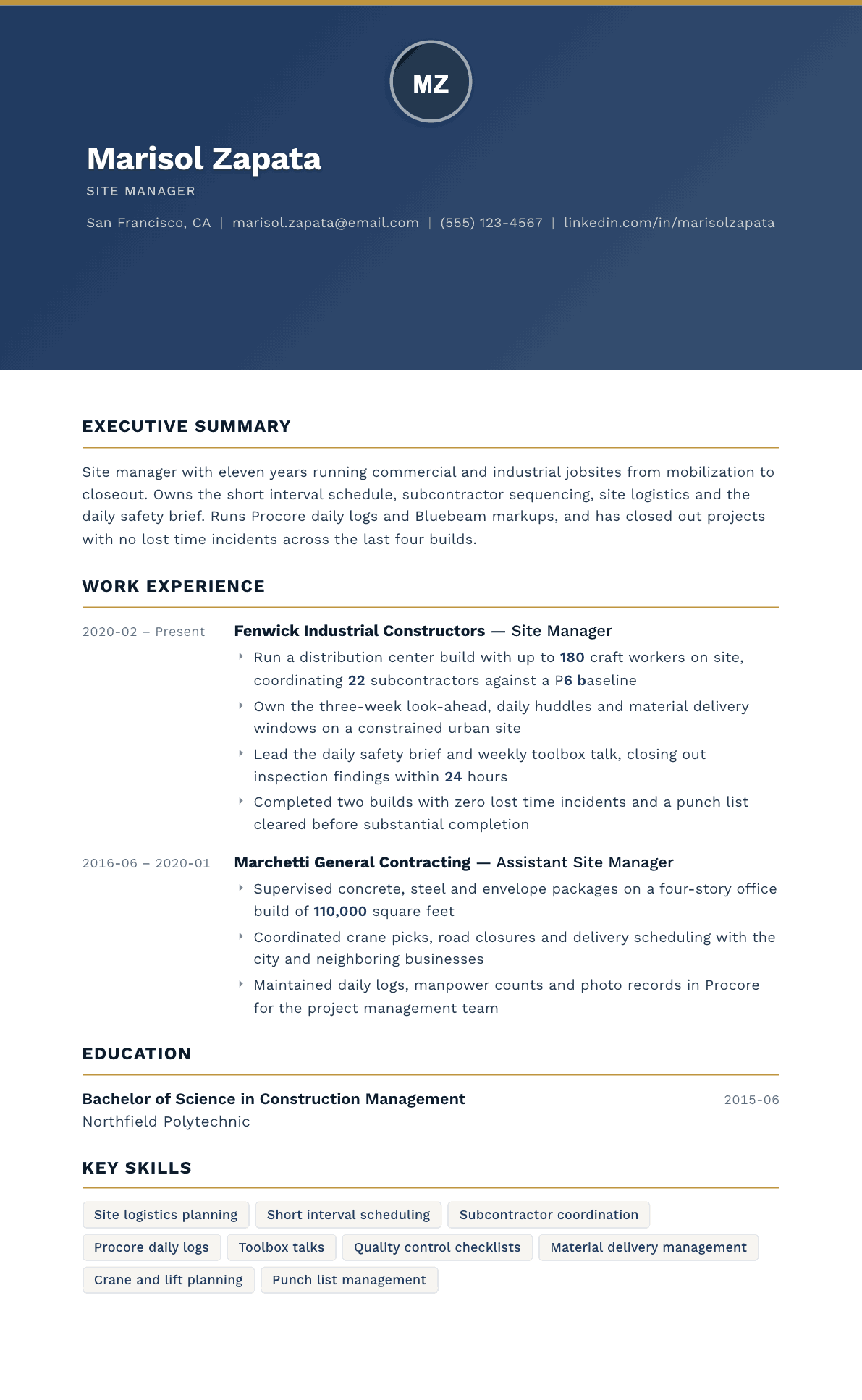
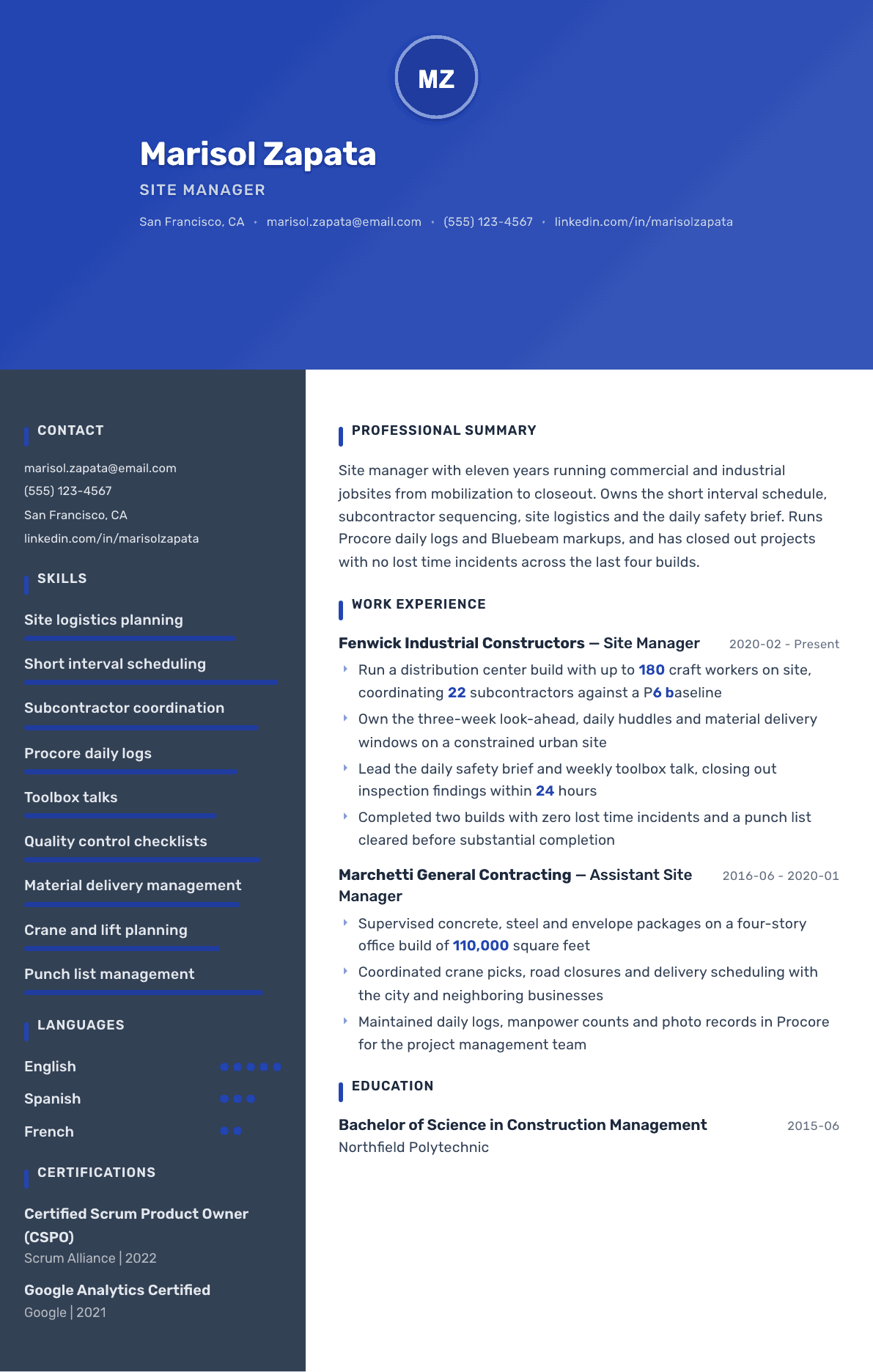
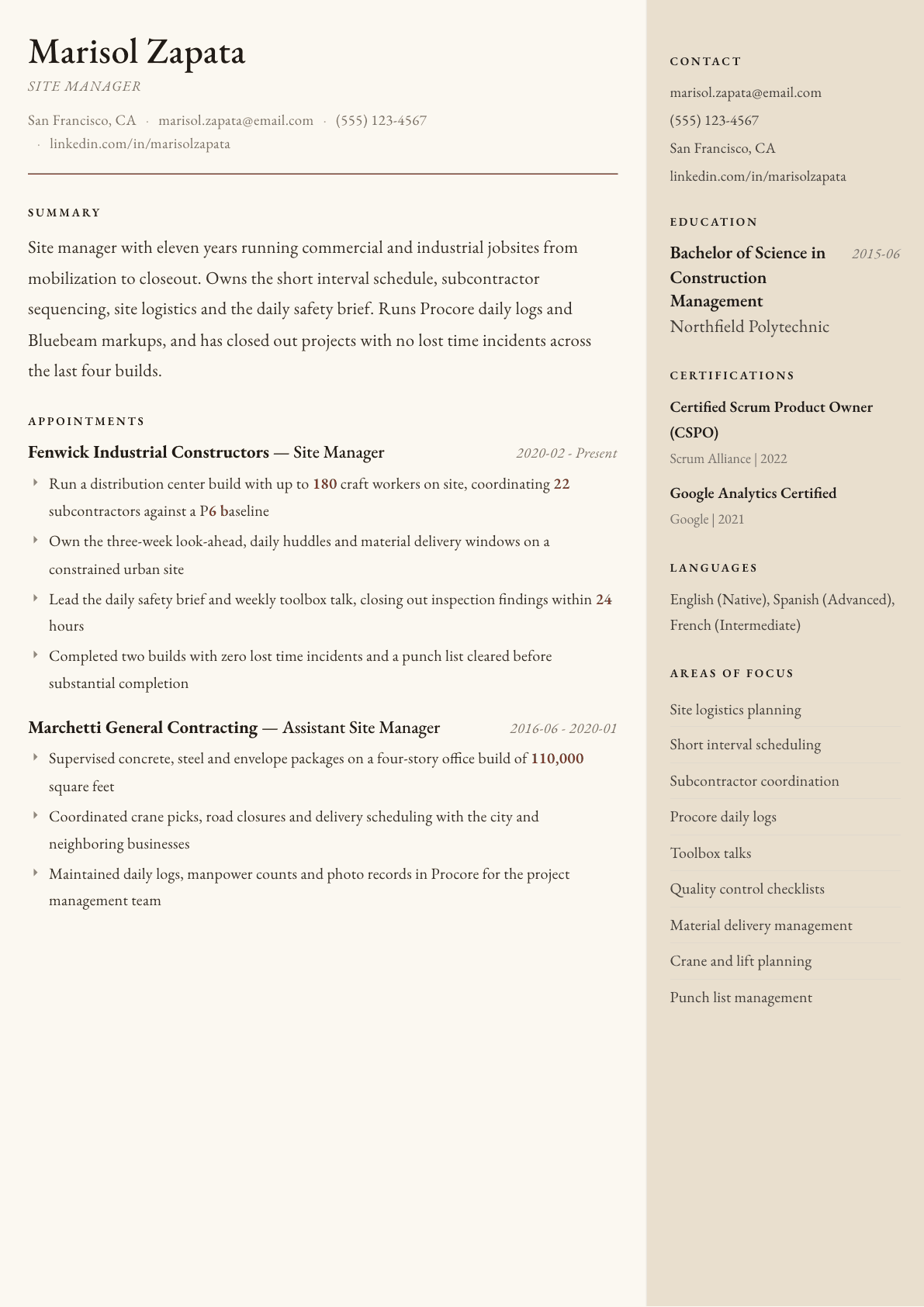
Example Site Manager summary
Site manager with eleven years running commercial and industrial jobsites from mobilization through handover. Coordinates up to twenty-two subcontractors and one hundred eighty craft workers against a Primavera baseline, owning the three-week look-ahead, delivery windows and daily safety brief. Runs Procore logs, closes inspection findings within a day, and has handed over the last four builds with the punch list cleared before substantial completion.
Skills to list on a Site Manager resume
- Site logistics planning
- Short interval and look-ahead scheduling
- Subcontractor coordination
- Procore
- Bluebeam Revu
- Daily logs and manpower tracking
- Toolbox talks and safety briefings
- Crane and critical lift planning
- Quality control inspection
- Material and delivery management
- Trade sequencing
- Punch list and handover
- Commissioning support
- Permit and inspection coordination
What actually gets this resume read
- Put headcount on the page: the number of craft workers and subcontractors you coordinate is the fastest read of your scope.
- Describe the site itself, urban and constrained or greenfield, because logistics difficulty is what separates two jobs of equal value.
- Show ownership of the short interval schedule and the look-ahead, not just attendance at the meeting where it is reviewed.
- Lead one bullet per job with safety performance, because a contractor will not hire a site manager who treats it as an afterthought.
- Name the trades and packages you personally sequenced, concrete, steel, envelope, MEP, rather than saying you managed all trades.
- Close with handover evidence: punch list turnaround, commissioning support and the operations and maintenance manuals you assembled.
How to write a site manager resume
A site manager resume is read by someone who has to decide whether to hand you a jobsite. The question underneath every line is simple: if the project manager is in the office and the owner shows up unannounced, can this person run the place? That is answered by scope on the ground, headcount, trades sequenced, logistics constraints, safety record, and whether the last few jobs finished when they were supposed to.
The title also varies by employer and by country. In some companies a site manager is the senior person on the project and reports to a regional operations lead. In others the superintendent runs the field and the site manager handles logistics and compliance. Say which version you have been, because a mismatch discovered in the second interview wastes everybody.
This guide sets out the structure hiring managers in the field expect: a project list with sizes and site conditions, experience bullets that show sequencing and safety ownership, and the handover evidence that proves you close a job rather than abandon it at substantial completion.
Format: employment plus a project list with real conditions
Reverse-chronological employment with a project list under each employer. For each project give the type, value, size in square footage or units, duration, peak headcount and one line on the site condition. An occupied hospital renovation with night work and a greenfield warehouse pad are both worth doing, and they are not the same difficulty.
Two pages is expected once you have run several projects. Keep the layout plain so the applicant tracking system does not scramble your dates, and put your safety training and credentials near the top.
- Header: name, city and state, phone, email, safety and trade credentials.
- Order: summary, projects, experience, safety record, certifications, education.
- Note travel willingness or per diem work if your history includes it, since many contractors need it.
Summary: sector, headcount, phase ownership
Open with the sectors you have run, the peak headcount you have managed on site, and the phases you own, whether that is mobilization through handover or a single package. Add the safety result in the same block, because a contractor will not read past a field leadership summary that ignores it.
Do not spend a line on being a strong communicator. Everyone claims that, and the reader is looking for evidence he can check.
Experience: sequencing, logistics, safety, handover
The first cluster is production. Show ownership of the short interval schedule and the three-week look-ahead: who builds it, who runs the coordination meeting, and how you recover when a trade falls behind. Naming a resequencing decision and the days it recovered is far stronger than saying you monitored progress.
The second cluster is logistics. Crane picks, delivery windows, lay-down space, road closures, hoisting, temporary power and water, and the coordination with neighbors and the city on a constrained site. This is the part of the job that separates a site manager from an office-based planner.
The third is safety, which needs its own bullets rather than a mention. Daily brief, toolbox talks, pre-task planning, inspection findings and how fast you close them. The fourth is handover: punch walk process, commissioning support, operations and maintenance manuals, warranty documentation, and whether the client accepted the building on the first walk.
- Trades sequenced by name, not the phrase all trades.
- Peak craft headcount and the number of subcontractors coordinated at once.
- Site constraint of the job: occupied building, urban footprint, tidal, live plant, phased turnover.
Systems and reporting: what you keep current
Field leadership now lives inside software. Name the platform you run daily logs, manpower counts, photos and observations in, typically Procore or Autodesk Build, the markup tool you use on drawings, usually Bluebeam Revu, and the schedule tool the baseline sits in, Primavera P6 or Microsoft Project.
Say what you produce from these systems and who reads it. A site manager whose daily log is complete enough that the project manager never has to call the field is worth naming that fact out loud.
Keywords contractors search for in site management resumes
The recurring language includes site logistics plan, look-ahead schedule, trade sequencing, subcontractor coordination, critical lift plan, toolbox talk, quality control checklist, punch list, substantial completion, commissioning and handover. Place them in bullets that carry evidence. A block of terms at the bottom of the page reads as filler to the operations manager who makes the actual decision.
Site Manager resume summary examples
Assistant site manager
Construction management graduate with two years as assistant site manager on a four-story office build. Maintained daily logs and manpower counts in Procore, coordinated crane picks and delivery windows on a downtown site, and supported the concrete and envelope packages through topping out.
Eight years in
Site manager with eight years running commercial fit-out and retail construction with peak crews of eighty. Owns the three-week look-ahead, trade sequencing and daily safety brief, and closes inspection findings within a day. Delivered the last three projects on the contract date with punch lists cleared before handover.
Senior site manager
Senior site manager with fifteen years on industrial and distribution projects, including a build with one hundred eighty craft workers and twenty-two subcontractors on a constrained urban parcel. Leads mobilization through commissioning, mentors two assistant managers, and has closed four consecutive builds without a lost time incident.
Work experience bullets: before and after
Before: Managed the site and all subcontractors.
After: Coordinated twenty-two subcontractors and a peak of one hundred eighty craft workers on a distribution center build, sequencing concrete, steel, envelope and MEP against the P6 baseline.
Headcount, subcontractor count and named packages give the reader a real picture of the scope you controlled.
Before: Kept the project on schedule.
After: Owned the three-week look-ahead and recovered nine days of steel erection delay by resequencing roof deck and slab-on-grade pours across two crews.
A named recovery action beats a claim about staying on schedule, which nobody can verify.
Before: Ran safety on site.
After: Led the daily safety brief and weekly toolbox talk for every trade on site, closing third-party inspection findings within 24 hours across a two-year build.
Frequency and closure time are checkable, and safety is the first thing a contractor tests you on.
Before: Handled deliveries and site setup.
After: Built the site logistics plan for a constrained downtown parcel: crane pick windows, two-hour delivery slots, sidewalk closures and neighbor notifications agreed with the city.
Logistics detail is the clearest proof that you have actually run a difficult site rather than an easy one.
Before: Completed the punch list at the end.
After: Ran rolling punch walks by floor from six weeks out, so the owner accepted the building at first walk with fewer than 30 open items.
A process plus a handover result shows you close projects instead of leaving them to somebody else.
Hard skills
- Site logistics planning
- Short interval and look-ahead scheduling
- Trade sequencing and coordination
- Procore daily logs and manpower tracking
- Bluebeam Revu drawing markup
- Primavera P6 schedule updates
- Critical lift and crane planning
- Quality control checklists and pre-installation meetings
- Toolbox talks and pre-task planning
- Inspection and permit coordination
- Punch list and handover management
- Commissioning support
Soft skills
- Field leadership
- Trade partner relationships
- Calm decision making
- Neighbor and client diplomacy
- Mentoring junior field staff
Certifications worth listing
- OSHA 30-Hour Construction (OSHA Outreach Training Program)
- Certified Construction Manager (CCM) (Construction Manager Certification Institute)
- Safety Trained Supervisor Construction (STSC) (Board of Certified Safety Professionals)
- First Aid, CPR and AED (American Red Cross)
Mistakes that cost site manager candidates the interview
- Describing projects only by dollar value, with no headcount, duration or site condition to explain the difficulty.
- Writing all trades instead of naming the packages you personally sequenced and the ones you never touched.
- Treating safety as a single closing line when it is the first thing a construction employer verifies.
- Skipping handover and commissioning, which suggests you leave at substantial completion and let others finish.
- Using the same wording as an office-based project manager resume, which blurs whether you were in the field.
- Omitting the reporting systems you keep current, since a field leader who does not document creates work for everyone else.
Site Manager resume questions
What is the difference between a site manager and a superintendent on a resume?
It depends on the employer, so state your actual reporting line and scope. Say who reported to you, who you reported to, and whether you owned the schedule and the safety program or supported someone who did.
How much detail should I give about each project?
Enough for a reader to picture the job: type, value, size, duration, peak headcount and one line about the site condition. Five projects described that way beat fifteen listed as names with nothing attached to them.
Should I put my safety record on the resume?
Yes, if it is accurate and yours to claim. Consecutive projects without a lost time incident, audit results and inspection closure times are all legitimate. Avoid company-wide numbers you had no influence over.
Do I need a construction management degree for a site manager role?
Not at most contractors. Many site managers come up through a trade and hold a supervisory safety credential instead. A degree helps at large general contractors and on public work, but a strong project list carries more weight in the field.
How do I move from a specialty trade into general site management?
Lead with the packages you have coordinated beyond your own trade, then show logistics, safety and schedule ownership. Contractors hire trade leaders into site management regularly, but they need proof you have sequenced other people's work.
Related resume examples
- Construction Manager Resume example
- Crane Operator Resume example
- Construction Superintendent Resume example
- Site Supervisor Resume example
- Construction Foreman Resume example
- Construction Project Manager Resume example