Safety Coordinator Resume Examples: the lines they read
Build a Safety Coordinator Resume That Shows Daily Field Presence
By Mustafa Tarabya, founder of CVBooster · Published · Updated
A safety coordinator resume sample with inspection, training and reporting tips, the field safety keywords employers screen for, and a full guide.
Sample resumes for a safety coordinator
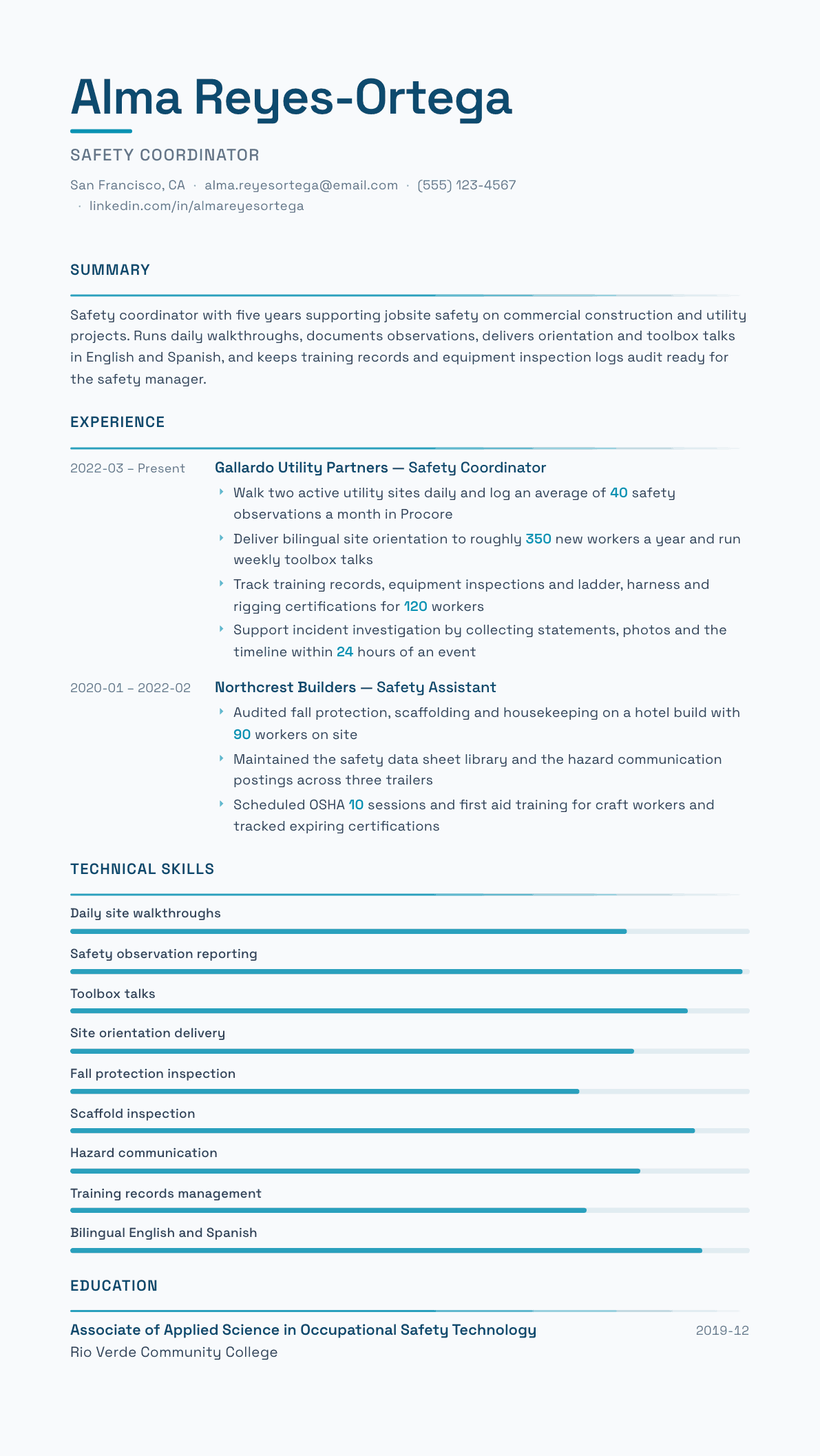
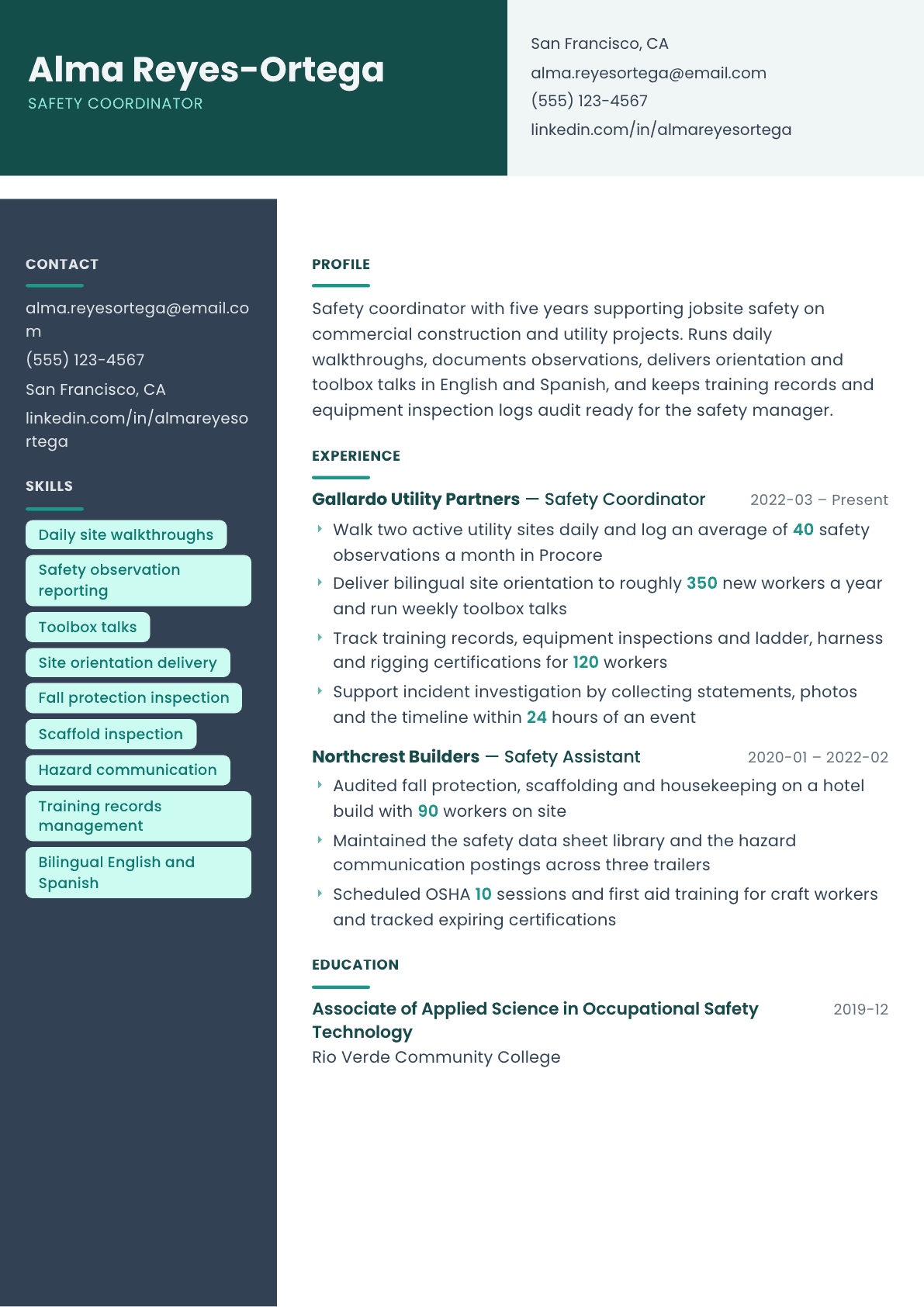
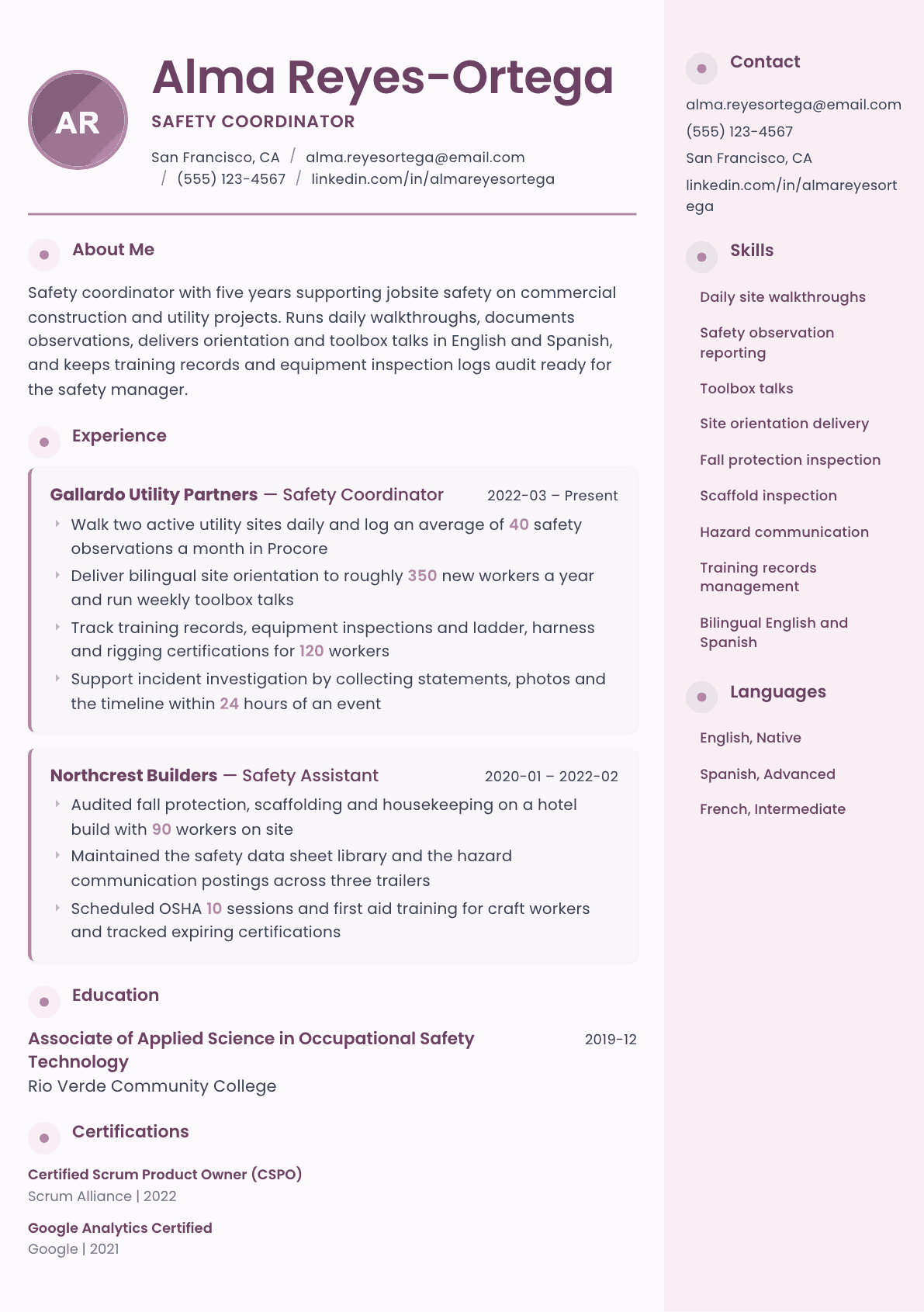
The same safety coordinator content laid out in three CVBooster templates, so you can see what the finished document looks like before you write a word.
Example Safety Coordinator summary
Safety coordinator with five years supporting commercial construction and utility jobsites. Walks active sites daily, logs observations in Procore, and delivers bilingual orientation and weekly toolbox talks to craft crews. Keeps training records, harness and rigging certifications and equipment inspection logs audit ready, and supports incident response by gathering statements, photos and a timeline within a day of the event.
Skills to list on a Safety Coordinator resume
- Daily site walkthroughs
- Safety observation reporting
- Toolbox talks
- New hire orientation delivery
- Fall protection inspection
- Scaffold and ladder inspection
- Hazard communication and safety data sheets
- Training records management
- Equipment inspection logs
- Incident evidence collection
- Personal protective equipment issue
- Procore and SafetyCulture reporting
- First aid and CPR response
- Bilingual safety communication
What actually gets this resume read
- Show daily field presence with numbers: sites walked, observations logged and toolbox talks delivered in a typical month.
- Make the training and certification tracking visible, because that record keeping is half of what a safety coordinator is hired for.
- Say which inspection routines you own, fall protection, scaffold, ladders, rigging, fire extinguishers and eyewash stations.
- Mention any second language you use on site, since bilingual delivery of orientation is a real advantage on construction crews.
- Describe your role in incident response, evidence collection and timelines, without claiming to lead investigations you supported.
- Name the tool you log observations in, Procore, HammerTech or SafetyCulture, because employers hire around their reporting system.
How to write a safety coordinator resume
The safety coordinator is the person who is actually out on the deck every day. The safety manager owns the program, the coordinator makes it real: walking the site, logging what is wrong, running orientation for new crews, keeping the training matrix current and making sure the harness inspection tags are not from last season. A hiring manager reading your resume is trying to work out whether you will be visible in the field or parked in the trailer.
Because the role is support, candidates often undersell it into a list of duties. That is the mistake. Coordinators produce measurable output: observations logged, workers oriented, talks delivered, certifications tracked, inspections completed. Those numbers make the difference between a resume that looks administrative and one that looks operationally useful.
This guide covers how to quantify field presence, how to describe the records you maintain, where language skills fit, how to write about supporting an investigation without overstating your role, and how to position yourself for a manager job later.
Format: one page early, two once you have projects
Reverse-chronological with the project or site listed under each employer including its type, size and workforce. Put safety training cards and any credential near the top, because on many jobsites you cannot badge in without them.
Keep the design plain and text-based. Companies feed these resumes through the same parsers as every other role, and a decorative layout can lose the certification dates that matter most.
- Header: name, city and state, phone, email, safety training and first aid credentials.
- Order: summary, certifications, experience by site, training delivered, education.
- Add languages you use on site, since crews are often bilingual and orientation has to reach everyone.
Summary: sites walked, people reached, records held
Open with the sectors and the number of active sites you support, the size of the workforce you orient and track, and the reporting system you log into. Add your first aid response capability, because that is a real duty rather than a bonus.
Name who you support. A coordinator reporting to a corporate safety manager across three sites is doing a different job from one embedded on a single large project, and employers hire for one or the other.
Experience: presence, records, training, response
Start with field presence. How many sites you walk, how often, and what you log. Safety observations with a monthly count and a system name is the most convincing single bullet a coordinator can write, because it shows the walk actually produces something.
Then records. Training matrices, certification expirations for harness, rigging, forklift and aerial lift qualifications, equipment inspection logs, safety data sheet libraries and hazard communication postings. This administration is half the role, and it is what fails an audit when it slips.
Then delivery. New hire orientation numbers, weekly toolbox talks, and any formal training you are qualified to run. Finish with incident support: securing the area, collecting statements and photographs, building the timeline, and handing a complete package to the investigator within the first day.
- Observations logged per month and the platform they live in.
- Workers oriented per year and the languages you deliver in.
- Inspection routines you own: fall protection, scaffold, ladders, rigging, extinguishers, eyewash.
Systems and equipment: be specific
Name the reporting platform you use, whether that is Procore, HammerTech, SafetyCulture or an internal system, and say what you produce from it: observation trends, open item lists and weekly reports for the site leadership meeting.
On the equipment side, list what you inspect and issue: harnesses and lanyards, self-retracting lifelines, gas detectors, respirators and fit testing support, hearing protection and eyewash stations. A coordinator who can be trusted with equipment control saves a manager a great deal of worry.
Keywords in safety coordinator postings
Common terms include safety observation, site walkthrough, toolbox talk, new hire orientation, job hazard analysis support, fall protection inspection, scaffold inspection, hazard communication, safety data sheets, training records, incident reporting and first aid response. Use the language of your sector too, since a utility contractor and a hospital facilities team describe the same duties with different words.
Safety Coordinator resume summary examples
Safety assistant
Occupational safety technology graduate with a year supporting a hotel build with ninety workers on site. Audited fall protection, scaffolding and housekeeping daily, maintained the safety data sheet library across three trailers, and scheduled first aid and outreach training for craft workers.
Five years in
Safety coordinator supporting two active utility sites, logging around forty observations a month and delivering bilingual orientation to roughly three hundred fifty new workers a year. Tracks harness, rigging and equipment inspection records for one hundred twenty workers and supports incident response within the first day.
Senior coordinator
Senior safety coordinator across four commercial projects, mentoring two junior coordinators and producing the weekly observation trend report for site leadership. Runs the training matrix and equipment control program, and has covered the safety manager role during extended absences on a live jobsite.
Work experience bullets: before and after
Before: Walked the site and looked for safety issues.
After: Walked two active utility sites daily and logged an average of 40 safety observations a month in Procore, tracking each open item to a verified correction.
A count, a platform and a closure step turn a walk into a documented, reviewable output.
Before: Gave safety orientations to new workers.
After: Delivered bilingual site orientation in English and Spanish to roughly 350 new workers a year, covering site rules, hazard reporting and the emergency assembly plan.
Volume, languages and content make orientation a concrete contribution rather than a listed duty.
Before: Kept safety training records.
After: Maintained the training matrix and certification expirations for 120 workers covering harness, rigging, forklift and aerial lift qualifications, flagging renewals a month ahead.
Naming the qualifications and the advance warning shows a system that prevents a badge-in failure.
Before: Checked safety equipment on site.
After: Inspected fall protection harnesses, lanyards, ladders and scaffold tags on a set weekly rotation, removing damaged equipment from service and logging the replacement.
A rotation and a removal-from-service step describe an equipment control routine, not a glance.
Before: Helped when incidents happened.
After: Supported incident response by securing the area, collecting witness statements and photographs, and handing the investigator a documented timeline within 24 hours.
It states the support role honestly and shows the specific deliverable produced under time pressure.
Hard skills
- Daily site walkthroughs
- Safety observation logging and trending
- New hire orientation delivery
- Toolbox talk delivery
- Fall protection and harness inspection
- Scaffold and ladder inspection
- Hazard communication and safety data sheet libraries
- Training matrix and certification tracking
- Equipment inspection logs
- Incident evidence collection
- Personal protective equipment issue and control
- First aid and CPR response
Soft skills
- Approachability on the deck
- Bilingual communication
- Follow-through on open items
- Attention to expiring records
- Supporting without overstepping
Certifications worth listing
- Construction Health and Safety Technician (CHST) (Board of Certified Safety Professionals)
- Safety Trained Supervisor (STS) (Board of Certified Safety Professionals)
- OSHA 30-Hour Construction (OSHA Outreach Training Program)
- First Aid, CPR and AED (American Red Cross)
- Adult First Aid and CPR (American Heart Association)
Mistakes that cost safety coordinator candidates the interview
- Writing the resume as a list of duties with no counts, which makes daily field presence impossible to verify.
- Claiming to have led investigations you supported, a claim that unravels the moment an interviewer probes it.
- Leaving out the records you maintain, even though certification and inspection tracking is half of the position.
- Skipping the reporting platform, when employers often hire specifically for familiarity with their own system.
- Omitting a second language you use daily on site, which is a genuine advantage on most craft workforces.
- Describing yourself as a safety manager when the title was coordinator, which damages trust before the interview starts.
Safety Coordinator resume questions
What is the difference between a safety coordinator and a safety manager?
A coordinator executes and documents the program in the field, while a manager writes it, owns the metrics and answers to leadership and regulators. Describe your actual authority, because overstating it is the fastest way to lose an offer.
How do I quantify safety coordinator work?
Count what you produce: sites walked per week, observations logged per month, workers oriented per year, toolbox talks delivered, certifications tracked and inspection routines completed. Those numbers convert an administrative-sounding role into measurable field output.
Does being bilingual help in a safety coordinator role?
Considerably, on most construction and industrial crews. Orientation and hazard briefings only work if everyone understands them, so state the languages you deliver in and whether you translate written materials as well as speak.
What certification should a safety coordinator get?
The construction health and safety technician credential from the Board of Certified Safety Professionals is the natural target, with a thirty hour construction outreach card and current first aid and CPR as the working baseline for site access.
How do I move from coordinator to safety manager?
Take on program pieces you can own outright: the training matrix, the equipment control routine, the observation trend report. Pursue a board credential, and describe any period covering for the manager, because that is the evidence hiring teams look for.
Related resume examples
- Construction Manager Resume example
- Electrician Resume example
- Construction Safety Manager Resume example
- Health and Safety Officer Resume example
- Site Supervisor Resume example
- Site Manager Resume example