Creative Director Resume Examples: the lines they read
Design a Creative Director Resume That Wins Awards
By Mustafa Tarabya, founder of CVBooster · Published · Updated
Craft a visually compelling creative director resume with campaign leadership, brand transformation, and team management expertise that creative agencies and brands demand.
Sample resumes for a creative director
The same creative director content laid out in three CVBooster templates, so you can see what the finished document looks like before you write a word.
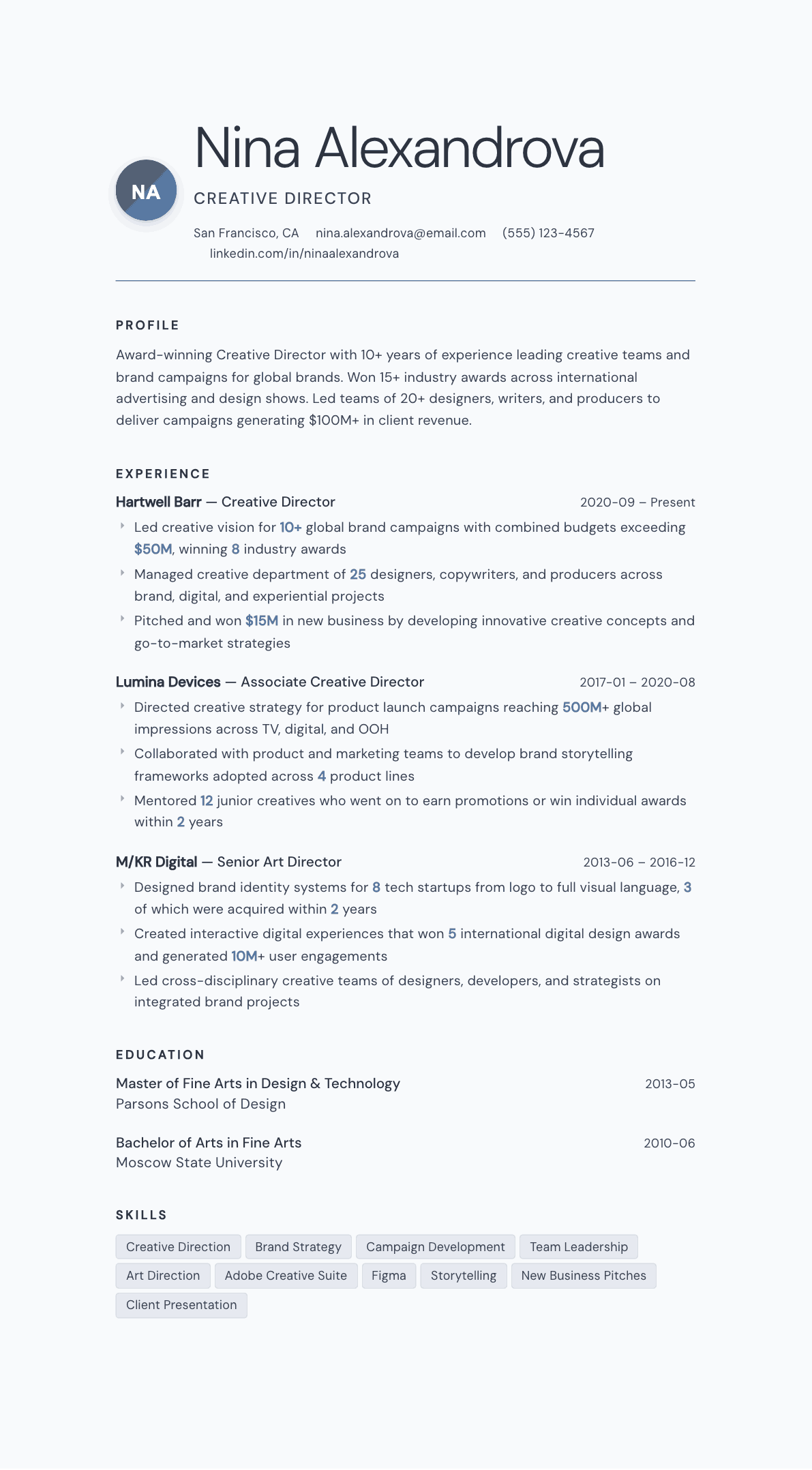
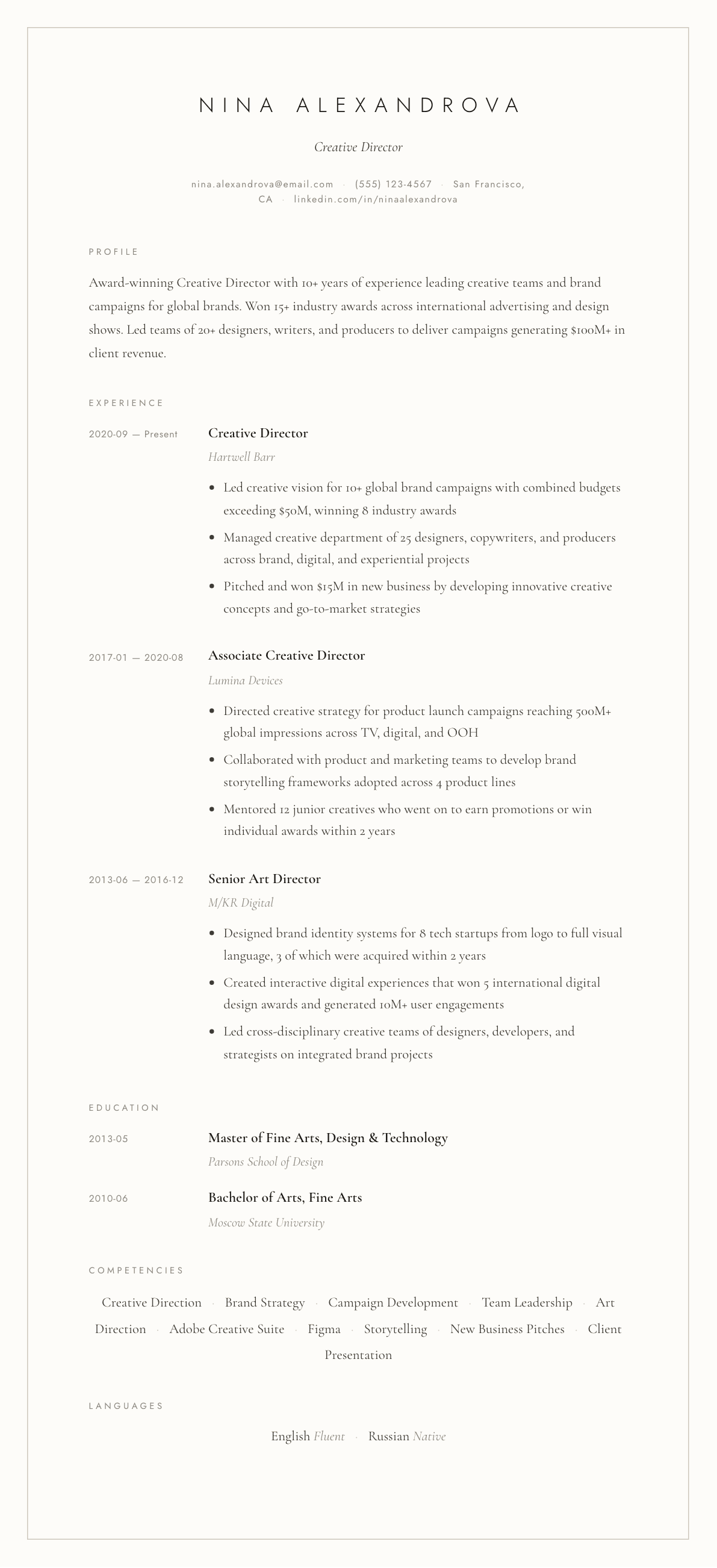
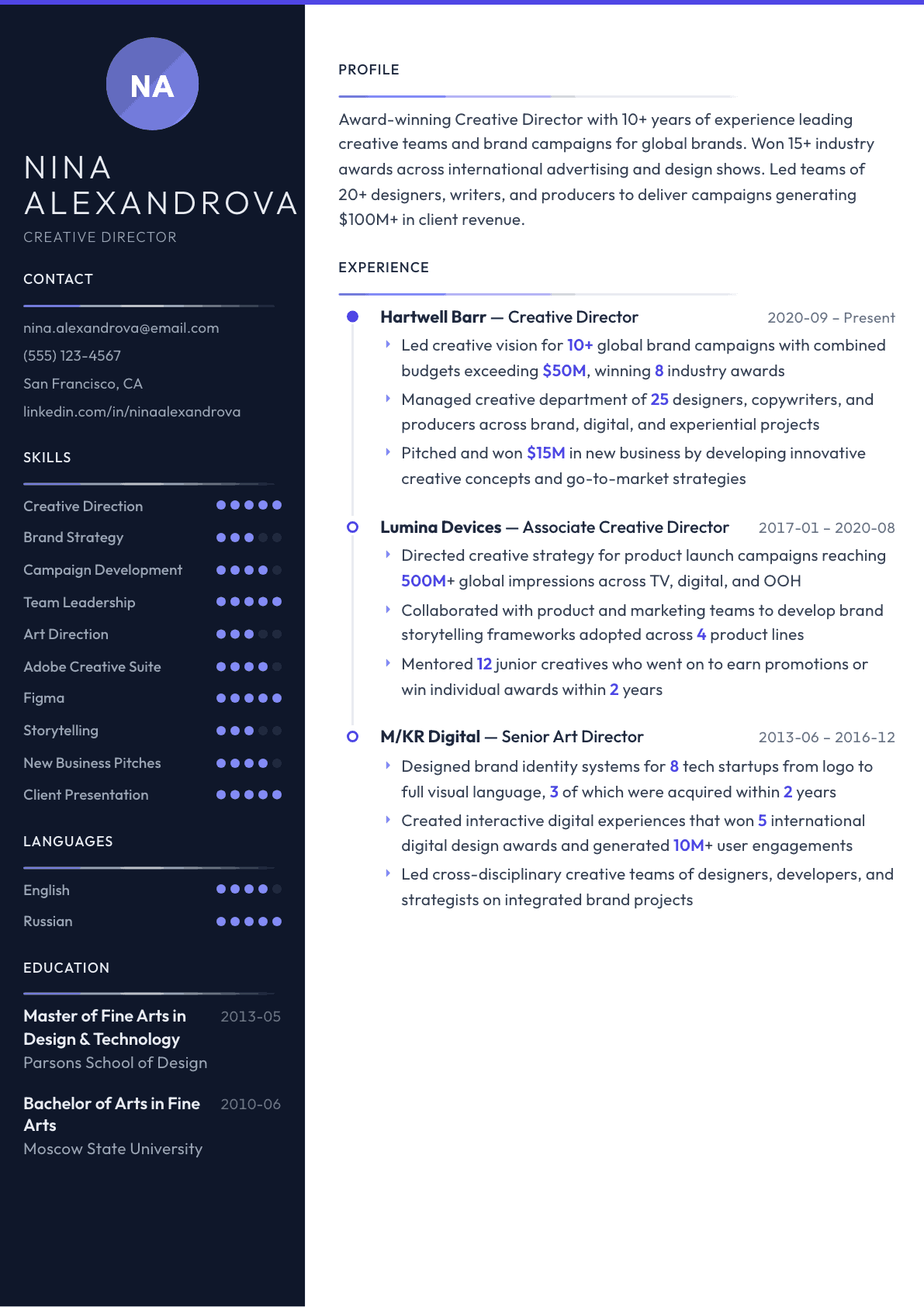
Example Creative Director summary
Creative Director with 10 years leading global brand campaigns on the agency and client side. Won 15+ awards at international advertising and design shows while running creative departments of 25 across brand, digital and experiential. Campaigns drove $100M+ in client revenue and $15M in new business wins.
Skills to list on a Creative Director resume
- Creative Direction
- Art Direction
- Brand Strategy
- Campaign Development
- Team Leadership
- Storytelling
- Adobe Creative Suite
- Figma
- Sketch
- New Business Development
- Client Presentation
- Visual Design
- Typography
- Motion Design
- UX/UI Direction
What actually gets this resume read
- Lead with awards won and campaign impact: Cannes Lions, D&AD, One Show, Webby Awards, Clio Awards.
- Showcase team leadership: size of teams managed, mentorship results, and creative culture building.
- Demonstrate business impact: revenue generated, new business won, client growth driven by your creative.
- Include a portfolio link -- a creative director resume without a portfolio link is incomplete.
- Highlight cross-channel expertise: brand identity, TV/film, digital, experiential, social.
- Mention your creative process and how you inspire and evaluate ideas from concepting to execution.
How to write a creative director resume
A creative director is hired on two things that pull against each other: the work and the room. The work is judged from the portfolio, which an executive creative director or a founder opens first. The room is judged from the resume, because that is where the reader learns how large a department you have run, how you cast teams, how you handle a client who hates the idea, and whether the standard on your reel survived after you stopped writing and art directing yourself.
The distinction between agency and in-house matters more than most candidates assume. Agency creative directors are read for new business, pitch record, account breadth and pace. In-house directors are read for brand stewardship, cross-functional operation with product and marketing, and building a system other people can use without you in the room. Naming which one you are, and which one you are moving to, prevents the reader from guessing wrong.
This guide covers the layout of a director-level creative file, how to write about work you led rather than made, three summaries covering a first director seat through a group role, before-and-after bullets, and the questions creative leaders ask when their credit is shared across a large team.
Format: one to two pages with the reel link at the top
One page is still possible at this level and reads confidently; two is acceptable once you have run a department. The portfolio or reel link belongs in the header, working and unlocked. Nobody at this level will chase you for access, and a dead link ends strong candidacies quietly.
Under the summary, add a leadership scope line: department size, the disciplines reporting to you (art direction, copy, design, motion, production), the accounts or brands you were responsible for, and your annual output shape. That line is the part of the resume the portfolio cannot express.
- Header: name, title, city, email, portfolio or reel link, and a phone number.
- Scope line: team size, disciplines led, brands or accounts owned, agency or in-house.
- Sections in this order: summary, scope, experience, selected campaigns, awards, speaking and teaching, education.
- Selected campaigns: four to six, each with the brand, the assignment, your role and where it ran.
Summary: the disciplines you lead and the standard you set
Three or four lines. Say what you direct, across which media, for what kind of brand, and what the work is known for. A director whose strength is craft in film should say so; a director whose strength is building a design system across a hundred touchpoints should say that instead. Range claimed without evidence reads as no point of view at all.
Add one line about how you lead, expressed concretely: the number of creatives you have hired, the review cadence you run, the way you brief. This is the section where agency and in-house candidates should each name the environment they are moving toward.
Experience: direct the work, do not describe the deliverables
Write bullets about decisions. Which idea you chose and why, which one you killed, how you defended it with the client, what you changed when the production budget was cut in half, how you cast the team for the assignment. A creative director resume that lists deliverables reads like a senior art director resume.
Give team building real space. Who you hired and what they became, how you paired writers and art directors, the review rhythm you installed, how you brought junior creatives up. In-house leaders should add the operating pieces: intake from marketing and product, brand guidelines and design systems, and the working relationship with legal and procurement.
For agency roles, include the commercial line. Pitches you led and won, accounts you held and grew, retainer scope you expanded, the roster of production partners you built. New business is a large part of the agency job and a resume without it looks incomplete.
Selected campaigns and honest credit
For each campaign, give the brand, the assignment, your specific role, the channels and where it ran, and the result if the client permits. State whether you concepted, directed a team who concepted, or oversaw production, because a shared credit stated honestly is stronger than an implied solo credit that a reference call unravels.
Awards belong in their own short section, with the show, the category and the level. List them plainly and do not pad with internal or pay-to-enter recognitions. If your best evidence is longevity rather than trophies, say that instead: a platform that has run for four years is a serious credential.
Craft, tools and the vocabulary the screen uses
Name the crafts you can actually direct: art direction, typography, photography and film direction, motion, illustration, sound, experiential and environmental, packaging, digital product. Directors are cast against briefs, so a reader is matching your craft list to their upcoming work.
Tools matter less at this level but still get parsed. Name the design and presentation environment your teams work in, the production workflow you run, and any brand or design system platform you have governed. Skip software you have not opened in years; nobody expects a director to be the fastest operator in the room.
Creative Director resume summary examples
First creative director seat
Associate creative director stepping into a first director seat, leading a team of six across art direction and copy for two consumer accounts. Concepted and directed a launch platform now in its third year, and rebuilt the internal review process so work reaches clients with a written point of view attached.
Eight years leading teams
Creative director with eight years leading integrated teams across film, social and experiential for retail and beverage brands. Runs a department of 14 across art, copy and motion, led four new business pitches with three wins, and holds craft standards through a weekly review the whole team presents into.
Group and executive level
Group creative director responsible for three brand teams and a shared production studio, working in-house across marketing, product and retail. Rebuilt the brand identity and the design system now used by 40 people in five markets, and hired and developed nine creatives, four of whom now lead their own teams.
Work experience bullets: before and after
Before: Led the creative team and oversaw campaign development.
After: Led a department of 14 across art direction, copy and motion, casting teams by assignment and running a weekly review where every project is presented with the strategy it answers.
Team size, disciplines and a named operating ritual show how you actually run a department.
Before: Directed a national campaign for a major brand.
After: Directed the relaunch platform for a national beverage brand across film, out of home and social, defended the idea through two rounds of client research, and kept the line intact into production.
The channels and the defense of the idea show creative leadership rather than a title over a deliverable.
Before: Won new business for the agency.
After: Led creative on four pitches over two years and won three, including a retainer that grew from a single project to an ongoing brand assignment across two categories.
A stated pitch record with an outcome is the commercial evidence agency readers look for first.
Before: Mentored junior creatives.
After: Hired nine creatives from portfolio schools and internships, paired each with a senior partner for a year, and promoted four into team lead roles.
Hiring, pairing and promotion outcomes prove development, which mentorship as a word does not.
Before: Created brand guidelines for the company.
After: Rebuilt the identity and wrote a design system covering type, color, photography and motion, then onboarded 40 people across five markets so regional teams could produce on-brand work without central review.
The point of a system is what it enables, so naming adoption and the review load it removed makes it a leadership result.
Hard skills
- Creative direction
- Art direction
- Campaign concepting
- Brand identity systems
- Film and photography direction
- Motion and design craft review
- Typography
- Production oversight
- Pitch and new business creative
- Client presentation
- Design system governance
- Creative briefing
- Casting and team structure
- Budget and scope negotiation
Soft skills
- Giving direct creative feedback
- Defending an idea with reasoning
- Hiring and developing creatives
- Calm under a live pitch deadline
- Cross-functional diplomacy
- Editorial restraint
Mistakes that cost creative director candidates the interview
- Sending a portfolio link that is locked, out of date, or missing the work most relevant to the brief.
- Listing deliverables instead of decisions, which makes a director file read like a senior art director file.
- Claiming solo credit on team campaigns in an industry small enough that everyone knows who did what.
- Leaving out team size and disciplines led, so the reader cannot tell an associate director from a group director.
- Applying to an in-house role with a pure pitch and awards narrative, with nothing about systems or cross-functional work.
- Padding the awards section with internal or pay-to-enter recognitions that weaken the genuine ones.
- Writing a summary of adjectives when the portfolio has already made the case for taste.
Creative Director resume questions
How long should a creative director resume be?
One page if you can, two at most. Give the last two roles the space and compress older ones to a line each. The portfolio carries the work, so the resume exists to explain scope, leadership and commercial results the reel cannot show.
Do I need a portfolio link on a creative director resume?
Yes, in the header, working and unlocked or with the password written next to it. A creative leadership application without accessible work is not evaluated, and hiring readers at this level will not request access before moving on.
How do I show credit on team campaigns?
State your role explicitly for each piece: concepted, directed a team, or oversaw production. Naming your contribution honestly reads as confidence, and it protects you in reference calls where former colleagues describe the same project from their side.
How do I move from agency to in-house creative direction?
Reframe the resume around stewardship rather than pitching. Lead with brand systems, long-running platforms, cross-functional work with product and marketing, and any time you built something a team could use without you, then keep the pitch record as a short supporting line.
Should I list awards if I only have a few?
List the real ones with the show, category and level, and let the rest of the case rest on the work and the leadership scope. A short honest awards section is stronger than a padded one, and many strong directors are hired with none at all.