Production Coordinator Resume Examples: read this first
Build a Production Coordinator Resume That Shows You Run the Middle
By Mustafa Tarabya, founder of CVBooster · Published · Updated
Production coordinator resume example and writing guide covering work order flow, job tracking, vendor follow up and cross-department reporting.
Sample resumes for a production coordinator
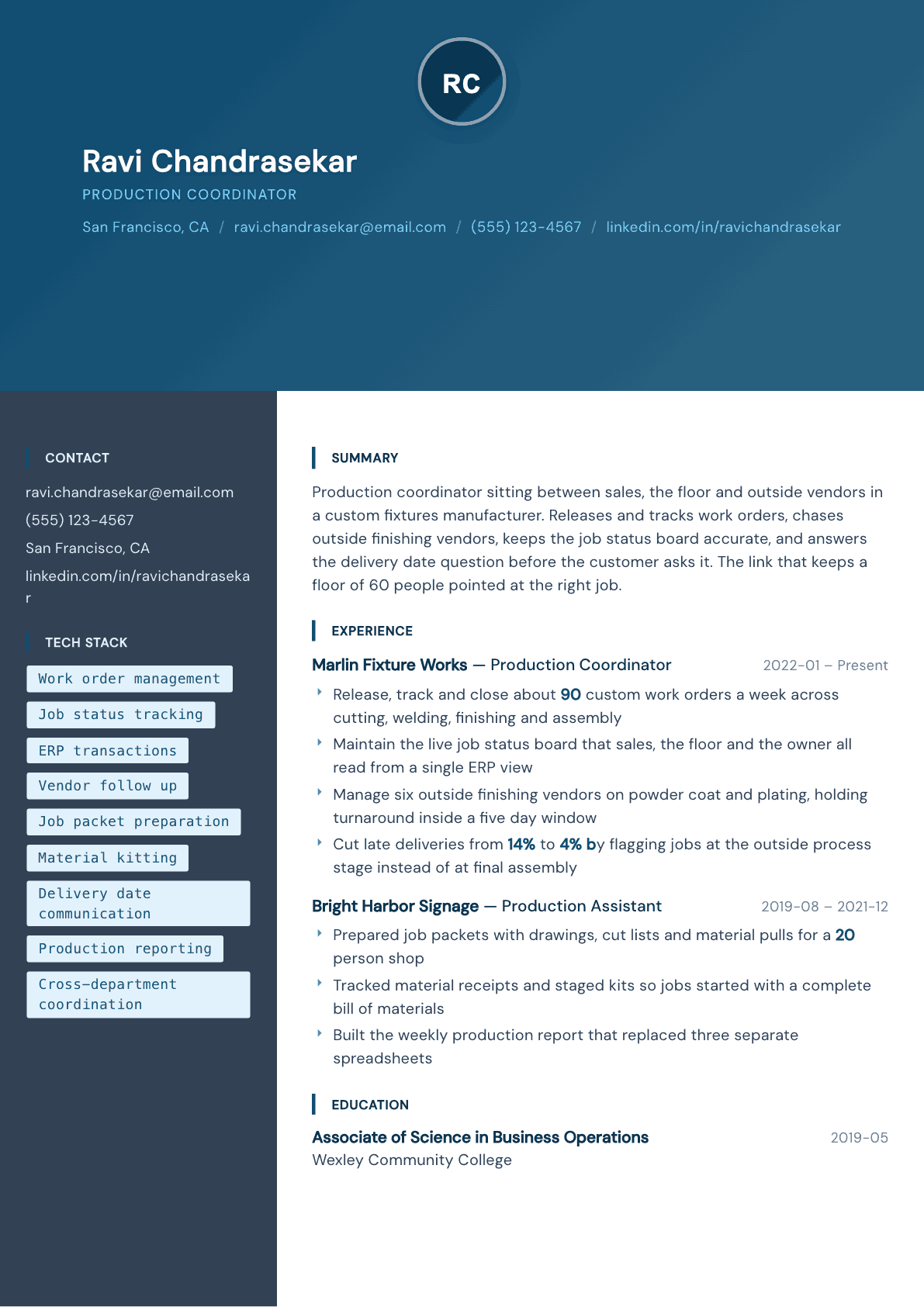
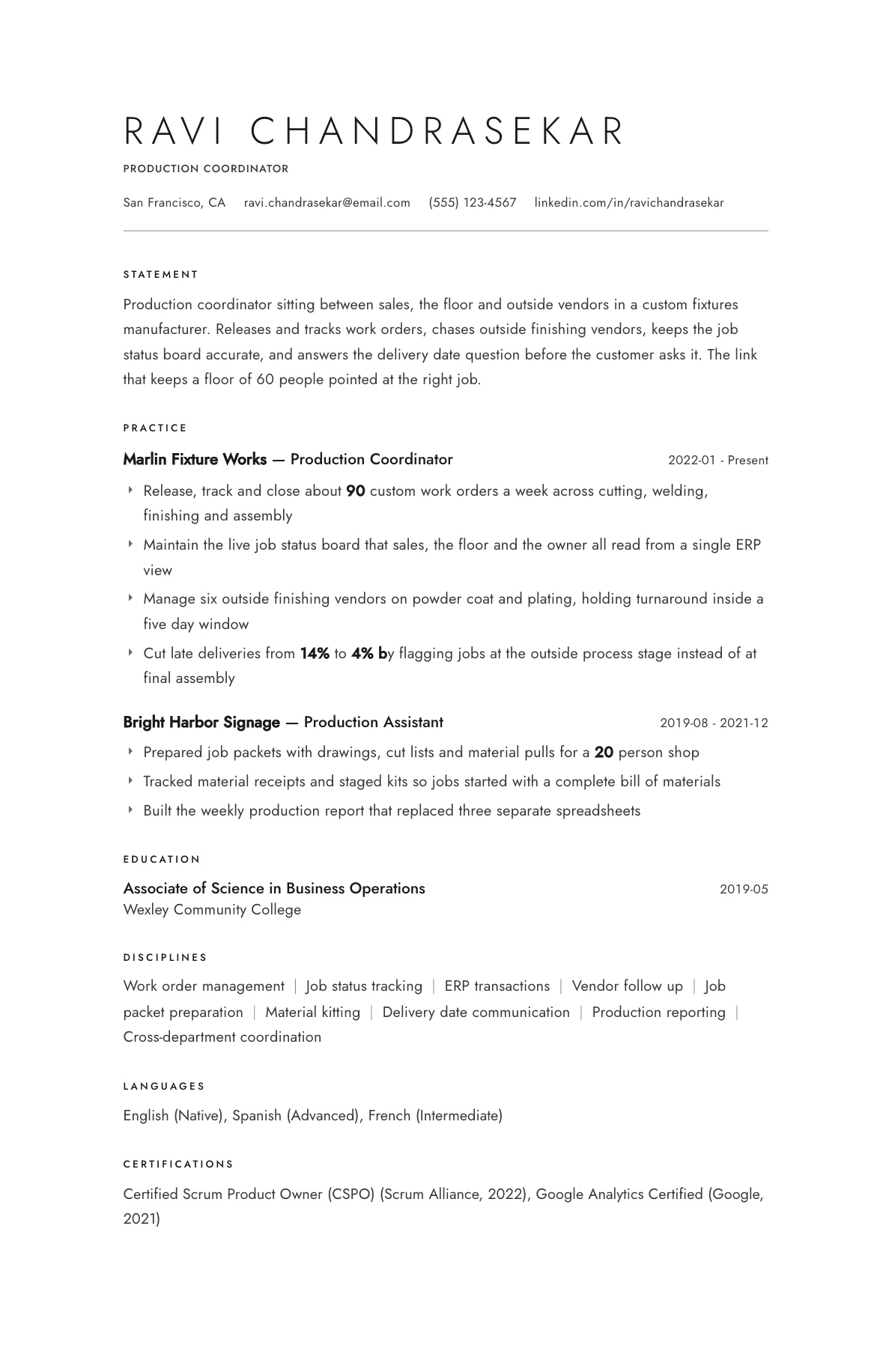
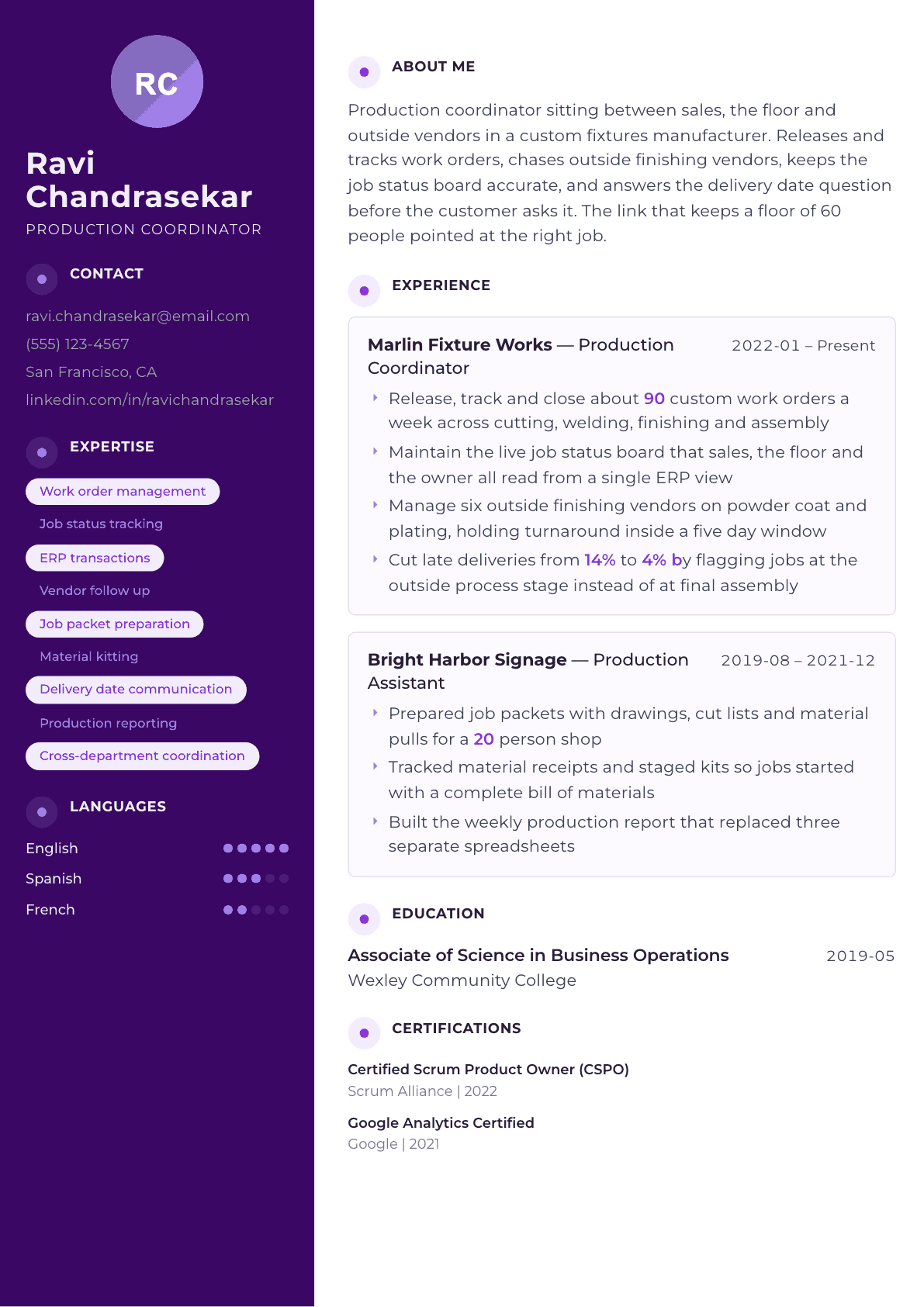
The same production coordinator content laid out in three CVBooster templates, so you can see what the finished document looks like before you write a word.
Example Production Coordinator summary
Production coordinator moving roughly 90 custom work orders a week through cutting, welding, finishing and assembly in a 60 person shop. Owns the live job status board that sales, the floor and ownership all read, manages six outside coat and plating vendors to a five day window, and cut late deliveries from 14% to 4% by flagging risk at the outside process stage instead of at final assembly.
Skills to list on a Production Coordinator resume
- Work order release and closure
- Job status board ownership
- ERP transaction processing
- Outside process vendor management
- Material kitting and staging
- Job packet and drawing control
- Delivery date estimation
- Expedite and hot job handling
- Production and backlog reporting
- Cross-department communication
- Bill of materials verification
- Purchase order follow up
- Excel reporting and dashboards
- Document and revision control
What actually gets this resume read
- Say how many work orders you move a week and through how many departments, since volume and handoff count define the job.
- Name the ERP or job tracking system and what you do inside it, from releasing orders to closing labor transactions.
- Show the outside vendors you chase and the turnaround window you hold them to, because outside processing kills schedules.
- Give a late delivery or on time number before and after, and explain the change in habit that produced it.
- Describe how you communicate a slipping date to sales or the customer, because that judgment is what you are hired for.
- List the reports you built and who reads them, since a coordinator is often the only source of plant visibility.
How to write a production coordinator resume
The production coordinator seat exists because information stops moving. Sales does not know when a job will finish, the floor does not know which job matters most, the outside plater has had a part for two weeks and nobody noticed. The owner or operations manager reading your resume is hiring someone to hold all of that in one place and answer the delivery date question before the customer asks it.
That makes this a throughput and visibility job, not an administrative one. The screen turns on how many jobs you moved, through how many departments and outside vendors, in which system, and what the on time number did while you were doing it. Coordinators who describe themselves as organized and detail oriented lose to coordinators who say ninety work orders a week through four departments.
This guide covers how to build a production coordinator resume: the volume and handoff line that opens it, the vendor and outside process work that usually gets left off, the reporting you built that gave a shop its first real visibility, and how to write the judgment involved in telling sales a date is slipping.
Format: volume, departments, system, on the first screen
One page for most coordinators. The opening block states the shop or plant size, how many work orders or jobs you handle per week, the departments a job passes through, and the system you run it in. Those four facts let a hiring manager judge whether his own volume would overwhelm you, which is the real question behind the screen.
Keep a clear systems line. Coordinators live in an enterprise platform, a job tracking board, a spreadsheet and an email inbox at once, and naming each one honestly matters. A shop that runs the same platform will call you first, and a shop that runs on spreadsheets wants to know you can build the structure it lacks.
- Opening block: shop headcount, jobs or work orders per week, departments crossed, and the customer type served.
- Systems line naming the enterprise platform, job tracking tool, and any drawing or revision control system.
- A vendor line covering outside processes managed: coating, plating, heat treat, anodizing, machining or printing.
- On time delivery or late job figures with the period they cover.
- Reports you own, and who reads them: the floor, sales, ownership or the customer.
Summary: the middle position, stated plainly
Three or four sentences. Where you sit between sales, the floor and vendors. The weekly job volume you move. What you own inside the system. And the delivery outcome. A coordinator who states the middle position clearly is easy to picture in the seat, and that is most of what a small manufacturer is trying to do while reading.
Avoid the word support unless you mean it. Coordinators who write that they supported production get read as clerical, while coordinators who write that they release, track and close work orders get read as operational. The work is often identical; the framing decides which pile the resume lands in.
Experience: the flow of a job through your hands
Walk a job through the shop in your bullets. Order received and reviewed, work order created with the right bill of material, packet built with drawings and cut lists, materials kitted and staged, job released to the floor, tracked through each department, sent to an outside process, received back, inspected, closed and invoiced. Naming the stages you personally own shows exactly how deep the role went.
Then show the exceptions, because exceptions are the job. What you do when a job hits a shortage, when a drawing revision lands mid build, when a hot order jumps the queue, or when the plater misses the promised return. A coordinator who has a routine for each of those is worth more than one who escalates every time, and the routine is easy to write in one line.
Give the numbers a small manufacturer cares about: late deliveries, average lead time, backlog value in words rather than digits, expedite frequency and outside process turnaround. Attach the habit that produced any improvement, because a shop wants the habit more than the result.
Vendors, outside processing and the phone half of the job
Outside processing is where jobs disappear. Coating, plating, heat treat and outside machining all take parts out of your building and out of your visibility, and most late deliveries in a custom shop trace back to one of them. If you have managed those vendors, write it with the vendor count, the process types and the turnaround window you held them to.
Describe how you track parts once they leave. A packing list routine, a due back date on the job board, a standing call with each vendor, or a simple aging report of everything outside the building. That structure is unusual and immediately valuable to a shop that currently discovers a missing job during final assembly.
Purchase order follow up belongs here too. Coordinators often chase materials without owning purchasing, and being clear about the boundary, that you expedite and confirm rather than negotiate and buy, keeps the resume accurate while still showing the work.
Reporting, communication and the keywords a shop searches
The reports a coordinator builds are often the only visibility a small manufacturer has. Say what you built, what data it pulled from, who read it and what decision it drove. A weekly backlog and promise date report that replaced three separate spreadsheets is a concrete achievement, and it demonstrates spreadsheet ability better than listing spreadsheet ability.
On communication, describe the hard version: telling sales a date is slipping early enough to be useful, with an alternative attached. Anyone can pass a message. The judgment is knowing which slips need escalation and which get absorbed, and one honest sentence about that reads better than any adjective.
Use the vocabulary a posting uses: work order management, job tracking, outside processing, kitting, expediting, backlog, on time delivery, bill of material, revision control, purchase order follow up, production reporting. Attach each to real work rather than clustering them at the bottom.
Production Coordinator resume summary examples
Production assistant
Production assistant in a 20 person sign shop preparing job packets with drawings, cut lists and material pulls, tracking receipts and staging kits so jobs start with a complete bill of material. Built the weekly report that replaced three spreadsheets. Ready for a full coordinator seat.
Coordinating a custom shop
Production coordinator moving roughly 90 custom work orders a week through cutting, welding, finishing and assembly for a 60 person fixture manufacturer. Owns the live job board, manages six outside coating vendors to a five day window, and cut late deliveries from 14% to 4%.
Lead coordinator
Lead production coordinator across two buildings with two junior coordinators reporting in, owning work order flow, outside processing and the promise date process for a make to order manufacturer. Rebuilt the backlog report ownership reads weekly and trains new coordinators on the platform.
Work experience bullets: before and after
Before: Managed work orders for the production department.
After: Released, tracked and closed roughly 90 custom work orders a week across cutting, welding, finishing and assembly, keeping every job status current in a single platform view.
Weekly volume plus the department path shows the real throughput a shop would be handing you.
Before: Coordinated with outside vendors.
After: Managed six outside powder coat and plating vendors against a five day turnaround window, tracking every job that left the building on a due back aging report reviewed each morning.
Vendor count, turnaround target and the tracking mechanism turn a vague duty into a controlled process.
Before: Helped improve on time delivery.
After: Cut late deliveries from 14% to 4% by flagging at risk jobs at the outside process stage instead of at final assembly, which moved the recovery window from hours to days.
The before and after figure with the timing change explains why the improvement held.
Before: Prepared paperwork for jobs on the floor.
After: Built job packets containing current revision drawings, cut lists, material pulls and routing steps, and verified the bill of material against stock before release so jobs did not start short.
Listing the packet contents and the pre release check shows the work that prevents floor stoppages.
Before: Created reports for management.
After: Built a weekly backlog and promise date report drawn from the platform that replaced three separate spreadsheets, and it became the document ownership used to set the following week's priorities.
Naming the source, what it replaced and the decision it drives makes the report an achievement.
Hard skills
- Work order release, tracking and closure
- Job status board ownership
- Enterprise platform transaction processing
- Outside process vendor management
- Material kitting and staging
- Job packet and drawing revision control
- Bill of material verification
- Purchase order follow up and expediting
- Delivery date estimation and promise dating
- Backlog and work in process reporting
- Hot job and expedite handling
- Spreadsheet reporting and pivot tables
- Shipment and receiving coordination
- Customer order acknowledgment
Soft skills
- Delivering bad delivery news early with an option attached
- Chasing a vendor without burning the relationship
- Holding several jobs in mind at once without losing one
- Translating between a salesperson and a shop lead
- Staying accurate under interruption all day
Certifications worth listing
- Certified in Planning and Inventory Management (CPIM) (Association for Supply Chain Management)
- Certified Associate in Project Management (CAPM) (Project Management Institute)
- Certified Six Sigma Yellow Belt (CSSYB) (American Society for Quality)
Mistakes that cost production coordinator candidates the interview
- Framing the role as support rather than as work order ownership, which pushes the resume into the clerical pile.
- Leaving out weekly job volume, the number a shop uses to judge whether its own workload would swamp you.
- Ignoring outside processing even though it causes most of the late deliveries in a custom manufacturing shop.
- Listing software generically instead of naming the platform screens and transactions you run daily.
- Describing communication as a strength without showing the harder judgment of escalating a slipping date.
- Omitting the reports you built, which are often the clearest evidence of the visibility you created.
Production Coordinator resume questions
What is the difference between a production coordinator and a production scheduler?
A scheduler decides sequence and capacity across work centers, while a coordinator keeps individual jobs moving through the shop and outside vendors. Many small manufacturers combine the two, so state clearly which parts you owned rather than letting the title imply both.
How do I quantify a coordinator job that has no obvious metrics?
Count what passes through you: work orders per week, departments crossed, vendors managed, purchase orders followed up, reports produced. Then add outcome measures such as late deliveries or average lead time. Almost every coordinator has volume figures available if they look at the system.
Do I need manufacturing experience for a production coordinator role?
It helps considerably, because you have to picture what happens to a part in each department. If you are coming from another industry, lead with transferable coordination volume and system experience, then show that you have learned the processes of the shop you are applying to.
Should I include the customer service side of the job?
Yes, briefly. Order acknowledgment, delivery date updates and handling a customer complaint about a late shipment are real parts of the role in a small manufacturer. Keep it to one or two bullets so the resume still reads as operations rather than as an inside sales page.
How do I show I can handle a higher volume shop?
Show the structure you used at your current volume: a job board with defined statuses, a due back report for outside work, a standing morning review. Structure scales in a way that personal memory does not, and a larger shop is buying the structure you bring.
Related resume examples
- Operations Coordinator Resume example
- Production Scheduler Resume example
- Logistics Coordinator Resume example
- Production Planner Resume example
- Production Associate Resume example
- Line Supervisor Resume example